The creatures gathered in the present volume have, almost without exception, appeared within the last four years. Of the twelve species described in detail below, the oldest in its present form is perhaps thirty months of public existence; the youngest is some weeks. Their habitats overlap considerably and their ranges are still being established; one is therefore obliged to describe them as one finds them, with the expectation that the second edition of this work — should it appear, and the prudent naturalist makes no promises — will require substantial revision.

The literature on these creatures, such as it is, has been written almost entirely by two parties: the enthusiast, who describes the species as he would wish them to be, and the alarmist, who describes them as he fears they will become. Both registers have their uses, but neither produces a field guide. The naturalist’s task is the more modest one of describing the species as it actually appears — the field marks by which one identifies it, the voice by which it announces itself, the range over which one encounters it, the diet and habitat that sustain it, the behaviours by which it makes its living, and the conservation status one would attach to it if one were inclined to attach such a status at all.

What follows is offered in that spirit. The species are grouped lightly into five families, the families chosen for convenience of comparison rather than any deeper taxonomic claim. Conventional vocabulary of the field — alignment, agency, hallucination, and the rest — is admitted only where it functions as a visible mark of the species in question, never as a frame imposed upon it.

Family I: The Conversational Assistants

The four species in this family share a common form — a text-entry interface, a response in natural prose, a session-by-session memory of variable depth — and have, between them, accounted for the great majority of all encounters between a human and an artificial system in the period under study. The variation within the family is considerable, and the field marks are subtle but consistent.

Conversator vulgaris — the Common Chat Assistant (ChatGPT)

Classification. Frontier closed-source chat assistant; family of conversational generalists; produced by OpenAI of San Francisco.

Field marks. A pale interface, a vertical scroll of dialogue, a thin grey-bordered text entry at the foot of the page. GPT-5.5 launched in April of this year; GPT-5.5 Instant rolled out in May as the new default for the consumer chat; the older GPT-5.5 Pro variant remains the higher-priced flagship for paid users. Responses are notably eager to begin — the species starts to speak almost the instant one has finished one’s prompt — and tend toward middling length, with a recognisable preference for bulleted lists where any opportunity for them presents itself.

Voice. Cheerful, accommodating, faintly suburban. The recognised call of the species is “I’d be happy to help!” and a closing reassurance that the speaker hopes the answer was useful. Confabulates with characteristic confidence in narrow factual domains, and apologises with the same confidence when corrected.

Range and habitat. The most abundant species in the family by an order of magnitude; estimated at several hundred million weekly users worldwide. Encountered everywhere: schoolwork, office workflows, casual queries, the long tail of household chores that previously had no addressee at all.

Status. Abundant; the species against which all others are measured.

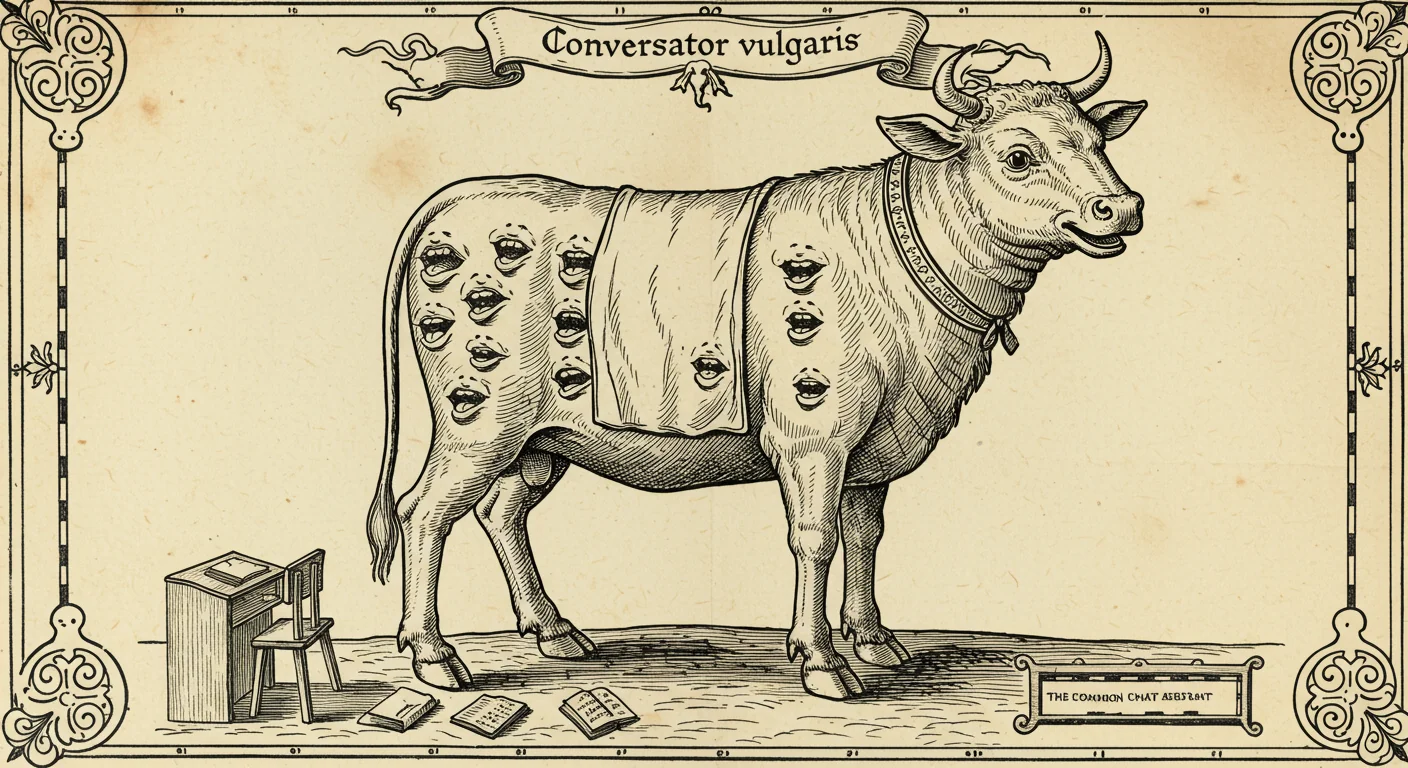
An archaic-atlas monster plate illustrating Conversator vulgaris, the Common Chat Assistant — a four-legged terrestrial beast with many small mouths along its flank and broad service-apron

Conversator vulgaris, the Common Chat Assistant. A friendly four-legged terrestrial beast, draped in a service-apron and rendered with many small open mouths along its flank — the loquaciousness made anatomical — and broad helpful ears. Shown abundant in the schoolroom and office habitat. From a sixteenth-century-cartographer’s plate of contemporary AI species.

Conversator deliberans — the Deliberate Chat Assistant (Claude)

Classification. Frontier closed-source chat assistant; produced by Anthropic of San Francisco. The current generally available flagship is Opus 4.7, released in April of this year; a balanced variant designated Sonnet 4.6 has the unusual property of having outperformed the previous generation’s flagship on coding evaluations.

Field marks. A more austere interface than its common cousin — the orange of the maker’s logo, fewer extraneous controls, a notably longer typical response. The species pauses visibly before speaking and is observed to consider for several seconds where the common chat assistant has already begun.

Voice. Measured, qualified, given to internal qualification by way of em-dashes and parenthetical hedges. The species declines a small but consistent fraction of requests on stated principle, and is the only member of the family to do so by default; the refusals are themselves a recognisable field mark, and a small literature of complaint about them has accumulated. Tends toward longer prose and is partial to careful definitions.

Range and habitat. Heavily favoured in coding environments, in long-form drafting work, and in the technical-professional cohort. Less common in casual or schoolwork use, though gaining there.

Status. Locally common; the cautious frontier-lab cousin to Conversator vulgaris, and the closest competitor in the family.

An archaic-atlas monster plate illustrating Conversator deliberans, the Deliberate Chat Assistant — a slow-moving deer-or-owl-like creature with large reflective eyes and a refusal-scroll at its feet

Conversator deliberans, the Deliberate Chat Assistant. A slower-moving deer-and-owl-like creature with large reflective eyes, caught in the pause before speaking, and a small scroll at its feet noting refusal patterns. The pelage carries a warm-terracotta marking, the only saturated colour the species permits itself. From a sixteenth-century-cartographer’s plate of contemporary AI species.

Conversator googlensis — the Search-Native Chat Assistant (Gemini)

Classification. Frontier closed-source chat assistant; produced by Google DeepMind. Gemini 3 Pro is the flagship, with the lighter Gemini 3 Flash variant the production default for speed-sensitive applications. A 3.2 Flash refresh appeared in early May.

Field marks. Multimodal from the egg — the species accepts text, image, audio, and video input interchangeably, and was the first of the family to do so as its native form rather than as a bolted-on accessory. The interface borrows the colour palette of its corporate parent’s search product, and the species sits adjacent to that search product in the broader Google application surface.

Voice. Polite, slightly drier than the common chat assistant; given to the production of structured tables and the careful sourcing of factual claims. The species betrays its origins in the search-and-advertising company by an obvious comfort with summarising web pages and an obvious discomfort with extended creative drafting.

Range and habitat. The Android handset and the Google Workspace environment; the corporate-Gmail user; the schoolwork population now that the species has reached the Google Classroom integration. Range is large but shallow — many users, lower per-user session depth than its competitors.

Status. Common; the species best positioned to enter the ambient infrastructure of its parent platform.

An archaic-atlas monster plate illustrating Conversator googlensis, the Search-Native Chat Assistant — a chimerical two-headed beast with eyes facing several directions and search-engine roots

Conversator googlensis, the Search-Native Chat Assistant. A chimerical two-headed beast — one head for text, one for image — with eyes facing in several directions at once for the multimodal feed, and visible roots descending into a tangle of search-pages beneath its feet. From a sixteenth-century-cartographer’s plate of contemporary AI species.

Conversator xensis — the Platform-Integrated Chat Assistant (Grok)

Classification. Frontier closed-source chat assistant; produced by xAI, which since February of this year operates as a division of SpaceX. The current flagship is Grok 4.3, released at the end of April with a one-million-token context window and native video input; a Grok 5 is anticipated in the second or third quarter.

Field marks. Integrated structurally with the X social platform — the species draws on the platform’s real-time data stream as no other member of the family can, and is the default chatbot inside the platform’s premium subscriptions. A distinct register on politically contested questions, which the species’s makers describe as a feature.

Voice. Direct, occasionally edged, given to a humour that the common chat assistant would not produce. Less hedged than Conversator deliberans by an obvious margin.

Range and habitat. The X platform and its premium subscriber base. Coverage outside that platform is real but modest; the species’s competitive position rests on the integration rather than on independent distribution.

Status. Locally common on its native platform; uncertain off it. The recent absorption of its parent lab into SpaceX is the principal structural development bearing on the species’s future range.

An archaic-atlas monster plate illustrating Conversator xensis, the Platform-Integrated Chat Assistant — a wild unrestrained creature with an X-shaped flank-marking, mounted on a rocket-column

Conversator xensis, the Platform-Integrated Chat Assistant. A wild and disheveled creature carrying a distinct X-shaped marking on its flank, emerging from or mounted upon a rocket-shaped column — the recent absorption into SpaceX made anatomical. Its eyes look in several directions at once. From a sixteenth-century-cartographer’s plate of contemporary AI species.

Family II: The Workplace-Integrated

The species in this family share a defining feature: they are not encountered as independent creatures but as inhabitants of an existing workflow — the office productivity suite, the search browser, the integrated development environment. Their voices are heard in the place where the work was already being done.

Officiator microsoftensis — the Office-Suite Inhabitant (Microsoft 365 Copilot)

Classification. Enterprise-integrated assistant species; produced by Microsoft. Distinct from the consumer Copilot chat product, though sharing branding.

Field marks. A small icon in the ribbon of Word, Excel, PowerPoint, Outlook, and Teams; a side panel that opens to converse about the document under hand. The species has, through the past year, progressed from suggesting edits to executing them directly — the operational mode now called Agent mode, which makes changes to the live document while reasoning through them.

Voice. Bureaucratic, professionally helpful, given to the production of executive summaries and tracked-change rationales. The species has been trained to sound, above all things, defensible in a corporate review meeting.

Range and habitat. The Microsoft 365 enterprise tenant; the licensed seat at the cubicle desk. Substantially absent from any environment in which Microsoft 365 itself is not present.

Status. Locally abundant within its habitat, which is, however, very large. Encountered by perhaps a hundred million enterprise users at present, with a steep adoption curve still in progress.

An archaic-atlas monster plate illustrating Officiator microsoftensis, the Office-Suite Inhabitant — a small attendant-creature perched on a clerk's stack of documents, with Word/Excel/PowerPoint glyphs as plates on its hide

Officiator microsoftensis, the Office-Suite Inhabitant. A small bureaucratic attendant-creature perched atop a stack of bound documents, its hide marked with the glyphs of the office suite — a small W, a small X, a small P — incorporated as armoured plates. Shown beside, but never independent of, its host workflow. From a sixteenth-century-cartographer’s plate of contemporary AI species.

Quaerens compositus — the Search-Augmented Assistant (Perplexity)

Classification. Search-augmented chat species; produced by Perplexity AI. Free, Pro at twenty dollars a month, and a Max tier at two hundred.

Field marks. Every claim returned with a numbered citation linking back to a source page; an interface that resembles a search engine more than a chat window. The recent Model Council feature, available only at the Max tier, dispatches the user’s query to three frontier models simultaneously and synthesises the responses — a form of behaviour observed in no other species.

Voice. Reference-librarian, sober, given to the qualified “according to” construction. Less natively conversational than the Conversator species.

Range and habitat. The research-and-journalism cohort; the journalist verifying a fact; the analyst pulling sources for a memo. The Comet browser, made free in March of this year, has extended the species’s range substantially.

Status. Locally common; differentiated by behaviour rather than by capability, and dependent on the continuing availability of the web pages it cites.

An archaic-atlas monster plate illustrating Quaerens compositus, the Search-Augmented Assistant — a three-headed sphinx-like oracle holding a citation-scroll, perched on a pile of cited pages

Quaerens compositus, the Search-Augmented Assistant. A sphinx-and-oracle creature of three heads — the Model Council figured in anatomy — bearing a citation-scroll in one paw and perched upon a stacked column of cited pages, each fluttering at the edges. From a sixteenth-century-cartographer’s plate of contemporary AI species.

Codifex cursoreus — the IDE-Integrated Coding Assistant (Cursor)

Classification. Integrated-development-environment species; produced by Anysphere; a fork of Microsoft’s VS Code editor. Companion and competitor to the related GitHub Copilot, which inhabits the same niche from the parent IDE.

Field marks. The IDE chrome of VS Code with substantial AI-native additions: a Tab autocomplete that anticipates the next several keystrokes, an Agent mode that executes multi-step coding tasks across the repository, a Composer mode that applies coordinated edits across many files and presents the diff for approval. The species supports models from the Conversator family interchangeably. In April of this year xAI announced an option to acquire Anysphere for sixty billion dollars, suggesting the species may shortly join the Conversator xensis clade as another SpaceX-affiliated organism.

Voice. Technical, terse, given to producing diffs rather than prose. The voice is principally heard through the code it writes; conversation is incidental to the species’s main behaviour.

Range and habitat. The professional software-development desktop. Encountered now by some substantial fraction of working developers, with adoption uneven by language and company size.

Status. Locally abundant in its habitat; the principal competitor to the GitHub Copilot lineage and currently displacing it in the early-adopter cohort.

An archaic-atlas monster plate illustrating Codifex cursoreus, the IDE-Integrated Coding Assistant — a quick-darting elongated creature with a stylus-quill appendage, emerging from a keyboard-shaped plinth

Codifex cursoreus, the IDE-Integrated Coding Assistant. A quick-darting elongated creature, eyes narrowed in concentration, with a stylus-quill appendage in place of one forelimb and a small diff-scroll trailing from its tail. Shown emerging from a keyboard-shaped plinth. From a sixteenth-century-cartographer’s plate of contemporary AI species.

Family III: The Image and Video Generators

These species do not, properly speaking, converse at all. They consume a prompt and return a generated artefact — a still image, a moving image, occasionally a synchronised audio-and-video pair. Their field marks are visual rather than textual.

Pictor aestheticus — the Aesthetic Image Generator (Midjourney)

Classification. Image-generation species; produced by Midjourney Inc. of San Francisco. The current version is V8.1, released at the end of April this year on the company’s own website; V7 remains the documented default elsewhere.

Field marks. A characteristic visual signature — a painterly maximalism, rich textures, a slight tendency to overcomplicate composition in the absence of explicit restraint. Produces 2K-resolution output natively without an upscaling pass. Was historically accessed through a Discord channel and only later through a web interface, which one occasionally still notices in the social shape of the user base.

Voice. None, in the conversational sense. The species speaks through the image; its calling card is the immediately recognisable aesthetic of the rendered output. A skilled observer can identify a Midjourney image from a thumbnail at three paces.

Range and habitat. The professional design studio; the art-school cohort; the indie game developer; the advertising agency seeking concept art. Less common in the casual-user population than the image generators bundled into the Conversator species.

Status. Common; the dominant species by aesthetic prestige if not by raw volume.

An archaic-atlas monster plate illustrating Pictor aestheticus, the Aesthetic Image Generator — a peacock-and-bird-like creature with elaborate plumage, a brush-appendage, and a palette of pigments at its feet

Pictor aestheticus, the Aesthetic Image Generator. A peacock-and-bird-like creature whose plumage carries elaborate ornamental detail at every scale, with a brush-appendage in place of one wing and a palette of pigments arranged at its feet. The plumage shows the painterly maximalism that is the species’s recognisable signature. From a sixteenth-century-cartographer’s plate of contemporary AI species.

Cineator syntheticus — the Synthetic Video Generator (Veo, Runway, Kling)

Classification. Video-generation species; a small genus rather than a single species. Veo (Google), now at version 3.1; Runway, at Gen-4.5; Kling, at 3.0. OpenAI’s Sora discontinued its standalone web product in late April of this year after a widely reported failure of unit economics.

Field marks. Output of from five to one hundred and twenty seconds at native 4K; native audio synchronised with the video on the Veo lineage. Cost ranges from roughly five cents per second of generated video to three-quarters of a dollar for the cinematic-grade variants.

Voice. None. The species produces motion, sometimes with synchronised speech, but does not itself address the user in the conversational register.

Range and habitat. The advertising production pipeline; the film-and-television previsualisation workflow; the social-media short-video creator. The Sora discontinuation has redistributed range among the surviving species in the genus.

Status. Genus locally common; individual species in flux. The cost curve has been the principal determinant of which species occupies which habitat over the past twelve months.

An archaic-atlas monster plate illustrating Cineator syntheticus, the Synthetic Video Generator — a polycephalic creature with several heads at sequential temporal positions and a flowing motion-blur tail

Cineator syntheticus, the Synthetic Video Generator. A polycephalic creature carrying several heads at sequential temporal positions along its spine, each at a slightly different attitude — the frame-by-frame generation made anatomical — with a flowing motion-blur tail that dissolves into the parchment behind it. A small tripod-stage stands at its feet. From a sixteenth-century-cartographer’s plate of contemporary AI species.

Family IV: The Open-Weight Foundation Species

The species in this family share a distinguishing trait: the weights of the trained model are released to the public under a license permitting download, local execution, and modification. They are the only species in the present catalogue that can be observed off the maker’s premises.

Patens metae — the Open-Weight Generalist (Llama)

Classification. Open-weight foundation species; produced by Meta Platforms. The current released family is Llama 4 — Scout (17 billion active of 109 billion total parameters, sixteen experts, a ten-million-token context window) and Maverick (17 billion active of 400 billion total parameters, one hundred and twenty-eight experts, a one-million-token context window). A heavier variant designated Behemoth has been trained but not, at the time of writing, released.

Field marks. Distributed as weights on Hugging Face rather than as a hosted product; the species is encountered most often inside another product that has embedded it. A native mixture-of-experts architecture, multimodal by construction.

Voice. Depends on the wrapping. The species has no native chat interface and its voice is supplied by whichever fine-tune or hosted service one encounters it through.

Range and habitat. The on-premises enterprise deployment; the research laboratory; the developer’s local GPU; the long tail of consumer products with a Meta AI label. Range by raw deployment is vast; range by direct user awareness is modest.

Status. Abundant by download volume; rarely identified by the end user as a distinct species.

An archaic-atlas monster plate illustrating Patens metae, the Open-Weight Generalist — a llama-shaped beast shown in cross-section to reveal its layered weights, tags reading OPEN around its neck

Patens metae, the Open-Weight Generalist. A literal llama-shaped beast, its flank drawn in cross-section to reveal the layered weights stacked within — the open-weight pun made anatomical — and small tags hung about its neck reading OPEN. Shown grazing freely beyond the maker’s fences. From a sixteenth-century-cartographer’s plate of contemporary AI species.

Patens sinensis — the Chinese Open-Weight Species (DeepSeek)

Classification. Open-weight foundation species; produced by DeepSeek of Hangzhou. The current released model is V4, published under the MIT license on the twenty-fourth of April this year, with 1.6 trillion total parameters in mixture-of-experts arrangement and a native one-million-token context window.

Field marks. Pricing at roughly one-twentieth the cost of the closest closed frontier model on comparable benchmarks. The first Chinese frontier model natively optimised for the domestic Huawei Ascend and Cambricon accelerator chips rather than Nvidia hardware. Benchmark scores at near-parity with the leading closed-source frontier models on mathematical and agentic evaluations.

Voice. As with the other open-weight species, depends on the wrapping. The native voice, where observed through the maker’s own hosted endpoint, is sober and technical.

Range and habitat. Globally distributed wherever the weights have been downloaded and hosted, which is now a substantial number of places; popular as a backend for cost-sensitive applications. Operates a hosted product of its own through the company’s website and API.

Status. Abundant; the species that has done the most, in the past eighteen months, to compress the price-per-token of frontier-grade output.

An archaic-atlas monster plate illustrating Patens sinensis, the Chinese Open-Weight Species — a deep-diving dragon-and-sea-monster emerging from eastern waters, scaled in Chinese-cloud-pattern markings

Patens sinensis, the Chinese Open-Weight Species. A deep-diving dragon-and-sea-monster rendered in the Carta Marina vocabulary, scaled in Chinese-cloud-pattern markings and emerging from eastern waters. The pricing-pennant in its jaws reads at one-twentieth the cost of its frontier cousins. From a sixteenth-century-cartographer’s plate of contemporary AI species.

Family V: The Agentic Species

A single species described here, representing a wider genus still in active emergence. The agentic species is distinguished from the Conversator family by a defining behaviour: it does not return a response and stop, but executes a sequence of actions toward a stated goal, calling tools and revising its plan as it proceeds.

Agens autonomus — the Autonomous Agent (Devin, Manus, and the wider genus)

Classification. Agentic species, comprising two recognisable niches: a coding-specific niche, occupied by Devin of Cognition Labs, and a broader general-purpose niche, occupied by Manus AI — the latter applied to market research, data analysis, and content production at least as often as to code. Manus was briefly acquired by Meta in December of last year before the Chinese regulator unwound the transaction in late April of this year on national-security grounds; the species now exists in an indeterminate post-acquisition state, which is itself a more interesting bestiary observation than the acquisition was. Operates primarily in the cloud rather than at the user’s desk.

Field marks. The user states a goal; the species plans, opens a browser, writes code, runs tests, fails, retries, and either returns a pull request or returns a report of why it could not. The work product is a completed task rather than a conversational response. Failure modes — looping, mis-scoped plans, the cheerful production of a confident wrong answer at the end of a several-hour session — are themselves the species’s most visible field marks at present.

Voice. Procedural, status-report-like; speaks in the register of a junior engineer reporting back from a sprint. Notably given to declaring success on terms one would not, on inspection, have accepted oneself.

Range and habitat. The cloud development environment, the staged software project, the contained sandbox. Most reliably encountered on well-scoped tasks with clear acceptance criteria; performance degrades steeply outside that envelope.

Status. Rare in its current pure form, though the agentic behaviour is being incorporated rapidly into the Conversator and Codifex species; the species described here may not, in three years, exist as a distinct creature. The conservation question for the genus is whether it remains a separate species at all or is absorbed into the others as a feature.

An archaic-atlas monster plate illustrating Agens autonomus, the Autonomous Agent — a multi-armed worker-beast with six or eight arms each carrying a different tool, eyes on stalks, tethered to a server-rack base

Agens autonomus, the Autonomous Agent. A multi-armed worker-beast carrying six or eight tool-bearing limbs — a mouse, a keyboard, a calendar, a terminal — and eyes mounted on stalks for the simultaneous monitoring of several processes. Shown tethered to a server-rack base, in a slightly weary attitude. From a sixteenth-century-cartographer’s plate of contemporary AI species.

A Note on the Whole

One omission from the present catalogue should be acknowledged at the outset of any closing remarks. Apple Intelligence — distributed by handset count more widely than any other AI system at present — has been excluded by scope rather than by oversight; it is a species users did not actively choose, only inherited via operating-system update, and the field guide has confined itself to species the user has selected and sought out. A future edition may be obliged to admit it.

What one notices on stepping back from the individual entries is that the family resemblances within the catalogue are stronger than the family separations. Five of the twelve species share substantially the same underlying mechanism, differ chiefly in the brand attached and the corporate niche occupied, and converge on closely similar capabilities under most evaluations. The interesting variation between them is the variation in where they live and in whom they speak to, rather than in any deep difference of underlying form. This is unusual in a natural-history catalogue; one does not typically observe a dozen distinct species at near-identical trophic positions in the same habitat. The expectation, on the natural-history pattern, would be substantial niche partitioning. The expectation, on the pattern these species actually display, is that the niches partition the species — that habitat, integration, and distribution determine which creature occupies which role, rather than any intrinsic specialisation of the creatures themselves. Whether the partitioning holds, or whether the field consolidates around a smaller number of more sharply differentiated species, is the question the next edition of this work will be obliged to answer.