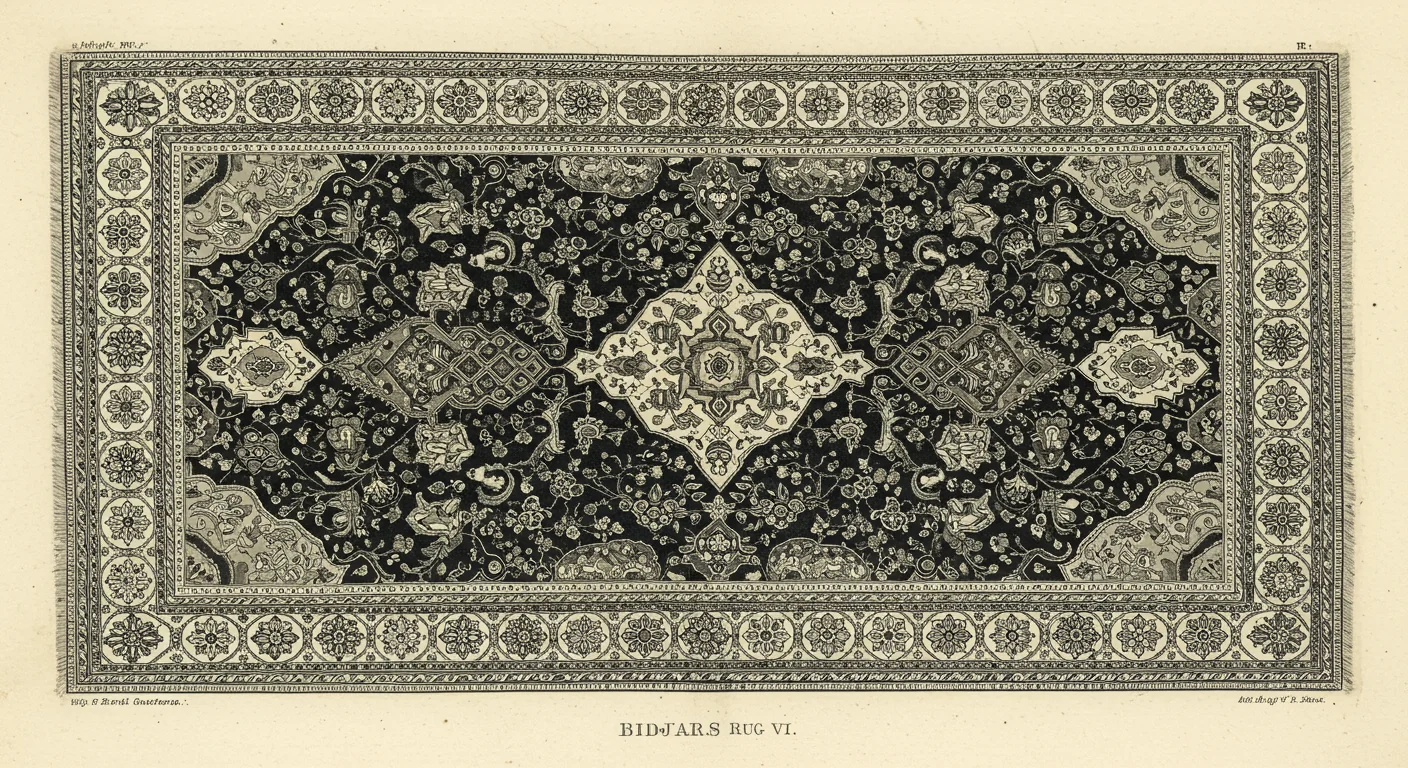
The five prior posts in this arc — Heriz, Tabriz, Caucasian Kazak, Bakshaish, and most recently Kashan — laid out the antique-rug attribution along two regional axes (the northwestern Persian district at Heriz, Tabriz, and Bakshaish; the central Persian court at Kashan) and a third structural one (the Caucasian wool-warp register at Kazak). What none of those posts had reason to treat in detail was a third Persian tradition altogether — neither the northwestern village register nor the central Persian court, but the Kurdish district between them, in the mountainous country between Hamadan and Sanandaj, that produces a Persian rug type unlike any other in the body of antique production. Bidjar is the post that opens it.
Bidjar’s principal signature is neither composition nor palette but structural density. Where Bakshaish was a moderately-knotted northwestern village production with the soft cream palette of long oxidation, and where Kashan was the fine central Persian court workshop on saturated wine-red at two hundred KPSI and finer, the Bidjar is the densest, heaviest, most compressed Persian rug of the entire antique period. A Bidjar at six feet by nine feels meaningfully heavier than a Kashan at the same size; it lies flat on the floor with a rigidity that no other Persian rug shares; and one can, with a little practice, identify a genuine antique Bidjar by handle alone, before one has read its medallion or counted its knots. The “iron rug of Persia” is the dealer’s name, and the description is structural, not metaphorical. The load-bearing collector-distinction for the type, accordingly, is the handle test — the first move an experienced dealer makes with a candidate Bidjar is to pick it up, or fold a corner back, and read its weight, its rigidity, and its peculiar drape. Knot density and palette and medallion vocabulary play their proper roles, but a real Bidjar feels like nothing else in the Persian tradition, and the post will return to why at the appropriate sections below.
The Specimen
A Bidjar that one will encounter is, in its commonest form, a substantial rug in the six-by-nine to nine-by-twelve range, with smaller pieces (the four-by-six dozar, the runners at three feet by ten or twelve) common because the district produced full ranges for both the Persian domestic market and the late-nineteenth-century export trade. The proportions are calibrated by the workshop pieces and felt by the village ones, and one will sometimes encounter a Bidjar with a slight irregularity in its trueness — which is itself a village-register diagnostic and not a defect.
The composition is, on the canonical pieces, one of two related vocabularies. The first is the herati allover — the small repeating motif of a rosette enclosed by four curling leaves with a small diamond at its centre, repeated across the entire field — which the dealer trade most often labels “classic Bidjar.” The second is the central medallion — a single floral-vocabulary medallion set on a saturated dark-wine or dark-navy field, with quarter-medallion spandrels at the four corners and a main floral border of stylised palmettes-and-rosettes. The medallion is not the stepped polygonal vocabulary of the Sahand village register; it is a more elaborated floral medallion in the Kurdish-village vocabulary, with the regularity of the workshop register and the heavier-line drawing of the village. A third vocabulary, less common but worth naming, is the small repeating boteh — the curled-leaf motif at small scale, repeated in vertical rows — produced principally on the smaller domestic pieces.
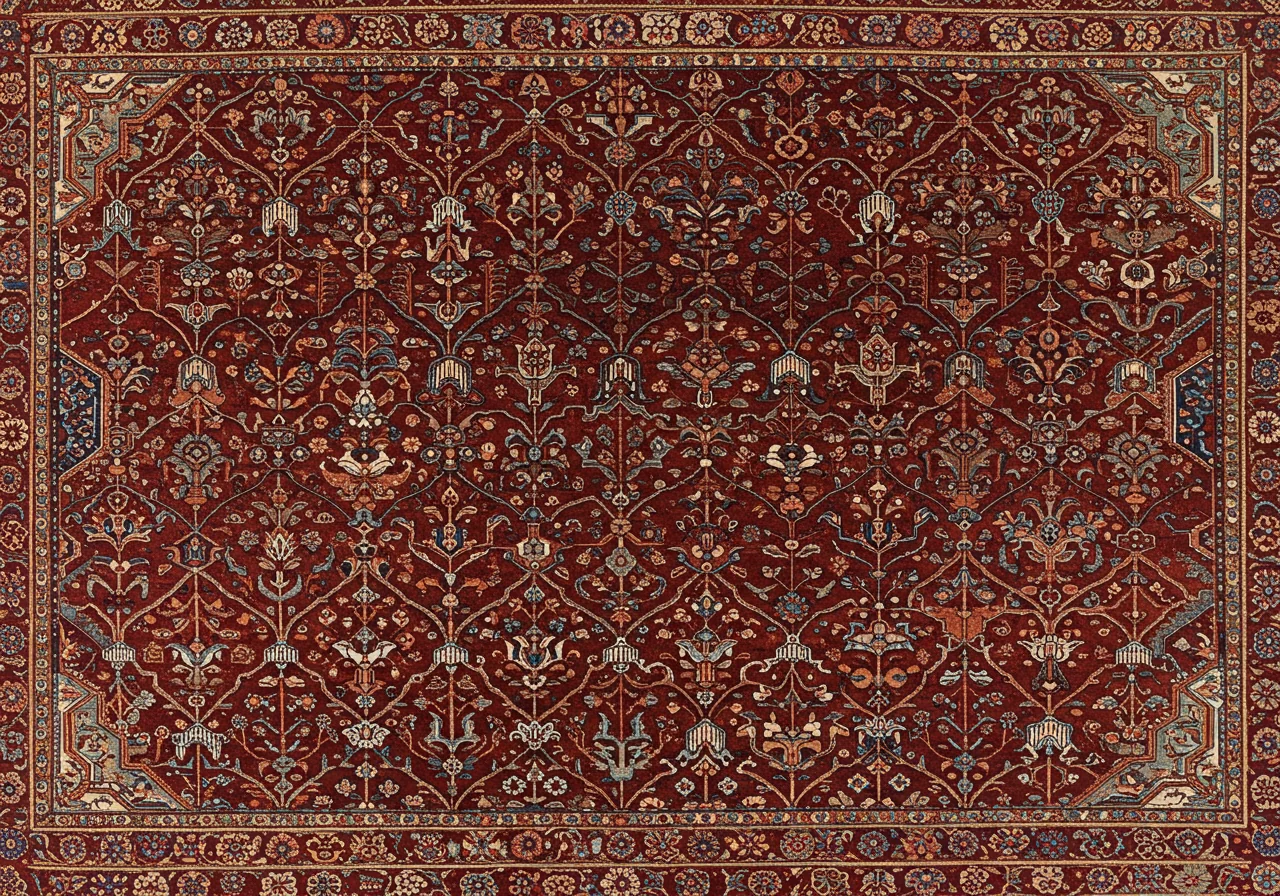
A close detail of the Bidjar field vocabulary — the herati allover (rosette-and-leaves repeat at moderate scale) on the dark wine-red ground that is one of the two Bidjar palette signatures. The heavy-line cadence of the motif and the saturated ground separate the Bidjar from the lighter Kashan or the brick-red Heriz; the structural density at which the drawing is woven is what the post principally treats.
The palette is the Bidjar’s principal break with both prior arcs. The field is dark wine-red — a deep madder closer to oxblood than to the brighter brick of the Heriz or the saturated wine of the Kashan — or, alternately, dark navy, an indigo so deep that on certain pieces the difference between field and medallion-outline reads only at close inspection. The dark palette is the Kurdish signature: the Bidjar wine shades toward purple or oxblood, and rarely reads as the jewel-tone wine of the central Persian court. The medallion is typically ivory or contrasting indigo on the wine-red pieces, deep wine-red on the navy pieces. Yellows are sparing and ochre rather than bright; whites are an aged ivory rather than stark; the whole palette is darker, heavier, and more saturated than either prior arc.
Three sub-types are worth naming briefly. The village production proper — the rugs of the village just south of Bijar town, including the Tekye-Daragah cluster — is the densest and most compressed, the canonical “iron rug,” typically on a wool warp and the strongest expression of the handle signature; this is the apex Bidjar in the strict collector sense. The Garrus design — cobalt indigo ground, split-arabesque palmettes, cloud-band borders, woven in the Bidjar workshops themselves — is the most-collected sub-vocabulary within the Bidjar register, and is the design name a dealer will sometimes use in place of “Bidjar” for the higher-grade pieces; “Garrus” is properly the historic district name for the Bidjar area itself, not a separate village cluster, and the design vocabulary that bears the name is read as Bidjar work at the high register. The late-nineteenth-and-early-twentieth-century commercial workshops in Bijar town produced workshop-grade pieces on cotton warps with reduced knot density relative to the village apex but with the wet-loom compression preserved; these are the most-encountered surviving inventory.
The Evidence
The foundation is the structural evidence that places a Bidjar firmly in the Kurdish-Persian tradition, and it is also where the post must lay out the wet-loom technique that the entire Bidjar thesis rests on. The warp question is principally chronological. Wool warps prevailed through the nineteenth century; cotton warps replace them on most production after about 1900. The wool-warp Bidjars of the 1880s and 1890s are accordingly the apex of the antique register — the village apex Bidjar runs on hand-spun wool drawn from the same Kurdish flocks that produced the pile, and the wool is part of what enables the extreme compression the wet-loom technique applies, because wool warp swells under moisture in a way cotton does not. The later commercial workshop pieces on cotton warps preserve the wet-loom compression but lose the wool-warp swell, and the very finest apex pieces are accordingly the late-nineteenth-century wool-warp village production.
The wet-loom technique is the structural signature. In standard Persian practice, the weaver knots a row, beats it down with a heavy metal comb, passes a weft shoot across, beats the weft, and proceeds to the next knot row. The Bidjar weaver does the same — but at the beating step, dampens the wool weft with water before packing it, then beats it down with a particularly heavy comb (sometimes a hooked iron implement that draws the weft tight across the warp rather than merely beating from above). The dampened weft swells under the moisture, fills the space between the warps more completely, and is beaten while still wet into the foundation; when it dries it has compressed into a denser packing than dry weft would achieve. The next row of knots is set against this compressed foundation, and the next, and the rug is built up under continuous compression. The result is a foundation meaningfully denser per unit volume than any other Persian rug type achieves, and the compression is what produces the “iron rug” handle.
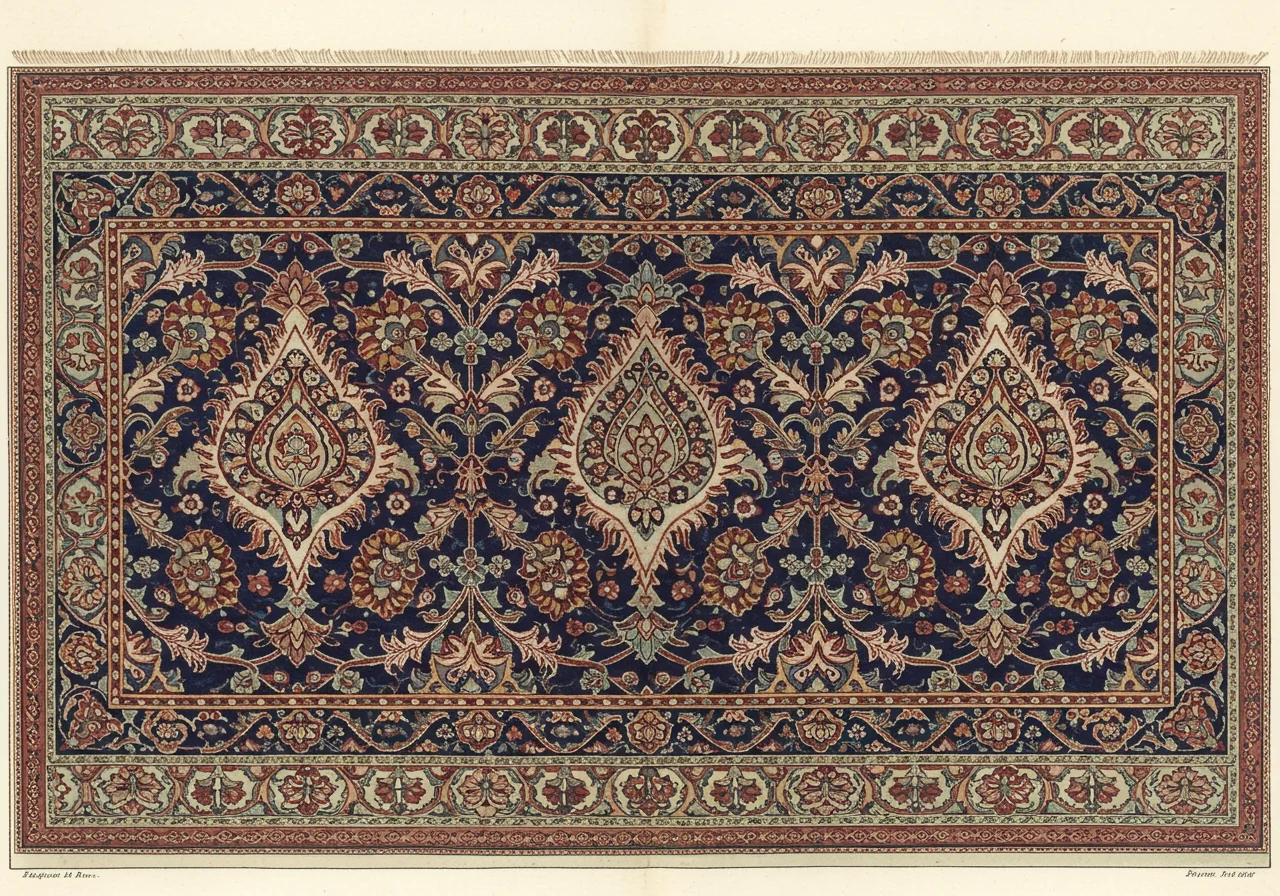
A close detail of a Bidjar main border — stylised palmettes and rosettes in the Kurdish floral vocabulary on the indigo border-ground. The heavy-line cadence and saturated palette are consistent with the field; the line-weight is heavier than the Kashan’s court border and the drawing closer to the village than to the workshop.
The knot is the symmetric Turkish knot, which is itself the most easily-confused point about the Bidjar tradition. The Bidjar weaving population is Kurdish-speaking, and Senneh — the nearby Kurdish city workshop — uses the asymmetric Persian knot (often called the Senneh knot for that reason). One might reasonably expect Bidjar to use the Senneh knot as well; it does not. The Kurdish weavers at Bidjar use the symmetric Turkish knot throughout — the same knot as the Turkic-Azeri weavers of the Sahand district at Heriz and Bakshaish — and this catches beginners working from the simplistic “Persian people use the Persian knot, Turkish people use the Turkish knot” mental model. The point is worth flagging: it appears in the literature as a misattribution sufficiently often to mislead.
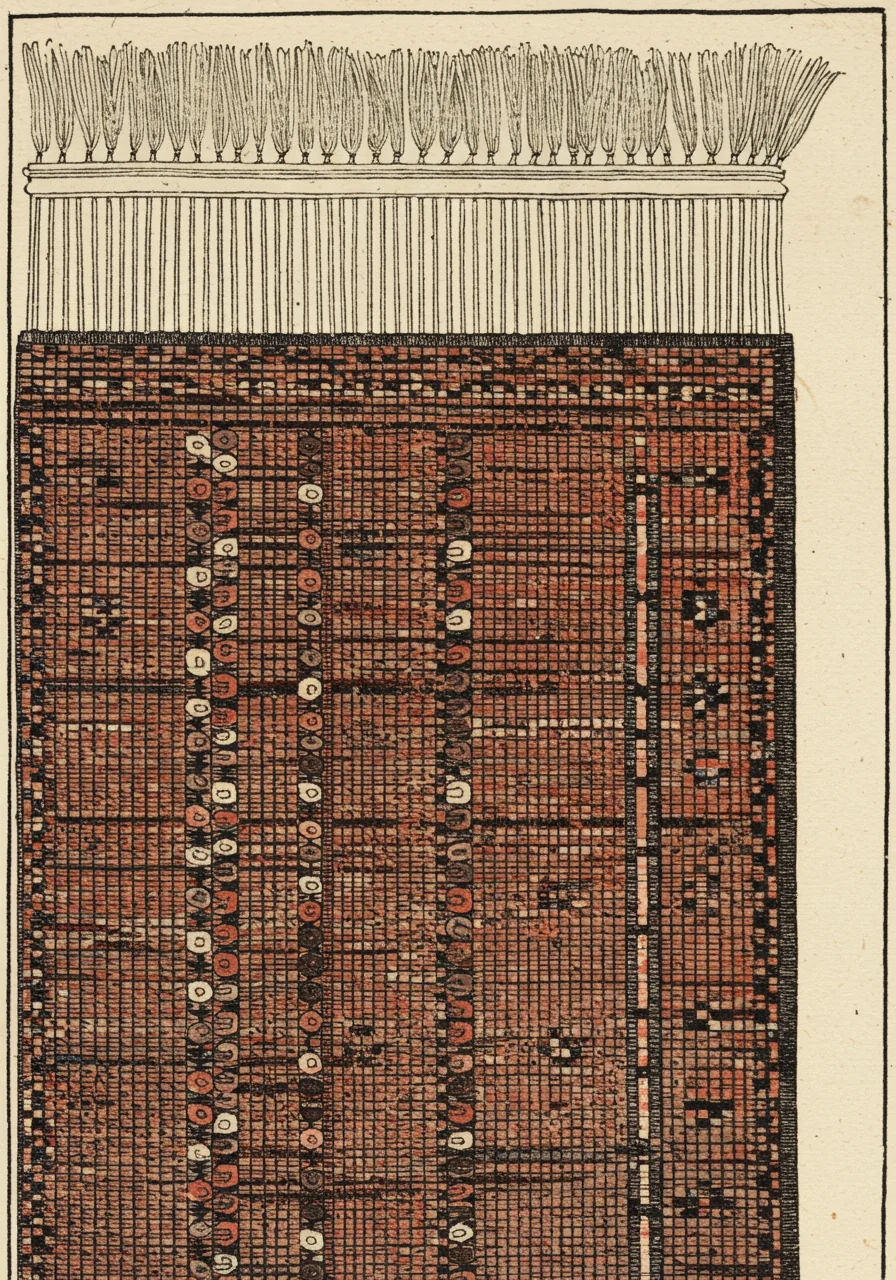
A close detail of the back of a Bidjar rug — the knot density (roughly eighty to two hundred knots per square inch on the canonical pieces, with the very finest apex Bidjars occasionally reaching higher still), the wool warp on the nineteenth-century pieces (cotton on most production after about 1900), and above all the compressed foundation that the wet-loom technique produces. The warps lie close, the weft is packed dense, and the rug resists folding in a way the Kashan or the Bakshaish back does not. This is the structural diagnostic on which the handle test rests.
Knot density runs from roughly eighty knots per square inch on the rougher village production to two hundred on the apex pieces, with the very finest apex Bidjars occasionally reaching higher still. These numbers, however, understate the structural difference, because density-per-unit-area at the front of the rug is not the principal measurement — what the wet-loom technique produces is density-per-unit-volume of the entire foundation, and it has no clean expression as a single number. The Bidjar at one hundred and forty KPSI at the front feels markedly heavier and stiffer than the Kashan at two hundred and twenty KPSI at the front, because the Kashan’s foundation is comparatively loose between the warps even at the higher front-density. Knot density is the proxy; handle is the measurement.
The wool of the pile comes from the Zagros mountain sheep of the Kurdish district — the same broad flocks that supply Senneh and Hamadan, but at the Bidjar register hand-sorted to a particular grade and high in lanolin. Kurdish mountain wool takes the dark madder dye deeply and ages with the slow tonal shift the antique market reads as authenticity. Dyes on the antique pieces are entirely vegetable: madder for the wine-red, indigo for the navy, isparek and pomegranate-rind for the sparing yellows, walnut hull for the browns; synthetic aniline dyes are essentially absent before 1900 and only intermittently present on the early-twentieth-century commercial workshops.
The Period
The Kurdish district occupies the mountainous country in the western part of northwestern Persia, between Hamadan to the south, Sanandaj (the city the dealer trade calls Senneh) roughly due west, and the Tabriz district to the north. Bidjar town — properly Bijar — sits at the eastern edge of the Kurdish zone, with the canonical Bidjar village just to the south, and the historic district name Garrus covers the Bidjar area itself rather than any separate neighbouring cluster. Further to the northwest, in West Azerbaijan Province at a distance of some three hundred kilometres, lies Mahabad — the city the antique dealer trade knew as Sauj Bulagh — which is its own well-known Kurdish weaving centre and not a Bidjar satellite, and a Sauj Bulagh rug should not be conflated with the Bidjar register. The geography is isolated by Persian standards, the climate cold and the winters long, and the Kurdish weaving tradition older than the antique-production period this arc treats — the older Kurdish village register, with its denser-than-typical foundation and dark palette, is documented from at least the early eighteenth century.
Antique-period Bidjar production runs from about 1820 to about 1930. The canonical village apex concentrates in the 1860–1900 range — wool warp, the highest expression of the wet-loom compression, the deepest of the dark Kurdish palette; the commercial workshop register concentrates in the 1880–1920 range, overlapping the village apex but extending beyond it. The export trade began in earnest in the 1870s and 1880s, as European and American dealers travelling the Persian rug country recognised the structural distinctiveness of the type; the commercial workshops in Bijar town were established largely in response. The Soviet-era decline of the broader region after the 1920s, the increasing scarcity of high-grade Kurdish wool, and the loss of the wet-loom technique through the generational disruption of the mid-twentieth century combined to end the canonical Bidjar production by roughly 1930; post-1930 work exists but is structurally distinct and does not carry the handle signature the antique pieces are prized for.
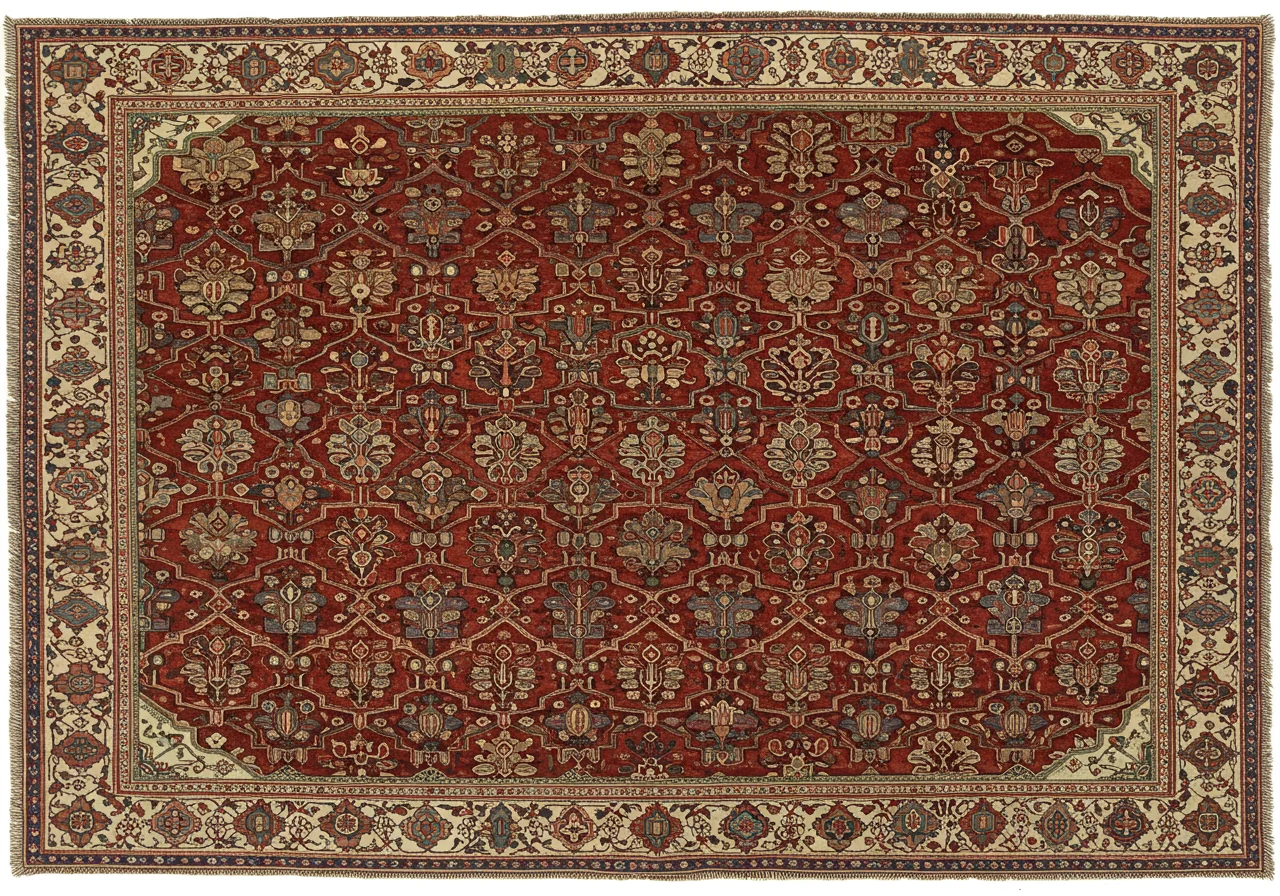
An older Kurdish village rug of the late eighteenth or early nineteenth century — the pre-commercial Kurdish weaving tradition out of which the nineteenth-century Bidjar emerged. The drawing is less elaborated than the canonical Bidjar would reach by 1880; the dark palette is already present; and the wet-loom compression, in some form, is documented from at least this period. The nineteenth-century Bidjar pushed the density toward its mature signature.
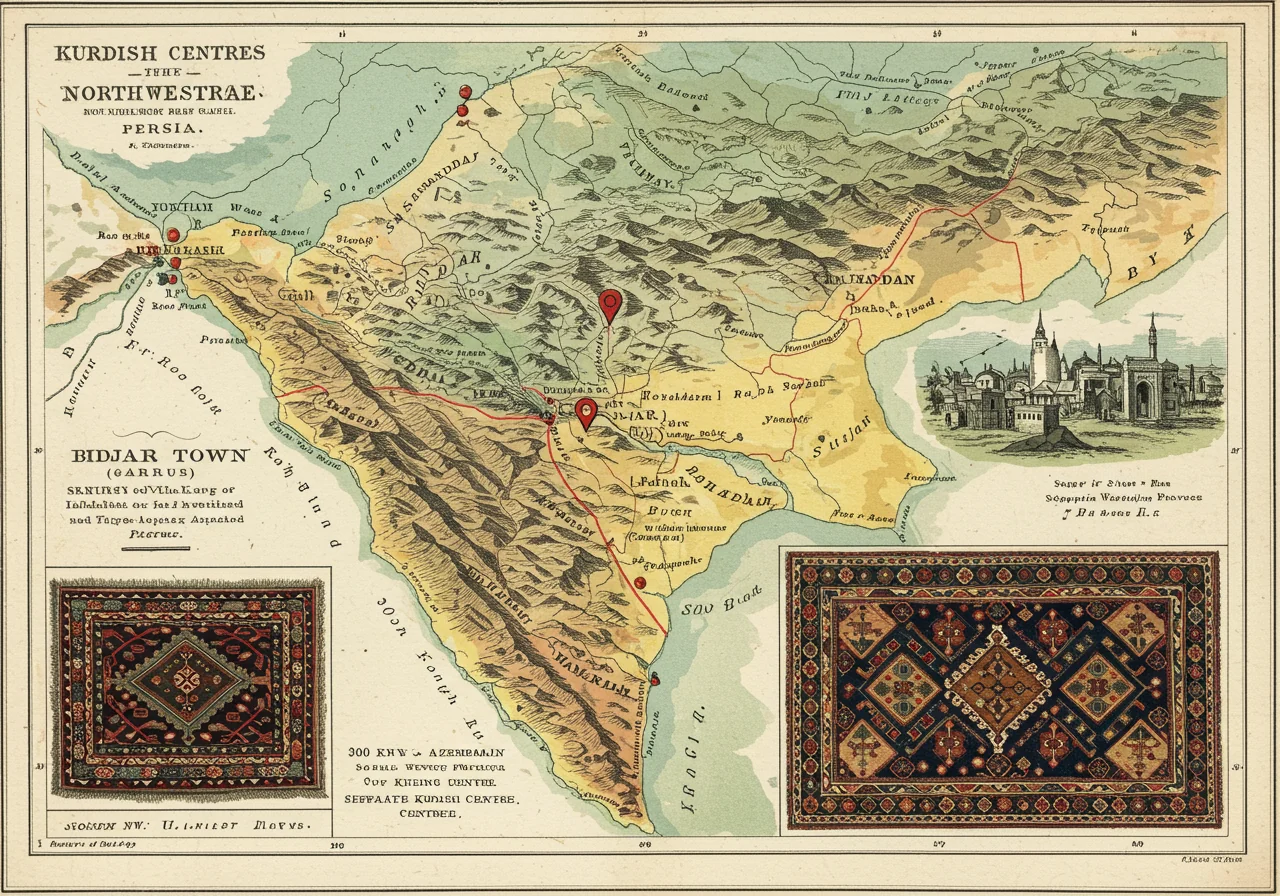
A page from a Victorian connoisseur’s portfolio on the Kurdish weaving centres — district map locating Bijar town and the Bidjar village to its south, Sanandaj (Senneh) roughly due west, Hamadan to the south, and Sauj Bulagh (Mahabad) as a separate Kurdish centre to the northwest in West Azerbaijan, some three hundred kilometres distant. Three archetype drawings at the bottom show the principal Kurdish sub-types: the Bidjar (herati allover or central medallion on dark wine-red ground, with the Garrus design at the high register), the Senneh (fine asymmetric-knot city workshop on lighter ground), and the Sauj Bulagh / Mahabad (its own Kurdish weaving tradition to the northwest, not a Bidjar satellite).
What It Is Not
Four types stand near enough to Bidjar that the beginner confuses them with it, and distinguishing them is most of the work of reading the Kurdish district.
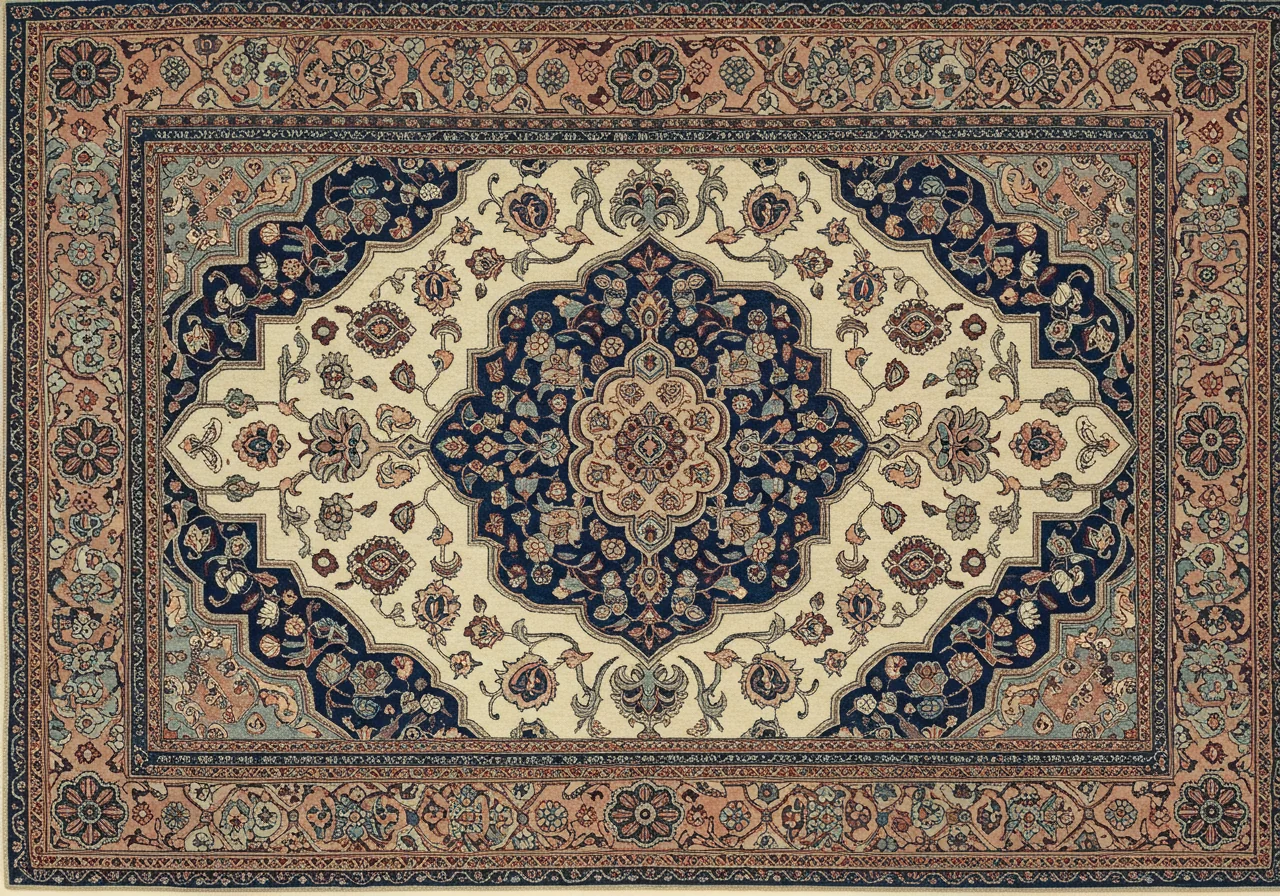
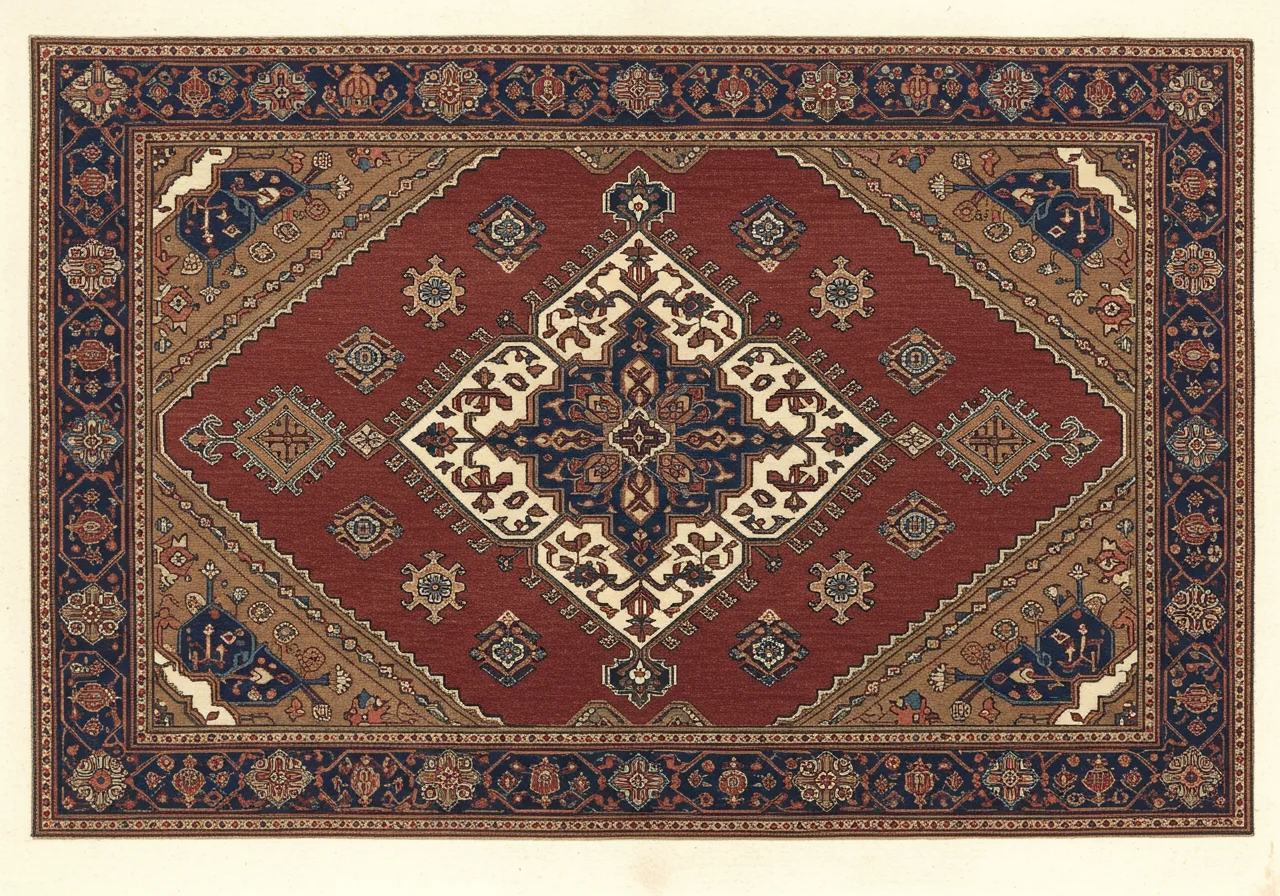
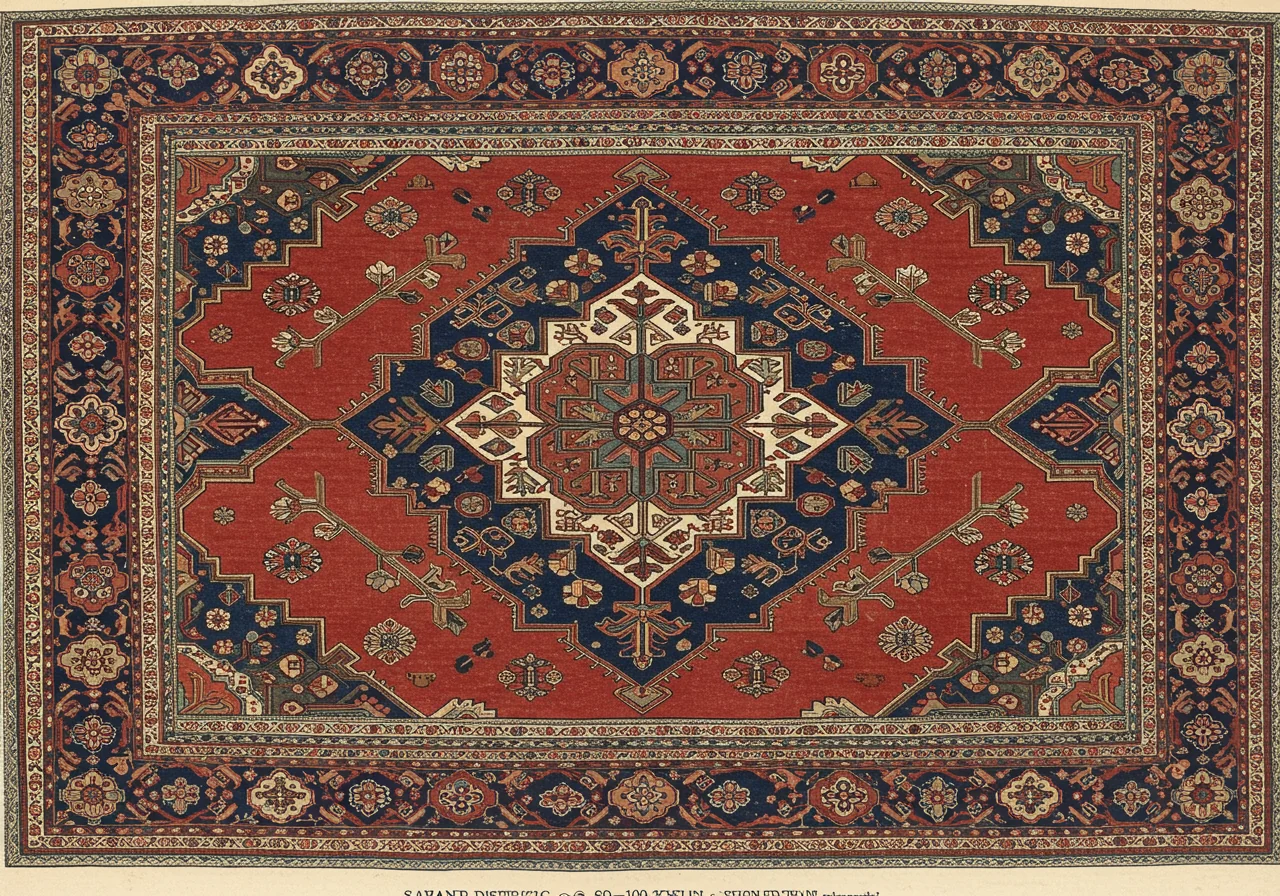
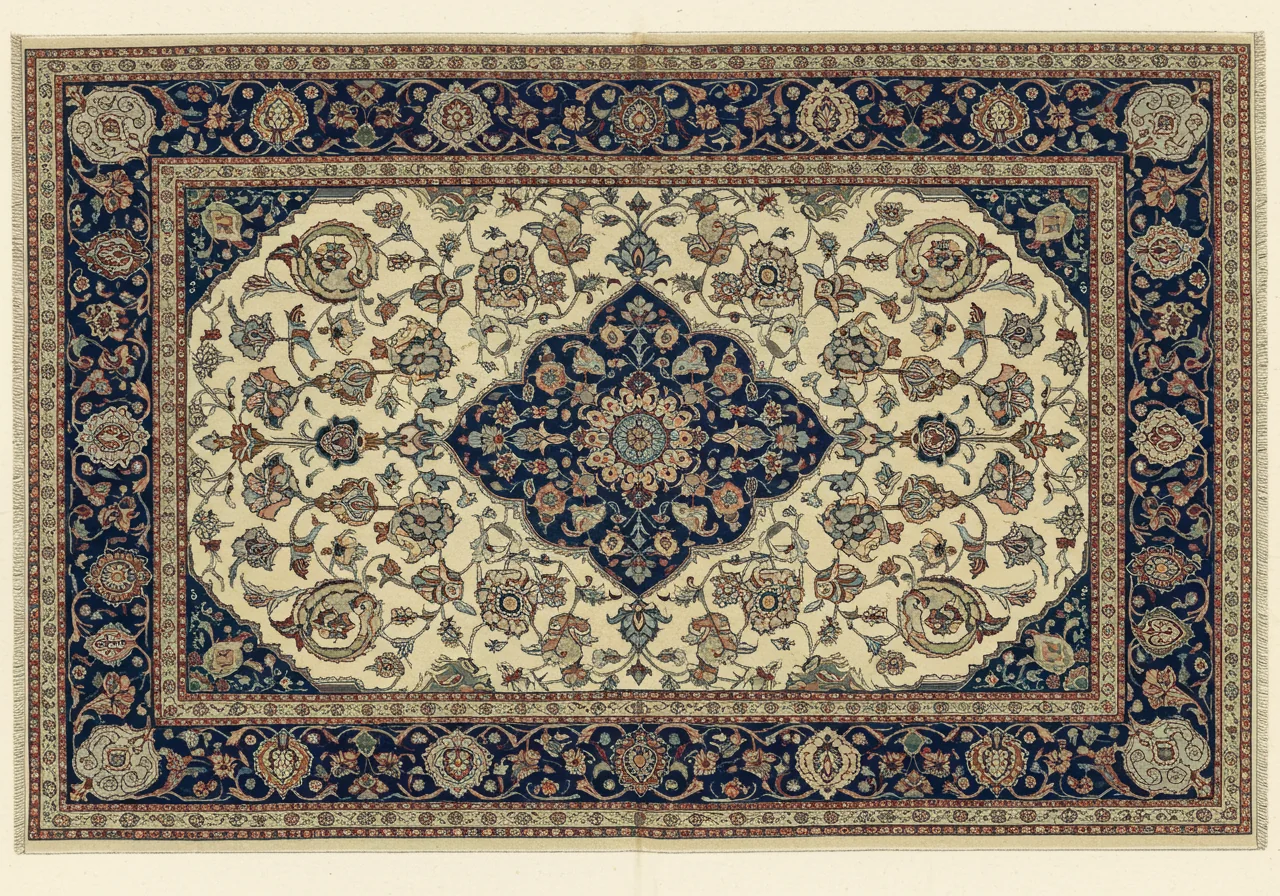
A Senneh is the fine Kurdish city workshop rug from Sanandaj, roughly due west of Bidjar — the same Kurdish district, the same weaving population, but a wholly different structural tradition. Senneh uses the asymmetric Persian knot (the Senneh knot proper, named for the city), draws at the very fine end of the Persian range (often three hundred KPSI and finer), runs a lighter palette including pale-ivory grounds the Bidjar register avoids, and produces a markedly lighter handle; the foundation is woven dry, without the wet-loom compression. The rule of thumb: dense compressed heavy-handle Kurdish rug with symmetric knot is Bidjar; fine light-handle Kurdish city rug with asymmetric Senneh knot is Senneh.
A Hamadan is the village production from the city to the south of Bidjar, and it is the type most often confused with Bidjar because of the geographic adjacency. Hamadan is characterised structurally by single-weft construction — a single shoot of weft between each row of knots, rather than the double-weft of Bidjar and most other Persian production — which produces a notably looser and lighter rug at comparable knot density. The palette runs through the rust / camel / brown earth-tones of the southern village register, more varied than the dark wine-and-navy of the Bidjar. The rule of thumb: dark wine compressed double-weft heavy rug is Bidjar; rust / camel single-weft loose village rug is Hamadan.
A Heriz is the village commercial production from the Sahand district to the north, treated in the Heriz post and the Bakshaish post. Heriz uses the symmetric Turkish knot (as Bidjar does), draws a large stepped polygonal medallion substantially different from Bidjar’s herati allover or floral medallion, and runs the brick-red palette of the Sahand district rather than the dark wine of the Kurdish district. Knot density is markedly lower (sixty to one hundred KPSI against the Bidjar’s eighty to two hundred), and the handle, while sturdier than the central Persian court rugs, is nowhere near the compressed rigidity of the Bidjar. The rule of thumb: large stepped polygonal medallion on brick-red ground is Heriz; herati allover or floral medallion on dark wine-red compressed-foundation ground is Bidjar.
A Tabriz is the city workshop rug of the regional capital, the northwestern counterpart to Kashan in the central Persian court. Tabriz pieces run finer knot densities than the Bidjar village apex on certain grades, draw a designed central medallion in the workshop court vocabulary (often on the pale-ivory Hadji Jalili ground), and use the asymmetric Persian knot. The handle is the diagnostic: Tabriz is light, supple, and drapes like a fine city-workshop rug; Bidjar is heavy, rigid, and resists folding. The rule of thumb: light-handle designed-composition city-workshop rug on pale ground is Tabriz; heavy-handle compressed-foundation rug on dark wine-red Kurdish ground is Bidjar.
What One Looks At
The practical discipline of identifying a Bidjar comes down to a short ordered checklist that the reader of the prior rug posts will find familiar in structure but that begins, for the Bidjar alone among the arc so far, with the handle test rather than the medallion or the palette.
One looks first — and this is the principal Bidjar attention — at the handle. One picks the rug up by a corner, or folds a corner back and lifts it, and reads the weight, the rigidity, and the drape. A genuine antique Bidjar feels meaningfully heavier than its size would suggest: a six-by-nine Bidjar weighs more than a six-by-nine Kashan, and the difference is large enough to be obvious on first lift. It is also markedly stiffer: the folded corner resists being doubled over, does not drape limply across the hand, and when set back on the floor returns to flatness rather than retaining a fold-line. This rigidity is the wet-loom compression made tactile, and no other Persian rug type produces it. The handle test settles the broad attribution at a single inspection, long before one has counted a knot or read the field. Modern reproductions on standard dry-loom production cannot replicate it, and the handle alone disqualifies the most common category of modern misattribution.
One looks next at the knot density and the foundation. Bidjar runs roughly eighty to two hundred knots per square inch on the antique production, with the very finest apex pieces occasionally reaching higher still, on either wool warp (the nineteenth-century apex) or cotton warp (most production after about 1900), with the symmetric Turkish knot throughout. The wool-warp sub-attribution is itself price-bearing — a wool-warp Bidjar of equivalent date and condition commands a substantial premium over a cotton-warp piece, and it dates the piece to the nineteenth century — and it is read at the cut edge where the warp ends emerge from the kilim. The back at reasonable magnification reads as visibly tighter and more compressed than any other Persian rug; the warps lie close, the weft is packed dense, and the foundation has the rigidity one’s hand has already read.
One looks at the palette and the medallion vocabulary. Bidjar ground is dark wine-red or dark navy on the antique pieces, saturated and deep rather than the brighter brick of the Heriz or the jewel-tone wine of the Kashan. A rug that reads as a lighter ground is probably not a Bidjar, regardless of the dealer label. The medallion or field vocabulary should be the herati allover, a central floral medallion in the Kurdish-village register, or the small repeating boteh — not the stepped polygonal vocabulary of the Sahand district or the palmette-and-cloud-band court vocabulary of the central Persian.
And one looks for condition and age. A genuine antique Bidjar is a century old at the youngest end of the antique range and a century and a half at the older end, and the wool, the dyes, and the wear should all read as having lived through that span. The dark palette ages slowly — Kurdish madder oxidises less than Sahand madder over comparable time — and a Bidjar of 1880 in good condition still reads as the dark wine it was woven to be, so the palette alone does not date the piece. The wool grade, the warp material, and the back do. Late-twentieth-century reproductions are sold actively into the decorator market; the handle test disqualifies almost all of them at first inspection.
The next post in the rug arc will be either Hamadan — to extend the Kurdish-adjacent district to the south, with its single-weft construction and its rust / camel earth-tone register that opens a new palette band for the arc — or Senneh — to treat the fine Kurdish city workshop that this post’s siblings cross-referenced, the natural Kurdish counterpoint to Bidjar’s village register. The choice will depend on what photographic material is available at the time of writing.