The two prior posts in this arc — Louis XV and Louis XVI — described the principal axis of eighteenth-century French royal furniture: the move from rocaille curve to neoclassical straight line, from floral marquetry to geometric trellis, from rocaille ormolu to Greek-key-and-laurel-wreath. Both styles were courtly, both were French, both were made for the aristocracy, both made their argument through historicist quotation — Louis XV quoting nothing in particular but the rocaille tradition itself, Louis XVI quoting the recently-rediscovered antiquity of Pompeii and Winckelmann’s Greek-Roman canon. The Biedermeier style this post takes up is the third position on the same axis and is, in important ways, the rejection of both. Where Louis XV and Louis XVI both made an aristocratic-historicist argument, Biedermeier makes a bourgeois-anti-historicist argument; and the resulting body of work, produced in the post-Napoleonic Continental cities between 1815 and 1848, is the first European furniture style to argue that design should derive from function and proportion alone, without reference to historical precedent or ornamental tradition. It is, by the strict definition of the term, the first modern furniture.
This is the third post in Reading the Period Cabinet, the furniture arc of the antiques series. It treats Biedermeier third because Biedermeier is the cleanest single statement of an argument that the prior two furniture posts could not make — that the principal moves of the cabinet-maker can be reduced to wood selection, proportion, and construction without recourse to either rocaille decoration or neoclassical quotation. Where the Louis XV/XVI pair establishes the historicist axis of eighteenth-century French royal furniture, the Biedermeier post establishes the anti-historicist counter-position that subsequent furniture history — through the modernist movements of the early twentieth century — would extend and elaborate. The two positions together are the axis along which European furniture of 1700–1930 can be located, and getting Biedermeier in place after Louis XV/XVI is what makes the rest of the arc legible at the period level.
The Specimen
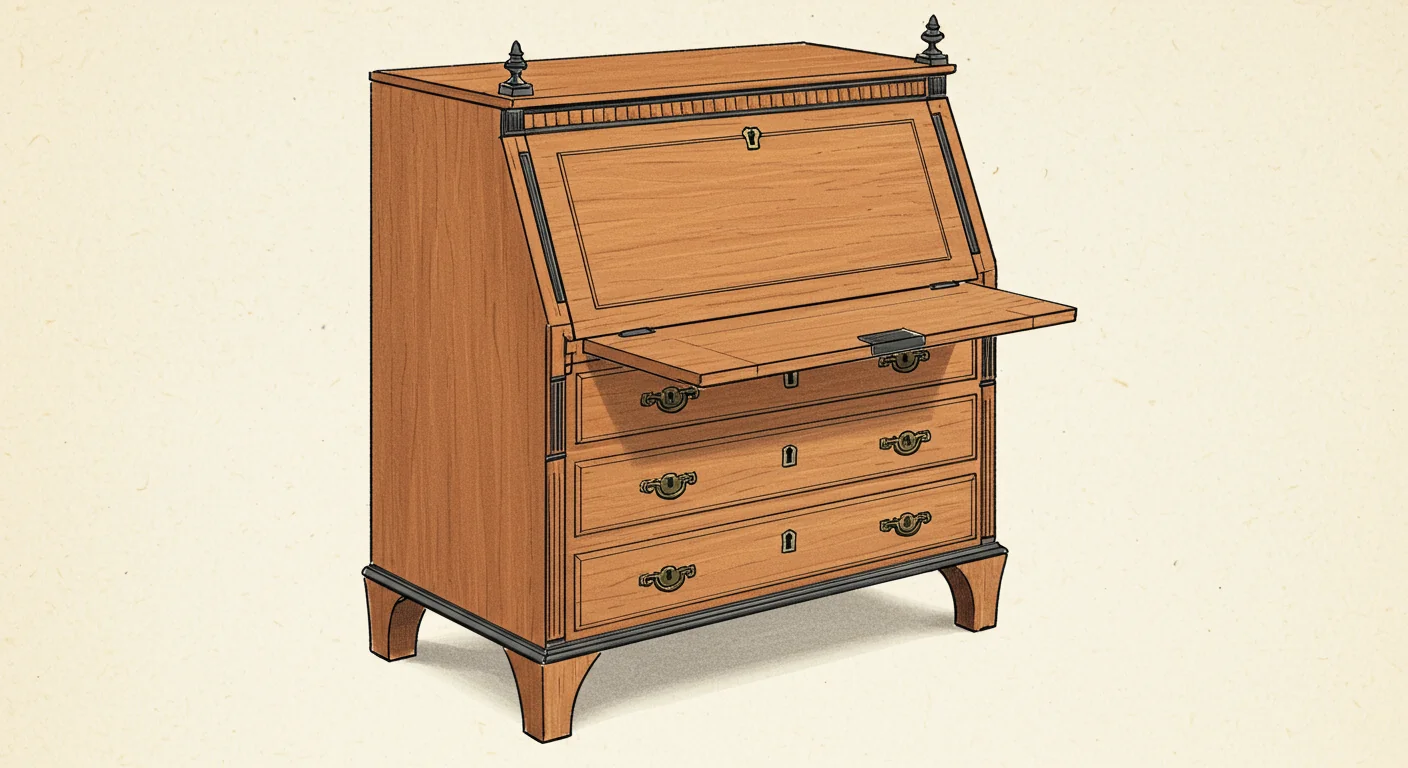
The canonical Biedermeier piece, for the purposes of this post and for the purposes of beginning to read the style at all, is the Sekretär — the drop-front writing desk with a chest of drawers below and a fall-front upper case concealing pigeonholes and small drawers. The Sekretär is the form in which the Biedermeier principles are most fully concentrated, the form most-produced across the period at every price level, and the form that subsequent modernist furniture-makers would most often quote when they wished to invoke the Biedermeier precedent.
A canonical Biedermeier Sekretär, then. It stands on four short tapered legs — straight, square in section, often with a small ebonized collar at the top and bottom and a small ebonized foot — or alternatively on a low rectangular plinth that lifts the case some inches above the floor. Above the legs, the lower case rises as a rectangular chest of three or four drawers, with the drawer fronts treated as continuous panels of cherry or walnut veneer, separated by narrow ebonized banding rather than by carved or applied mouldings. Above the lower chest, a rectangular upper case rises as a separate volume, usually slightly recessed in plan, with a drop-front writing surface hinged at the bottom and falling forward to provide the working surface. Behind the drop front, an interior of pigeonholes and small drawers in matching pale wood is revealed when the front is opened. The upper case is often crowned by a small architectural pediment — sometimes a simple flat cornice, sometimes a low triangular pediment quoting Greek architecture in small-scale form, sometimes a curved-broken pediment.
The whole composition reads as architecture in miniature. The Sekretär is not, in the Biedermeier register, a piece of decorative furniture; it is a small building, with a base, a body, and a crown, organised by classical proportions, executed in restrained materials, and ornamented (where it is ornamented at all) by small architectural details rather than by figurative or floral decoration. This is the principal aesthetic move of the style and what most distinguishes it from the Louis XV/XVI tradition the prior posts described.
The decorative apparatus has three components, each treated at restrained scale.
The first is the wood itself, which carries the principal decorative work of the piece. Biedermeier wood selection is the signature of the style: pale local European species — cherry (the most characteristic Vienna wood, with its warm pale-golden tone), walnut (the Berlin and Munich preference, slightly darker), ash, birch, satinwood, occasionally maple. These are local European woods, used either as solid timber on chair frames and structural members or as thin veneer over pine carcase on case furniture. The pale tones of the local woods are the principal palette-statement of the style — and are the pointed rejection of the dark exotic veneers (kingwood, rosewood, ebony) that the Louis XV/XVI ébénistes had built their work around. A Biedermeier Sekretär in cherry, beside a Louis XVI commode in kingwood, reads as the same furniture-tradition’s-bones in entirely different paint: pale local wood versus dark exotic wood, restraint versus richness, bourgeois versus aristocratic.
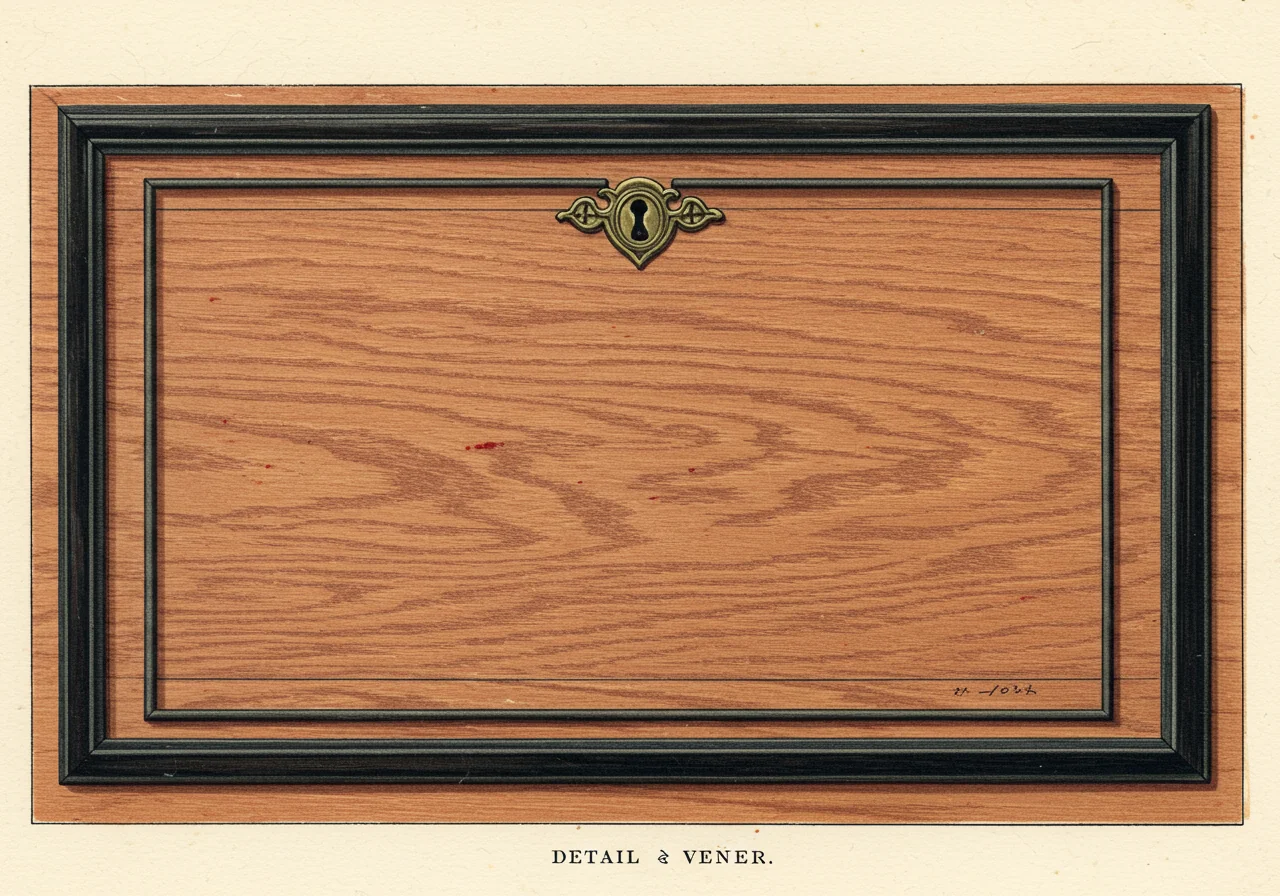
A close detail of Biedermeier cherry-wood veneer — the pale golden timber with its characteristic narrow figured grain, framed by narrow ebonized banding that defines the panel edges. The Biedermeier preference for pale local woods (cherry, walnut, ash, birch, satinwood) is the principal palette-statement of the style and the pointed rejection of the dark exotic veneers (kingwood, rosewood, ebony) that the Louis XV and Louis XVI ébénistes had built their work around. Where the French royal tradition had quoted the exotic-wood vocabulary of the colonial trade, the Biedermeier tradition asserted the European local-wood vocabulary as its own — a quiet but consequential rejection of the historicist materials-vocabulary alongside the rejection of the historicist ornamental-vocabulary.
The second component is the ebonized banding — narrow strips of pearwood or sycamore stained black, applied as a defining line at the edges of drawer fronts, panel edges, and the borders of the upper-case cornice. The ebonized banding is the principal applied-ornament of the Biedermeier style, used sparingly and architecturally to define proportions rather than to decorate surfaces. The contrast between the pale field and the narrow black banding is the visual signature of the style — restrained, geometric, architectural — and is the single most reliable identifier of Biedermeier work at a distance.
The third component is the small architectural hardware — restrained brass escutcheons, small ebonized columnar accents flanking the upper case, occasional small carved capitals on the columnar elements, small brass or ebony knobs as drawer pulls. The ormolu sculptural mounts of the Louis XV/XVI period are absent; the figurative carving of the Empire period is absent; the bold ornament of every prior royal tradition is absent. What is present is small, architectural, restrained.
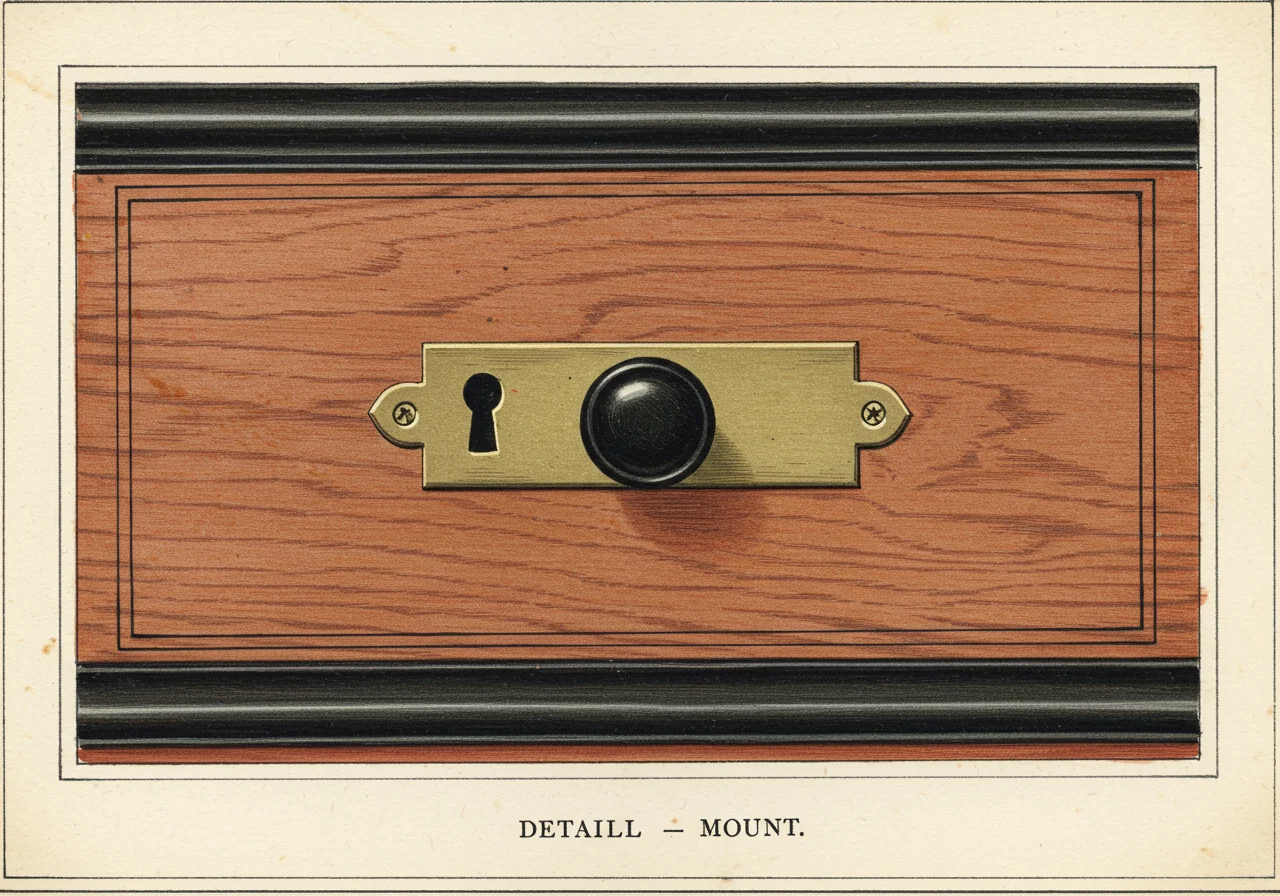
A close detail of Biedermeier hardware — a small brass escutcheon and an ebony knob on a cherry-wood drawer front, with the characteristic narrow ebonized banding defining the panel edges and the simple rectangular geometry of the drawer face. The hardware is deliberately small and restrained, in pointed contrast to the elaborate ormolu mounts of the Louis XV and Louis XVI traditions — the Biedermeier piece earns its visual interest from the proportions of the case and the figure of the wood, not from applied decoration. The same restraint extended to the chairs, the tables, the vitrines, and every other form the style produced.
Assembled together — pale local wood with restrained banding, rectangular architectural composition, small classical-architectural hardware, no figurative or floral ornament anywhere — these are the canonical Biedermeier components. The variations within the type are considerable across the period 1815–1848 and across the Vienna / Berlin / Munich / Hamburg / Mainz / Dresden geographies of production, but the principal moves do not vary.
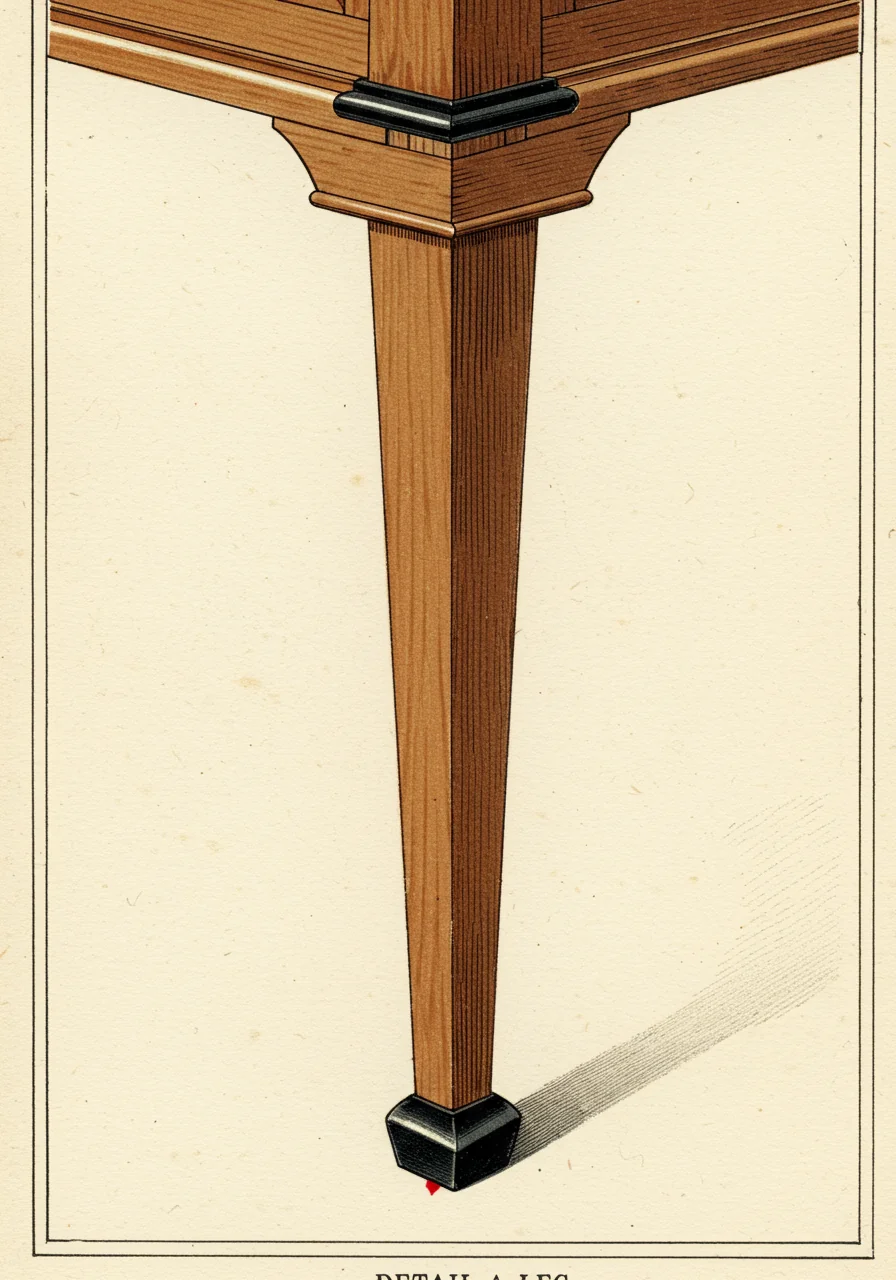
A close detail of a Biedermeier leg — the tapered architectural form characteristic of the style, square in section rather than the columnar round of Louis XVI, with restrained ebonized accent at the top where the leg meets the case and at the bottom in a small simple foot. The Biedermeier saber-leg variant (a slightly curving leg that descends in a sabre’s arc) was the alternative form for chair and table production, drawing on the Greek klismos chair tradition that the period’s neoclassical interest had recovered. Both forms are architectural and restrained, in pointed contrast to both the cabriole leg of Louis XV and the fluted columnar leg of Louis XVI.
The Evidence
Behind the visible composition is the structural and material evidence by which a Biedermeier piece is identified at close range and its provenance dated and attributed.
The wood, first, is the principal evidence one is reading for. Cherry (the warm pale-golden tone of European cherry-wood, with characteristic narrow figured grain) is the canonical Vienna wood — Josef Danhauser’s workshop produced cherry-wood Sekretärs by the thousand from approximately 1815 through the 1840s, and the cherry-on-pine-carcase construction is the most-encountered Biedermeier substrate. Walnut (slightly darker, with more pronounced grain) is the Berlin and Munich preference and appears across the period in those geographic registers. Ash and birch are common alternatives — paler still than cherry, sometimes with a striped or rippled figure that the Biedermeier cabinetmakers selected for. Satinwood (pale yellow, glossy when polished) appears on the more substantial pieces and is associated with the upper-end Vienna and Berlin commissions. Maple and pearwood appear less frequently.
The construction, second, is hand-craft of generally good quality but of a register quieter than the Parisian ébéniste tradition. The carcase is typically solid pine or solid oak, with the cherry or walnut applied as veneer (typically one to two millimetres thick) on every visible surface. The dovetails at the corners of the drawers are hand-cut, with irregular spacing characteristic of pre-machine work; the drawer runners are solid wood; the back panels are tongued and grooved plank construction. The Biedermeier carcase quality is comparable to the Louis XVI in technique and care, though the materials are humbler and the hardware substantially simpler. The hand-construction extends through to roughly 1840–1845, when the first factory-production methods began to appear in the larger Vienna workshops; pieces from the late Biedermeier period (1840–1848) sometimes show the first machine-cut joinery in the Continental tradition, and the distinction between pre-1840 hand-construction and post-1840 transitional construction is one of the dating signals collectors learn to read.
The ebonized banding, third, is the surest single applied-ornament identifier. The bands are typically pearwood or sycamore (chosen for stability) stained black with a logwood-and-iron-acetate dye solution applied across multiple coats, then polished to match the surrounding cherry or walnut veneer in surface finish. The bands are usually one to three millimetres wide, applied at panel edges, drawer-front edges, and the borders of the upper-case cornice. The black bands against the pale field are the visual signature of the style, and learning to recognise the period banding (which has a particular slightly-greyed depth to its black) versus the later-revival banding (which tends to be a flatter and more uniform black) is one of the harder-won judgments of Biedermeier connoisseurship.
The hardware, fourth, is restrained throughout. Small brass keyhole escutcheons in simple rectangular or oval shapes, small ebony or brass knobs as drawer pulls, occasional small carved-wood columnar accents in cherry or walnut flanking the upper case. The brass hardware is typically un-gilt — polished brass rather than mercury-gilded bronze — which is the period-appropriate finish and which gives the Biedermeier piece its slightly cooler hardware register relative to the warm ormolu of Louis XVI. The hardware is small enough that on a thumbnail photograph of a Biedermeier piece, the visual story is the wood and the proportions; on a Louis XVI piece by contrast, the ormolu often dominates the visual story.
The stamp, fifth — and here the Biedermeier tradition differs from the Parisian. There was no equivalent of the JME stamp requirement in the German-speaking territories; Biedermeier makers were not required to stamp their work, and the great majority of period pieces are unsigned. The major Vienna workshops (Josef Danhauser, Carl Hagenauer) sometimes applied a small paper trade-label to the back of a piece or to the inside of a drawer, but these labels were ephemeral and most have not survived. Berlin and Munich workshops similarly produced largely unsigned work. Attribution of Biedermeier pieces is therefore principally stylistic — by comparison to the documented surviving pieces in museum collections, by comparison to the surviving pattern-book drawings (Danhauser’s surviving 2,500-drawing pattern book is the principal documentary basis), and by provenance documentation where it exists. A documented Danhauser piece commands a substantial premium in the current market; an unattributed Vienna Biedermeier of comparable quality is necessarily a stylistic judgment.
The Period
The Biedermeier style proper runs from approximately 1815, with the Congress of Vienna and the post-Napoleonic settlement, through to 1848, with the revolutions that ended the conservative Metternich system across the German-speaking territories. The thirty-three-year window is short for a furniture style by the standards of the broader tradition — the Louis XV style ran for approximately forty years, the Louis XVI for thirty, and both were exceeded by the longer-running historicist styles that bracket the modern period. Biedermeier is, by any reasonable measure, a tight and well-defined historical phenomenon, and its tightness is part of what makes it intellectually legible in a way the more diffuse styles are not.
The geographic centre of Biedermeier production was Vienna, the capital of the Habsburg empire. Vienna in the post-Napoleonic period was the political centre of the Metternich system (the Austrian foreign minister who dominated Continental European politics from 1815 until the 1848 revolutions ended his tenure), the cultural centre of Central European intellectual life (the musical world of Schubert and the literary world of Grillparzer and Stifter and Nestroy), and the principal market for Biedermeier furniture. Berlin (the Prussian capital), Munich (Bavarian), Hamburg, Mainz, Dresden, and the smaller German princely capitals were secondary production centres, each with characteristic regional variations on the broader Vienna template.
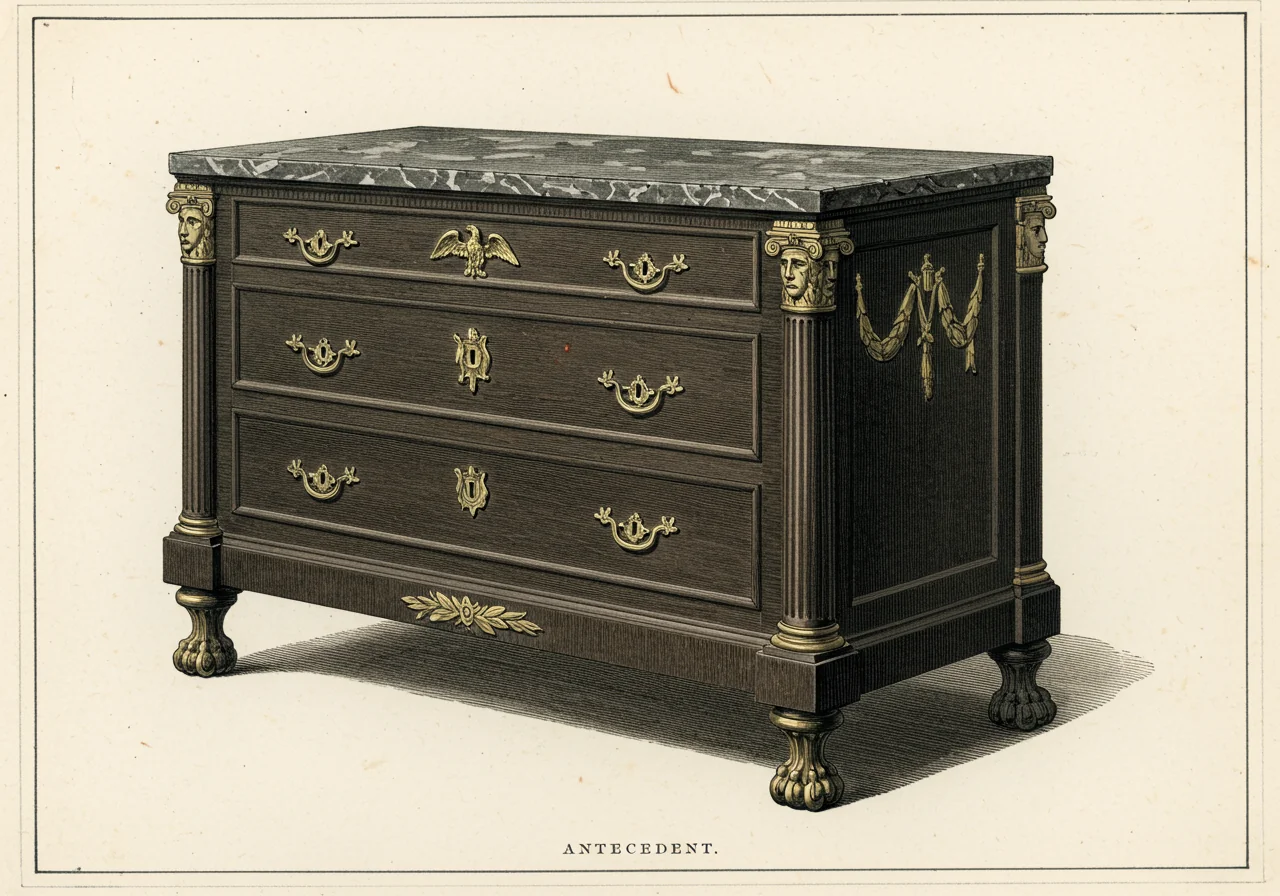
An Empire commode of the Napoleonic period — heavy dark mahogany, substantial gilt-bronze mounts in martial vocabulary (Imperial eagle at the centre, sword-and-laurel garlands across the drawers, lion-paw feet), columnar corners with acanthus capitals, deep colour and grandeur throughout. The Empire style (1804–1815) was the official Napoleonic vocabulary, and Biedermeier emerged in direct reaction against it after the 1815 settlement: where Empire was heavy, gilded, martial, and aristocratic, Biedermeier was light, restrained, domestic, and bourgeois. The two styles are temporally adjacent — the Empire ending with Napoleon’s fall, the Biedermeier emerging immediately after — but aesthetically and socially they are opposites.
The patron class of Biedermeier was the post-Napoleonic Continental bourgeoisie — the merchants, lawyers, doctors, professors, civil servants, military officers, and Bildungsbürgertum (educated middle class) of the German-speaking territories during a period of rapid economic and demographic growth. This was a substantial expansion from the aristocratic patron class of Louis XVI: the Biedermeier buyer was a Hamburg shipping merchant, a Vienna professor, a Berlin lawyer, a Dresden civil servant, not an aristocrat with a country estate. The bourgeoisie’s furniture purchases were correspondingly different from the aristocracy’s — smaller in scale, more practical in form, less elaborate in ornament, more focused on the domestic interior than on the public reception room. Biedermeier furniture was made for the bourgeois Wohnzimmer (sitting room) rather than for the palace salon, and the form vocabulary the style developed (the Sekretär for the household correspondence, the round dining table for the family meal, the comfortable chair for the evening’s reading by lamplight, the vitrine for the modest collection of porcelain and glass) reflects this domestic register at every point.
A note on the name, because the name is itself instructive. Biedermeier was not what the period called the style; the period had no single name for what was simply contemporary cabinet-work. The name was invented in the 1850s as a pejorative, by the satirists Ludwig Eichrodt and Adolf Kußmaul, who published a series of comic poems in the Munich magazine Fliegende Blätter under the pseudonym Gottlieb Biedermeier — a fictional bourgeois philistine whose narrowness of taste and earnestness of intent the satires mocked. The name attached itself, retrospectively and pejoratively, to the furniture and interior style of the 1815–1848 period, and through the later nineteenth century Biedermeier was used in the German-speaking critical literature as a term of mild disparagement for bourgeois sobriety. The name retained its pejorative edge through to roughly 1900, at which point the Vienna modernist movement — Adolf Loos, Josef Hoffmann, the Wiener Werkstätte — explicitly reclaimed Biedermeier as a positive precedent and rehabilitated the term. By 1920 the rehabilitation was complete; by 1950 Biedermeier was widely recognised as the most important Continental furniture style of the early nineteenth century and the direct ancestor of twentieth-century modernist design.
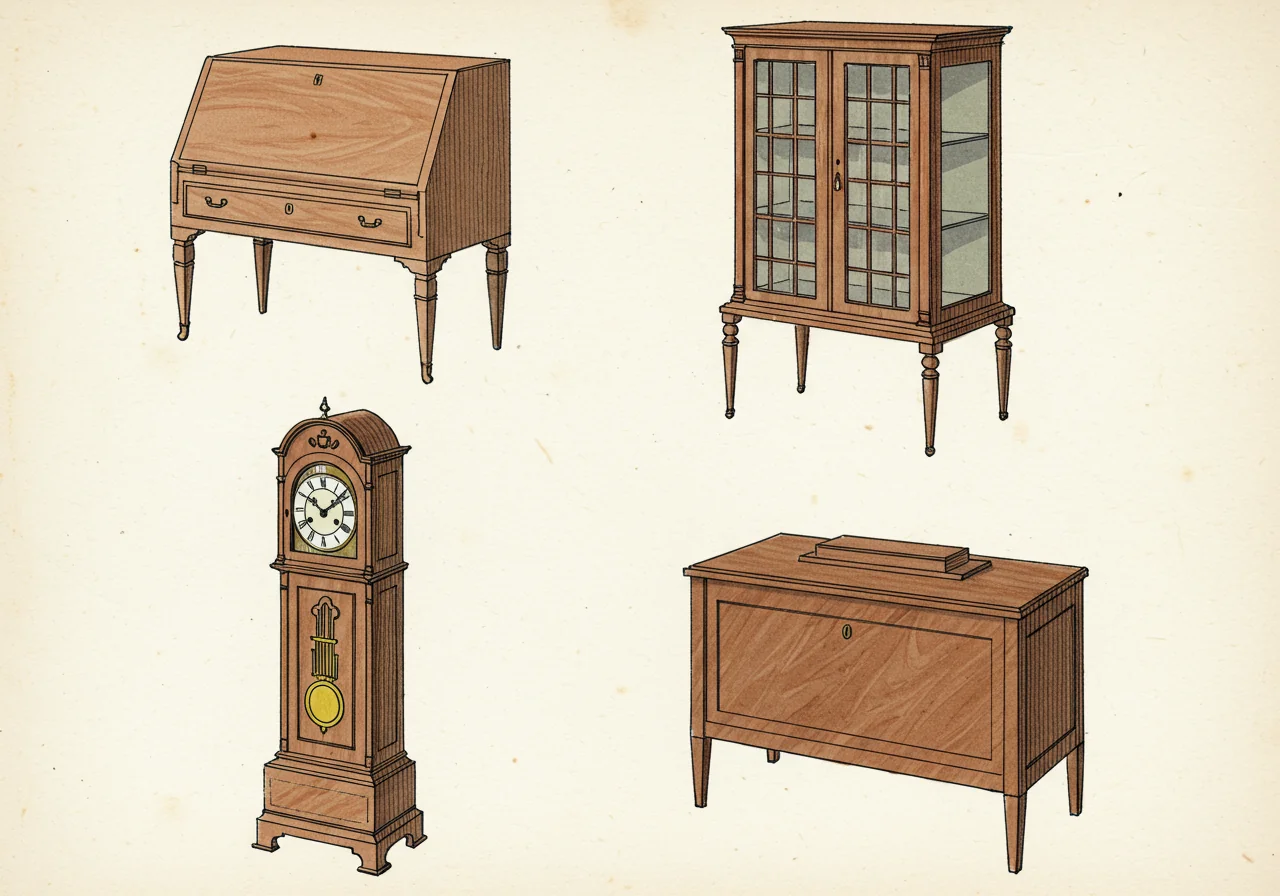
A page from the Vienna workshop pattern book of Josef Danhauser (the principal Biedermeier figure, whose Danhauser furniture factory was the largest Continental furniture producer of the period 1815–1830) — perspective drawings of four canonical case-furniture forms: a Sekretär (drop-front writing desk), a Vitrine (glass-fronted display cabinet), a Standuhr (tall-case longcase clock), and a Nachttisch (bedside cabinet). All four show the canonical Biedermeier vocabulary at small scale: pale cherry wood, narrow ebonized banding at the panel edges, restrained small brass hardware, rigorously architectural proportions. Danhauser’s surviving pattern book runs to over 2,500 individual drawings and is the principal documentary basis for modern Biedermeier scholarship; many of the canonical Biedermeier forms can be traced to specific Danhauser designs and dated by their position in the pattern-book sequence.
The principal Biedermeier figure is Josef Danhauser (1780–1829), the Vienna entrepreneur and designer who established the Danhauser furniture factory (Wiener Möbelfabrik) in 1804 and developed it into the largest Continental furniture producer of the early nineteenth century. Danhauser’s workshop employed at peak more than a hundred craftsmen, produced furniture across the full Biedermeier price range from substantial Sekretärs for the upper bourgeoisie to modest chair-and-table sets for the modest household, and supplied not only the Vienna market but the broader Habsburg empire and significant export to Berlin, Munich, Prague, and Budapest. Danhauser’s son Josef Danhauser the Younger (1805–1845) continued the workshop after the elder Danhauser’s death, and the firm operated until 1838 when financial difficulties forced its closure. The surviving body of documented Danhauser pieces, together with the surviving pattern book, constitutes the principal corpus of Biedermeier scholarship.
Alongside Danhauser, several other Biedermeier figures deserve naming. Karl Friedrich Schinkel (1781–1841), the Berlin architect-designer principally known for his Prussian state architecture (the Altes Museum, the Neue Wache, the Bauakademie), also produced furniture in the Biedermeier register, characterised by greater architectural rigour and more substantial classical references than the Vienna workshop tradition. Carl Hagenauer in Vienna; Johann Wilhelm Wittig in Berlin; the Mainz and Hamburg workshops less well-documented but productive across the period — each contributed to the Biedermeier corpus in their respective regional registers.
The end of the Biedermeier style proper came with the Revolutions of 1848 — the wave of liberal-democratic uprisings that swept across the German-speaking territories in March 1848, ended the Metternich political system, and produced a cultural reaction against the bourgeois sobriety of the prior thirty-three years. The Continental furniture market after 1848 turned decisively toward historicist revival — Neo-Renaissance, Neo-Rococo, Neo-Gothic, eventually Neo-Baroque — and the Biedermeier vocabulary was rejected as bourgeois philistinism. The historicist period lasted approximately from 1848 to 1900; the rehabilitation of Biedermeier as a positive precedent for modernist design began only around 1900, with Loos’s “Ornament and Crime” (1908) and the broader Wiener Werkstätte movement, and was consolidated through the 1920s.
What It Is Not
Four styles stand near enough to Biedermeier that the beginner confuses them with it, and distinguishing them is most of the work of reading early-nineteenth-century Continental and English furniture.
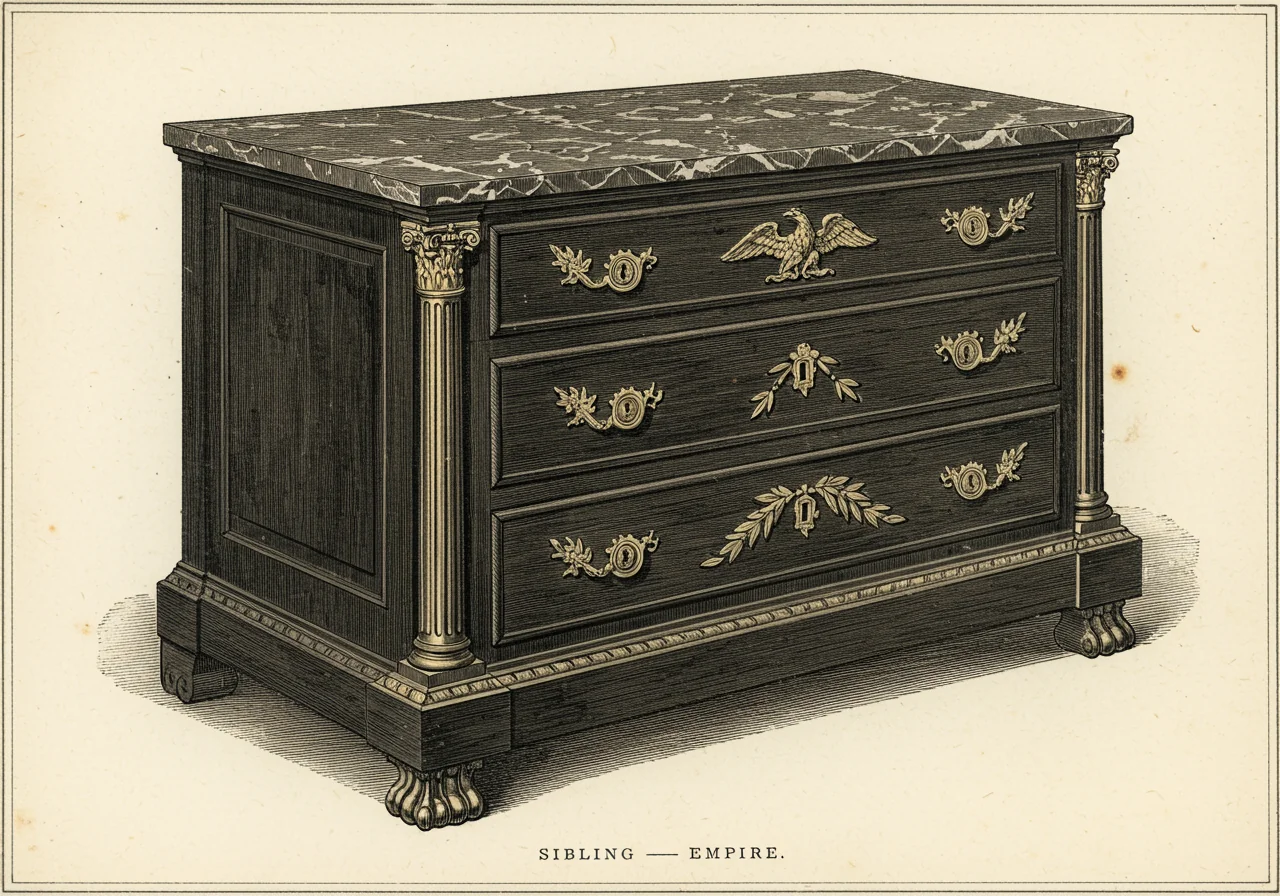
The first is the Empire (1804–1815, the immediate antecedent that Biedermeier rejected). An Empire commode is dark mahogany, substantial in scale, with heavy gilt-bronze mounts in martial-imperial vocabulary (eagles, swords, laurel wreaths in Roman-triumphal arrangement, sphinx heads, lion-paw feet), columnar corners with acanthus capitals, often a marble top of dark colour. The Empire style was the official Napoleonic vocabulary, made for the imperial court and the senior administration; it is grand, ceremonial, and deliberately monumental. A Biedermeier piece beside an Empire piece reads as an entire register-shift — pale wood versus dark mahogany, restrained hardware versus ornate ormolu, domestic scale versus ceremonial scale, bourgeois patron versus imperial patron. The two styles are temporally adjacent (Empire ending 1815, Biedermeier beginning 1815) but aesthetically and socially opposite. The rule of thumb: heavy dark mahogany with martial gilt-bronze is Empire; pale local wood with restrained banding is Biedermeier.
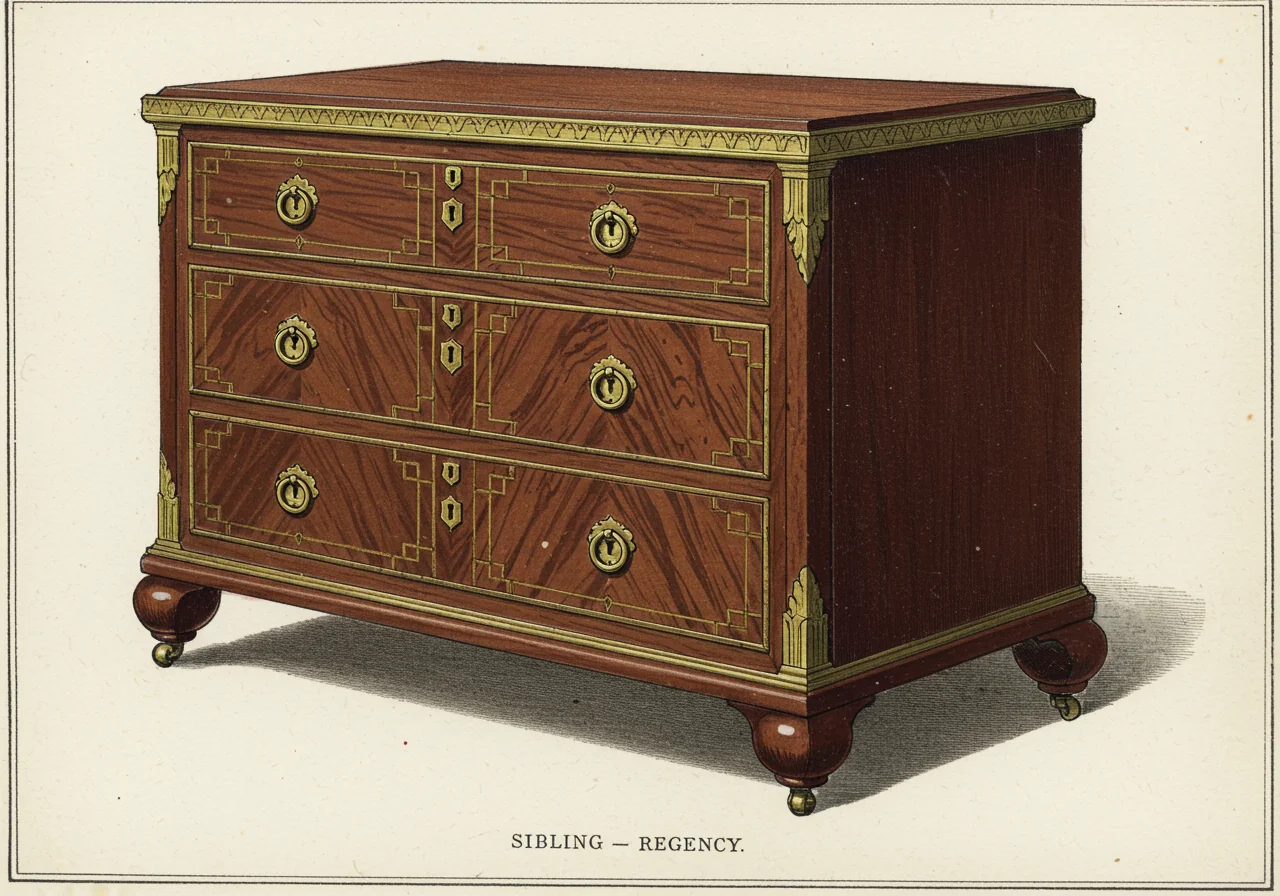
The second is English Regency (1811–1820, the contemporary parallel across the Channel). Regency English furniture shares some of Biedermeier’s architectural-classicist vocabulary — Greek revival sources, klismos chairs, sabre legs, restrained classical ornament — but is generally more ornate, more grand, and more public in scale than the Biedermeier domestic register. The Regency uses rosewood (often combined with brass inlay, the so-called Buhl-work or boullework of the period) where Biedermeier uses cherry; it carries more ornament, more architectural elaboration, and more reference to fashionable historicist sources (Egyptian motifs from the Napoleonic Egyptian campaigns, Chinese motifs from the East India trade). The Regency and Biedermeier are siblings — both descended from the broader Greek-revival aesthetic that swept Europe in the post-Napoleonic period — but the Regency is the grand-house English-aristocratic version and Biedermeier is the domestic Continental-bourgeois version. The rule of thumb: rosewood with brass inlay and Egyptian motifs is Regency; cherry with ebonized banding and restraint is Biedermeier.
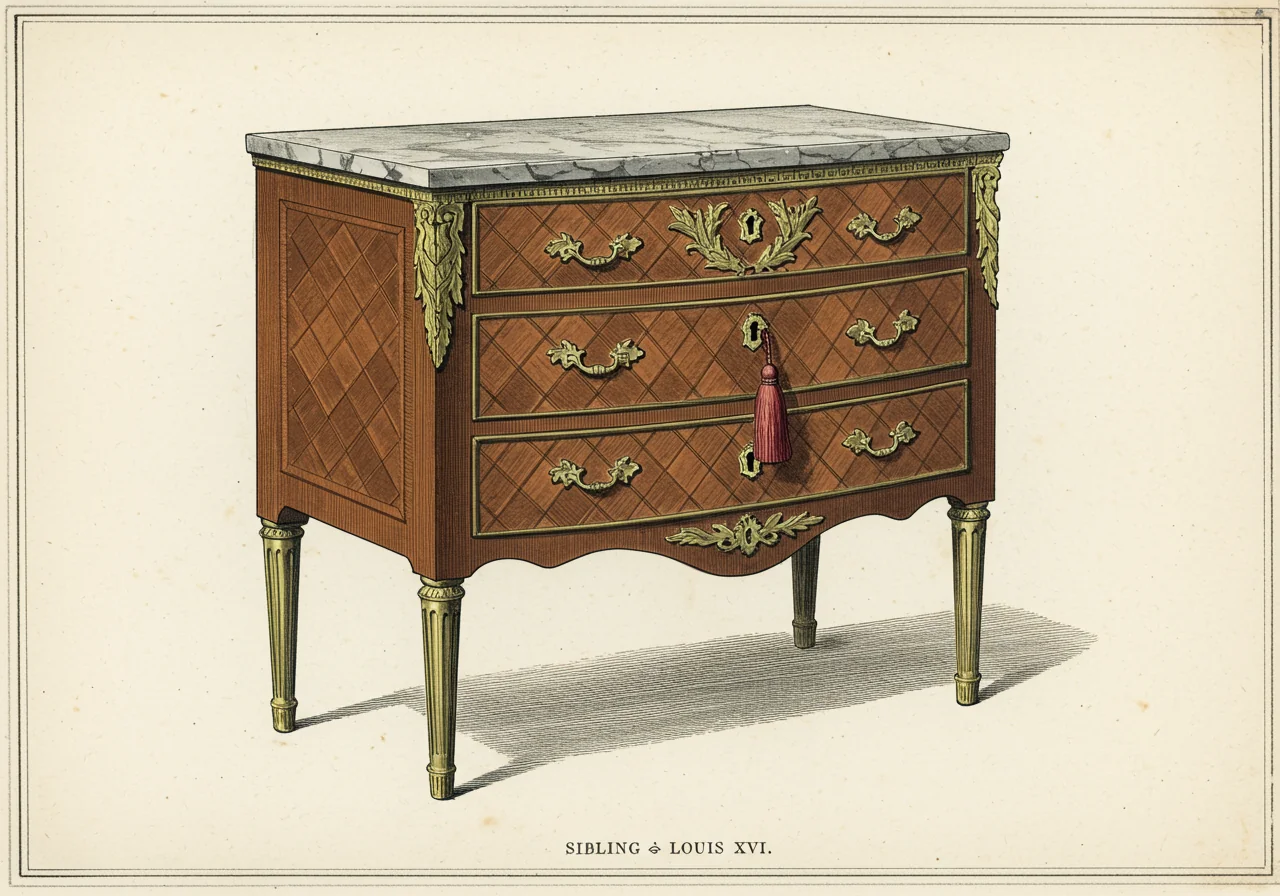
The third is Louis XVI (1774–1792, the French royal predecessor, examined in the previous post). The two styles share the broader neoclassical aesthetic and some specific vocabulary (rectangular cases, straight legs, restrained ornament), but the Louis XVI is aristocratic-historicist where Biedermeier is bourgeois-anti-historicist. A Louis XVI commode carries elaborate gilt-bronze mounts in Greek-key and laurel-wreath vocabulary, exotic-wood marquetry in geometric patterns, the formal symmetric composition of the royal commission; a Biedermeier Sekretär carries restrained brass hardware, pale local cherry veneer, the domestic restraint of the bourgeois household. The thirty-year temporal gap and the social gap (French royal versus German bourgeois) are not large enough to keep the two styles cleanly separable for the beginner, but the materials and the hardware register settle the question on inspection. The rule of thumb: exotic-wood marquetry with elaborate ormolu is Louis XVI; pale local wood with restrained banding is Biedermeier.
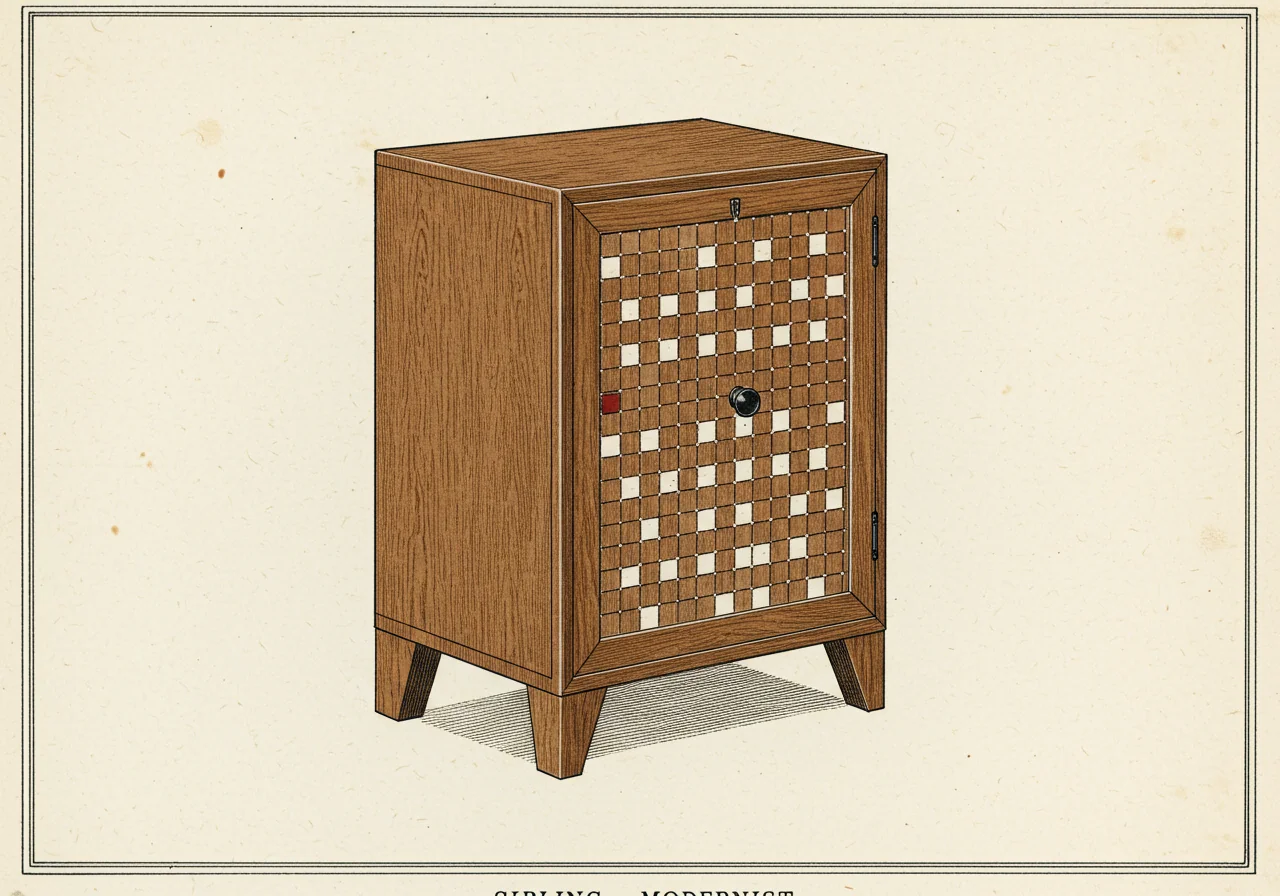
The fourth is the Wiener Werkstätte and the broader early-twentieth-century modernist Vienna tradition (1903 onward), which is the descendant of Biedermeier rather than a confusing contemporary. Josef Hoffmann, Koloman Moser, Adolf Loos, and the broader Vienna modernist circle of 1900–1920 explicitly named Biedermeier as their precedent and produced furniture in a register that is recognisably Biedermeier-evolved — pale woods (often stained beech or oak), extreme geometric restraint, complete rejection of historicist quotation, small architectural details (often grid patterns in checkerboard arrangement), bourgeois domestic scale. A Hoffmann chair of 1905 beside a Danhauser chair of 1820 reads as the same vocabulary at two different stages of its development; the modernist piece is more rigorously geometric, more abstract, more programmatic, but the family resemblance is unmistakable. The rule of thumb: if the piece is from 1815–1848 and has cherry wood and ebonized banding, it is Biedermeier; if the piece is from 1903–1920 and has stained beech and grid patterns, it is Wiener Werkstätte modernist quoting Biedermeier.
These are the four principal confusing-with siblings. There are others (the late-nineteenth-century Biedermeier revival pieces of the 1880s–1890s; the American Federal furniture of Duncan Phyfe and his contemporaries; the Scandinavian Empire-and-post-Empire tradition), but the four above account for the great majority of misattributions a careful collector will encounter.
What One Looks At
The practical discipline of identifying a Biedermeier piece, when one is standing in front of a candidate cabinet, comes down to a short ordered checklist.
One looks first at the wood. Pale local European species — cherry, walnut, ash, birch, satinwood — is the Biedermeier signature. Dark mahogany suggests Empire (heavy and gilded) or Regency (English). Exotic veneers (kingwood, tulipwood, rosewood) suggest French royal tradition (Louis XV, Louis XVI). The wood settles the broad provenance at three paces.
One looks next at the ornament. Restraint is the Biedermeier principle. If the piece carries elaborate gilt-bronze mounts, it is not Biedermeier; if it carries elaborate carved ornament, it is not Biedermeier; if it carries figurative or floral marquetry, it is not Biedermeier. What it should carry is narrow ebonized banding at panel edges, small brass hardware, occasional small ebonized columnar accents, and architectural proportion as the principal aesthetic move. Anything more elaborate suggests another tradition.
One looks at the composition. Rectangular architectural with classical proportions is the Biedermeier composition principle. Cabriole legs are Louis XV; fluted columnar legs are Louis XVI; heavy columnar mounts are Empire. The Biedermeier leg is straight tapered (or, on chairs, the curving saber leg of the klismos influence), the case is rectangular, the proportions are classical and restrained.
One looks at the construction. Hand-cut dovetails of irregular spacing on pine carcase with cherry or walnut veneer, hand-cut ebonized banding, period brass hardware, evidence of period repair — these are the marks of an authentic 1815–1848 piece. Machine-cut joinery on a piece with otherwise Biedermeier vocabulary suggests either the late-Biedermeier transitional period (1840–1848) or, more often, the late-nineteenth-century Biedermeier revival.
One looks for documentation. The major Vienna workshops (Danhauser especially) sometimes applied paper trade-labels to the back of pieces; surviving labels are rare but decisive. Provenance documentation through a known historical owner is the next-best evidence. In the absence of either, attribution is stylistic — by comparison to documented Danhauser pieces in museum collections (the Wien Museum, the MAK in Vienna, the Bauhaus-Archiv in Berlin), by comparison to the Danhauser pattern-book drawings, by careful reading of the piece’s wood, hardware, and construction against the period norms.
And one looks at the proportions. The hardest-won judgment of Biedermeier connoisseurship is the proportions — the relationship of the upper case to the lower case on a Sekretär, the height of the chair seat to the height of the back, the relationship of the leg to the case on a writing desk, the way the architectural pediment sits relative to the body of the piece. A great Biedermeier piece has proportions of an immediate rightness that the revival work almost never quite achieves; learning to see this is the slow work of comparative looking across many examples that the arc as a whole is in the business of building.
The next post in the furniture arc will be either English Chippendale — the Anglophone flagship of the eighteenth-century Rococo tradition, the cross-channel translation of Louis XV vocabulary into mahogany rather than marquetry — or one of the Italian or Dutch traditions that the arc has not yet treated. The choice will depend on what photographic material is available at the time of writing.