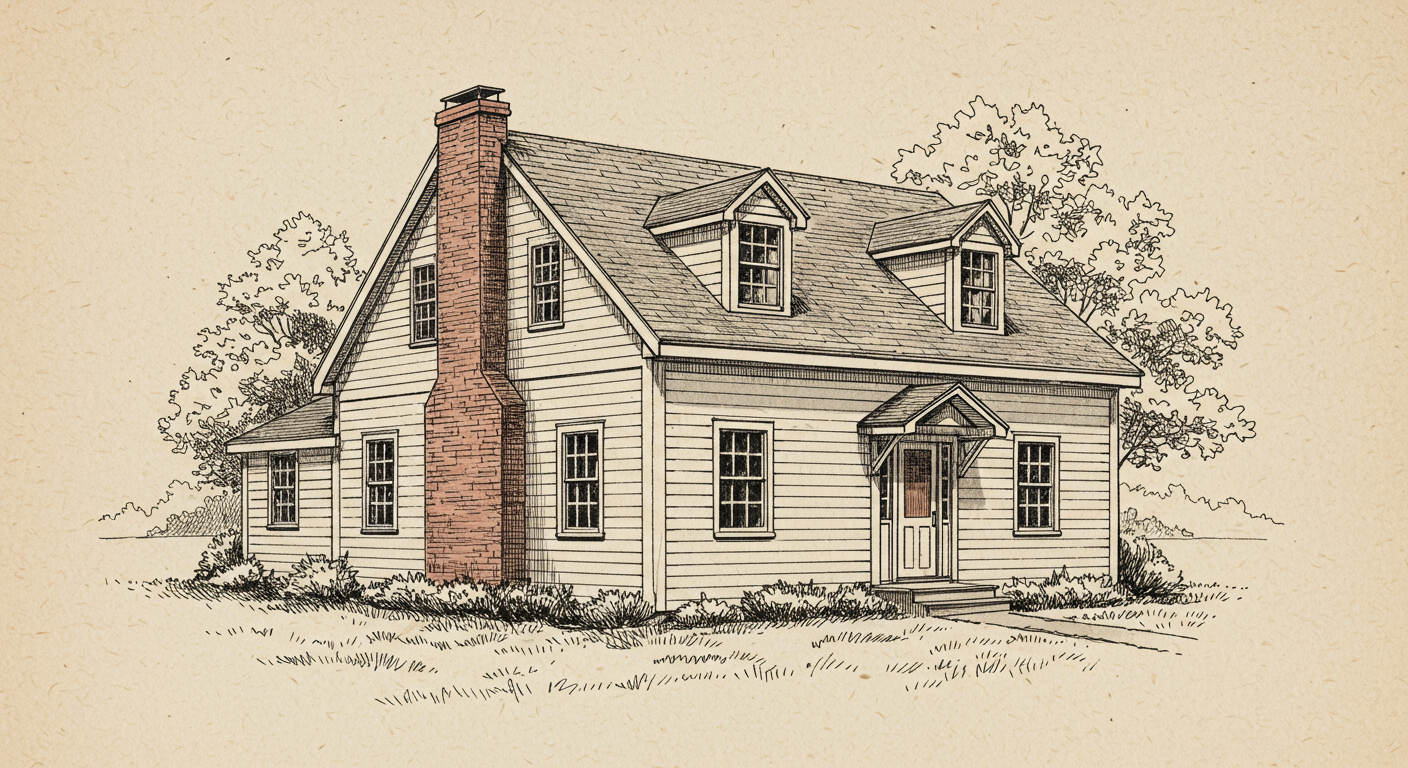
The California Ranch of the previous post described the Western half of the post-war American suburb — the one-storey horizontal Mediterranean-descended sprawl that the post-1945 tract developers produced for the new subdivisions of Los Angeles and Phoenix and Dallas and Houston, and that the post-1955 builder-grade Ranchburger settled into as the dominant residential form of the West and the South. The Cape Cod this post takes up is the Eastern half. It is the form that Levitt and Sons built at Levittown on Long Island in 1947, that the regional builders of New England and New Jersey and Pennsylvania and Ohio and Michigan reproduced through the late 1940s and the 1950s, and that came to dominate the post-war suburbs of New York and Boston and Philadelphia and Chicago in the way the Ranch dominated those of Los Angeles and Phoenix — a one-and-a-half-storey symmetric cottage with a steep gable, a central chimney at the ridge, six-over-six sash windows in symmetric pairs about a centred front door, the whole rendered in uniform clapboard or wood shingle, and intended, on its 1947 builder’s drawings, to be the smallest defensible image of a New England farmhouse that could be produced for a returning sergeant on an FHA-eligible mortgage.
This is the sixteenth post in Reading the American House. It treats Cape Cod in the position the California Ranch post pointed toward — the Eastern counterpart, named at the close of that post and reserved for treatment in this one. Taking the two together, one can read the post-war American suburb as a two-part architectural settlement that mirrored the inter-war pair: the Tudor Revival and the Spanish Colonial Revival were the upper-middle-commission historicist pair of the 1920s, one for the Eastern professional class and one for the Western; the Cape Cod and the California Ranch are the post-war mass-market pair of the late 1940s and 1950s, one for the Eastern returning-veteran household and one for the Western. The geographical division survives. The class is altered. The architectural mechanism — a Eastern colonial-revival vocabulary paired with a Western Mediterranean-descended one, sold to households of substantially the same economic register on substantially the same suburban lot — is structurally the same as it was twenty years before.
The Specimen
If one is to identify a Cape Cod — and one will find them in considerable numbers across the post-war suburbs of New England, the Mid-Atlantic, and the Midwest, often constituting the dominant residential stock of the 1947–1960 subdivisions and a substantial component of those built into the late 1960s — the exercise begins, as it did for the Ranch and the Spanish Colonial Revival before it, at the silhouette.
The principal feature is the one-and-a-half-storey symmetric volume under a steep gable. A Cape Cod presents a rectangular footprint, typically twenty-four to thirty-two feet across the front facade by twenty-four to twenty-eight feet deep — the smallest defensible American single-family house, considerably more compact than even the smallest tract Ranch — with the full first storey at ground level and a partial second storey tucked into the roof above. The roof is a steep gable at roughly forty to forty-five degrees of pitch (in pointed contrast to the Ranch’s twelve-to-twenty-five-degree low gable), the ridge running parallel to the front facade, the eaves cut close to the wall with at most six to ten inches of overhang (in equally pointed contrast to the Ranch’s eighteen-to-thirty-six-inch sweep). A central chimney rises at the ridge, quoting the seventeenth-century New England original’s massive central stack that once served four ground-floor fireplaces at once — though on the post-1947 house the chimney is often a token vent serving a single decorative fireplace, the silhouette preserved because the silhouette is what reads as “Cape Cod” from the street. Two small gabled dormers set symmetrically into the front roof slope complete the upper storey and light the upstairs bedrooms; the dormers are themselves a twentieth-century revival addition, principally the work of Royal Barry Wills and the other Boston colonial-revival architects of the 1930s and 1940s, who introduced them to make the half-storey habitable as bedroom space at modern ceiling heights. Their position is rigorously symmetric, equidistant from the central ridge, and their windows align vertically with the first-floor windows below. The whole upper-storey complex — steep gable, central chimney, paired front dormers — is upright where the Ranch is horizontal, and the contrast between the two silhouettes is the first thing one notices when the two styles sit on the same suburban street.
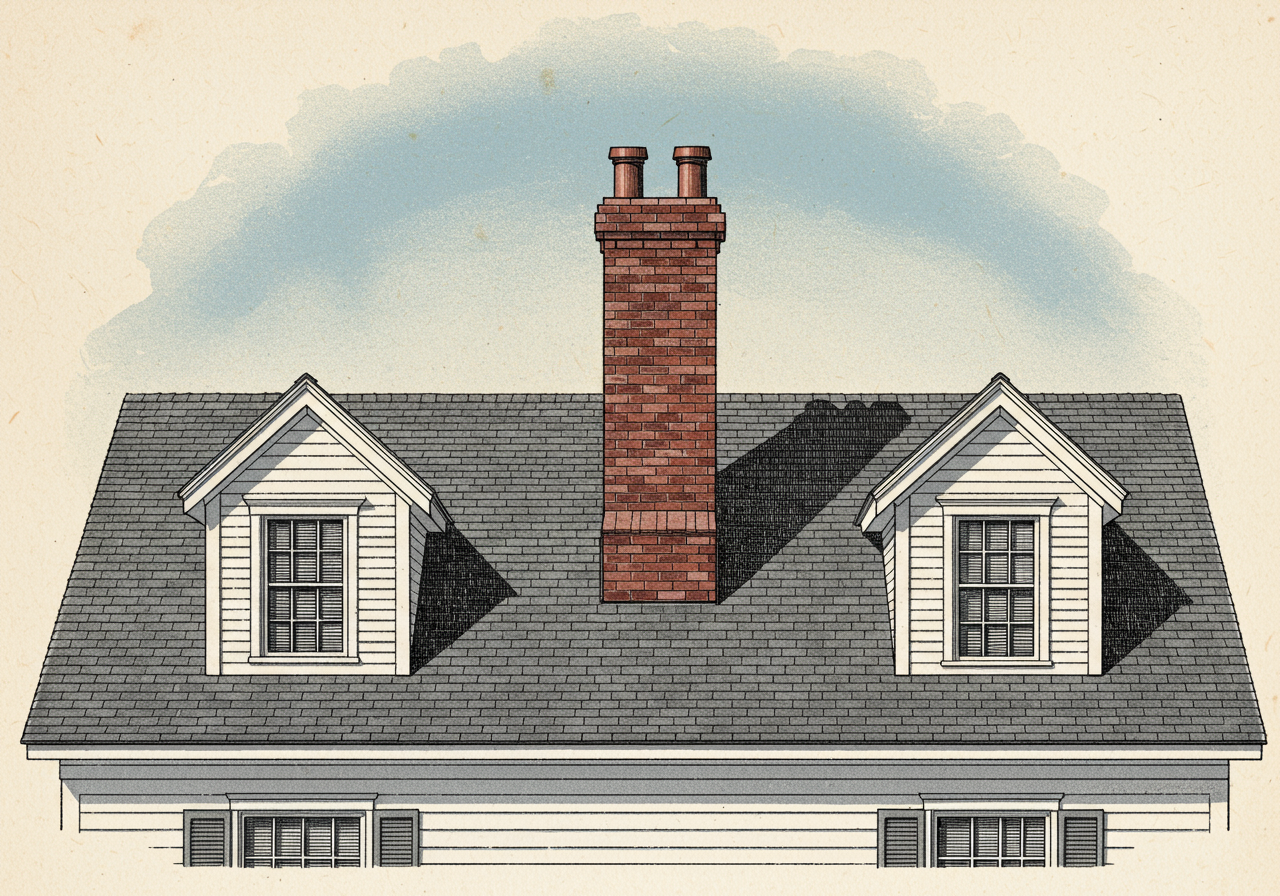
The canonical Cape Cod upper-storey complex — steep gable at roughly forty to forty-five degrees, central brick chimney at the ridge, two symmetric front dormers, eaves cut close to the wall in the manner of the seventeenth-century original.
The wall surface is the third feature, and unlike the Ranch’s deliberately mixed materials the Cape Cod wall is uniform. A Cape Cod presents a single material across the entire facade — either white-painted clapboard (horizontal wood boards of three-to-five-inch exposure, painted white in the Connecticut and Massachusetts builds, occasionally pale yellow or grey-blue) or unpainted wood shingle (cedar shingles of five-to-seven-inch exposure, left to weather to silver-grey on the coastal New England builds, painted or stained on the inland and Mid-Atlantic variants). There is no mixing — no board-and-batten next to brick next to stucco, but a single material wrapped uniformly around the four walls of a small symmetric box. Where the Ranch’s mixed materials signalled casual modernity, the Cape Cod’s uniform clapboard or shingle signals deliberate restraint and a quotation of the colonial-vernacular New England wall: a kind of building that had no architects and no material variety and no facade composition, only a small symmetric box in one material.
The entrance and the fenestration together do the colonial-revival quotation. A Cape Cod front door sits at the exact middle of the front facade, painted in a colour that contrasts with the wall (deep red, deep blue, dark green, or black being canonical), and surrounded by an architectural treatment in the restrained colonial-revival register — typically a simple pedimented hood (a small triangular pediment on two thin brackets) or a Doric pilaster surround (two thin pilasters under a flat entablature), or on the simplest builder Capes no surround at all. Flanking the door, in symmetric pairs at exactly equal distance from the centre, are six-over-six double-hung sash windows, with two further pairs disposed on the second-floor dormers above. The small panes — six lights over six, divided by thin wood muntins — are a direct quotation of the seventeenth- and eighteenth-century small-pane glazing, preserved even though twentieth-century plate glass would have permitted a single large pane per sash; the small panes signal the colonial quotation in the way the central chimney signals the seventeenth-century plan. Narrow shutters in a contrasting paint colour (deep green, black, or red) flank the windows, fixed and decorative on the production tracts though operable on the better builds. Entrance and windows together make the same argument: colonial-revival quotation in the smallest defensible form, where the Ranch’s entrance and picture-window refused the historicist quotation altogether.
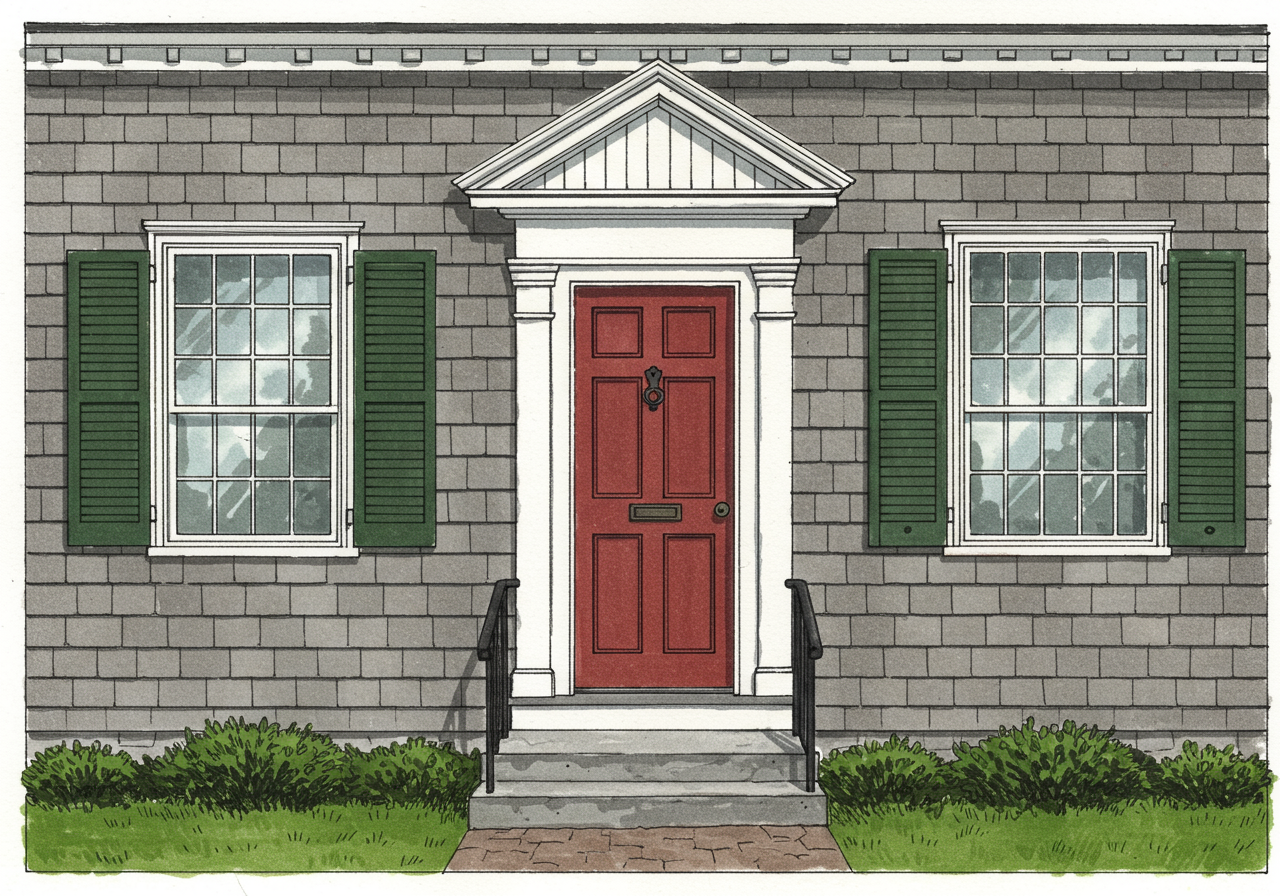
The canonical Cape Cod front facade — six-over-six double-hung sash in symmetric pairs flanking a centred door under a pedimented hood or Doric pilaster surround, with narrow shutters in a contrasting paint colour, the wall surface a single material (either painted clapboard, as in the Connecticut and Massachusetts builds, or weathered wood shingle, as in the coastal Cape Cod builds — the image here shows the shingle variant typical of the original Cape Cod region itself). The rigorous symmetry is the single fastest way to tell the Cape from the Ranch on the street.
The Cape Cod is oriented to the street: the principal first-floor rooms face the front yard through the symmetric six-over-six sash, with no picture window onto the front and no sliding glass door onto the rear. The garage is kept off the principal facade entirely — either attached at one side with a side-facing door set back from the front plane, or built later as a detached outbuilding at the rear (on the earliest 1947 Levittown Capes there was no garage at all, only a carport).
Levittown and the Post-War Cape
The documentary anchor of the post-war Cape is Levitt and Sons at Levittown on Long Island in 1947, and a clear account of the firm and the project is owed to the reader because it sits at the centre of the post’s load-bearing distinction.
Levitt and Sons was a Long Island home-building firm — Abraham Levitt, the founder, and his two sons William and Alfred, the operators — that had built small custom and speculative tracts on the Island through the 1930s. The Navy contract at Norfolk in 1942–44 was the firm’s apprenticeship in industrial production: William Levitt broke house construction into twenty-seven sequential tasks with specialised crews moving from house to house. When the war ended and the Servicemen’s Readjustment Act of 1944 made FHA-and-VA-backed mortgages available to returning veterans, Levitt and Sons acquired four thousand acres of potato farmland twenty-five miles east of Manhattan and announced, on the seventh of May 1947, that it would put up two thousand rental houses there for returning veterans — the first three hundred families took occupancy as renters on the first of October that year, and half of the announced two thousand units had been spoken for within two days of the May announcement. The houses were Cape Cods, and the production rate that became the famous figure was one house every sixteen minutes — something on the order of a hundred and fifty houses a week at the project’s peak. The rental price was sixty dollars a month. In 1949, with the rental experiment having demonstrated the market, the Levitts pivoted to selling: the houses went on sale for seven thousand nine hundred and ninety dollars, no money down for a qualifying veteran, monthly mortgage payment of fifty-eight dollars. The total of seventeen thousand four hundred and forty-seven houses was reached gradually over the four years to 1951 rather than announced in a single 1947 figure. Levitt and Sons reproduced the model at Levittown in Pennsylvania (begun 1951) and at Willingboro Township in New Jersey (selling from June 1958, renamed “Levittown” by referendum in November 1959 and renamed back to Willingboro in 1963), where the firm offered Colonial, Ranch, and Cape Cod models side by side; and the regional builders of New England and the Mid-Atlantic and the Midwest reproduced the form on smaller scales through the late 1940s and the 1950s. The post-war Cape is what Levittown 1947 was, in its first and most documented expression, and the choice of the Cape Cod silhouette over any other available post-war form is the principal architectural-historical question one can ask about the East Coast post-war suburb.
The question is not idly asked, and answering it requires the post’s central distinction. The seventeenth-century original Cape Cod cottage and the post-1947 mass-market builder Cape Cod are often conflated in the broader American architectural vocabulary, and the conflation obscures what is in fact two different kinds of object descended from a single silhouette. The original Cape was a vernacular New England farmhouse type — built by ship’s carpenters in the small coastal Massachusetts fishing villages of Cape Cod and the South Shore and the Islands from roughly 1680 through 1850, using the small-dimension framing timbers and the riven-shingle wall and the small-pane hand-blown glazing and the central-chimney plan that were the methods available to a seventeenth-century New England coastal carpenter. It had a single ground-floor storey under an attic, a massive central chimney serving four fireplaces, no dormers (the half-storey was lit through small gable-end windows), unpainted riven-cedar shingle walls weathered to silver-grey, a heavy framed door of vertical pine boards without surround, and a footprint of roughly twenty by thirty feet. The post-1947 builder Cape borrowed the silhouette of this vernacular — the symmetric box, the steep gable, the central chimney — and reproduced it on FHA-mortgage-eligible specifications with stock dimensional lumber from the Western mills, plywood subflooring, mass-produced sash whose twentieth-century plate glass was divided by thin muntins to simulate small-pane glazing, electric and oil heat (the central chimney often vestigial), pedimented or pilastered door surrounds quoting the post-1750 colonial-revival vocabulary rather than the seventeenth-century original (which had no such surrounds), and added the symmetric front dormers that the twentieth-century revival architects (Royal Barry Wills above all) had introduced in the 1930s and 1940s but that neither the original Cape nor the post-1750 New England farmhouse had carried. The post-war Cape is not the seventeenth-century original. It is the colonial-revival mass-market quotation of that original, produced by a builder-developer firm on industrial production lines (Levitt and Sons offered five Cape Cod models with four front-elevation variations each, in five exterior colour schemes) in pointed contrast to the carpenter-built one-off houses of seventeenth-century Yarmouth and Truro and Eastham. The pattern that Levitt and the regional builders simplified was not the seventeenth-century original directly but the small Cape plans of Royal Barry Wills (1895–1962), the Boston architect whose Houses for Good Living of 1940 became the canonical post-war Cape Cod pattern reference and whose modest two-bedroom Capes were the immediate template the production builders stripped further to FHA-mortgage specifications. The distinction is to the Cape Cod what the Cliff May custom versus the post-war Ranchburger distinction is to the California Ranch; it is the central interpretive move of the post.
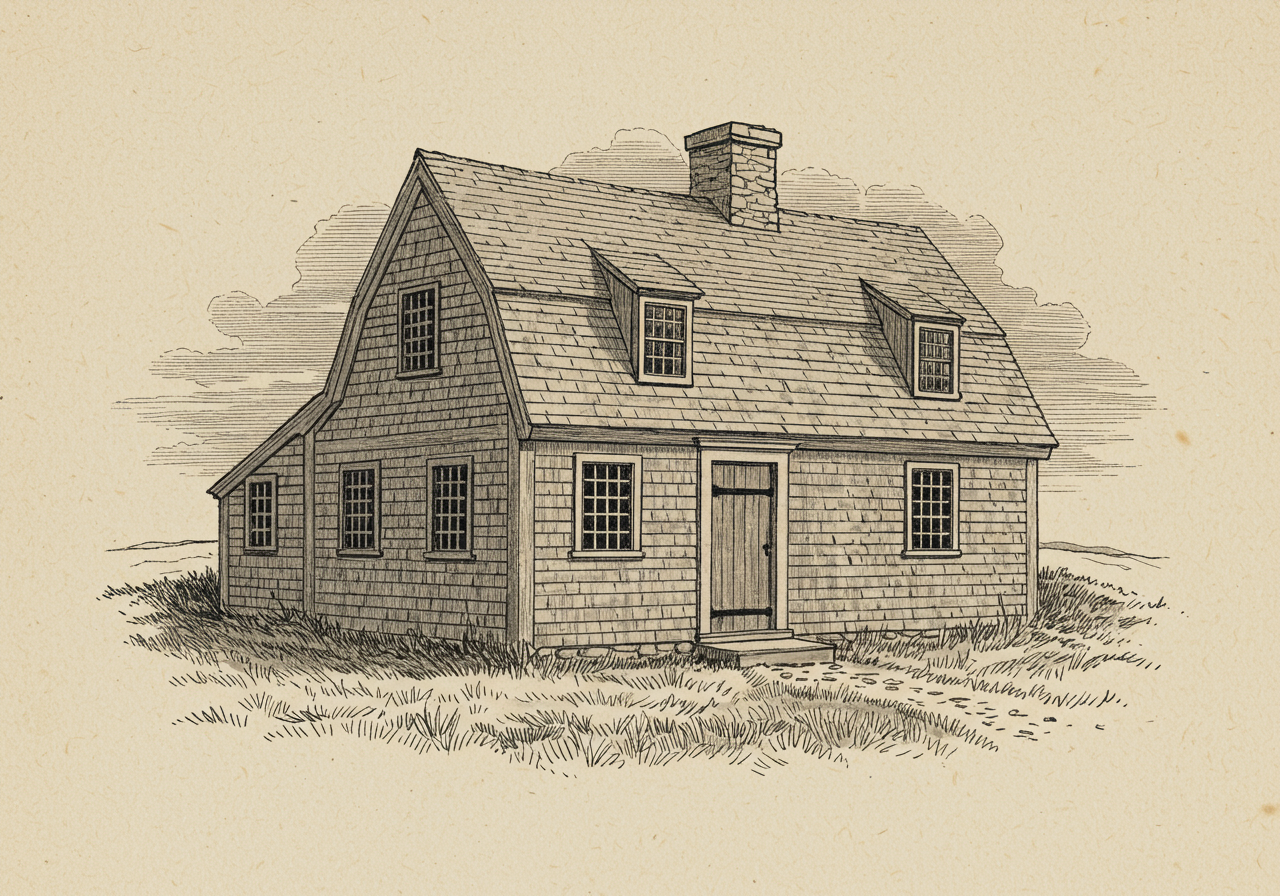
A seventeenth-century Cape Cod original — the New England coastal-vernacular farmhouse from which the post-war builder Cape borrowed its silhouette, photographed at one of the surviving 1680–1750 cottages on the outer Cape. The original is a single ground-floor storey under an attic, massive square central chimney serving four fireplaces, no dormers, riven-cedar-shingle walls left to weather, hand-blown small-pane glass in six-over-six sash, no door surround, footprint roughly twenty by thirty feet. The original was a carpenter-built vernacular object of the small coastal fishing villages. The post-war Cape is the colonial-revival mass-market quotation of this original, produced by a builder-developer firm on FHA-mortgage-eligible specifications for returning veterans. The two are descended from one silhouette but are architecturally and socially different kinds of object.
What It Is Not
Four styles stand near enough to Cape Cod that the beginner confuses them with it, and distinguishing them is most of the work of reading the post-war American suburb of the East and the Midwest.
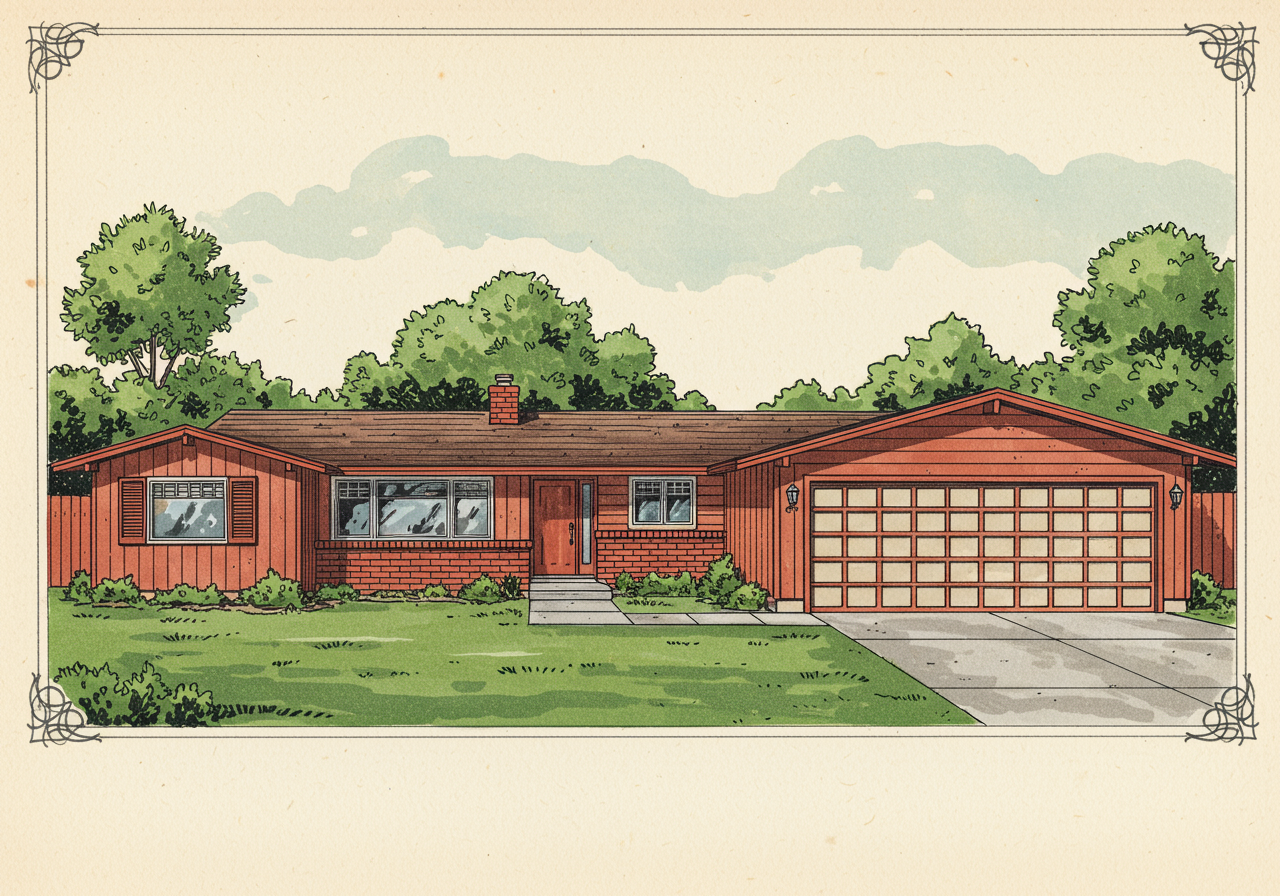
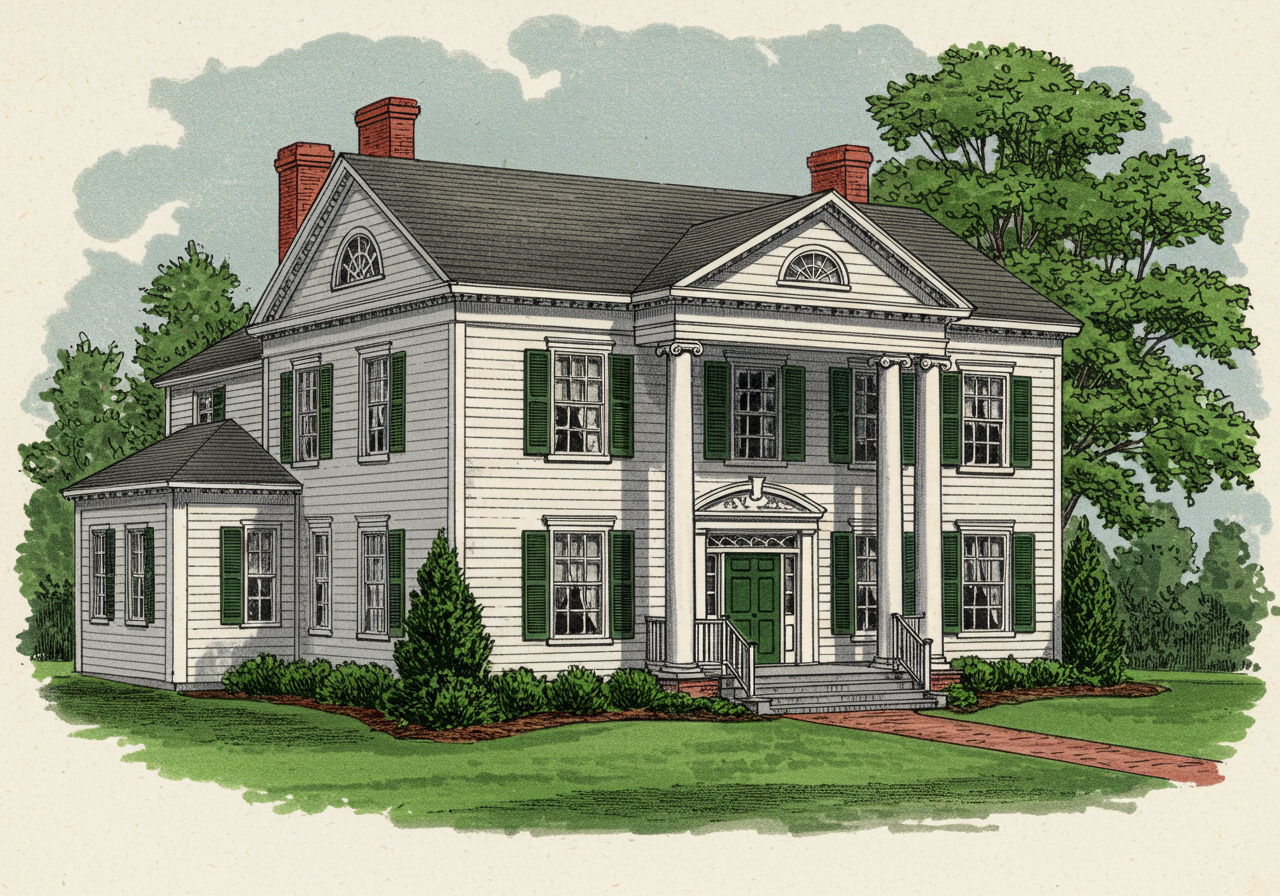
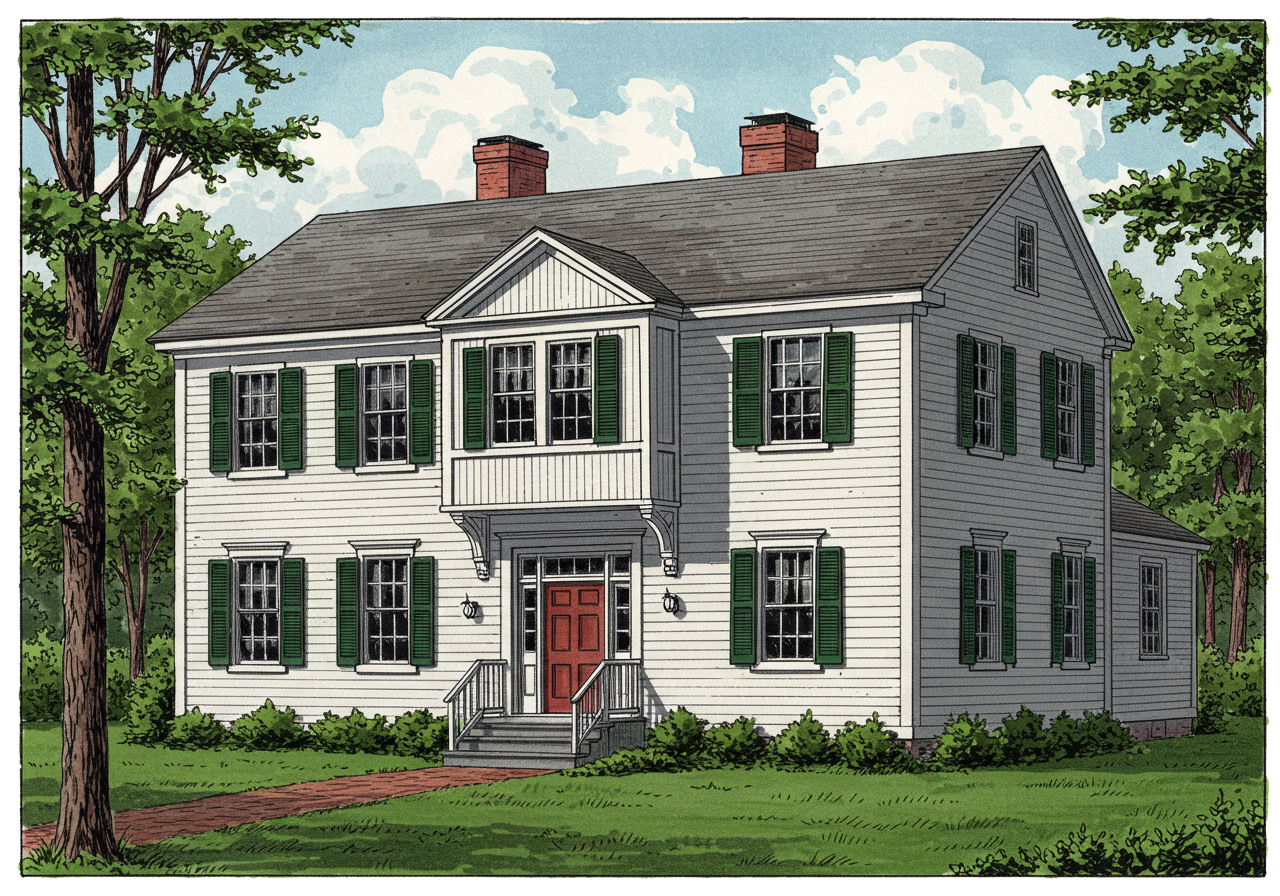
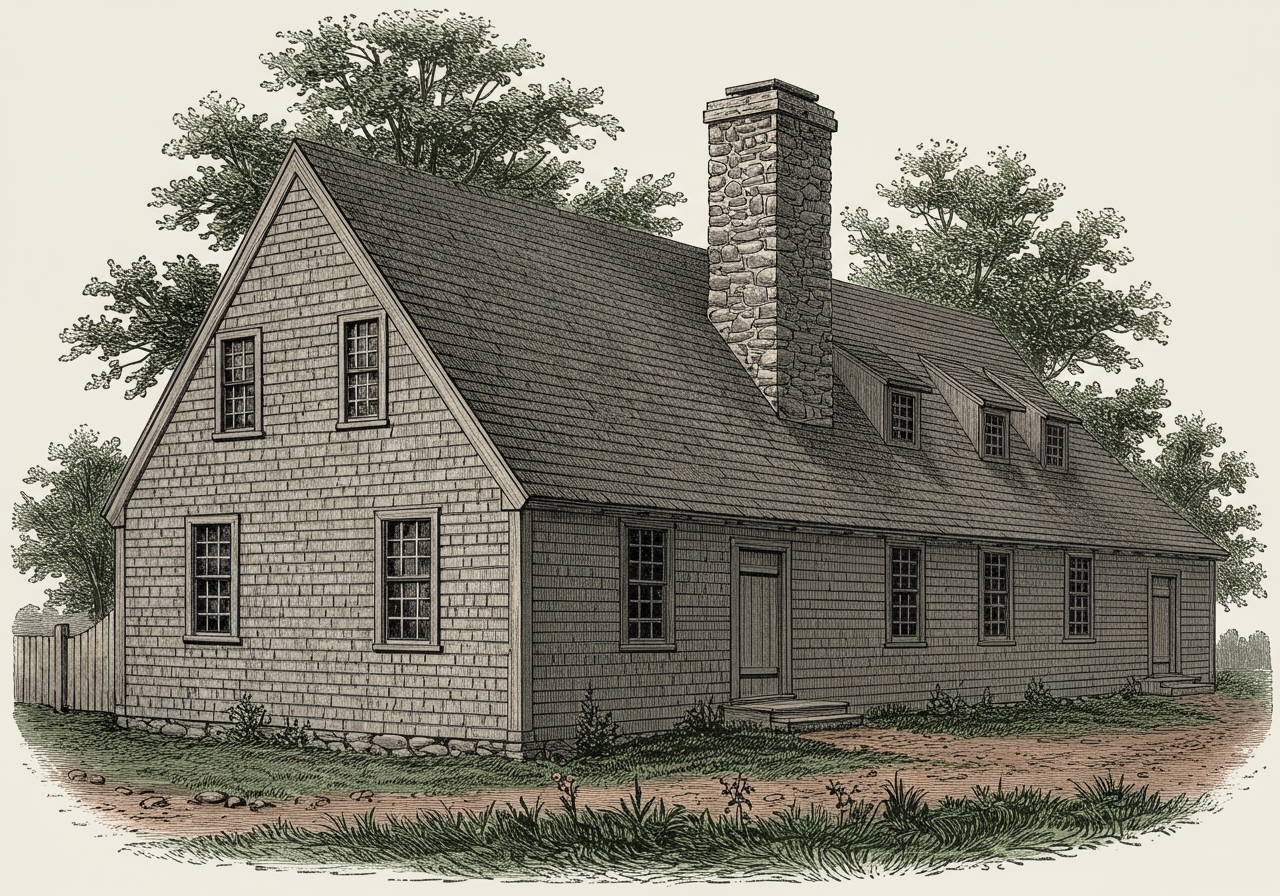
A California Ranch is the West Coast post-war counterpart and was treated in the previous post. The Ranch is one storey (the Cape is one-and-a-half), runs to a horizontal sprawl (the Cape is upright and compact), uses a low-pitched gable at twelve to twenty-five degrees (the Cape’s is steep at forty to forty-five), presents mixed wall materials (the Cape’s wall is uniform), features a picture window at the principal living room (the Cape has only six-over-six sash in symmetric pairs), and projects an attached two-car garage forward of the front facade (the Cape keeps it off the principal facade entirely). The two styles serve the same returning-veteran household at the same FHA price point in different architectural registers across different regional geographies. The rule of thumb: one storey with picture window and attached garage projecting forward is Ranch; one-and-a-half storeys with central chimney and symmetric six-over-six sash is Cape Cod.
A Colonial Revival is the more elaborate pre-war parent style of the post-war Cape — the upper-middle inter-war commission of which the post-war mass-market form is the stripped-down descendant, the same relation the Spanish Colonial Revival bears to the California Ranch. A Colonial Revival is fully two storeys (the Cape is one-and-a-half), is substantially larger (thirty-six to forty-eight feet across the front, against the Cape’s twenty-four to thirty-two), features a prominent projecting entrance portico with full Doric or Ionic columns or a Palladian fanlight (the Cape’s pedimented hood is a tenth the size), and presents an elaborate cornice with full classical entablature at the eaves (the Cape’s eaves are cut close to the wall with no entablature). The Cape Cod is to the Colonial Revival what the post-war Ranchburger is to the Spanish Colonial Revival — the mass-market post-war stripping-down of the inter-war historicist parent into the smallest defensible production form. The rule of thumb: two storeys with full portico and elaborate cornice is Colonial Revival; one-and-a-half storeys with pedimented hood and close eaves is Cape Cod.
A Garrison Colonial is the Cape’s late-1950s and 1960s descendant — the form the same builders moved to when household sizes grew and the half-storey upstairs became insufficient for a four-or-five-bedroom family. The Garrison is fully two storeys, with the upper storey projecting forward of the lower by twelve to eighteen inches on cantilevered framing — a quotation of the seventeenth-century New England garrison houses of the King Philip’s War period (1675–1676), in which the projection was a defensive feature allowing fire to be directed at attackers at the wall’s base. The post-1958 builder’s Garrison preserves the projection as pure historicist decoration, keeps the Cape’s six-over-six sash and central chimney and uniform clapboard, and scales the Cape’s colonial-revival vocabulary to a fully two-storey form. The rule of thumb: one-and-a-half storeys with symmetric front gable is Cape Cod; two storeys with the upper projecting forward of the lower is Garrison Colonial.
A Saltbox is the seventeenth-century New England vernacular relative of the original Cape Cod, and the distinction operates at the original-vernacular level rather than the post-war level. A Saltbox shares the Cape’s central-chimney plan and small-pane glazing and clapboard or shingle walls, but is asymmetric in profile: where the Cape’s roof descends symmetrically from a central ridge, the Saltbox’s has a short front slope and a substantially longer rear slope that continues low to the ground over an extended lean-to addition at the rear — a shape said to resemble a wooden box for storing salt. The Saltbox was the seventeenth-century carpenter’s response to the same household-growth problem the Garrison addressed three centuries later, solved by a rear lean-to under a continuous roof rather than a cantilevered second storey. There is no post-war builder Saltbox to speak of; the style appears in the post-war suburb only as an occasional architect-designed custom or a surviving seventeenth-century original. The rule of thumb: symmetric front-and-rear roof slopes is Cape Cod; asymmetric long-rear-roof-slope is Saltbox.
What It Was Trying to Say
What I find most telling about the Cape Cod, taking the Specimen and the Levittown account together, is that the style achieved the opposite of what the Ranch achieved, and the contrast illuminates the post-war American suburb at a level the architectural critics of the period were poorly placed to see. The Ranch’s central argument was casual modernity — mixed materials, broad eaves, picture window, attached garage on the principal facade — all signalling a deliberate break with the inter-war historicist tradition and an alignment with a Western lifestyle lived in the back yard and on the private automobile. The Cape Cod’s central argument was deliberate restraint and historicist quotation in the smallest defensible form — uniform clapboard, steep symmetric gable, central chimney quoting the seventeenth-century plan, six-over-six sash quoting the colonial-period glazing, pedimented hood quoting the colonial-revival doorway — all signalling continuity with the colonial New England tradition and a deliberate refusal of the picture window and the mixed materials and the front-facing garage. These were not the same architectural argument. They were sold to households of substantially the same economic register at substantially the same FHA price, but they proposed two different versions of what the post-war American suburb should look like.
The first argument is the colonial-revival-quotation-in-a-regional-vocabulary argument, and it is the principal aesthetic fact about the Cape Cod. A returning veteran in Massachusetts or Pennsylvania who had grown up among the surviving eighteenth-century colonial farmhouses of his town read the Cape Cod silhouette as a small and restrained version of the local tradition, where a California Ranch on the same New England lot would have read as exotic and unsuitable; a veteran in Los Angeles read the Ranch as a stripped version of his own Mediterranean tradition, and would have found a Cape on his California lot faintly ridiculous. The post-war American suburb gave each region the version of itself the buyer could read. But what the Cape Cod gave the Eastern buyer was not the seventeenth-century vernacular original directly: a four-thousand-square-foot Colonial Revival of 1925 in Bronxville had carried the historicist quotation through a full Doric portico, a Palladian fanlight, and a classical cornice with dentils and modillions, and a nine-hundred-square-foot Cape of 1947 in Levittown had room for none of these things. What remained, once the builder removed everything that could not fit at the twenty-four-by-thirty-foot footprint and the seven-thousand-nine-hundred-and-ninety-dollar price, was the pedimented hood, the six-over-six sash, the central chimney, and the steep gable — the smallest defensible set of quotation-elements that still communicated “colonial” to a buyer walking up the front path. The architectural critics of the 1950s, who dismissed the form as a debased simulation of the seventeenth-century original, misread what the builder was doing. The builder was not simulating the original; the builder was quoting the Colonial Revival, which had already done the simulating forty years earlier on a budget that permitted full elaboration. The post-war Cape was the Colonial Revival’s mass-market translation into a regional vocabulary, not the seventeenth-century vernacular’s, and the distinction explains why the post-war Cape’s details are post-1750 colonial-revival quotations rather than seventeenth-century vernacular forms.
The second argument is the post-war suburban settlement argument, and it is the principal social fact about the Cape Cod. A 1925 Bronxville Colonial Revival cost twelve to twenty-five thousand dollars on a half-acre lot and was bought by a household in the upper decile of American income. A 1947 Levittown Cape cost seven thousand nine hundred and ninety dollars on a sixty-by-one-hundred-foot lot and was bought by a returning-veteran household at the median on a thirty-year FHA mortgage. The architectural translation between the two — the same colonial-revival vocabulary, stripped of everything that could not fit at the new price and the new lot, preserved in the smallest defensible quotation of the inter-war parent — is the Eastern register of the broader post-war American class-shift from upper-middle custom commission to middle-class mass-market production. The Ranch made the same translation in the Western register, against the Spanish Colonial Revival parent. The two together are the architectural settlement of the post-war American suburb, and the suburb the United States actually built between 1945 and 1965 — some seventeen million single-family detached houses, the largest expansion of single-family-house ownership in the history of any country — was the suburb this two-form pair made possible. The architectural conversation that has dismissed both forms as banal has misread the settlement they expressed.
The next specimen I should like to take up is the Split-Level — the late-1950s and 1960s descendant of the Ranch and the Cape that distributed a single low-pitched silhouette across three or four staggered levels on a sloping suburban lot, and that dominated the subdivisions of varied topography through the 1960s and into the 1970s. Reading the Cape Cod and the Ranch and the Split-Level in succession illuminates the three principal architectural forms of the post-war American suburb, and reading those together with the Tudor Revival and the Spanish Colonial Revival pair of the inter-war suburb completes the post-1920-through-1975 American suburban account in five forms.