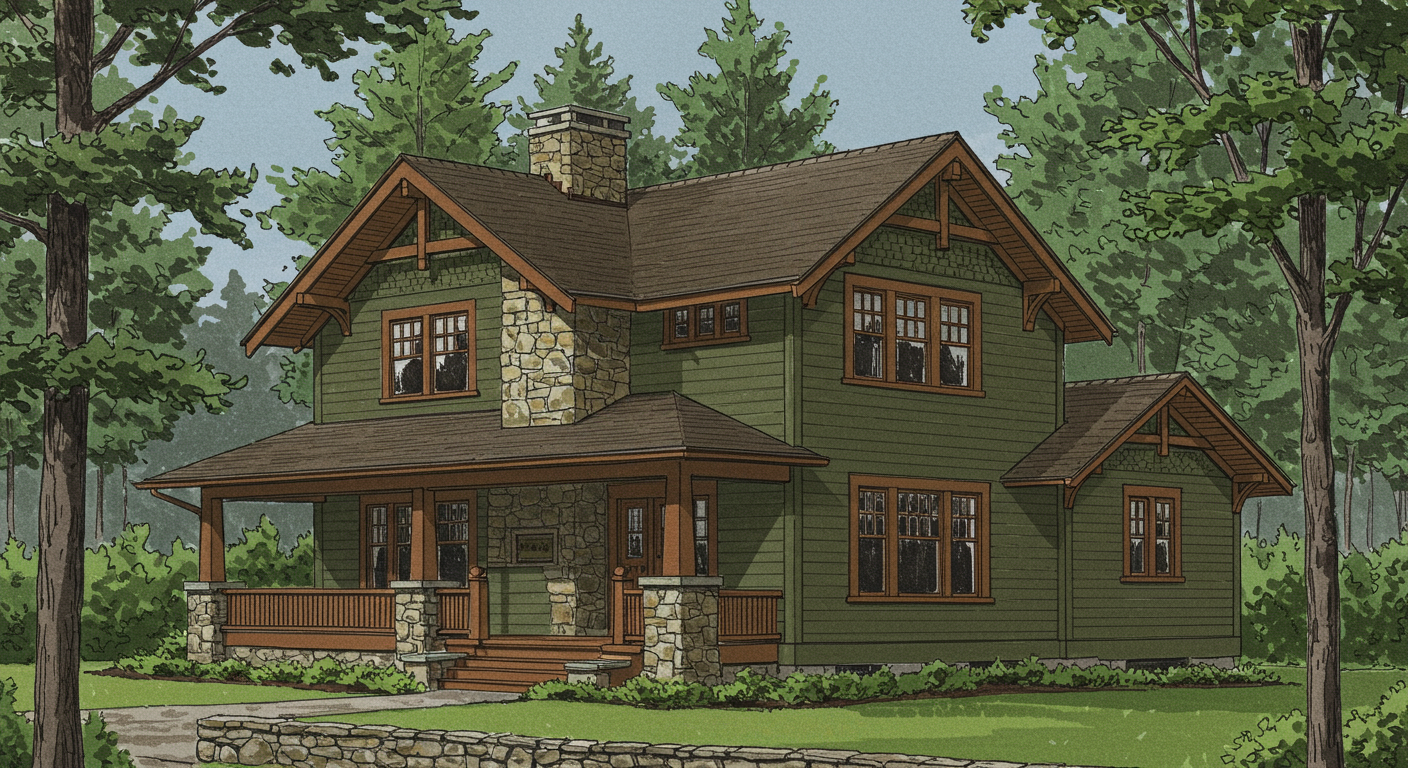
The Craftsman is the only style in this series whose name was, at the moment it was being built, a registered trademark. The Craftsman was the title of a monthly magazine, published from 1901 to 1916 by Gustav Stickley out of Eastwood, New York, and Craftsman was Stickley’s trade name for his furniture, his architectural plans, his published designs, and his entire commercial enterprise. When a builder in 1912 ordered a “Craftsman bungalow” from Sears Roebuck, or built one from a plate in Bungalow Magazine, the word Craftsman in the listing referred specifically to Stickley’s brand of houses, the way Hoover refers to a specific brand of vacuum cleaner. After Stickley’s bankruptcy in 1915 the trademark became commercially unenforceable, and the term passed into general use as the name for the entire Arts-and-Crafts-influenced American residential style of the period. But for the first decade and a half of the style’s existence, Craftsman was a corporate name that belonged to one man.
This is the Craftsman, then, by the surviving genericised use of Stickley’s trade name. What follows is the tenth in a series that has been, in a quiet way, trying to read American houses for what they were trying to say. The nine previous posts have covered the styles of the long nineteenth century and the late-Victorian close — Greek Revival through Romanesque Revival — and the Colonial Revival which displaced the Shingle in residential architecture after 1890. The Craftsman emerged in parallel with the Colonial Revival’s literal-academic phase, between roughly 1905 and 1930, and it was, more than any predecessor, a reaction. Where the Colonial Revival argued that the right American architecture was a careful reproduction of the country’s own Anglo-Georgian past, the Craftsman argued that the right American architecture should look at no past at all — that the long chain of revivals was finally exhausted, and that what a house should declare on its exterior was its own materials and its own handcraft, drawn from English Arts and Crafts theory rather than from any historical American or European style.
The Misnomer
The first thing worth knowing about the Craftsman is that the handcraft on it was almost never actually handcraft.
The style’s name and its central architectural argument both pointed at the same thing: the building should be the visible product of skilled hand-labour on natural materials, in the manner of the English Arts and Crafts movement that William Morris had founded in the 1860s and that the architects Philip Webb, Charles Voysey, and Edwin Lutyens had carried into late-Victorian English country-house design. The argument was a moral argument about the relation between worker and product. Machine production, on the Arts and Crafts view, alienated the worker from the work and produced ugly objects; handwork produced beautiful objects and contented workers. The right way to build a house, by this argument, was for an actual craftsman to chisel an actual mortise-and-tenon joint in actual oak, leave the joinery visible as evidence of the work, and finish the wood with hand-rubbed wax rather than industrial varnish.
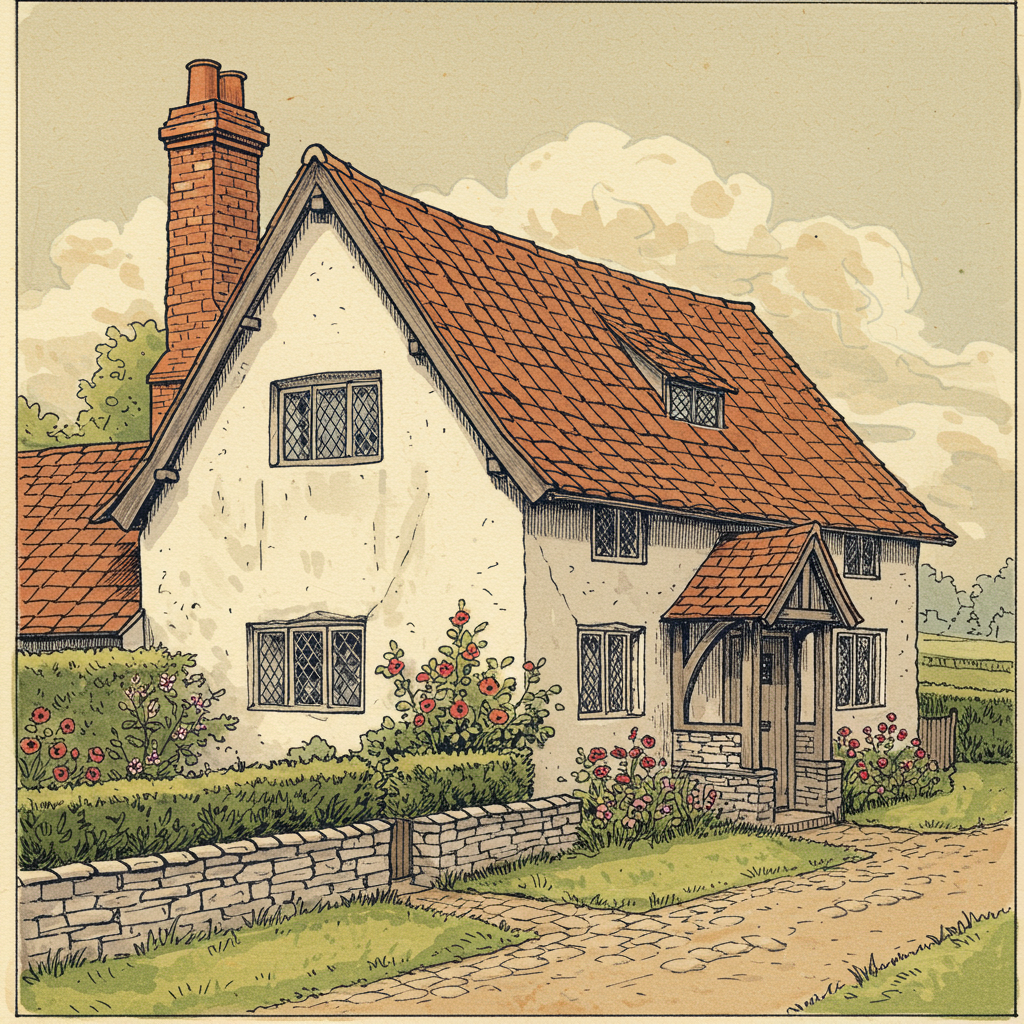
An English Arts and Crafts country cottage in the manner of Charles Voysey, roughly 1898 — roughcast stucco walls, a long low-sweeping tile roof with deep overhanging eaves, small mullioned casement windows in irregular groupings, a heavy stone chimney rising from the side wall. The English source from which the American Craftsman drew its central argument: that a house should look like the handwork of a skilled builder rather than the industrial product of a factory. The American expression would translate the stucco into wood and the tile into composition shingle, but the moral argument and the silhouette descended directly from Voysey’s circle.
In practice, almost nothing on a typical 1912 Craftsman bungalow was handcraft. The decorative knee braces under the eaves were sawn from standard-dimension lumber and nailed to the gable end with wire nails. The exposed rafter tails were trimmed to a decorative profile by a circular saw at the lumber mill before the rafters were shipped to the building site. The tapered porch posts were turned on factory lathes and assembled with through-bolts. The multi-pane upper sashes were factory-glazed, the trim millwork was catalogue-ordered, the door hardware was foundry-cast, and the entire house, in the most common case, had arrived at the building lot in a numbered set of crates from Sears Roebuck or Aladdin or Pacific Ready-Cut Homes — pre-cut, factory-finished, ready to be nailed together by two carpenters in a long weekend. The visible evidence of handwork was real; the handwork itself, in the strict Morris-Voysey sense, was an architectural fiction that the house performed for its viewer.
This is the same gap, in different costume, that the Stick post examined: an architectural argument about structural honesty implemented through decorative gestures that pretended to express what the building no longer actually did. The Craftsman’s argument was a moral argument about labour rather than a moral argument about framing, but the form of the contradiction is the same. The architecture says handcraft; the architecture is factory-cut. One reads the two styles together, on inspection, as the late-Victorian and early-Edwardian American working through the same problem twice: how to make a building visibly declare a moral commitment to a manner of production that the building, in its actual construction, no longer maintains.
The Stickley trademark itself participated in this. The Craftsman magazine published, in every issue, plans for houses that subscribers could send away for and have built by their local carpenter. The plans were standardised; the carpenter assembled them from mill-cut lumber; the result was a bungalow that bore the Craftsman trademark but had been produced entirely by industrial supply chains. Stickley himself ran a furniture factory in Eastwood that used powered saws, planers, and routers — his Craftsman dining table was machine-rough-cut and finished by hand to look as if it had been entirely hand-cut. The factory was honest about being a factory; the marketing was not. By 1910 Stickley’s competitors — L. and J. G. Stickley (his brothers, who had broken with him), Limbert, Roycroft — were all running the same factory-rough-and-hand-finish operation, all selling the result as Arts and Crafts, all calling it Craftsman style after the brand that had naturalised the term.
One is obliged to concede that this is, in its way, the most thoroughly American thing one could have done with an English moral argument.
The Specimen
If one is to identify a Craftsman house — and they are, by some considerable margin, the dominant pre-1940 American single-family residence in any town that grew between 1905 and 1925 — the simplest exercise is, as before, to walk around a specimen and assemble the evidence.
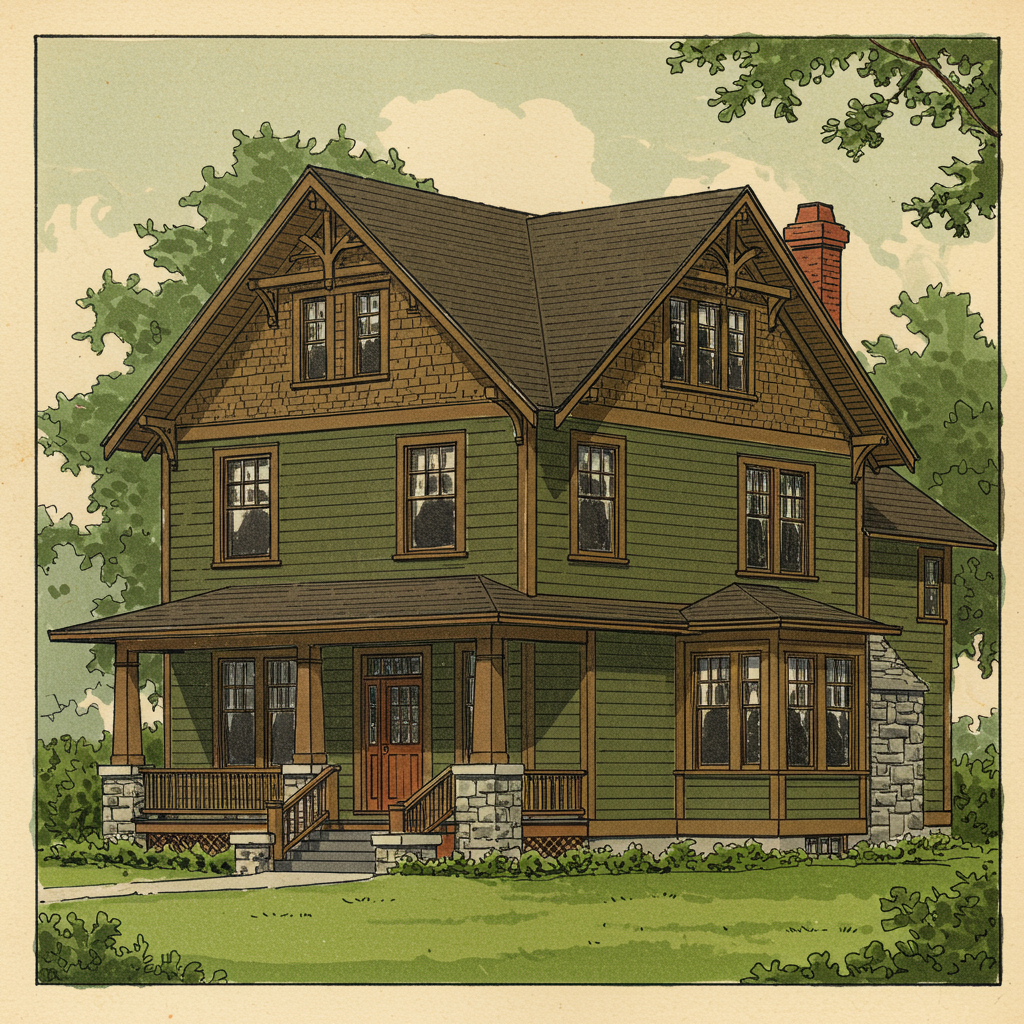
Begin at the silhouette. A Craftsman house presents, almost without exception, a low-pitched gabled roof with very wide overhanging eaves — the gable end often facing the street directly, the roofline running shallow at perhaps twenty-five to thirty degrees, and the eaves projecting eighteen inches to three feet beyond the wall on every side. The overhang is the first reliable identifier. Where the Colonial Revival’s eave is tight to the wall and trimmed with a dentil cornice, the Craftsman’s eave is broad and trimmed with nothing — left open, with the structural members of the roof visible beneath. The horizontal proportion is the design’s central commitment. A Craftsman house spreads sideways across its lot rather than rising above it.
Look up under the eaves. This is where the Craftsman makes its strongest visual claim. The underside of the wide projecting eave reveals exposed rafter tails — the structural roof rafters extending beyond the wall plane, trimmed to a decorative profile (often a simple chamfer or a small ogee curve at the tip), left visible rather than enclosed in a soffit. Set into the gable end above the eave, decorative knee braces — heavy triangular wooden brackets or paired diagonal wooden struts — appear to support the overhang. The braces, like the rafter tails, are visible structural-looking elements that on inspection are decorative rather than load-bearing; the eave is in fact carried by the rafters themselves, and the braces are nailed to the cladding as expressive ornament. Together the rafter tails and the knee braces are the most reliable visual identifier of the style.
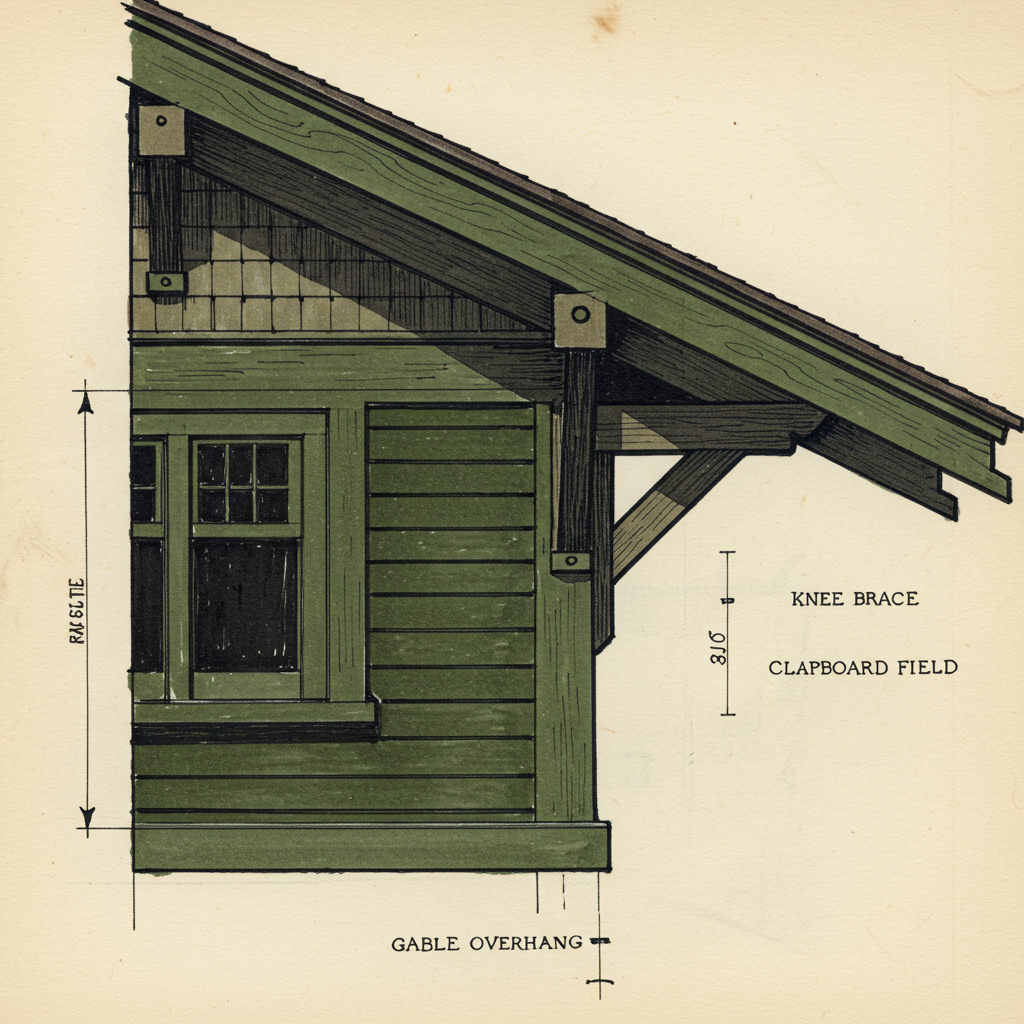
Wide overhanging eaves with exposed rafter tails — the structural roof rafters extending beyond the wall plane, trimmed to a decorative profile at the tip — and decorative triangular knee braces nailed to the gable end appearing to support the overhang. The Craftsman’s first visual signature, and the most reliable identifier of the style.
Come down to the porch. Every Craftsman bungalow worth the name carries a wide front porch, often the full width of the front elevation, sheltered by an extension of the main gable roof or by its own subsidiary gable. The porch is supported on tapered wooden posts standing on heavy battered stone or brick piers — the posts narrower at the top than at the bottom, with the lower portion stopping at perhaps three or four feet above the porch deck and continuing downward as a substantial stone or brick pier. The piers usually carry on past the porch deck to form the porch’s railing wall, with no slender wooden balustrade between them. The pier-and-post composition is the Craftsman’s second strongest identifier: a wide porch with battered stone piers carrying tapered wooden posts is Craftsman to a strong probability, and it is the single element most likely to be missing on a heavily-altered surviving example.
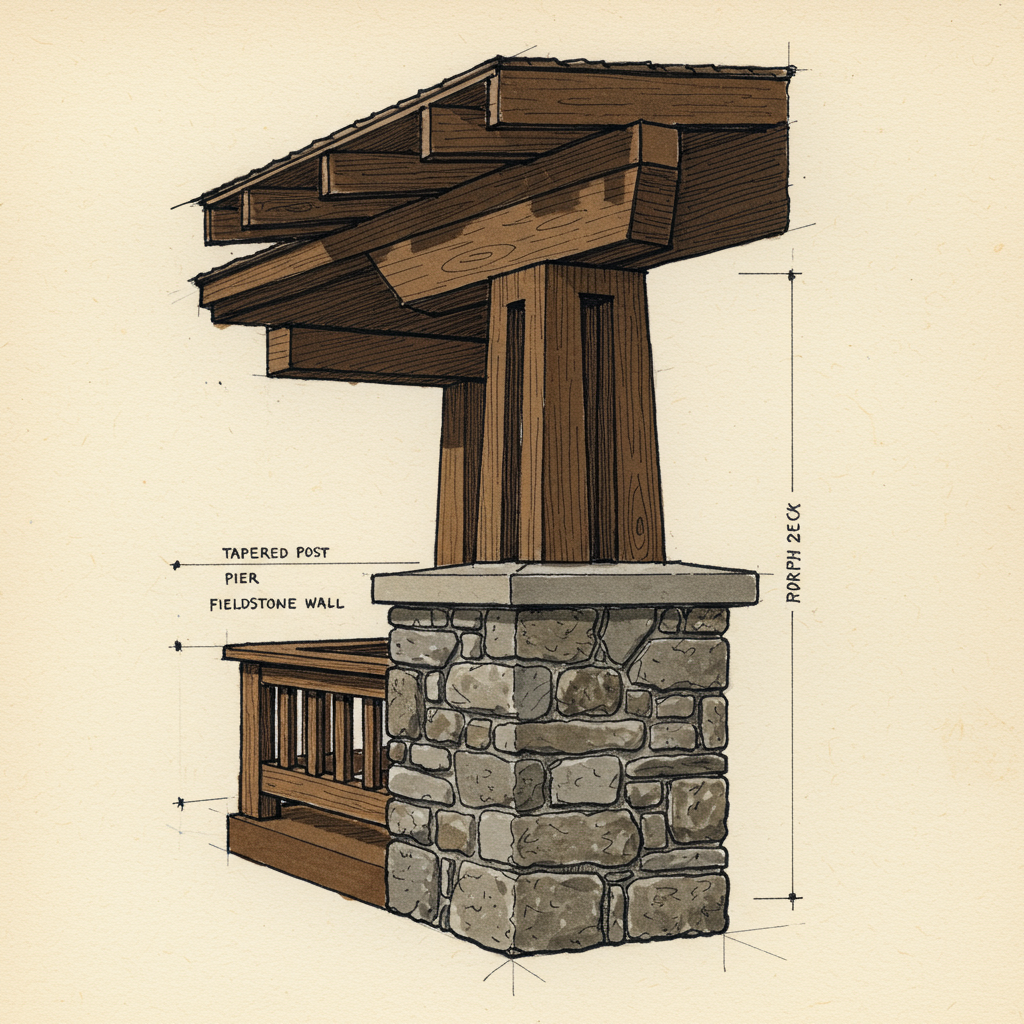
A tapered wooden porch post standing on a heavy battered fieldstone pier — the post narrower at the top than the bottom, the lower portion stopping at the level of the porch railing, the stone pier continuing the support down to the foundation. The pier-and-post is the Craftsman’s second signature. The stone is usually local fieldstone, undressed; the wood is usually oak or fir, stained dark.
Examine the windows. Craftsman windows are double-hung wooden sash with a multi-pane upper sash and a single-pane lower sash — the upper sash divided into three vertical lights, or four, or sometimes a small grid of six or nine, and the lower sash a single large pane. The pattern is distinctive enough that one can identify a Craftsman from a hundred feet by the window-glazing alone. Windows are usually grouped in twos or threes under a single horizontal lintel, often arranged in a band running across the front of the house rather than in regular bays. There are almost never shutters — the shutter is a Colonial Revival vocabulary element that the Craftsman explicitly rejected.
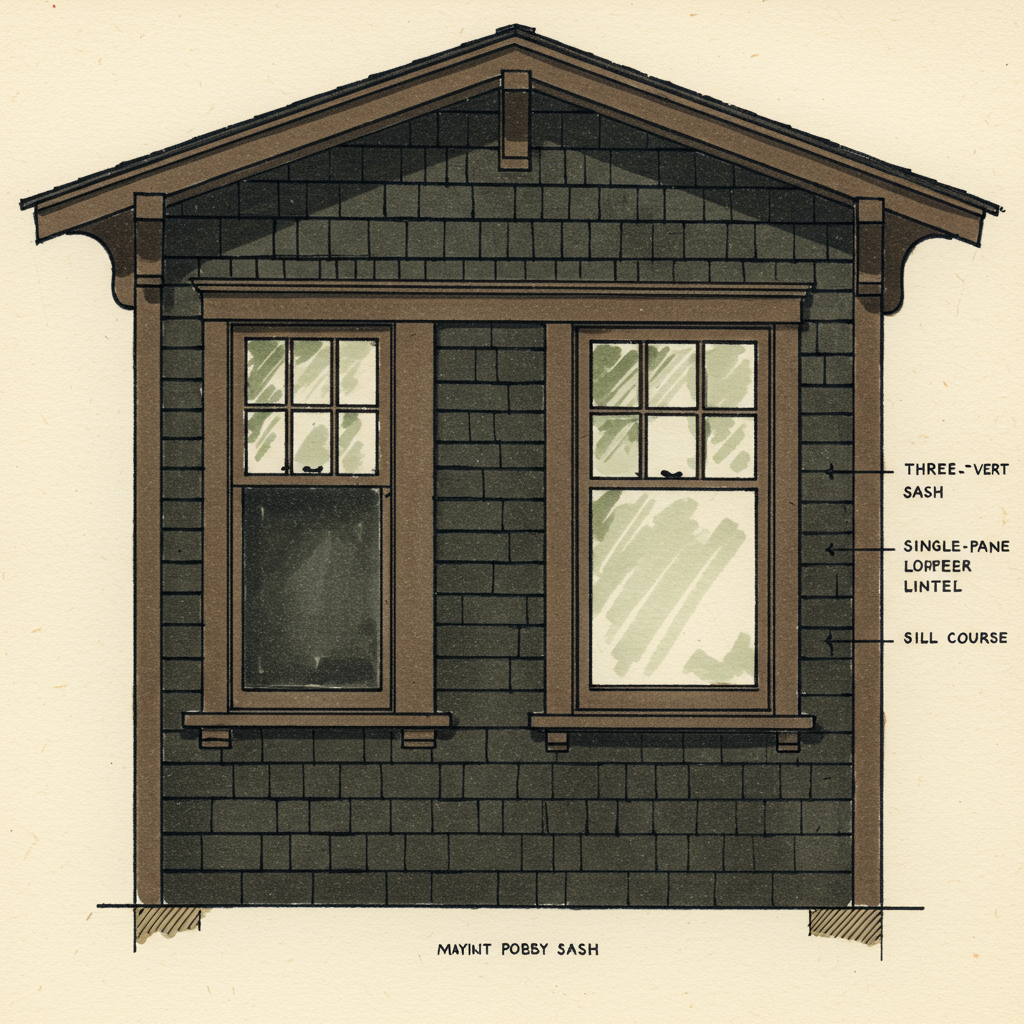
Paired Craftsman windows — three-vertical-light upper sashes over single-pane lower sashes, grouped beneath a single horizontal lintel. The three-over-one or four-over-one sash pattern is distinctive enough that one can identify a Craftsman bungalow at a hundred feet by the windows alone. No shutters — the shutter belongs to the Colonial Revival vocabulary the Craftsman was reacting against.
Examine the walls. Craftsman walls are usually horizontal clapboard, wooden shingle, or stucco — almost never brick at the wall plane (though brick chimneys are common). The cladding is stained or painted in a muted earth-tone palette: forest green, deep brown, dark mustard, deep red, sage. The bone-white of the Colonial Revival and the polychrome of the Queen Anne are both alien to the style. The walls are meant to look as if they have weathered into the landscape rather than asserted themselves against it; a freshly-painted Craftsman in a bright colour reads as wrong almost immediately to the trained eye.
Two more details round out the specimen. Craftsman houses very often carry a massive central chimney of natural stone or rough brick, rising from the centre of the roof or from a side wall, executed in undressed fieldstone with deep mortar joints — the chimney as a deliberate emphatic vertical element against the horizontal sweep of the house. And inside (which one can often glimpse through the wide front-porch windows), built-in furniture is the Craftsman’s interior signature: window seats, bookcases, china cabinets, fireplace inglenooks, all panelled in dark-stained oak and built into the walls rather than free-standing as movable furniture.
Assemble these — the wide low-pitched gable with overhanging eaves, the exposed rafter tails and knee braces, the wide porch on tapered posts and stone piers, the three-over-one windows in groupings, the muted earth-tone clapboard, the massive stone chimney, the built-in interior — and one has a Craftsman. A one-and-a-half-storey specimen with all of them is the standard Craftsman bungalow; a two-storey specimen with the same vocabulary is a Craftsman foursquare; a high-style California specimen with elaborated joinery (visible mortise pegs, structural tile, Japanese-influenced bracketing) is a Greene-and-Greene-school bungalow. The style scales from the smallest mail-order kit to the largest Pasadena estate without changing its grammar.
The Workshop and the Mill
The historical arc of the Craftsman is the story of a moral argument about handcraft being disseminated, with maximum efficiency, through industrial mass production.
The roots are English. William Morris had founded Morris & Co. in 1861 as a design firm built around the premise that decorative art should be honest, hand-made, and morally serious. By the 1880s the English Arts and Crafts movement — Morris, Webb, Voysey, Ashbee, Lethaby — had become a coherent design movement with houses, furniture, books, and magazines all arguing for the same set of values. Charles Voysey’s white-stuccoed country cottages of the 1890s, with their long sweeping tile roofs, deep eaves, and mullioned casement windows, were the central English Arts and Crafts residential idiom. By 1900 American architects and designers had begun to study them.
Gustav Stickley made the first decisive American translation. Stickley had been making oak furniture in his Eastwood, New York shop since the early 1890s, but in 1900 he visited England, met Morris’s circle, and returned committed to translating the Arts and Crafts argument into an American commercial enterprise. In October 1901 he launched The Craftsman magazine — a monthly publication that combined photographs of his furniture, full architectural plans for houses (which a subscriber could send away for at modest cost), didactic essays by Stickley and his collaborators on Arts and Crafts ideology, and reviews of new books on William Morris and his successors. The magazine ran for fifteen years, sold tens of thousands of copies monthly at its peak, and was the single most influential vehicle for the American Craftsman style. By 1908 The Craftsman had published more than two hundred complete house designs, all available as plan packages by mail order; by 1916 it had published nearly four hundred.
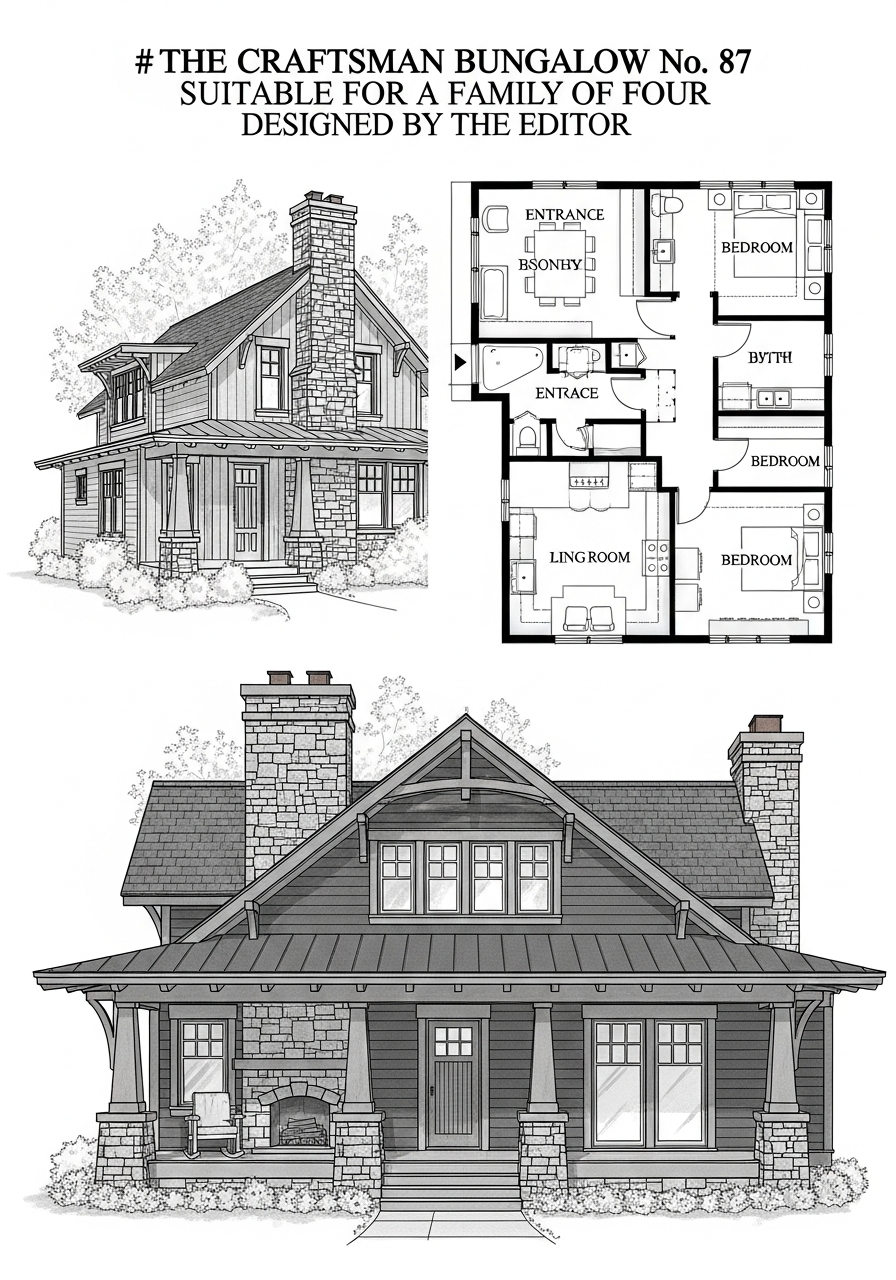
A page from Gustav Stickley’s The Craftsman magazine, c. 1910 — elevation, plan, and didactic descriptive text for a Craftsman bungalow. The magazine ran monthly from 1901 to 1916, published nearly four hundred complete house designs over its run, and disseminated the style through subscription-based plan packages a builder could send away for at modest cost. The Sears Roebuck and Aladdin and Pacific Ready-Cut house catalogues, which appeared shortly after, took the same designs to the mail-order kit-house market.
The other major American expression was geographic. In Pasadena, California, the brothers Charles and Henry Greene — both trained in carpentry before they studied architecture at MIT in the late 1880s — set up a practice that, between 1903 and 1914, produced perhaps a dozen elaborate Arts-and-Crafts residences for wealthy Californians: the Gamble House (1908), the Blacker House (1907), the Pratt House (1908-9), the Thorsen House (1908-10). The Greenes drew on the same Voysey-school English sources as Stickley but combined them with Japanese carpentry influences (the Greenes had visited the Japanese pavilion at the 1893 Columbian Exposition) and California-specific climatic adaptations (long sleeping porches, ventilated attics, overhanging eaves for sun-shading). Their houses were the high-style apogee of the American Craftsman: every joint visible, every mortise pegged, every piece of wood selected and hand-finished. They were also extraordinarily expensive, accessible only to the wealthy. Few of the Greenes’ houses look quite like a typical bungalow — they are larger, more elaborate, more Japanese-influenced — but the vocabulary they refined (exposed structure, hand-finished wood, integrated furniture, deep eaves, low pitches) descended in simplified form into the mass-market bungalow that the catalogues sold.
The mass market arrived through three pattern-book and kit-house operations. Sears Roebuck began selling pre-cut house kits in 1908, with Craftsman bungalows among the first designs offered; by 1915 the Craftsman bungalow was Sears’s best-selling form, and remained so through the 1920s. Aladdin Homes, based in Bay City, Michigan, offered competing kits from 1906 onward. Pacific Ready-Cut Homes, based in California, supplied the western markets. Bungalow Magazine (1909-1918), edited by Henry Saylor, Jud Yoho, and a succession of others, published plates and plans for bungalow-form Craftsman houses suitable for builders to copy without buying a kit. By the early 1910s a small-town family in any American state with a railroad spur could order a complete Craftsman bungalow — pre-cut lumber, mill-finished trim, factory-glazed sashes, foundry-cast hardware — for somewhere between four hundred and twelve hundred dollars, depending on the model, and have it delivered in two boxcars and assembled by a local carpenter in a long weekend.
The number of Craftsman houses built between 1905 and 1930 is hard to estimate precisely but runs, by recent accounts, somewhere between half a million and a million single-family residences. By comparison, the Italianate and Stick produced perhaps a hundred thousand each over comparable arcs; the Queen Anne perhaps two hundred thousand; the Colonial Revival several million across its longer arc. The Craftsman is, in terms of pure volume of construction, the third or fourth most common American single-family residential style ever built. Almost every small American town that grew between 1905 and 1925 — and most large cities — has a Craftsman neighbourhood, often the dominant residential type of one or two streets, and the style still defines the architectural character of those neighbourhoods today.
The style faded after 1925. The reasons were several: the cultural turn after the First World War against pre-war Anglo-American sensibilities; the rise of competing revival styles (Tudor, Spanish Colonial, French Eclectic) that the catalogues began offering alongside the bungalow; Stickley’s bankruptcy in 1915 and the dissolution of The Craftsman magazine; the Greenes’ practice winding down around 1914; and the broader American architectural conversation moving toward the international modernism that would arrive after the 1932 MoMA exhibition. By 1930 the Craftsman was old-fashioned. By 1940 the bungalow was being built only as the cheapest possible suburban form, stripped of most of its identifying features. The style had run twenty-five years as a major idiom and produced, in that span, a remarkable percentage of all the residential architecture the country could afford during its peak.
What It Is Not
Four styles stand near enough to the Craftsman that the beginner confuses them with it, and distinguishing them is most of the work of reading the early-twentieth-century American suburban house.
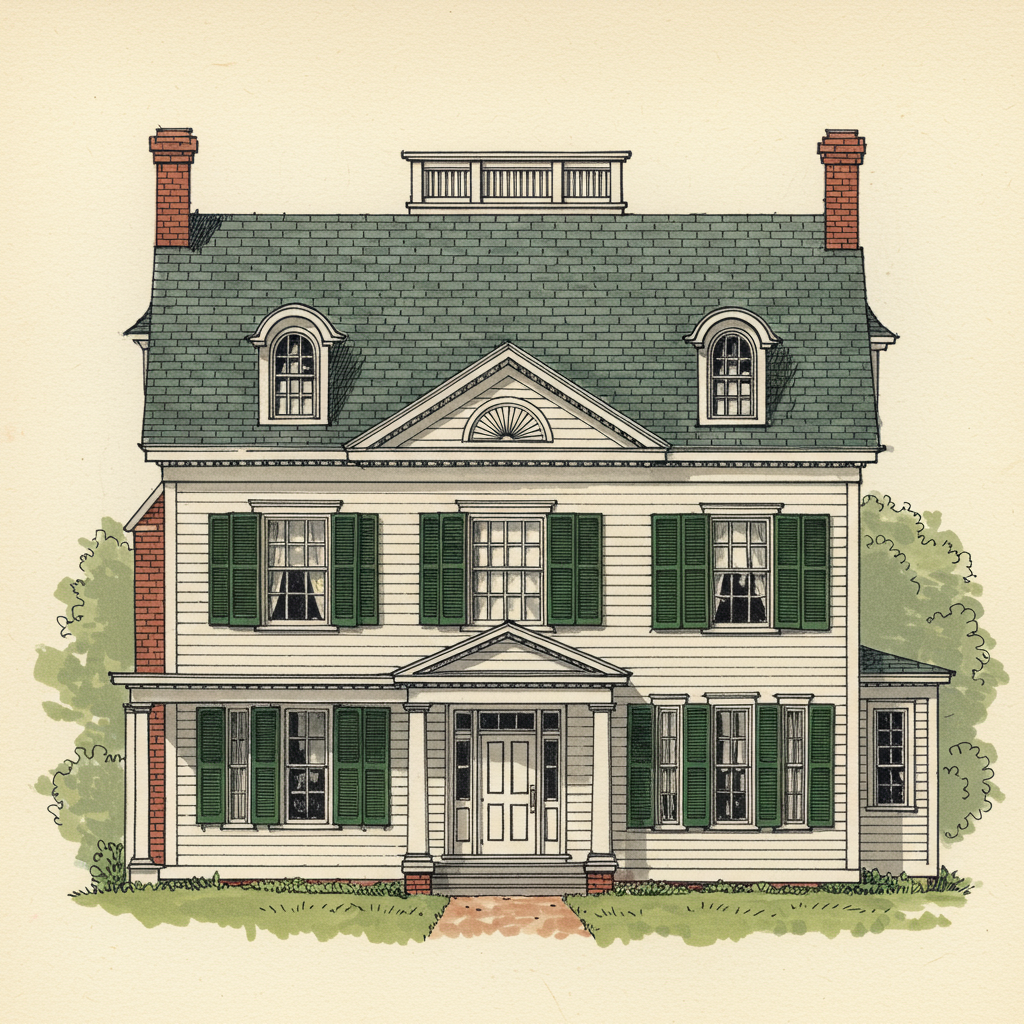
The Colonial Revival — the Craftsman’s contemporary and the style it was reacting against, examined in the previous post — argued for academic symmetry, classical entries, white-painted clapboard, dentil cornices, and shutter-flanked sash windows. The Craftsman argued for asymmetric massing, exposed eaves, earth-tone cladding, multi-pane sashes without shutters, and the rejection of classical ornament. The two styles competed directly for the early-twentieth-century suburban commission — often on the same street, sometimes on adjacent lots — and represented opposing arguments about what a modern American house should declare. The Colonial Revival argued for continuity with the country’s own past; the Craftsman argued for a break with all pasts in favour of an Arts-and-Crafts-influenced present. The rule of thumb: symmetric facade with shutters is Colonial Revival; asymmetric porch on stone piers with exposed eaves is Craftsman.
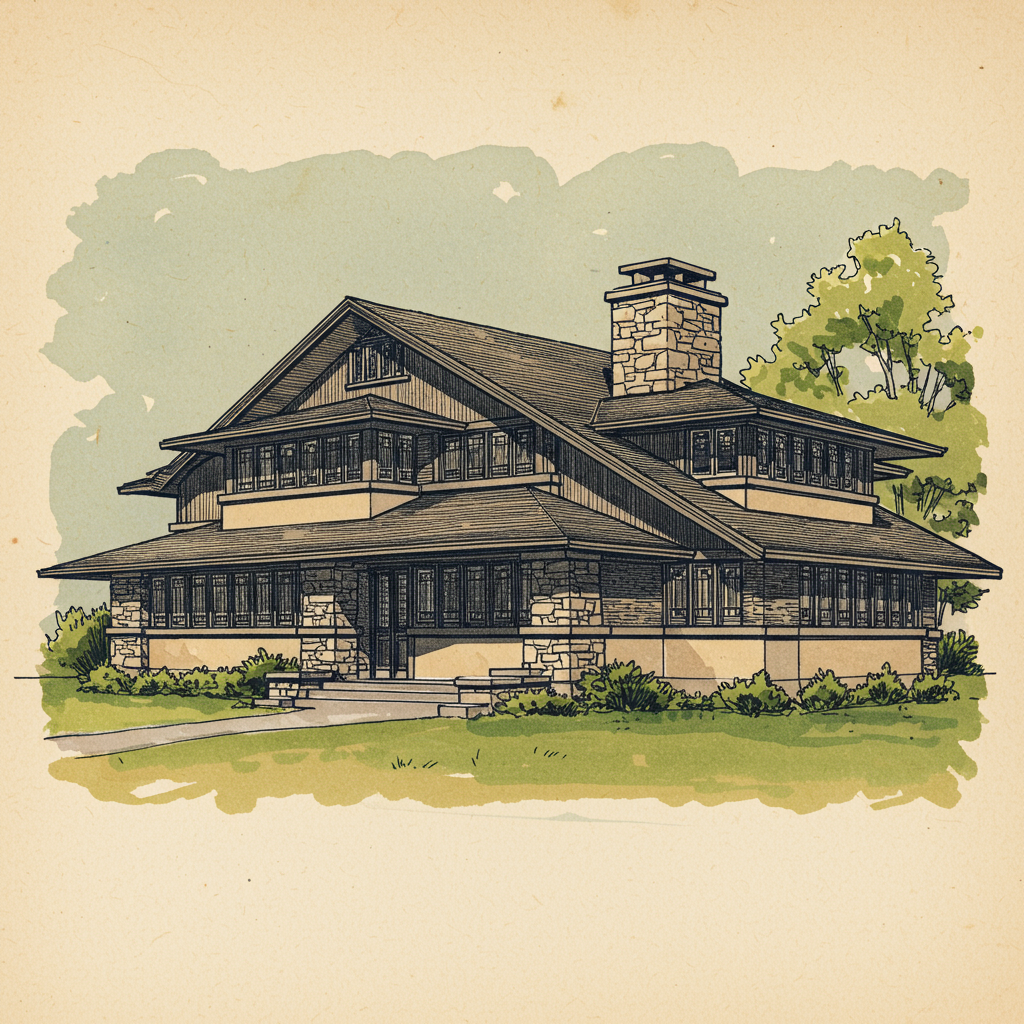
The Prairie — Frank Lloyd Wright’s Midwestern parallel, examined in the next post — emerged from the same Chicago architectural milieu as the Craftsman and shares many of its features (low-pitched roof, wide overhanging eaves, horizontal proportions, integration with site, deep porches), but takes them further into a more abstracted geometric vocabulary. A Prairie house typically carries a hipped rather than gabled roof, dispenses with the exposed rafter tails in favour of clean horizontal eaves, uses art-glass casement windows in long ribbon bands rather than three-over-one sashes, and reduces ornament to abstract geometric pattern rather than Arts-and-Crafts-influenced naturalism. The two styles overlap (1905-1920) and often appear in the same Midwestern neighbourhoods, but the Prairie is the architect-defined high-style version, dominated by Wright’s office and his Chicago-school followers, while the Craftsman is the pattern-book and mail-order mass-market form.
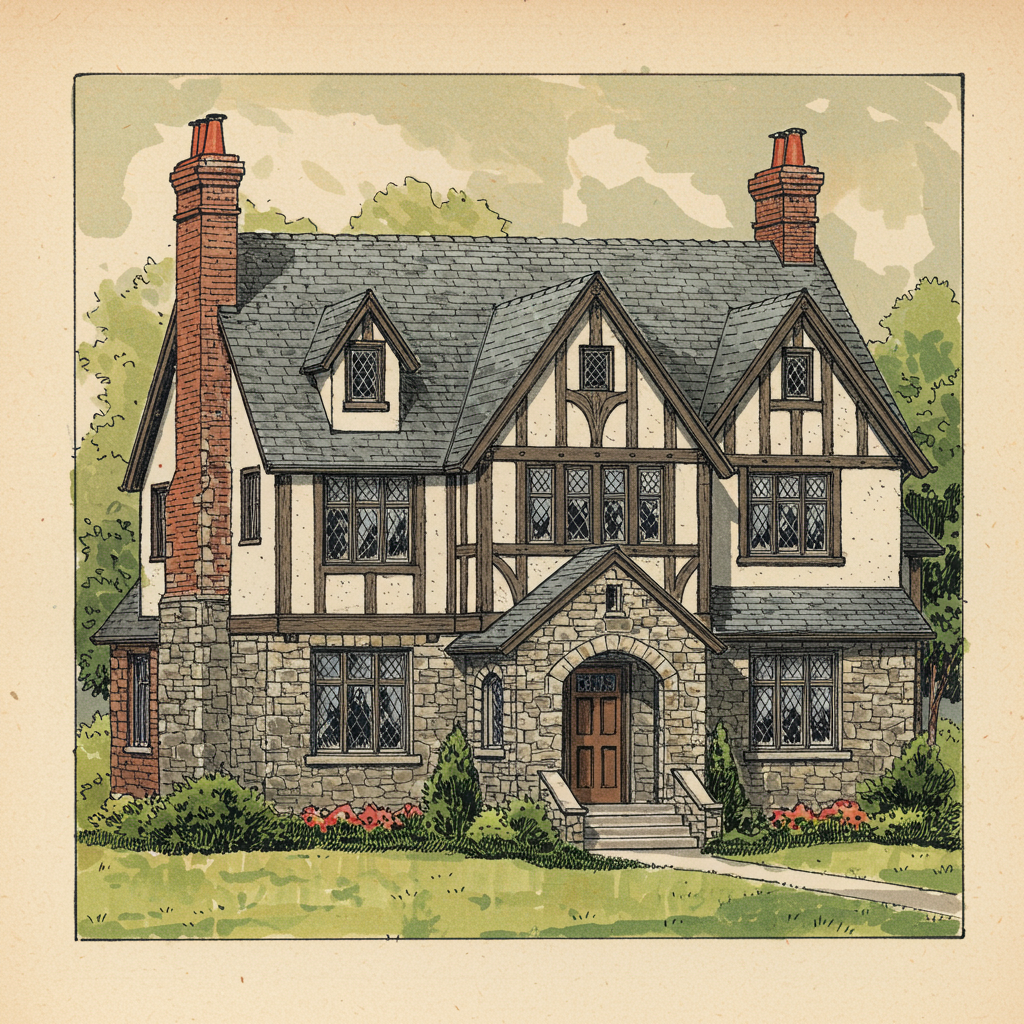
The Tudor Revival — the Craftsman’s suburban contemporary — drew on English Tudor-and-Jacobean sources rather than English Arts and Crafts ones, and produced houses with half-timbered upper storeys, steep cross-gables, mullioned casement windows, and prominent brick chimneys. The two styles ran in parallel through the 1910s and 1920s for suburban residential commissions, and the catalogues offered both alongside each other. The visual distinction is straightforward: half-timbered upper storey and steep cross-gables is Tudor Revival; clapboard or shingle with wide overhanging eaves and exposed rafter tails is Craftsman.
The American Foursquare — the Craftsman’s two-storey cousin — is a closely related form that emerged from the same pattern-book and kit-house economy at roughly the same moment. A Foursquare is, on inspection, a Craftsman cubed: a square two-storey plan, a hipped roof of moderate pitch with a single central dormer, a wide front porch on tapered posts and stone piers, and the same multi-pane upper sashes and earth-tone cladding as a Craftsman bungalow. The two styles are best read as variants of the same Arts-and-Crafts-influenced impulse applied to different lot sizes: the bungalow is the one-and-a-half-storey Craftsman for narrow city lots; the Foursquare is the two-storey Craftsman for larger suburban lots. Many catalogues sold both forms interchangeably, with the same trim details available on either plan.
What It Was Trying to Say
The Craftsman flourished in America between roughly 1905 and 1930, with its sharpest period falling in the decade and a half between 1908 and 1925. After the First World War the cultural temper that had supported the style — anti-industrial moralism, Arts-and-Crafts ideology, an Anglo-American sensibility about labour and the home — was steadily eroded by the cultural shifts of the 1920s, and by 1930 the style was old-fashioned. The peak years had produced something close to a million single-family residences in the idiom; the style’s surviving stock remains, today, the architectural character of dozens of early-twentieth-century American neighbourhoods.
What it was trying to say is best taken, again, as the sum of two arguments running in parallel.
The first is the anti-industrial argument. The Craftsman was the architectural expression of an American moment — roughly 1900 to 1915 — when the industrial economy that had built the country’s wealth had also become the subject of widespread cultural concern. Factory work was alienating; tenement housing was bleak; the long days and short pay of the late-Victorian wage economy had produced visible social damage. The Arts and Crafts movement offered, against this, a vision of a more human relationship between work and product — the craftsman in his workshop making beautiful objects by hand, the family in its bungalow living among handcrafted things, the labour visible in every wooden surface as the product of skilled human effort. The Craftsman bungalow was, on this argument, a sanctuary from the industrial economy that built it: an architectural environment that performed handcraft for its inhabitants even when the actual production of the building had been industrial. The performance was the point. One lived inside the visible argument that a different relationship between worker and work was still possible, and the architectural argument was real even when its premise (that the house had been hand-built) was a polite fiction.
The second is the anti-revival argument. The Craftsman was the second American style — after the Shingle, examined two posts ago — that did not justify itself by reference to a historical revival source. The Shingle had drawn on Colonial American vernacular but had treated it loosely, as an evocation rather than a literal source; the Craftsman drew on English Arts and Crafts theory but did not claim to be reproducing any specific historical building. The two styles together represent the end of the long American revival cycle that had begun with the Greek Revival in the 1820s. By 1905 the American architectural conversation had begun to take seriously the question of whether one could build a house that argued for itself rather than for an idea of the past. The Craftsman answered yes, in a particular way: the right argument was a moral one, about labour and materials, rather than a historical one about which country’s eighteenth-century vocabulary to quote. The architecture is meant to read as of its own moment — using natural local materials, expressing its own structure, declaring its own production — rather than as a quotation of any earlier place.
What I find most telling about the Craftsman, taking these two arguments together, is its democracy. No other style in this series was so completely available to so wide an economic range. The Colonial Revival, in its 1910s academic phase, was the architecture of the wealthy; the Romanesque Revival was civic-and-institutional; the Italianate had been bourgeois-suburban; the Queen Anne had been middle-class-elaborate. The Craftsman bungalow was, by 1912, available as a $450 mail-order kit, a $1,200 carpenter-built plan-book house, a $25,000 California estate, and every intermediate price point in between. A young couple making a small wage could afford a Craftsman; a wealthy California family could commission one. The vocabulary scaled cleanly across that range, and the moral argument the style was making remained legible at every price. This was the first time in this series that an American style was for everyone in the same way. It was, on inspection, the architectural register of the Progressive era — the moment when the American conversation about social policy was, with some seriousness, attempting to extend the conditions of decent middle-class life to the wage-earning working class — and the bungalow was the building that did the most to make that conversation real in domestic architecture.
The next specimen I should like to take up is the Prairie — Frank Lloyd Wright’s Midwestern parallel to the Craftsman, which emerged from the same early-twentieth-century Chicago architectural milieu but pursued the horizontal-massing and integrated-site arguments to a more abstracted geometric conclusion, and which spoke, in long ribbon windows and abstracted ornament, of an American architectural sensibility finally willing to argue for itself without any European reference at all.