The Federal post, several entries back, closed by promising one of two styles for later treatment: the Pueblo Revival of the Southwest, or the Dutch Colonial of the Hudson — and named the second in passing as “the gambrel-roofed farmhouse of the Jersey shore, the colonial form the Federal never displaced.” The Pueblo Revival of the previous post paid the first of those debts and closed, in its turn, by pointing here — back from the Southwest to the second style the Federal post had left standing. This post pays that debt, taking up the Dutch Colonial on its own terms.
This is the twenty-first post in Reading the American House. It takes up the Dutch Colonial — and a qualification must be made at once, because it is the qualification the whole post turns on. There are two things the term names. There is a genuine colonial article: the farmhouse of New Netherland, of the Hudson valley and northern New Jersey and the western reaches of Long Island, built from the seventeenth century onward in stone and brick by Dutch and Flemish settlers. And there is the thing this post is principally about — not that house at all but its twentieth-century descendant: the Dutch Colonial Revival, the gambrel-roofed suburban house built across the United States from roughly 1895 to 1940, at its height in the prosperous 1920s, one of the most popular sub-types the broad Colonial Revival produced. The two are connected, but loosely, and the looseness is the subject. The Revival borrowed a roof and a name and built, in ordinary frame construction on ordinary suburban lots, a romantic image of a Dutch colonial past the house itself had very little to do with. That gap, between the gambrel as image and the New Netherland farmhouse as fact, is the load-bearing distinction of this post.
The Specimen
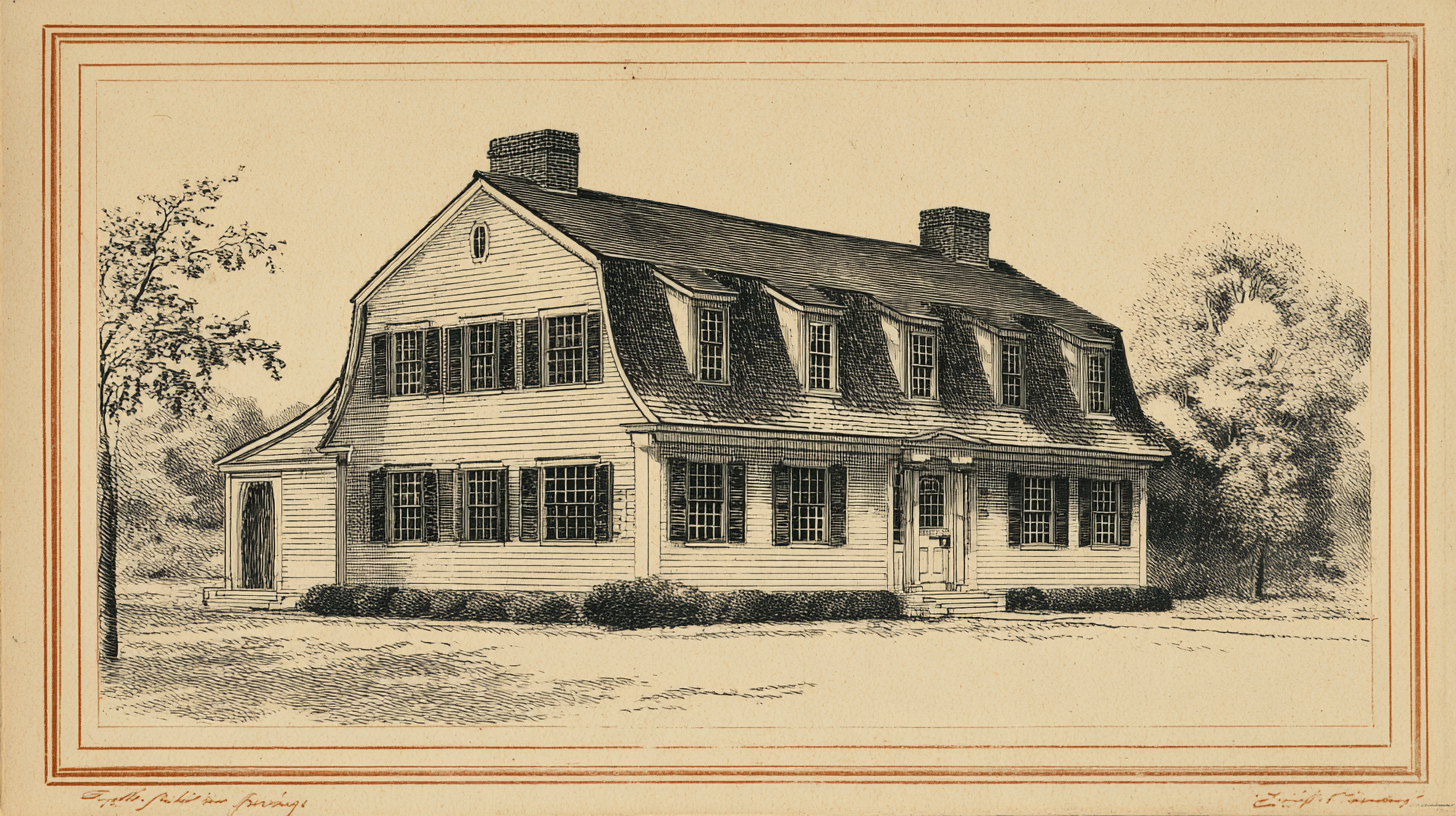
If one is to identify a Dutch Colonial Revival house — and one will find them in number, the style having been a builder’s-catalogue staple of the inter-war suburb from Connecticut to California — the exercise begins, as always in this series, at the silhouette. And here the silhouette does almost the whole of the work, for the Dutch Colonial Revival is, before it is anything else, a roof.
The principal feature of the Dutch Colonial Revival house is the gambrel roof. A gambrel is a roof with two pitches on each side rather than one: a shallow upper slope, running close to the ridge, and a steep lower slope, dropping nearly vertically toward the eave. Seen from the gable end it describes a broad, blunt, faintly barn-like profile — and the barn comparison is not idle, the gambrel being the standard roof of the American agricultural barn for the same reason it serves the Dutch Colonial: volume. A simple gable encloses a triangular attic in which a person may stand upright only along the ridge; the gambrel refuses that geometry. By carrying the lower portion of the roof down steeply, almost as a wall, before easing it back at the shallower upper pitch, it encloses a space whose section is very nearly rectangular — a full storey of headroom carried to within a foot or two of the eave, won under what reads, from the street, as a roof rather than a storey.
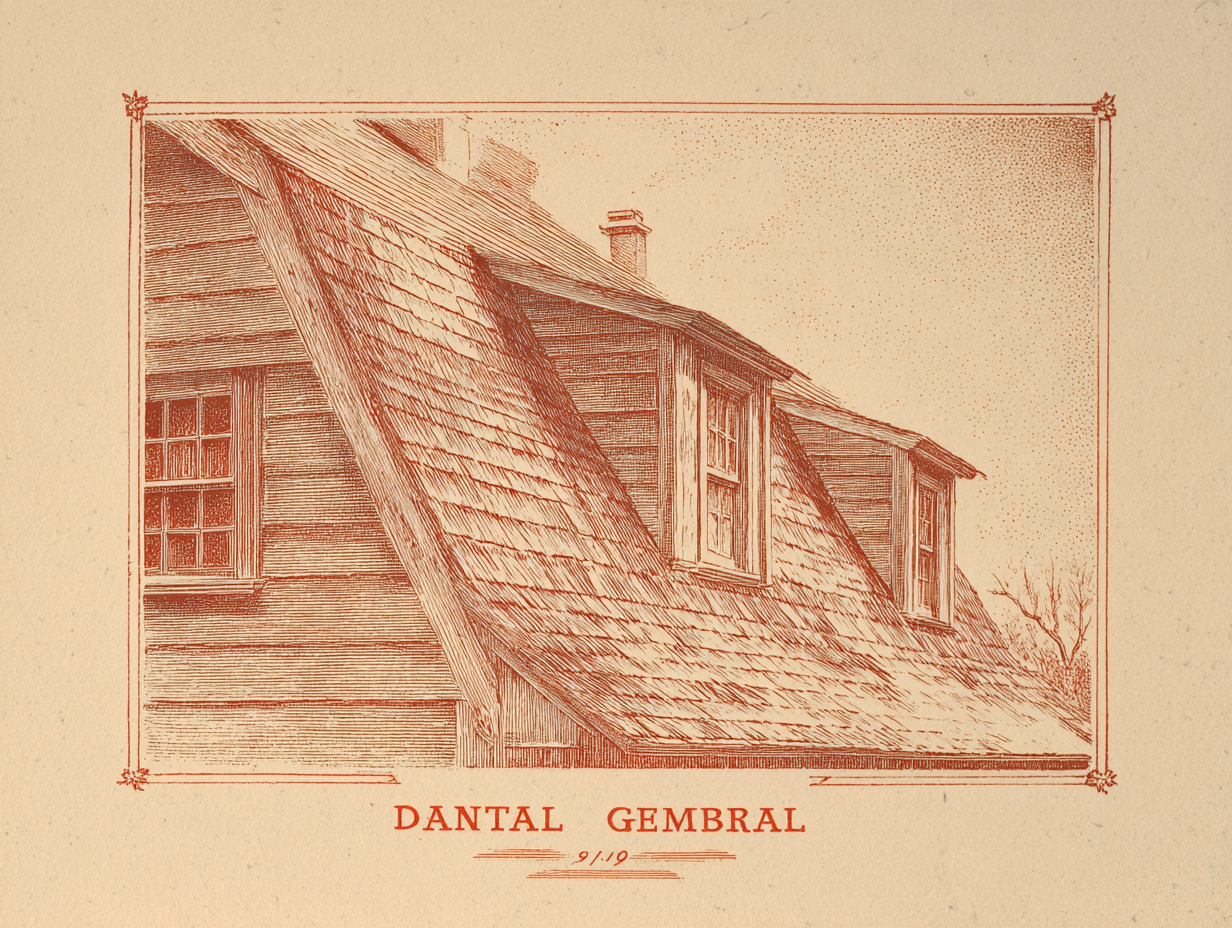
The defining Dutch Colonial Revival element — the gambrel roof with its long front shed dormer. The roof breaks into two pitches on each side: a shallow upper slope near the ridge and a steep, almost vertical lower slope toward the eave, the break enclosing a section very nearly rectangular and so a genuine full storey of headroom. Set into the steep front slope is the shed dormer — a single long dormer with its own low-pitched roof, running most of the width of the facade, its band of windows lighting the upstairs rooms. Without the shed dormer the gambrel gives volume but no light; with it the upper floor becomes a proper second storey. The gambrel is the fastest way to know the style from the street, and the place where this post’s argument begins.
The second feature is the shed dormer, the gambrel’s necessary companion. The gambrel, left to itself, gives the upper floor its volume but withholds its light: a person may stand upright in the space, but the windows, confined to the gable ends, leave the long middle of it dim. The shed dormer answers this. It is a single broad dormer — not the small gabled dormers of the Cape Cod, set in pairs, but one long dormer running most or all of the width of the facade — its own low roof a near-flat continuation of the gambrel’s shallow upper pitch, its face carrying a continuous band of windows. Set into the steep front slope, it brings the wall and windows of the upper storey forward and upright and converts what would otherwise be a generous attic into a genuine second floor. The gambrel supplies the room; the shed dormer makes it livable. A Dutch Colonial Revival house without one is uncommon, and looks, when one meets it, faintly unfinished.
The third feature is the flared eave — the detail the trade has long called the Dutch kick, and sometimes the spring eave. Where the steep lower slope of the gambrel meets the wall, it does not stop square; it turns outward in a gentle concave flare, the last foot or two of the roof curving up and away to project as a small overhang. On the genuine New Netherland farmhouse this flare was often pronounced, carried far enough to roof a porch running the length of the front. The Revival kept it in a quieter form, a soft sprung curve at the eave line — the one piece of the New Netherland house the Revival reproduced with real fidelity, and the detail by which a careful eye separates an intentional Dutch Colonial from a builder’s gambrel raised without reference to anything.
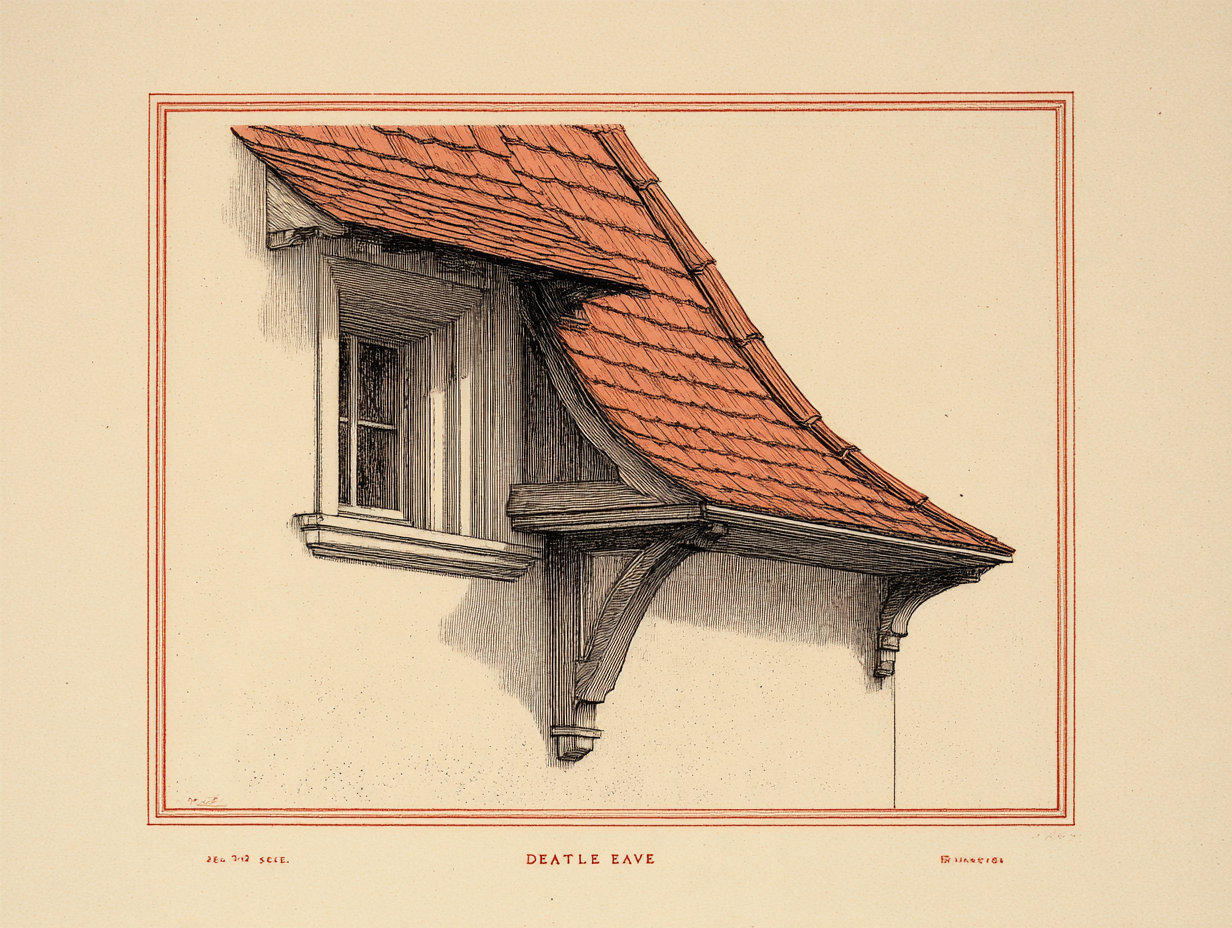
The flared eave — the ‘Dutch kick,’ also called the spring eave. The steep lower slope of the gambrel does not meet the wall square; it turns outward in a soft concave curve, the last foot or two of the roof springing up and away to project as a modest overhang. On the genuine New Netherland farmhouse the kick was often emphatic, carried far enough to shelter the wall or roof a full-width porch. The Revival kept it as a quieter, more decorous grace note — and it is the detail done with the most fidelity to the colonial original, the surest sign that a gambrel was raised with the Dutch Colonial deliberately in mind.
The fourth feature is the wall, and the wall is where the style’s modesty shows. Under the gambrel the Dutch Colonial Revival house is, almost without exception, an ordinary frame house — its walls sheathed in clapboard, in wood shingle, occasionally in a brick veneer over the same frame, the standard surfaces of the inter-war American suburb that the Cape Cod and the Colonial Revival proper wore. There is no stone. The genuine New Netherland farmhouse, as the history section will recount, was very often a masonry building, its walls a foot and more thick; the Revival reproduced none of that. It built the New Netherland house’s most conspicuous gesture — the roof — in the cheap and quick frame construction of its own century, and let the gambrel carry the whole argument. The wall is not making the Dutch claim. The roof is making it alone.
The fifth feature belongs to the entrance and the fenestration, and here the Dutch Colonial Revival behaves as a well-mannered member of the Colonial Revival family. The front door sits at or near the centre of the facade, generally under a small classical hood or a modest entrance porch, sometimes carrying a fanlight or sidelights in frank quotation of the Federal doorway; the windows are double-hung sash in multi-pane glazing — six-over-six, eight-over-eight, the small panes signalling the colonial register as they did on the Cape Cod — disposed with a symmetry the gambrel’s bulk tends to soften but rarely abandons. A Dutch door, divided horizontally so the upper leaf may open while the lower stays shut, appears often enough to be worth naming, being the one detail that, like the kick, came straight from the genuine article. The whole lower half of the house, by itself, would pass without comment as a plain symmetric colonial cottage. It is the gambrel above it that names the style.
The Farmhouse and the Revival
The documentary anchor of the Dutch Colonial Revival is not a single pattern book, as the Federal’s was, nor a city’s ordinance, as the Pueblo Revival’s was. It is a broad national enthusiasm — the Colonial Revival at large — and a particular romantic idea about the Dutch that the enthusiasm took up. But the place to begin is with the genuine architecture the Revival decided to remember.
That architecture is the farmhouse of New Netherland. The Dutch West India Company planted its colony on the Hudson in the 1620s, and Dutch and Flemish settlement spread out from New Amsterdam along the Hudson valley, across the western end of Long Island, and into the rich farmland of northern New Jersey. The English took the colony in 1664 and renamed it New York, but Dutch building habits did not leave with the Dutch flag; the farmhouses went up through the whole of the eighteenth century, raised by the descendants of the first settlers on land their families had held for generations. These were low buildings, generally a storey and a half, and very often built of masonry — of fieldstone gathered from the land, of brick, sometimes of stone below and a frame gable above — their walls thick, the houses sitting close to the ground. The earliest of them, in the seventeenth century, were finished with a plain steep gable; the gambrel arrived later, an eighteenth-century development on the type — common from roughly 1725 onward — and it is the eighteenth-century house, gambrel-roofed and finished at the eave with that emphatic outward flare, the kick, that the modern eye pictures when it pictures the genuine article. On the most characteristic Jersey and Long Island examples the kick swept far enough beyond the wall to cover a porch running the length of the front, a deep shaded gallery that is the single most memorable feature of the type. This is the house the Revival took its name from: stone-walled, ground-hugging, gambrel-roofed, deeply eaved, the work of a colonial Dutch culture that persisted in its building long after it had ceased to be politically Dutch at all.
Here the post must record an irony, because the irony is the hinge of the whole subject. The gambrel roof — the feature the Revival made central, the feature that is the Dutch Colonial in the popular eye — was never, in any strict sense, distinctively Dutch, and was never even original to the New Netherland house. It arrived on the type a full century after the first settlers landed, an eighteenth-century borrowing rather than an ancestral inheritance; and it was borrowed broadly, gambrels standing thick across the English colonies as well, the form having antecedents in English building independent of anything the Dutch brought across. It was a sensible roof, and sensible roofs respect no ethnic boundaries. What the genuine New Netherland house did have that was particular to it was the stone wall and the deep flared eave with its sheltering porch — and those were precisely the features the Revival reproduced least, the stone not at all and the kick only in a softened token form. The Revival, in other words, fastened the name “Dutch” onto the one major feature of the house that was neither especially Dutch nor especially old, and let go of the features that were. It assembled not the New Netherland farmhouse but a romantic image of a Dutch colonial past, and the gambrel was the image’s badge.
What turned the genuine farmhouse into a revival was the same broad current that produced every other style this series has filed under that word. The Centennial Exposition of 1876 at Philadelphia is the conventional marker — the moment a self-consciously modern, industrial America turned to look back, with sudden affection, at its own colonial beginnings; and out of that backward look came the whole Colonial Revival, the long inter-war enthusiasm for Georgian doorways and fanlights and clapboard symmetry that the Colonial Revival post treated directly. The Dutch Colonial Revival was one branch of it — a colonial house with a difference, and the difference was a roof, picturesque, instantly legible, and one that paid for itself. The architects of the better houses worked the manner with some care, studying the surviving stone farmhouses and reproducing the kick and the proportions with intelligence. But the style’s real career was in the catalogue. Through the 1910s and the prosperous 1920s the Dutch Colonial was a fixture of the mail-order house plan and the speculative builder’s pattern sheet — Sears, Roebuck sold gambrel-roofed models; the plan books offered them by the dozen — and it was sold, very often, on the explicit and practical argument that a family bought, for the price of a roof, the floor area of a two-storey house while paying the smaller tax and fuel bill of a storey-and-a-half cottage. The gambrel was romance and the gambrel was also arithmetic, and the inter-war suburb found the combination irresistible. By 1940 the style had faded before the post-war Ranch and Cape; but for the two decades of its height it was, by the count of houses raised, among the most successful colonial sub-types the country produced.
What It Is Not
Four styles stand near enough to the Dutch Colonial Revival that the beginner confuses them with it, and the last of the four is the confusion this whole post has been built to resolve.
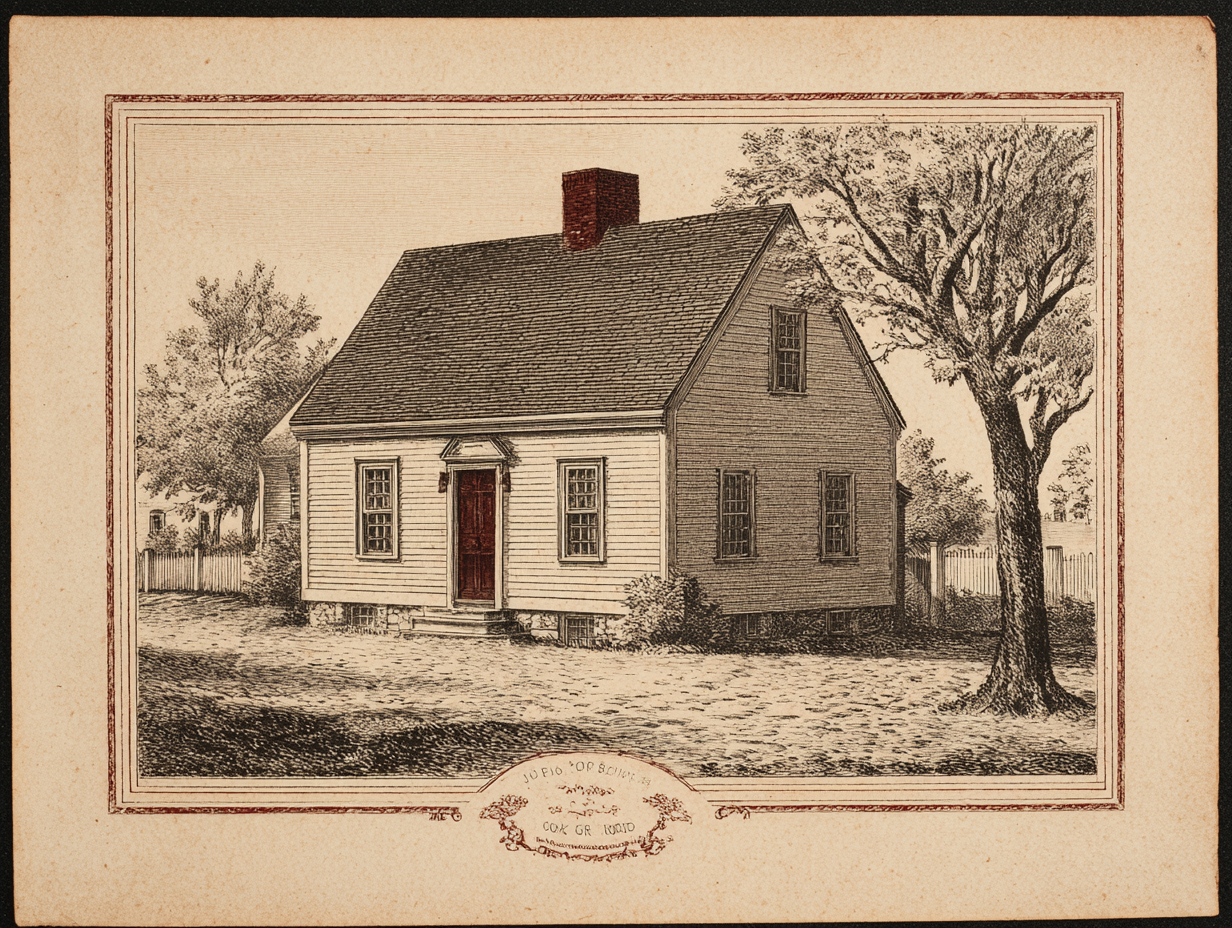
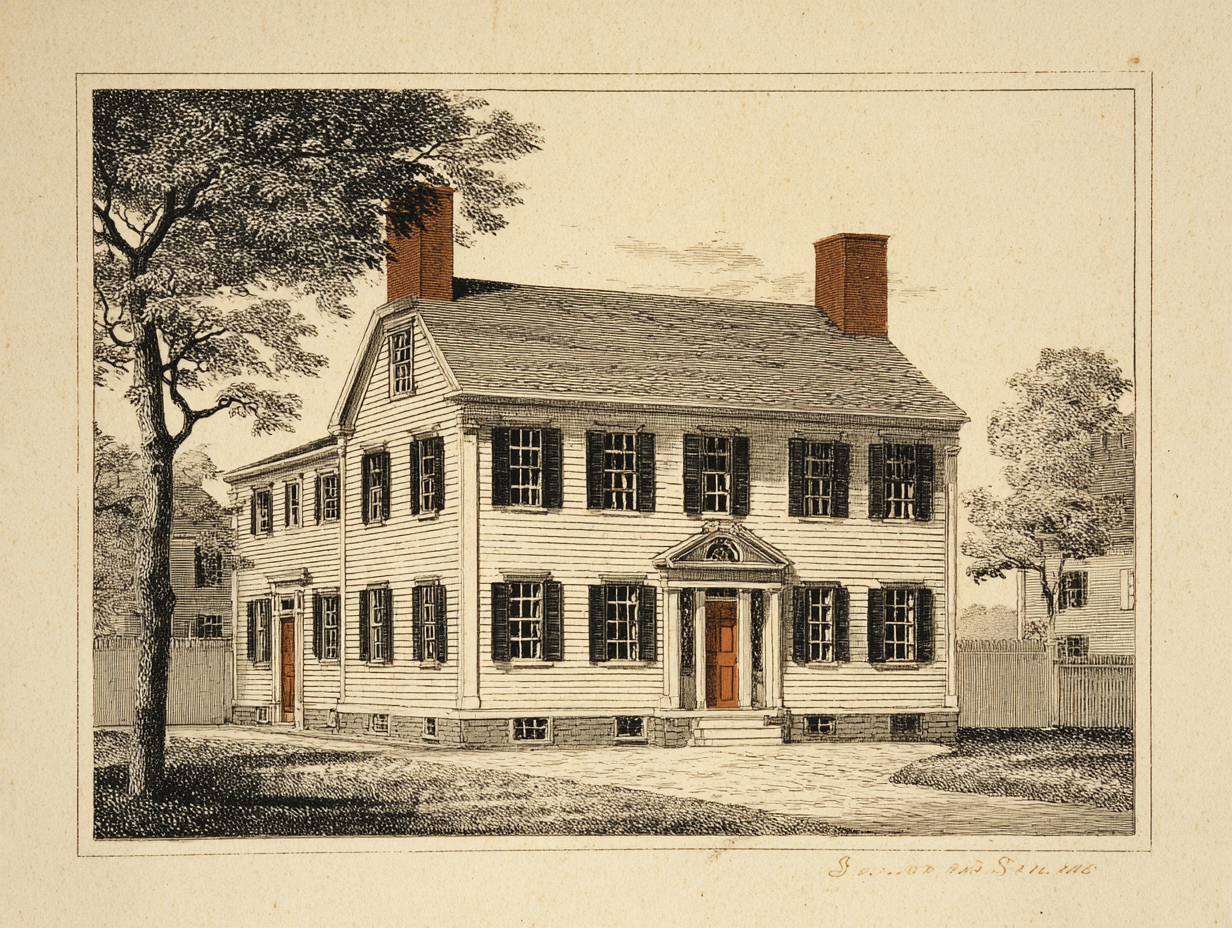
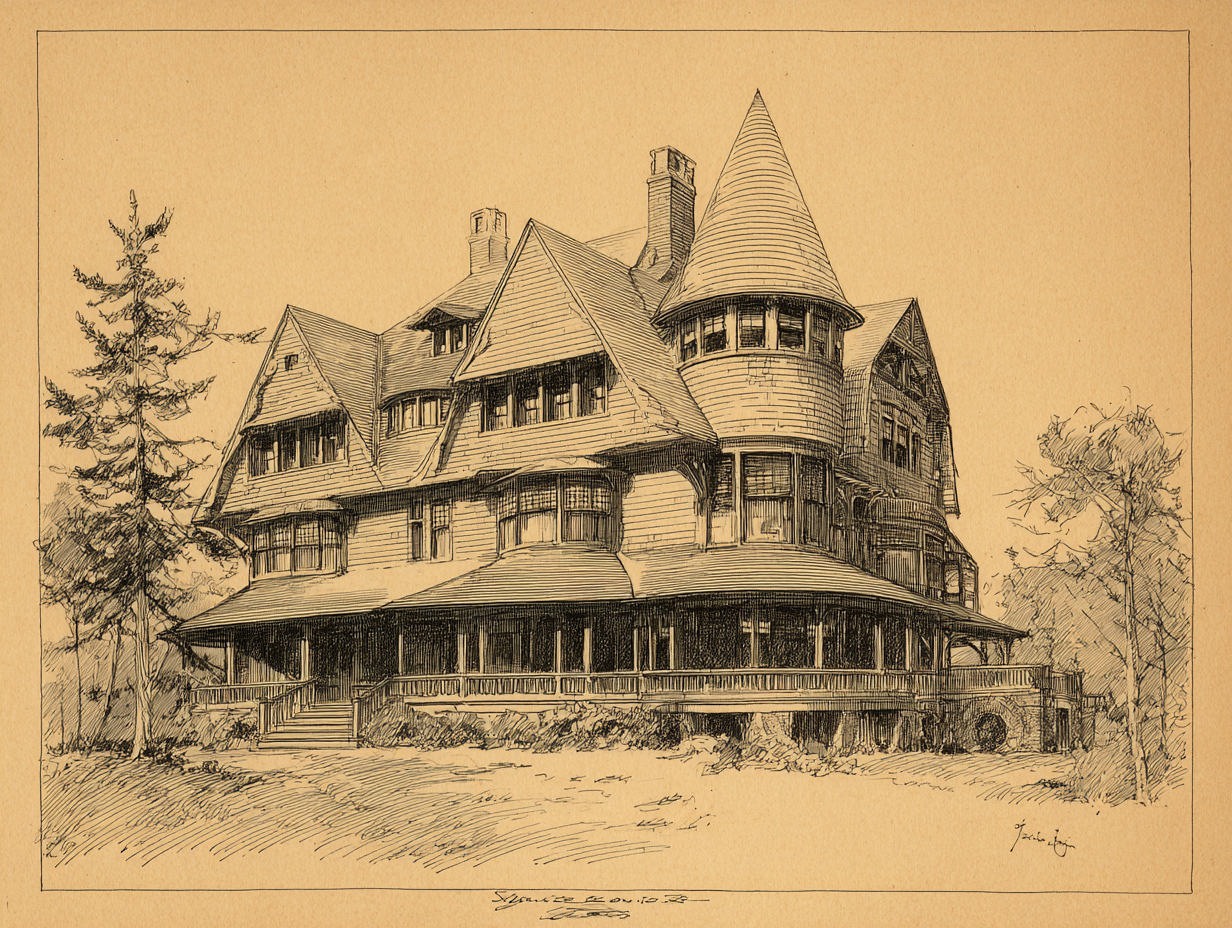
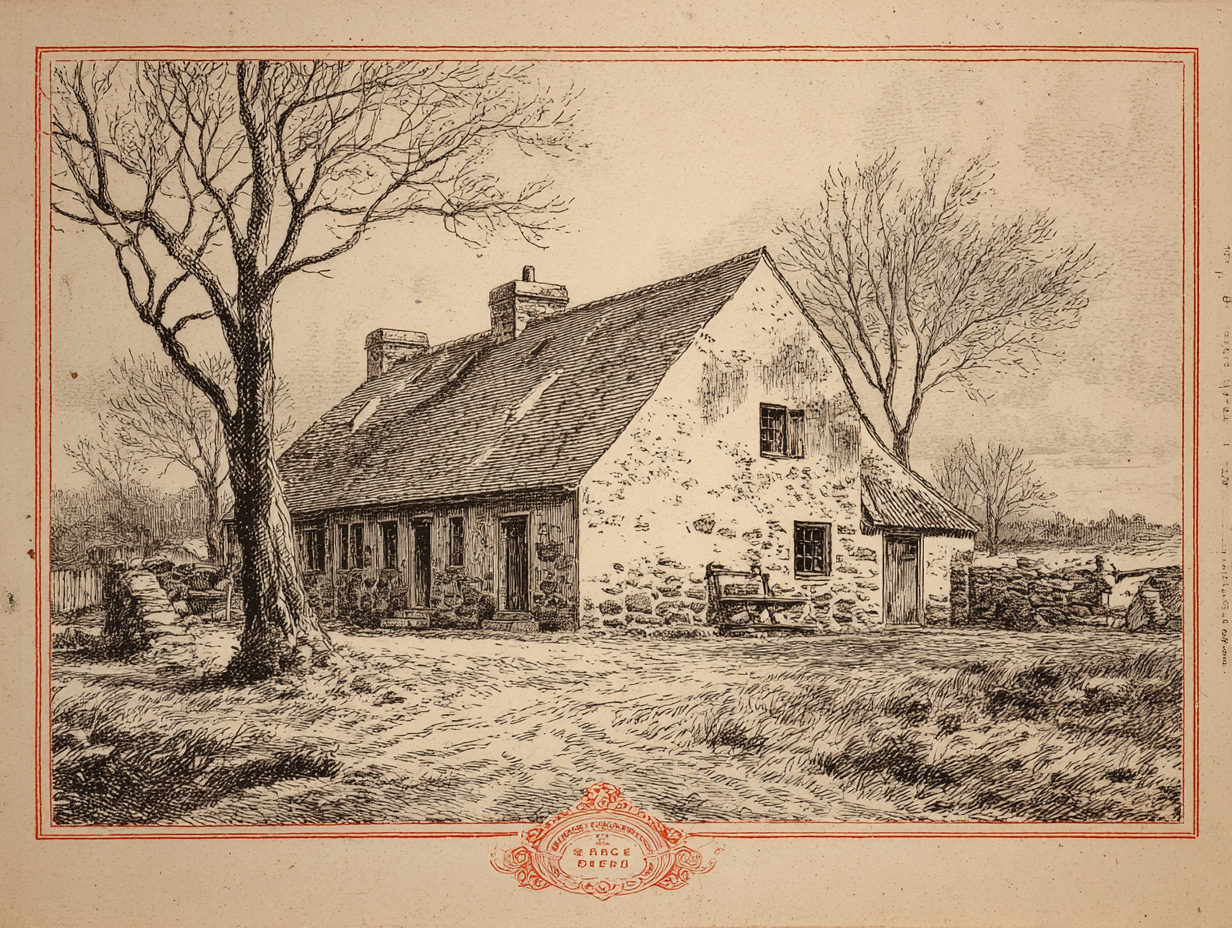
A Cape Cod is the gable-roofed cottage cousin, the style’s nearest sibling in the whole series — examined a handful of posts back, and worth setting beside the Dutch Colonial, because the two answer the same question with two different roofs. Both are compact one-and-a-half-storey colonial-revival cottages; both wear uniform clapboard or shingle, carry multi-pane sash and a centred classically dressed door, and were builder’s-catalogue staples of the same decades. The difference is the roof, and it is total. The Cape Cod carries a simple gable and wins its half-storey of upstairs space the hard way, in a cramped attic lit by two small symmetric gabled dormers — a half-storey in fact as well as in name. The Dutch Colonial carries the gambrel, and wins a genuine full upper storey, lit by the one long shed dormer — a half-storey only in the way it reads from the street. The rule of thumb: a simple gable with paired small dormers is a Cape Cod; a double-pitched gambrel with a single long shed dormer is a Dutch Colonial.
A Colonial Revival proper is the symmetrical Georgian parent — the broad mainstream of the revival, of which the Dutch Colonial is one specialised branch. The Colonial Revival in its central form is a full two storeys, its walls carried up square to a simple side-gabled or hipped roof, its facade rigorously symmetric about a classically detailed central entrance, its model the Georgian house of the English colonial seaboard. It finishes those two storeys with a quiet, conventional roof, making its display at the entrance and the cornice; the Dutch Colonial raises a storey and a half and finishes it with the loud, particular gambrel. The rule of thumb: two full storeys of wall under an unremarkable roof is Colonial Revival proper; a storey and a half under an emphatic gambrel is the Dutch Colonial branch of it.
A Shingle-style house is the large picturesque relation, and the confusion here is precise, because the Shingle style used the gambrel too. It was the architecture of the wealthy New England and Eastern-seaboard resort of the 1880s and 1890s — of Newport and Bar Harbor and the shingled summer houses of the coast — a large, loose, picturesque manner, the whole building wrapped uniformly in unpainted wood shingle and composed in an irregular sprawl of gables and porches and towers. Among the forms it drew into that sprawl was the broad gambrel, used freely and at scale — but as one element of a large irregular composition, one move among many in a rambling, asymmetric house built for a rich family’s leisure. The Dutch Colonial Revival uses the gambrel as the roof of a small symmetric box — a modest suburban house, the gambrel its single picturesque gesture and the rest disciplined and plain. The rule of thumb: a gambrel as one incident in a large rambling shingled resort house is the Shingle style; a gambrel as the whole roof of a compact symmetric suburban cottage is the Dutch Colonial Revival.
The original Dutch Colonial is the genuine thing — the New Netherland farmhouse the Revival is named for and exists to remember — and the comparison closes the circle the post opened, being the load-bearing distinction of the whole essay. The genuine article, surviving in scattered hundreds along the Hudson and across northern New Jersey and the older towns of Long Island, is a low storey-and-a-half house built very often of masonry, its walls a foot and more thick. The eighteenth-century examples carry the gambrel, finished with a deep, emphatic kick, the flare frequently swept far enough beyond the wall to roof a long porch running the full front. The Dutch Colonial Revival reproduces the gambrel, the kick in a softened form, the Dutch door — and almost nothing else. The Revival house is wood frame, clapboard-walled, raised on a modern suburban lot, its masonry abandoned for the cheap fast construction of the twentieth century, its deep sheltering eave reduced to a decorous curve. The rule of thumb is therefore, as it was for the Pueblo Revival, not finally a matter of the eye: one tells the genuine New Netherland article from the 1920s Revival cottage not by the roofline they share but by the wall, the date, and the depth of the eave.
What It Was Trying to Say
What I find most telling about the Dutch Colonial Revival is that it is, of all the houses this series has treated, the one that carries its entire historical argument in a single structural member — and that the member was chosen, one comes to suspect, at least as much for its arithmetic as for its romance.
The first thing the Dutch Colonial Revival was saying it said, like every revival in this series, by its choice of antecedent — but it chose with a freedom none of the others quite allowed itself. The Colonial Revival borrowed the Georgian house and reproduced it fairly faithfully; the Tudor Revival laboured at the half-timber; the Pueblo Revival copied every visible feature of the adobe village in stucco. The Dutch Colonial Revival borrowed the New Netherland farmhouse and then declined to reproduce most of it. It took the roof and discarded the stone; it softened the kick past recognition; it kept the Dutch door as a token and let the deep sheltering porch go. What it retained was exactly enough to license the name, and the name was the point — it placed the suburban buyer’s ordinary frame cottage in a line of descent from the picturesque colonial Dutch and asked very little of the builder in exchange. The Dutch Colonial Revival is the series’ clearest case of a revival that wanted a label more than it wanted a building.
The second thing the Dutch Colonial Revival was saying is bound up in the irony the history section recorded. The gambrel, on which the whole identification of the style rests, was neither distinctively Dutch nor even original to the New Netherland house; the Revival nonetheless made it mean Dutch — made it so thoroughly the badge of the type that a gambrel raised anywhere, for any reason, now reads to the ordinary American eye as “Dutch Colonial” on sight. This is a thing a successful revival can do that is faintly unsettling once one sees it plainly: it can attach a historical meaning to a neutral feature and make the attachment stick, until the meaning seems native to the feature and the actual history is the part that must be argued for. The Pueblo Revival had Santa Fe legislate an image into a real place; the Dutch Colonial Revival did something quieter — it taught a country to read a roof, and the reading it taught was not quite true.
The third thing the Dutch Colonial Revival was saying is the one that returns the post to the gap it was built to measure, and it is, in the end, the most sympathetic of the three. The Dutch Colonial Revival house is a plain frame house wearing a gambrel as a costume — its walls clapboard where the original’s were stone, its eave a grace note where the original’s was a porch, its Dutchness a name fastened to a roof. One could call this dishonest, and the series has watched the stricter critic call exactly this of every revival in it. But the Dutch Colonial never asked to be mistaken for a New Netherland farmhouse. It offered, openly and cheerfully, a picture of one — and offered, alongside the picture, something the picture’s antecedent could not give: a genuinely clever house. The gambrel was romance, but it was also a real and honest piece of engineering, a roof that won a family a full upper floor of bedrooms while the tax assessor and the fuel merchant went on charging it for a cottage. The Federal’s imitators repeated the fanlight for its charm alone; the Dutch Colonial Revival repeated the gambrel for its charm and because the gambrel did a day’s work. And so the series, having reached the gambrel-roofed suburb, finds the one revival in which the borrowed feature was not a quotation but a tool — a house that wore a costume, meant it only loosely, and underneath it was quietly the most sensibly built cottage on the street.
The next specimen I should like to take up holds to the eastern colonial ground this post has worked, and to the line the Cape Cod and the Dutch Colonial together open — the seventeenth-century New England houses that stand behind the whole colonial-revival enterprise, the genuine vernacular the revivals were reaching back to imitate. The series has spent twenty-one posts among the imitations; it is time it looked at the originals.