The Mid-century Modern of the previous post closed the series’ long descent through the twentieth century — from the Colonial Revival of the 1880s through the inter-war Tudor and Spanish Colonial Revival and on into the post-war suburb of Ranch and Split-Level — and it closed by promising a return from the post-war moment to what was there called “the longer American argument about what a house should be made to remember.” This post makes that return, and makes it as far back as the series can go. Eighteen posts have treated the American house, and every one of them a house built in 1825 or after — the Greek Revival being the earliest the series had until now reached. The Federal is the house that stood before the Greek Revival, before the series proper began at all, and treating it here fills the single largest gap the eighteen posts left open: the architecture of the first decades of the republic itself.
This is the nineteenth post in Reading the American House. It takes up the Federal style — known also, after the Scottish architect whose neoclassicism it adapted, as the Adam or Adamesque style — the symmetrical, flat-faced, delicately ornamented house of the new nation’s first half-century, built roughly between 1780 and 1830. The Federal is, in the plainest sense, the architecture of the early American republic: what a prosperous merchant or a substantial farmer built in the years when the Constitution was new and the country had not yet decided what it wished to look like. It is also — and this is the connection the Colonial Revival post reached for and could not properly furnish — much of what the word “colonial” was later made to mean. When the Colonial Revival of a century later went looking for an American past to revive, the past it most often found and most freely borrowed was not in fact colonial at all; it was Federal. The series’ earliest house turns out to be the one its later houses were quietly quoting all along.
The Specimen
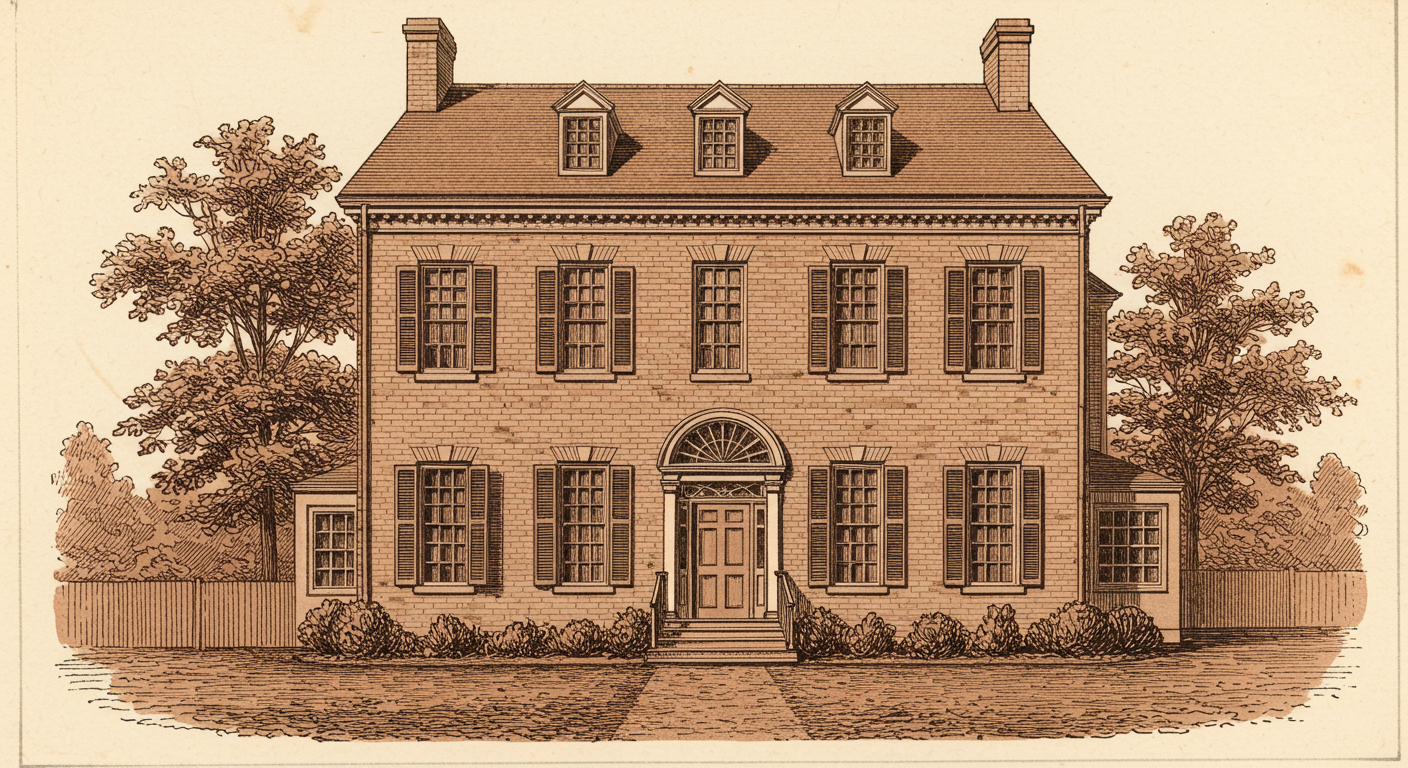
If one is to identify a Federal house — and one will find them in number, the style having been the standard idiom of the eastern seaboard for two full generations, surviving most densely in the older brick quarters of the Northeastern cities and the river towns of New England — the exercise begins, as always, with the silhouette. The Federal silhouette is the plainest the series has yet treated. That plainness is not an absence of design. It is the design.
The principal feature of the Federal house is its strict bilateral symmetry carried on a flat, low-relief facade. A Federal presents a front elevation that is a calm, regular grid: a centred front door with an equal number of windows ranged to either side — most often two, making the canonical five-bay front — and the upper-storey windows set directly above the lower, aligned to a hair. The facade is two storeys, occasionally three in the town houses, capped by a low-pitched or hipped roof that does little to draw the eye and is frequently finished with an edging balustrade. The wall is smooth and unbroken: in the Northeastern cities it is almost always brick, laid in a fine even bond with thin mortar joints; in rural New England and along the coast it is as often clapboard, kept flat and tight and painted a pale, even colour. The Federal facade neither breaks forward into wings or pavilions nor steps back into bays. It is a single plane, pierced by openings in a strict order, and the discipline of that plane is the first and surest sign of the style.
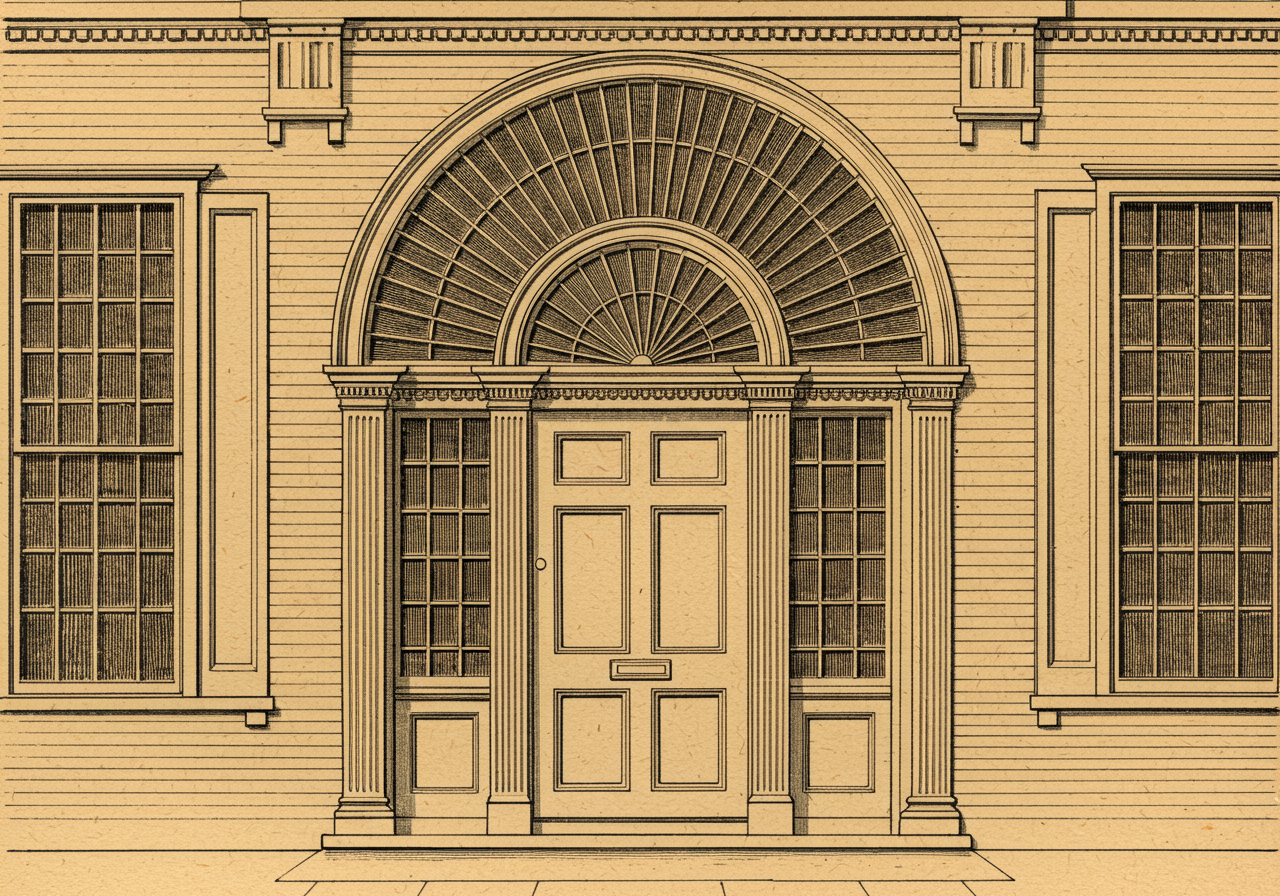
The signature Federal element — the fanlit and sidelit doorway. A semicircular or elliptical fanlight, its muntins radiating like the ribs of a fan, is set in the arch above the front door; narrow sidelights flank the door itself; the surround is a pair of slender pilasters or engaged columns carrying a thin entablature. The whole composition admits daylight to the entrance hall and announces, in a single concentrated gesture, the refinement the rest of the flat brick facade keeps in reserve. Where a Federal facade spends ornament at all, it spends it here.
The architectural event of the Federal facade — the place where its restraint is broken, deliberately and once — is the front entrance. Above the panelled front door sits a fanlight: a window in the shape of a half-circle or, in the more developed examples, a flattened ellipse, its glazing divided by slender muntins that radiate like the spokes of an opened fan. To either side, narrow vertical sidelights are frequently set, so that the door is surrounded on three sides by glass; the whole is framed by a pair of attenuated pilasters or thin engaged columns carrying a light entablature, and the entrance is sometimes sheltered by a small flat-roofed portico or a delicate iron-railed stoop. The fanlit doorway is the single fastest way to identify a Federal house from the street, and it is more than a convenience of recognition. Everything the Federal believed about ornament — that it should be concentrated rather than spread, delicate rather than robust, classical rather than invented — is stated at the door, and the flat facade exists in part to set it off.
The third feature is the Palladian window, and where it appears it appears almost always in one place: centred on the second storey, directly above the front entrance. The Palladian window is a unit of three openings — a tall arched window in the centre, flanked by two shorter square-headed windows, the three separated by slender columns or pilasters and unified under a single composition. Borrowed, by way of England, from the sixteenth-century Italian architect Andrea Palladio, it served the Federal builder as the vertical answer to the fanlight below: door, fanlight, Palladian window stacked up the centre line of the facade in a single composed axis, the one place on the elevation where the eye is invited to dwell. Not every Federal carries one — the plainer farmhouses do without — but its presence is a reliable mark of the style at its more ambitious, and its position never varies.
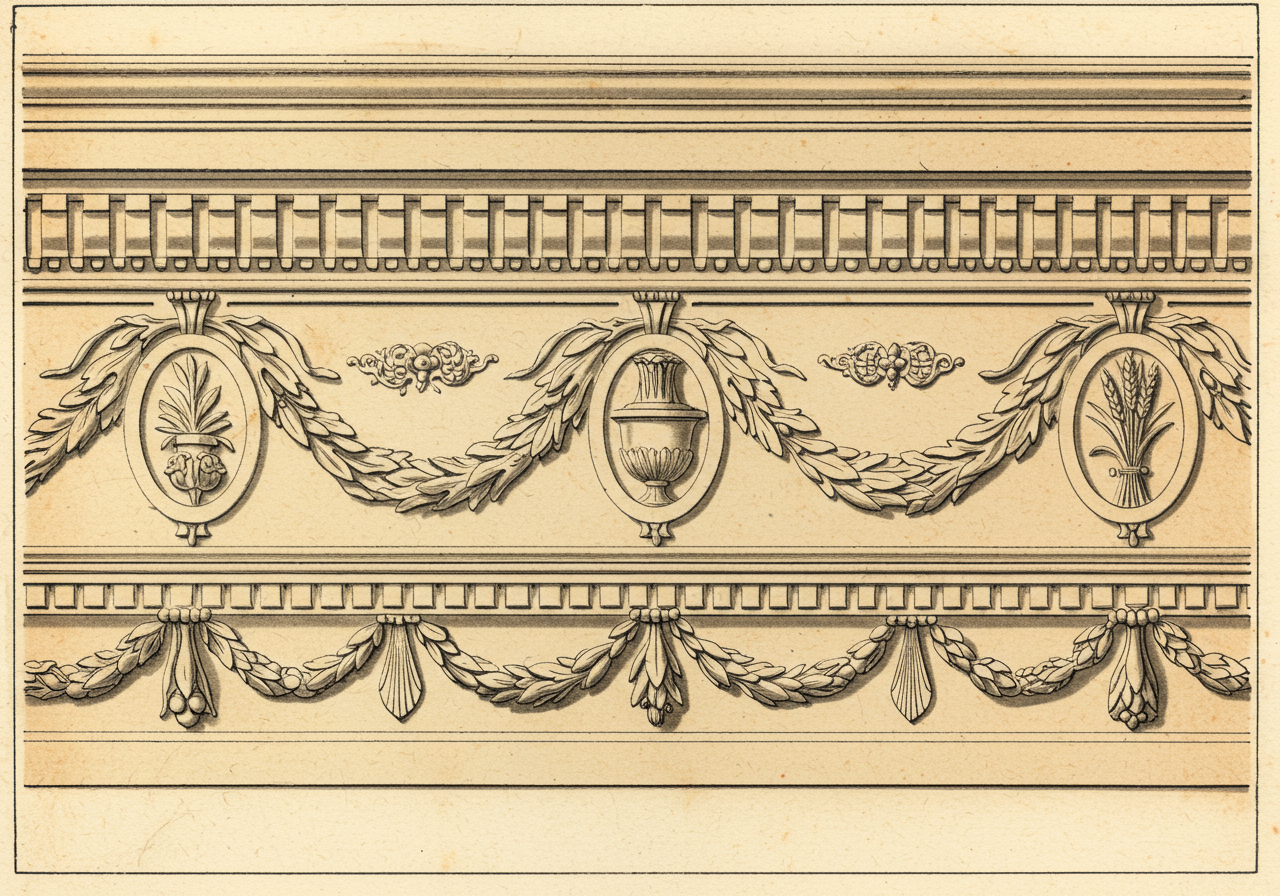
The Federal ornamental vocabulary in close view — swags and garlands of husks, oval paterae, urns, fluted bands, all carved or moulded in very low relief and stretched thin against a smooth ground. This is the same classical repertoire the heavier Georgian had used, but rendered shallow, slender, and delicate where the Georgian rendered it deep and bold. The attenuation is the whole point: the Federal took the classical motifs and drew them out, as a wire is drawn, until they were fine. To learn the difference between a Federal and a Georgian is, more than anything else, to learn to read this depth of relief.
The fourth feature is the ornament itself, and it is the feature on which the whole of this post finally turns. Where the Federal house carries decoration — at the door, around the windows, on the cornice, and above all within doors, on mantelpieces and overdoors and the plaster of ceilings — that decoration is drawn from a fixed classical repertoire: swags and garlands of husks, oval and circular paterae, urns, sheaves of wheat, slender fluted bands. None of these motifs was new; the heavier classicism that preceded the Federal had used every one of them. What was new was the handling. The Federal carved and moulded its ornament in very low relief, shallow and flat against its ground, and it drew the motifs out thin — the urns narrowed, the swags lightened, the columns made taller and more delicate in proportion than any classical rule would have sanctioned. This delicacy is not incidental decoration; it is the defining quality of the style, the quality by which the Federal is told from every house near it, and the next two sections are given over to it.
The fifth feature belongs to the interior, unseen from the street but worth looking for once inside. The Federal introduced, into the otherwise rectangular American house, the curved room — the elliptical or oval or fully circular chamber, set most often at the centre or the garden front of the better houses, its bowed wall sometimes pushing out through the facade as a shallow projecting bay. A direct importation from the English source, it was the Federal’s chief spatial novelty: where the colonial house had been a grid of square boxes, the Federal allowed itself, at least once per ambitious plan, the geometry of the ellipse. A bowed bay on the rear elevation, or a curving wall glimpsed through a doorway, is as sure a sign of the style as anything on the front.
The Pattern Book and the New Nation
The documentary anchor of the Federal style is not a single building, nor a single patron, nor a development firm. It is a book — a particular kind of book, produced in numbers, carried in a builder’s satchel, and consulted on the job — and the place to begin is with the English source it transmitted.
That source has a name: Robert Adam. Adam was a Scottish architect, the most celebrated of his generation in Britain, who with his brother James developed through the 1760s and 1770s a manner of neoclassical design that swept the British Isles. The Adam style was a deliberate lightening of the classical. The Georgian classicism that had ruled British building for the first half of the eighteenth century was a robust, full-bodied affair of heavy mouldings, deep relief, and bold projecting members. Adam, having studied the actual remains of Roman antiquity rather than the textbook rules, proposed something thinner and more delicate: shallow ornament, attenuated proportions, a repertoire of swags and urns and paterae used decoratively and lightly, interiors of oval and apsed and circular rooms finished in pale colours and fine plasterwork. This refined and graceful classicism is the immediate parent of the American Federal — received across an ocean, which is why “Adam” and “Adamesque” remain, two centuries on, the alternative names for it.
But the manner of the receiving matters as much as the thing received, and here the Federal differs sharply from the Mid-century Modern of the previous post. The Mid-century Modern arrived in America in the persons of its architects — émigrés who had practised the European modernism before they crossed. The Adam style arrived almost entirely without its architects. Robert Adam never crossed the Atlantic; very few trained architects of any kind were at work in the early republic. What crossed instead was print — the pattern book, the illustrated builder’s manual, a volume of engraved plates showing doorways, mantelpieces, cornices, window surrounds, and the correct proportions of the orders, with instruction enough that a competent carpenter could execute them without ever having seen the originals. The pattern book is to the Federal what the architect’s program was to the Mid-century Modern: the mechanism by which an idea became a thousand houses.
The American who did most to make the pattern book American has a name as well: Asher Benjamin. Benjamin was a New England housewright and joiner who, finding the English manuals expensive, ill-suited to American materials, and pitched above the ordinary builder’s training, set out to write manuals of his own. His Country Builder’s Assistant of 1797 was the first architectural book written and published by an American, for American builders, using American practice; his American Builder’s Companion of 1806 carried the project further and went through edition after edition for decades. What Benjamin did was to take the Adam manner — the delicate ornament, the fanlight, the attenuated proportions — and translate it into plates that a carpenter in a Vermont or a Maine village could read on a winter evening and build from in the spring. The consequence is the most important social fact about the Federal style. Because the manner travelled as a cheap and reproducible book rather than as a scarce and expensive architect, it travelled everywhere — into the small river town as readily as the seaport, onto the modest farmhouse as readily as the merchant’s mansion — and it produced, across the early republic’s settled territory, a remarkable uniformity of idea. The reader who has learned the Federal doorway in Salem will recognise it in a farmhouse three hundred miles inland, both having been built from the same book.
Around the pattern book stood the figures who gave the Federal its more celebrated monuments. Charles Bulfinch of Boston was the nearest thing the early republic had to a professional architect of the first rank; his Massachusetts State House, completed in 1798 with its broad dome and its colonnaded and arcaded front, gave the new nation a public building in the Adam manner, and his Boston town houses set the pattern for the brick urban Federal up and down the Eastern seaboard. Samuel McIntire of Salem came to architecture from the other direction — a woodcarver and joiner first, of extraordinary skill — and the houses he built and ornamented for the shipowners grown rich on the China trade are the Federal at its most refined, the carved swags and baskets of fruit and sheaves of wheat of his interiors among the finest low-relief ornament the style produced anywhere. Bulfinch gave the Federal its public scale and McIntire its decorative finish, but it was Benjamin’s books, more than either man, that gave it its reach. The State House is visited; the pattern book was used.
What It Is Not
Four styles stand near enough to the Federal that the beginner confuses them with it, and the first of the four is the confusion this whole post has been built to resolve.
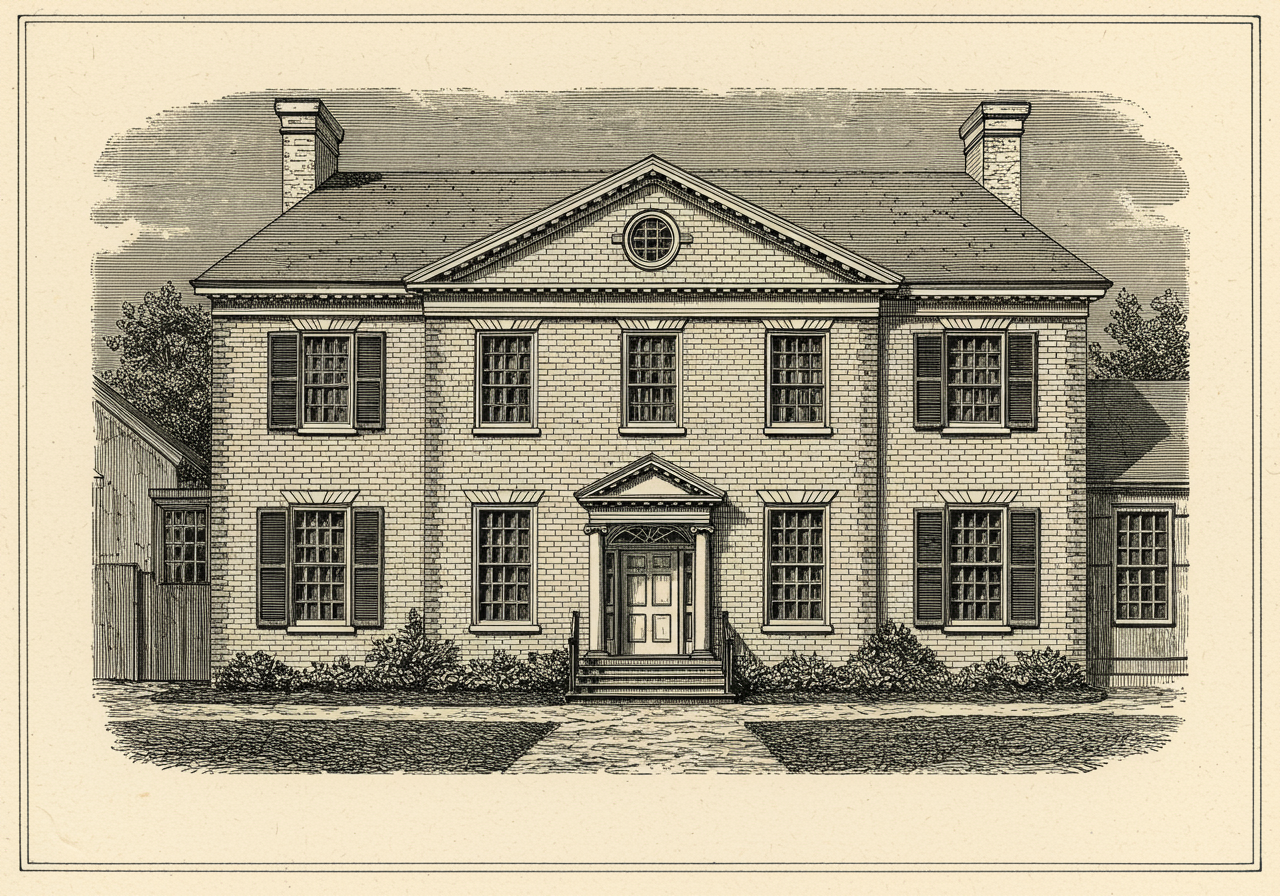
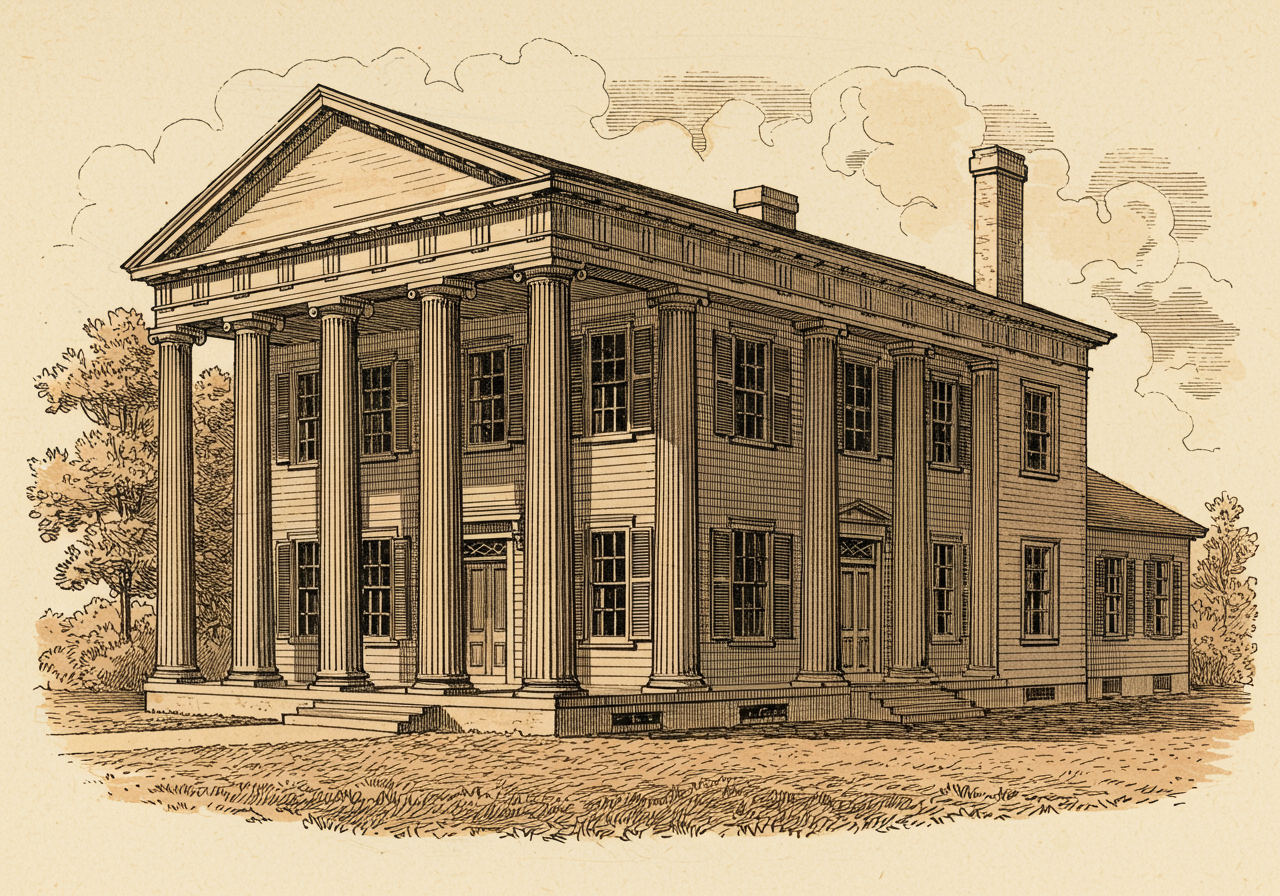
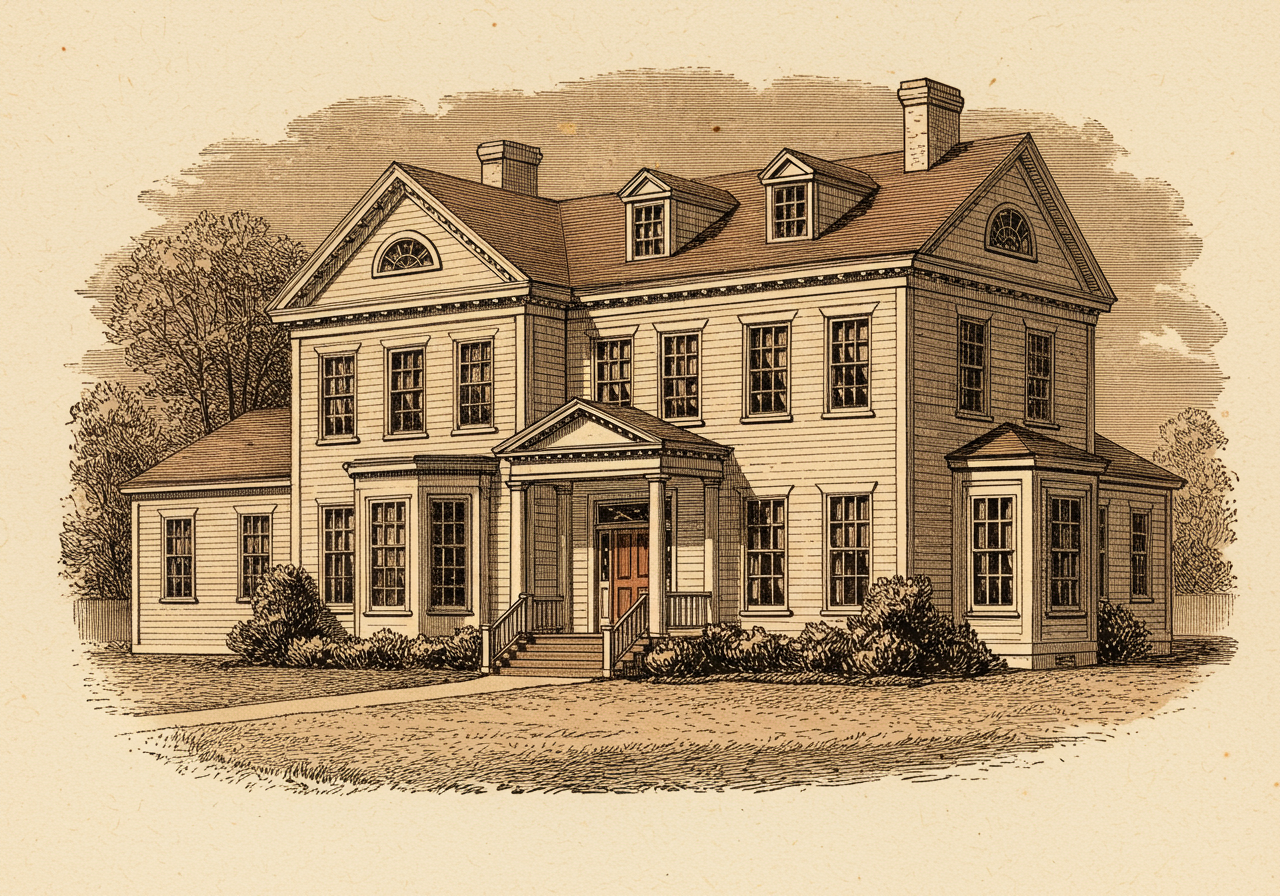
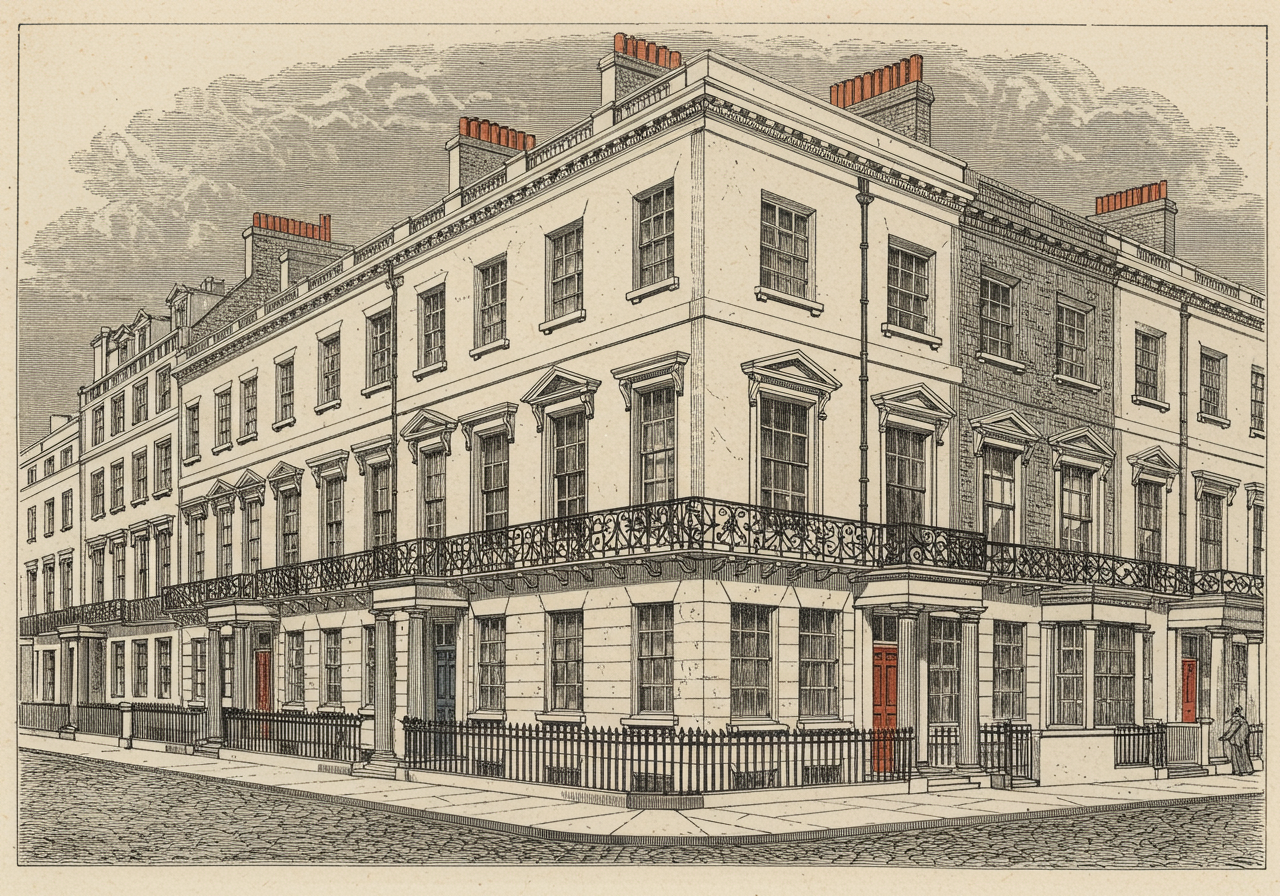
A Georgian Colonial is the heavier predecessor, and telling it from the Federal is the load-bearing distinction of this post and the most genuinely difficult one in the series. The two styles are built on the same plan and the same classical vocabulary. Both present a strictly symmetrical multi-bay front, two storeys, a centred door, aligned windows, a side-gabled or hipped roof; both are brick in the cities and clapboard in the country; both draw their ornament from the same Roman repertoire. The difference is not in what is done but in how heavily. The Georgian — the style of the colonial decades, before independence — is robust, bold, full-bodied: its front door is framed by a substantial pediment, triangular or segmental or broken, carried on thick consoles; its cornice projects deeply; its corners are often marked by heavy quoins; its ornament is carved in high, full relief. The Federal takes every one of those elements and thins it: the projecting pedimented doorway becomes the flat fanlit one, the deep cornice becomes a shallow one, the heavy quoins vanish, the bold high-relief ornament becomes the delicate low-relief swag and patera. The rule of thumb: if the classical detail is heavy, deep, and boldly projecting, the house is Georgian; if the same detail is thin, shallow, attenuated, and delicate, the house is Federal. One is the colonial house in full body; the other is the same house, drawn fine, by the new republic.
A Greek Revival is the bolder successor — the style at which this series properly began — and it parted from the Federal by a complete change of classical model. The Federal looked to Rome, and to Roman ornament in particular: it is a style of decoration, of the swag and the urn and the delicate moulded surface. The Greek Revival looked to Greece, and to the Greek temple as a whole form: it is a style of massing, its central gesture the full-height columned portico and the broad triangular pediment composing the house as a temple front, frequently with the gable turned to face the street. It abandoned the Federal’s delicacy as well: its mouldings are bold and simple, its ornament spare. The rule of thumb: a flat facade carrying delicate ornament at a fanlit door is Federal; a temple front of heavy columns under a broad pediment is the Greek Revival that displaced it.
A Colonial Revival is the later quotation, and the comparison is the one the Colonial Revival post itself anticipated. Emerging in the 1880s and running for seventy years, the Colonial Revival went looking for an American architectural past to revive and found, more often than not, the Federal and the Georgian — which is to say it is in large part the Federal, revived. The two are therefore genuinely alike: symmetry, the centred fanlit door, the Palladian window, the aligned sash. They are told apart by scale, regularity, and freedom of combination. The Colonial Revival house is built on the larger scale of the turn-of-the-twentieth-century suburb; its proportions are looser; its ornament is machine-made and mechanically even where the Federal’s was hand-carved and slightly irregular; and it combines its borrowed elements freely and abundantly — a fanlight and a Palladian window and a columned portico and a row of dormers all on one house — where the Federal was disciplined and sparing. The rule of thumb: a small, sparing, hand-finished, slightly irregular symmetrical house is the Federal original; a large, abundant, crisply machined symmetrical house quoting the same elements is the Colonial Revival that admired it a century on.
An English Adam style house is the source, and the comparison closes the circle the post opened. The British neoclassicism of Robert and James Adam out of which the Federal was made shares with it the entire ornamental vocabulary — the delicacy, the attenuation, the fanlit doors and oval rooms. The two differ in context and idiom rather than in detail. The English Adam style was largely an urban and aristocratic architecture of grand London town houses and great country seats, built in continuous brick and stucco terraces in cities like Bath and Edinburgh, often carrying iron balconies and a degree of finish the new republic could rarely afford. The American Federal took the same manner and made it provincial, republican, and freestanding: it built the detached merchant house and the village farmhouse rather than the aristocrat’s terrace, worked more often in plain brick and clapboard than in stucco, and simplified the Adam interiors to what a joiner with a pattern book could execute. The rule of thumb: the same delicate neoclassicism built as a grand stuccoed urban terrace is the English Adam source; built as a freestanding brick or clapboard house for an American merchant or farmer, it is the Federal that the source became.
What It Was Trying to Say
What I find most telling about the Federal is that the style was, almost alone among the houses this series has treated, the architecture of a political beginning — everything delicate and restrained about it readable as the architecture of a republic working out how it wished to be seen.
The first thing the Federal was saying it said by what it chose not to be. The new nation, having just fought a war to be rid of a monarchy, was not going to build itself a monarchical architecture. The heavy, full-bodied Georgian classicism was the architecture of the colonial and royal order — the manner of the king’s governors and the crown’s officers — and to continue it unchanged would have been, in a quiet way, a political statement the republic did not wish to make. The Federal’s lightening of that classicism, its thinning of the inherited Georgian into something delicate and graceful, was therefore not merely a matter of fashion imported from Adam’s London. It was also a way of keeping the prestige and the order of classical architecture while setting aside its heaviness — of building a house unmistakably civilised and unmistakably not the governor’s mansion of the old regime. The republic wanted the dignity of the classical and not its weight, and the Federal gave it exactly that.
The second thing the Federal was saying is bound up in the pattern book, and it is the most genuinely democratic fact in this whole series. Because the Federal travelled as Asher Benjamin’s cheap, reproducible, carpenter-legible book rather than as a scarce and costly architect, it was a style that the ordinary builder could build and the ordinary prosperous family could own. There is something fitting in this — a republic’s first native architecture being one that spread not by the patronage of the few but by the printed book in the hands of the many, a publication that, unlike an architect, could be in a thousand places at once.
The third thing the Federal was saying is the one that explains its long afterlife, and it returns the post to the confusion it was built to resolve. The Federal did its work so thoroughly — produced so many houses, so widely, so memorably — that when the Colonial Revival of a century later went looking for an American past to claim, it was the Federal it kept finding and kept reviving, often under the borrowed and inaccurate name of “colonial.” It is, in the most literal sense, the original of which a great deal of the twentieth-century suburb is a copy. And so the series ends its long reach backward at the house all the later houses were quoting — and reading the Federal turns out to be reading the source: learning to see, beneath the crisp machined symmetry of the Colonial Revival and beneath the borrowed word “colonial,” the delicate, flat-faced, fanlit, hand-carved house that the new nation built first, and built for itself.
The next specimen I should like to take up depends, as these things do, on what photographic material is available. Should the record of the Southwest prove the better furnished, the post will be the Pueblo Revival — the earth-walled, flat-roofed, vigally-beamed house held over from the close of the Mid-century Modern post. Should the supply instead favour the early-republican vernaculars that stood alongside the Federal rather than beneath it, it will be the Dutch Colonial — the gambrel-roofed farmhouse of the Hudson and the Jersey shore, a colonial form the Federal never quite displaced and the Colonial Revival later took up with great enthusiasm. Either choice would keep the series, for one more post at least, in the older American argument it has now finally reached the beginning of.