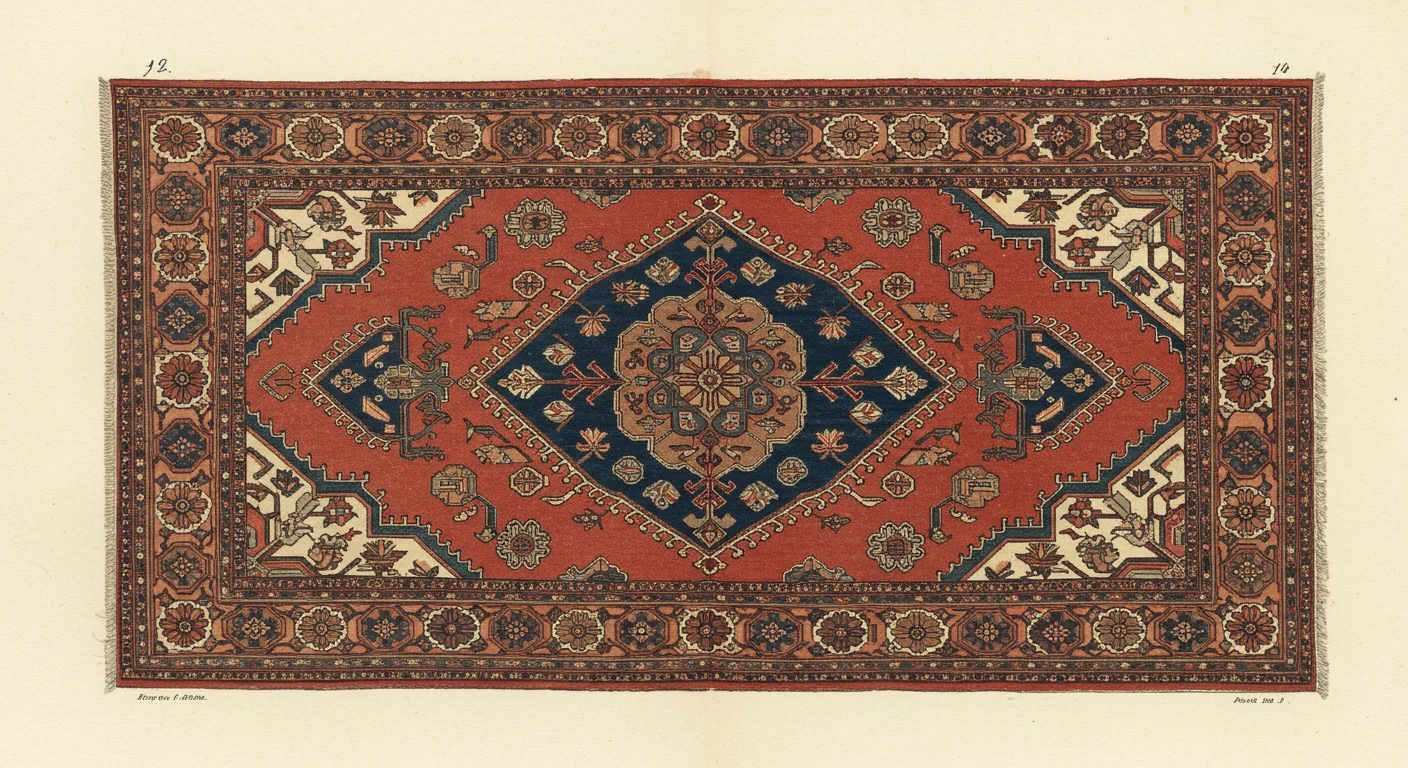
The rug at the centre of every American living room of any pretension between roughly 1890 and 1940 was, very probably, a Heriz, even when it was sold to its purchaser as something else. The piece would have measured perhaps nine feet by twelve, or ten by fourteen if the room was generous; the field would have been a brick-red verging on rust, the medallion at the centre angular and stepped, navy or indigo on the brick-red ground, the corners worked into spandrels that mirrored the shape of the medallion, the border heavy and walnut-toned. The dealer in the eastern city from which the rug had been shipped would have called it, depending on his confidence and his estimate of the customer’s gullibility, a “Persian” or an “Oriental” or — to a customer who had already learned a few terms — a “Tabriz” or a “Sultanabad” or, if the seller wished to suggest some additional age and refinement, a “Serapi.” It was, in nine cases out of ten, a Heriz: woven on a sturdy cotton foundation in the villages on the slopes east of Tabriz, in a coarser knot than its Tabriz neighbours and in a bolder geometric vocabulary than they would have countenanced. It was the great room-size rug of the Anglophone middle class, and it remains, on inspection, the type one is most likely to encounter in any American household with rugs in it at all.
This is the first post in Reading the Antique Rug, the rug arc of the new antiques series the previous post introduced. It treats Heriz first because Heriz is the type that most rewards an opening post — the most encountered, the most often mistaken for something else, and the type whose place in the wider weaving tradition makes it the cleanest first specimen against which the others can later be compared. The aim of this post is the aim of every post in the arc to come: to set out what one is looking at, to give the structural and material evidence by which one identifies it, to place it among the types most often confused with it, and to leave the reader with the trained eye that the arc as a whole is in the slow business of building.
The Specimen
The Heriz that one will encounter is, in its commonest form, a room-sized rug — somewhere between eight by ten and twelve by fifteen feet, with the nine-by-twelve and ten-by-fourteen formats accounting for the bulk of what was woven for export. Smaller pieces exist; larger pieces exist; runners and scatter rugs from the same district exist (the Karaja runner, with its row of small medallions, is the runner-form most often seen). But the canonical Heriz is the room-size piece, woven specifically for the European and American demand for carpets that would furnish a parlour or a dining room without further accompaniment.
The composition is rigorous and almost diagrammatic. There is a central medallion, bold and rectilinear, often stepped or notched at the points of a star or a stretched octagon, and almost always rendered in navy or indigo against the brick-red field. The corners of the rug carry spandrels that mirror the shape of the medallion in a quarter-iteration, locking the composition into a four-cornered frame. The field between medallion and spandrel is usually filled with smaller floral or palmette ornaments, geometric and angular in execution, set against the dominant red. The border is wide, usually carrying a stylised vine or palmette pattern in walnut or brown ground, often with an inner and outer guard band of contrasting palette. The whole composition is symmetrical along both axes, and reads as cleanly from one end as from the other — a property that mattered when the rug was being sold from a roll in a dealer’s shop and could be presented either way around to the customer.
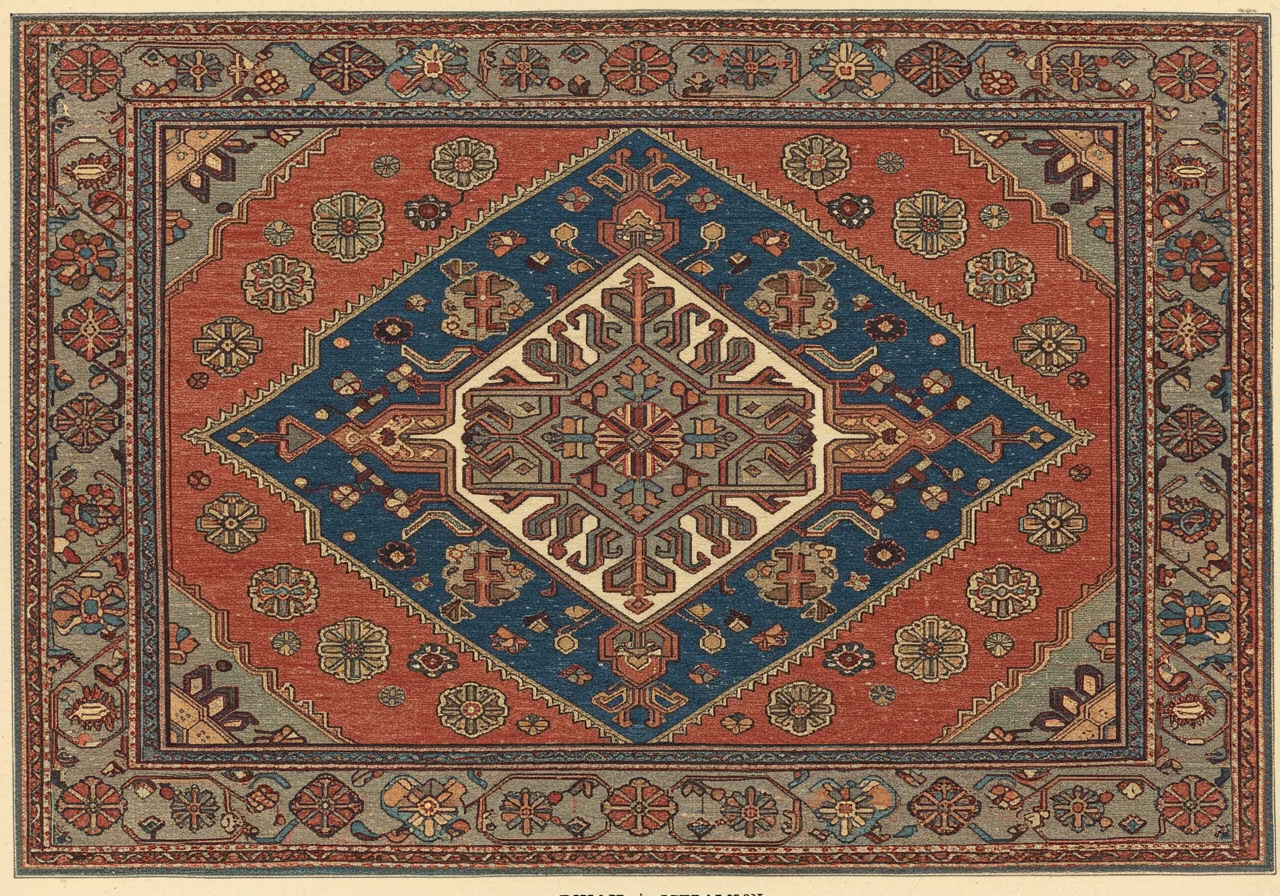
A close detail of a Heriz central medallion — the stepped octagonal indigo shape on the brick-red field, with smaller geometric palmettes and rosettes filling the surrounding ground. Every motif is rectilinear: the angular drawing is the consequence, not the limitation, of the moderate knot density. At sixty knots per square inch the curve cannot be drawn cleanly, so the medallion stems from a vocabulary of stepped polygons and rectilinear pendants. The same vocabulary, with district-specific variation, appears across the great majority of the Heriz district output of the period 1890 to 1930.
The colour palette is the first thing one’s eye registers. The dominant red is not crimson — it is a brick-red verging on rust, the colour of the local madder root from which the dye is derived, and it is the single feature most diagnostic of the type. The medallion blue is navy or indigo, deep and matte. The spandrels are usually ivory or cream, the borders walnut or brown, and a muted green appears in floral fillers and in the borders, almost always present, almost never dominant. The whole palette is anchored in earth tones — vegetable dyes worked into the locally lustrous wool — and the result is a rug that will sit happily in a room of dark wood and leather furniture and not fight with any of it. This was, one suspects, no small part of the type’s commercial success in the Edwardian and inter-war American household, where the dark wood and leather were the standard.
The construction is sturdy. The foundation — warp and weft — is cotton, which gives the rug its body and prevents the dimensional drift that wool-foundation rugs are prone to. The pile is wool, knotted in the symmetrical (Turkish) knot, which is the geographically expected knot in this part of Azerbaijan and which favours the angular geometric vocabulary the Heriz design tradition has settled on. Knot density is moderate — sixty to a hundred knots per square inch is typical — and is the explanation, not the limitation, of the rug’s bold design: one cannot draw a fine curve at sixty knots per inch, so one designs in straight lines and stepped angles, and the result is a vocabulary that one comes to read as Heriz at first glance.
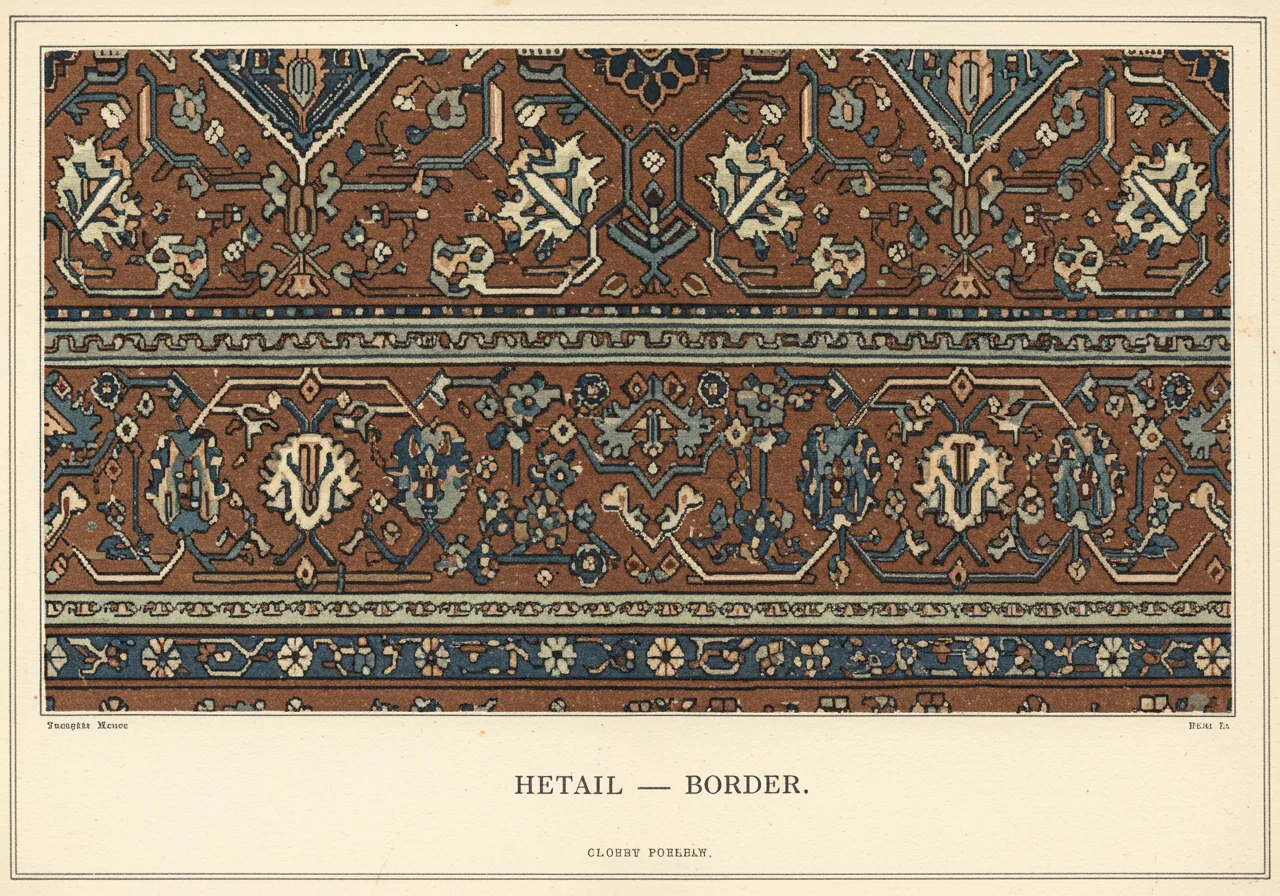
A section of the Heriz main border — a stylised vine-and-palmette pattern in walnut-brown ground, with the narrow guard bands of contrasting palette running above and below. The border vocabulary is angular throughout, in keeping with the moderate knot count, and the same border pattern, in subtle district-specific variants, appears across most of the Heriz district output of the export period. The border is, after the central medallion, the second feature one identifies at a distance — its proportions and palette are characteristic of the type.
The Evidence
Behind the visible composition is the structural evidence by which a Heriz is identified at close range and its provenance dated.
The knot, as noted, is Turkish — symmetrical — with the wool wrapped around two adjacent warps and the loose ends pulled down between them. A Persian (asymmetrical) knot in a rug of this design would mark it as something else: most likely a Tabriz attempting Heriz vocabulary, or a Mahal from the Sultanabad region, or one of several other workshop products that have copied the Heriz format. The knot is most easily inspected from the back of the rug, where the rows of small bumps reveal the structure plainly to the trained eye, and where the colour visible through the knots gives a second confirmation of the dye palette.
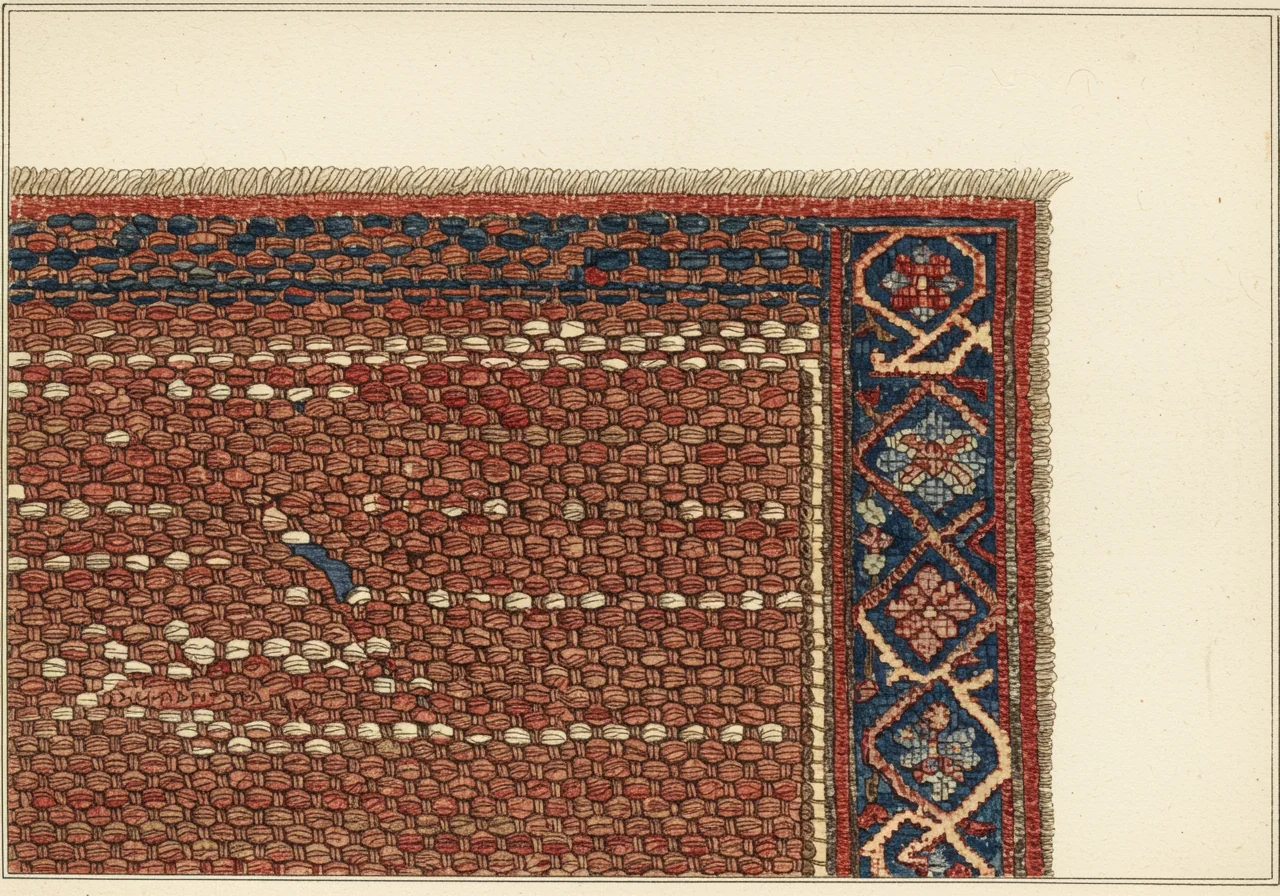
The back of a Heriz rug at magnification — the symmetrical Turkish knots arranged in regular rows on a doubled cotton weft, the cotton foundation visible at the selvedge and along the short kilim end-finish above the fringe, the colours of the field showing through the structure. The great majority of any Heriz attribution can be made from this side of the rug: the knot type, the doubled weft, the cotton foundation, the dye palette, and the knot density are all visible at once. A trained eye spends as much time looking at the back of an unfamiliar rug as at the front, and often more.
The weft is doubled — two passes of cotton weft between each row of knots, which gives the Heriz its characteristic body and keeps the rug lying flat against the floor. A Hamadan rug, which uses a single weft, will be visibly thinner in the hand. A Bidjar, which packs its wefts more densely still, will be famously stiff — the “iron rug of Persia,” as the trade has long called it. Heriz sits firmly between the two, which is one of the reasons it became the favoured room-size export of the late nineteenth and early twentieth centuries: heavy enough to lie flat under furniture, supple enough to roll for shipment.
The wool of the pile is the second physical signature. Heriz wool comes from local sheep grazed on the high pasture above the villages, and it is high in lanolin, lustrous, and takes the natural dyes generously. An old Heriz, after a century of household weather, develops a patina that synthetic-dyed and carded wool simply cannot reproduce. The colours soften and blend; the pile, where the household traffic has worn it, takes on a silvery sheen against the unworn margins. A Heriz that has been in a room for fifty years looks unmistakably so, and a great deal of the satisfaction of an old Heriz is in this slow textural ageing.
The dyes, in the older pieces, are entirely vegetable. Madder for the brick-red and the rust; indigo for the navy and the deeper blues; walnut hull for the brown borders; weld or the local pomegranate rind for the yellows; cochineal occasionally for accent reds. The vegetable dyes age in particular ways — the indigo never quite leaves; the madder reds soften into apricot and salmon at the worn edges; the yellows shift towards old gold. A Heriz from after the first decade of the twentieth century may show the chemical-aniline reds and synthetic dyes that arrived in the region around then; the difference, to a trained eye, is immediate — the synthetic reds are sharper, more uniform across the field, and they age into a flat dull tone rather than into the layered patina the vegetable dyes produce. The trade name for that flatness, when one finds it on an otherwise honest old rug, is “tea-washed” or “chemically treated”; it is the residue of an attempt, often midway through the rug’s life, to artificially soften the harsh aniline tones into something approximating the look of vegetable dye. It rarely succeeds.
The selvedges of a Heriz are wrapped in wool, usually of the dominant border colour, and the ends are typically finished with a short kilim section before the fringe. The fringe itself is the cotton warp continued and tied off; the older the rug, the shorter the surviving fringe, since the fringes are what household wear takes first and what dealers most often shorten in the course of repair.
These are the physical facts. They are what one is reading for. None of them, in the older pieces, is concealed. All of them are on the back of the rug if one knows to turn it over.
The Region
Heriz is the district name. The rugs come from the villages of Heriz proper, plus Mehraban, Ahar, Bakshaish, Karaja, and a number of smaller villages, all clustered on the slope of the Sahand mountain east of Tabriz in what is now Iran’s East Azerbaijan province. The district sits at perhaps fifteen hundred metres’ elevation, with cold winters and brief summers, on the northwestern edge of the Iranian plateau. The population is largely Azeri Turkic — which is the explanation for the Turkish knot — and the weaving tradition, as best one can reconstruct it, runs back several centuries before the rugs that became famous in the European market.
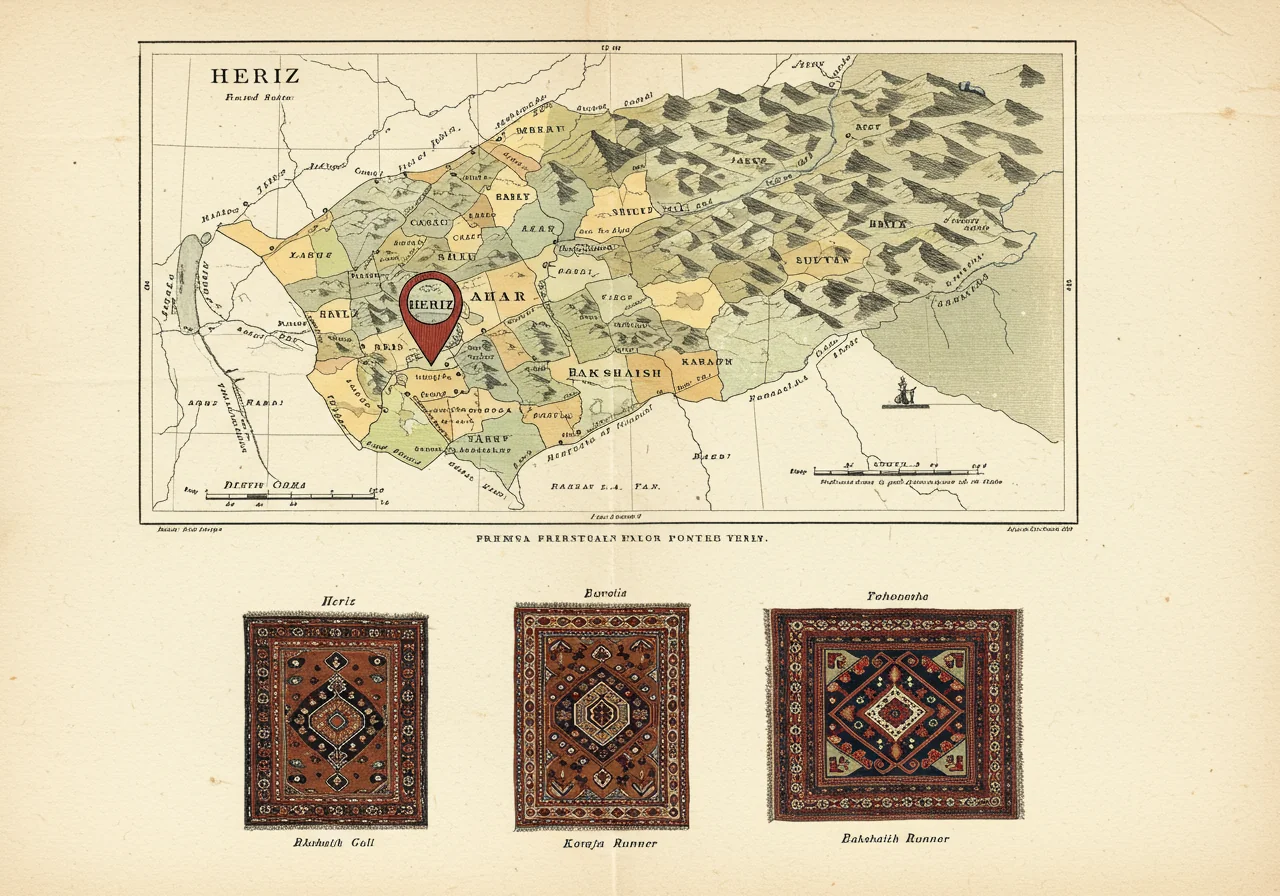
A page from a Victorian connoisseur’s portfolio on the Heriz district — the district map locating the principal weaving villages (Heriz proper, Mehraban, Ahar, Bakshaish, Karaja) on the slope of the Sahand mountain east of Tabriz, with three small archetype rug drawings at the bottom showing the principal sub-type designs (Heriz, Serapi, and Bakshaish). The plate is the kind of reference page that would have appeared in a serious dealer’s portfolio of the period, intended for the customer’s quiet education while the dealer fetched the next rug from the storeroom.
The European and American collecting market knows Heriz, however, almost entirely as a phenomenon of the late nineteenth and early twentieth centuries. Two things made the Heriz the great export rug of that period. The first was the Tabriz merchants, who from roughly 1880 onward organised the district’s weaving on a workshop and merchant-distribution basis — supplying cartoons, dyes, and in some cases warps to village weavers, then collecting the finished pieces for shipment to the Tabriz bazaar and from there to Constantinople, Vienna, London, New York, and Boston. The second was the European and American demand for room-size carpets in the brick-red-and-navy palette that the Heriz tradition was already producing for its own use. The convergence of that demand and that organisation is what made the Heriz of the years 1890 to 1930 the Heriz one most often encounters today.
A note on naming, because the trade vocabulary is more particular than the broad term Heriz might suggest. Heriz is the modern collector’s term for the district output broadly. Among older or more careful dealers, several finer distinctions are made.
Serapi is the trade-name applied to Heriz district rugs from before the 1890 commercial reorganisation — looser drawing, softer colour palette (apricots, faded madder, old rose, more open spandrels), simpler ornament, often slightly larger formats. The name itself appears to be a Western corruption of Serab, the name of a town in the district; the term has come to mean, in practice, “antique Heriz of better quality than the post-1890 commercial run.” It is not a separate weaving tradition; it is the same district at an earlier moment, and the price differential between an antique Serapi and a comparable but later Heriz can be substantial.
Bakshaish refers specifically to rugs from the village of that name, often older still than Serapi, with more primitive geometric vocabulary, occasional “elephant foot” gul motifs of clearly tribal provenance, and a strong following among current collectors who prize the quality of the older drawing and the unstandardised character of the older weaving.
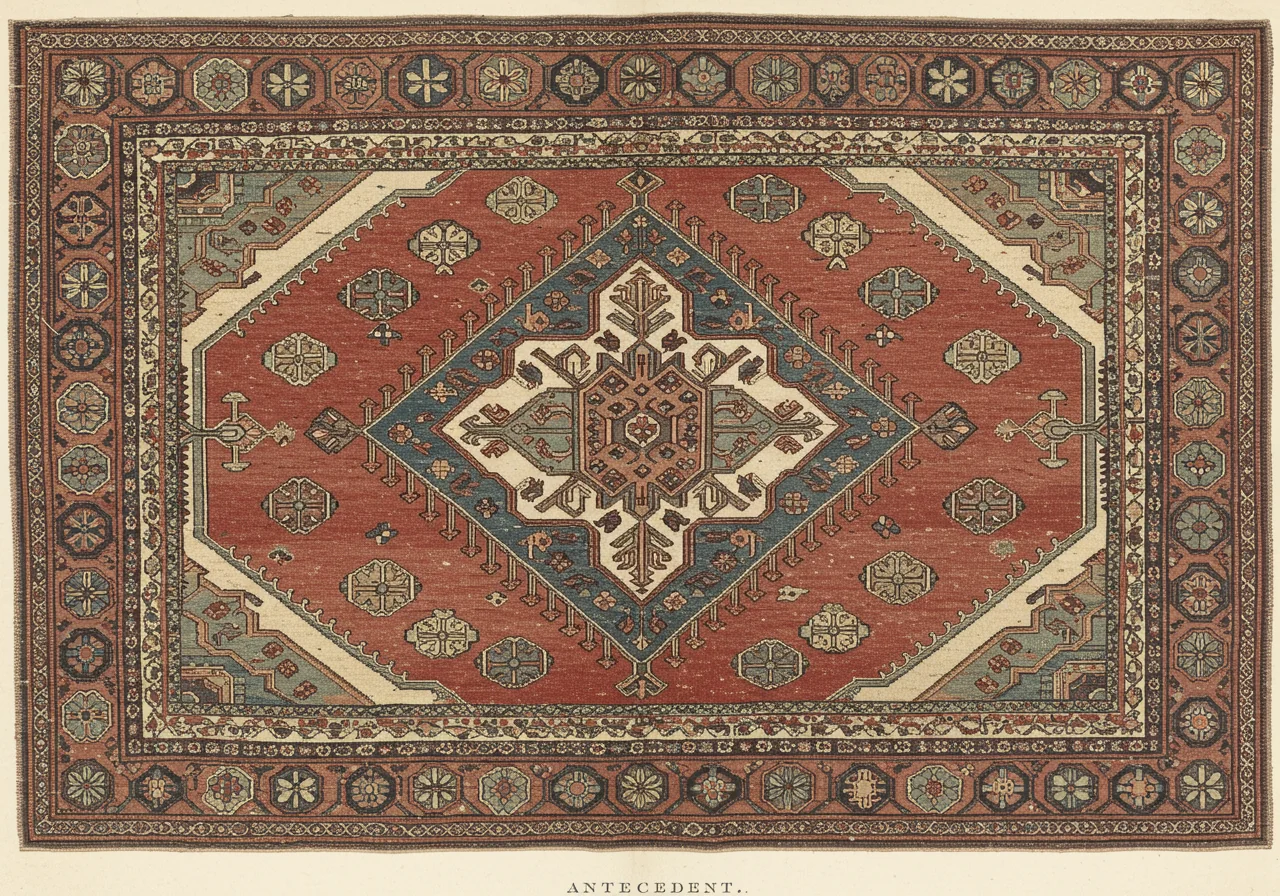
An antique Bakshaish village rug from the Heriz district — softer madder-rose palette, looser drawing, narrower borders, and the more primitive geometric vocabulary out of which the standardised post-1890 Heriz format emerged. Bakshaish remains the most-collected of the Heriz district sub-types, valued for the unstandardised handmade character of the older village tradition and the older vegetable-dye palette that the workshop-organised Heriz could not always match. The relationship between Bakshaish and Heriz is the relationship between an older village craft and the merchant-organised export production that descended from it.
Karaja refers to the Karaja village output — usually small pieces and runners with distinctive multi-medallion compositions, often mistaken for Caucasian work because of the medallion vocabulary. Mehraban and Ahar are slightly finer Heriz-style work from those particular villages, and a few more granular village names occasionally appear in dealer descriptions of pieces with particularly distinctive provenance.
All of these are Heriz district rugs in the structural sense; the trade names are the dealer-and-collector vocabulary for finer distinctions one learns to make over time. A reasonable working approach for the beginner is to use Heriz as the type name, recognise Serapi and Bakshaish and Karaja as the principal sub-distinctions, and treat any further village-specific naming with a degree of polite scepticism unless the dealer can show how the attribution was arrived at.
What It Is Not
Most of the rugs that get called Heriz are Heriz. A few are not, and the distinctions are worth carrying in mind.
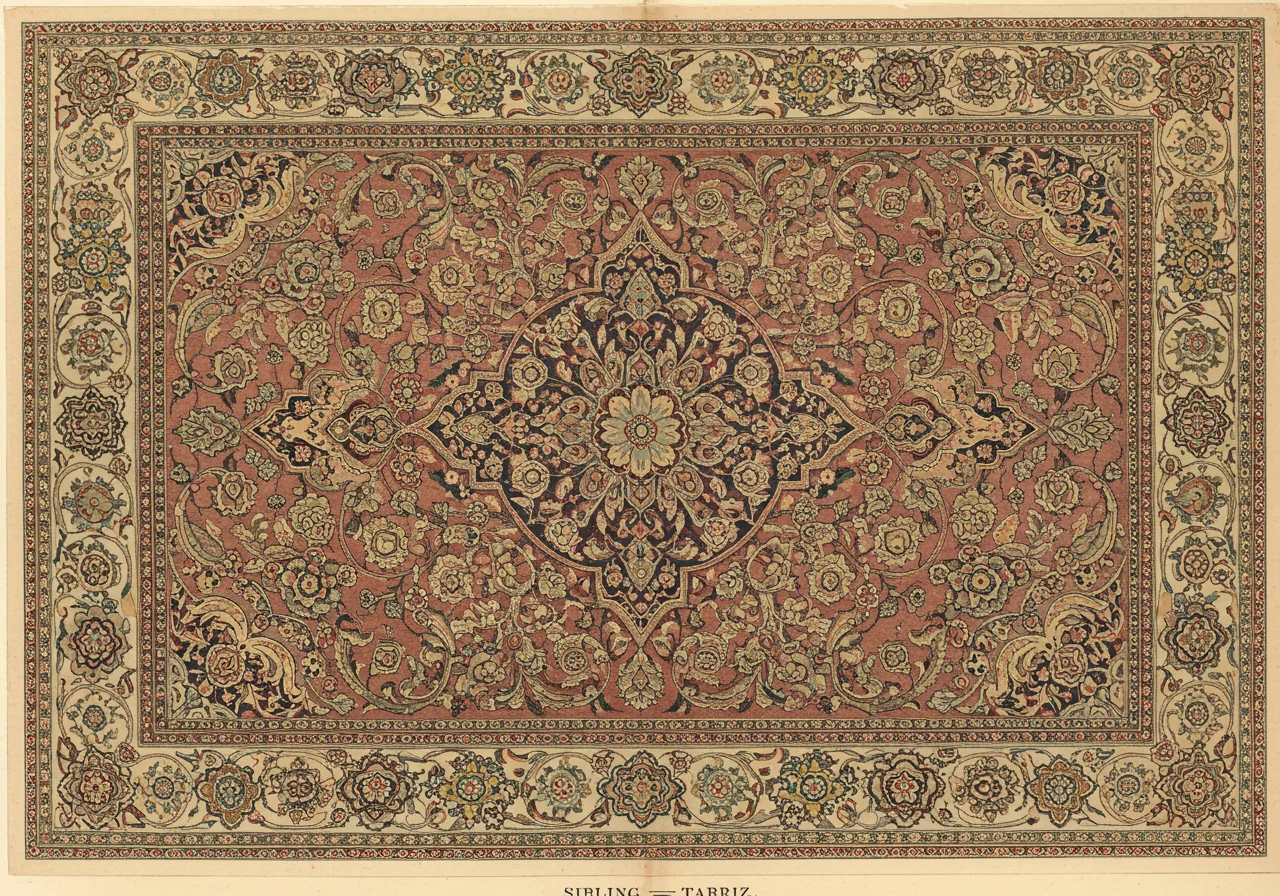
A Tabriz is the city-workshop rug from the city sixty kilometres away. Tabriz uses curvilinear floral and arabesque vocabulary — sweeping vines, leaves rendered with curves rather than steps, central medallions of intricate scroll-work — and a substantially finer knot count, often a hundred and fifty or more knots per square inch. A “village Tabriz” or coarser Tabriz can superficially resemble a Heriz in its medallion-and-spandrel layout, but the floral elements give it away on close inspection: a Heriz rendering of a leaf is a stepped polygon; a Tabriz rendering of a leaf is a curve.
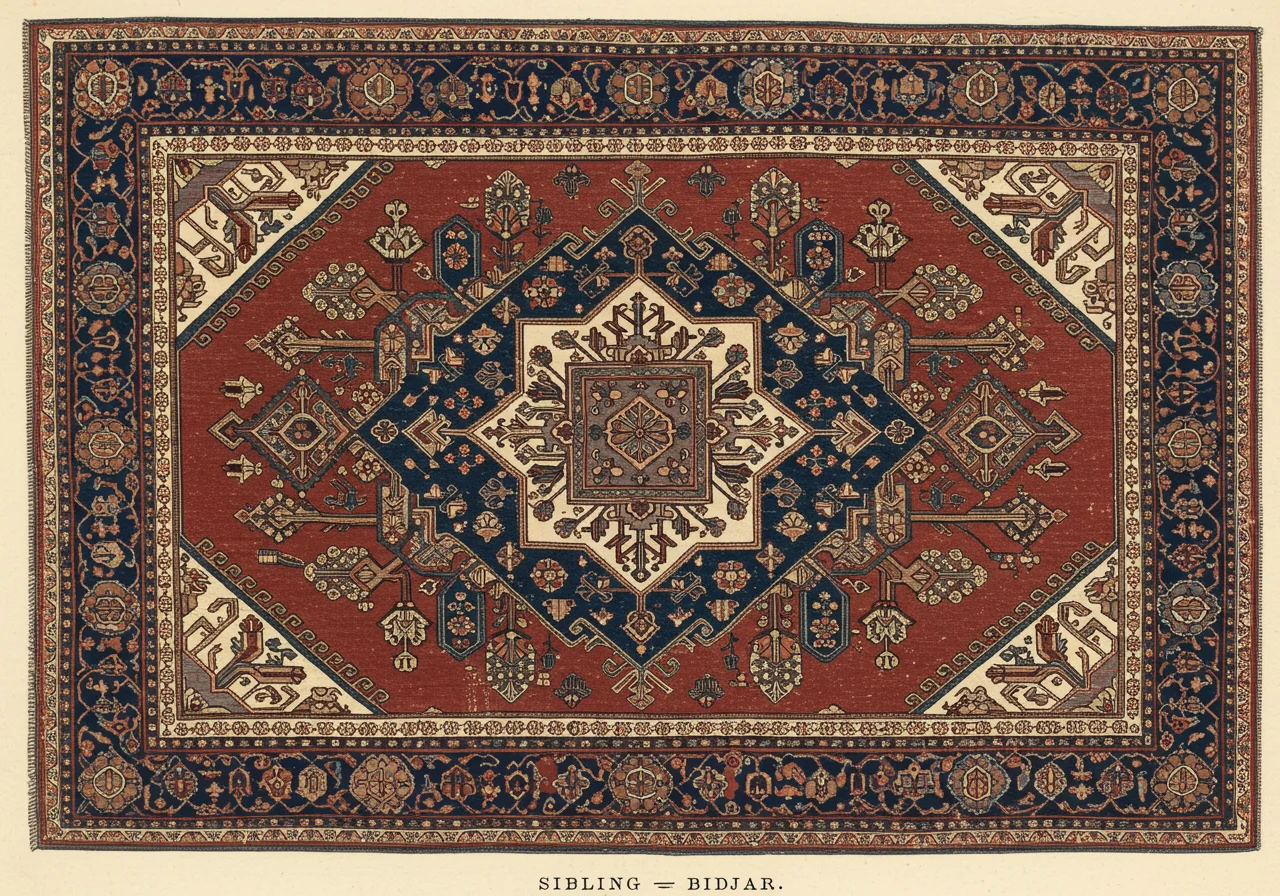
A Bidjar is the Kurdish-region rug from west of Hamadan. Bidjar uses geometric medallions and shares some of Heriz’s bold-pattern aesthetic, but it is a wool-foundation rug rather than cotton, packed extremely densely (a Bidjar is famously stiff and heavy, the “iron rug of Persia”), and the palette runs to deeper, more saturated reds and blues. A Bidjar will not lie down flat and limp the way a Heriz will; lift the corner and the difference is immediate.
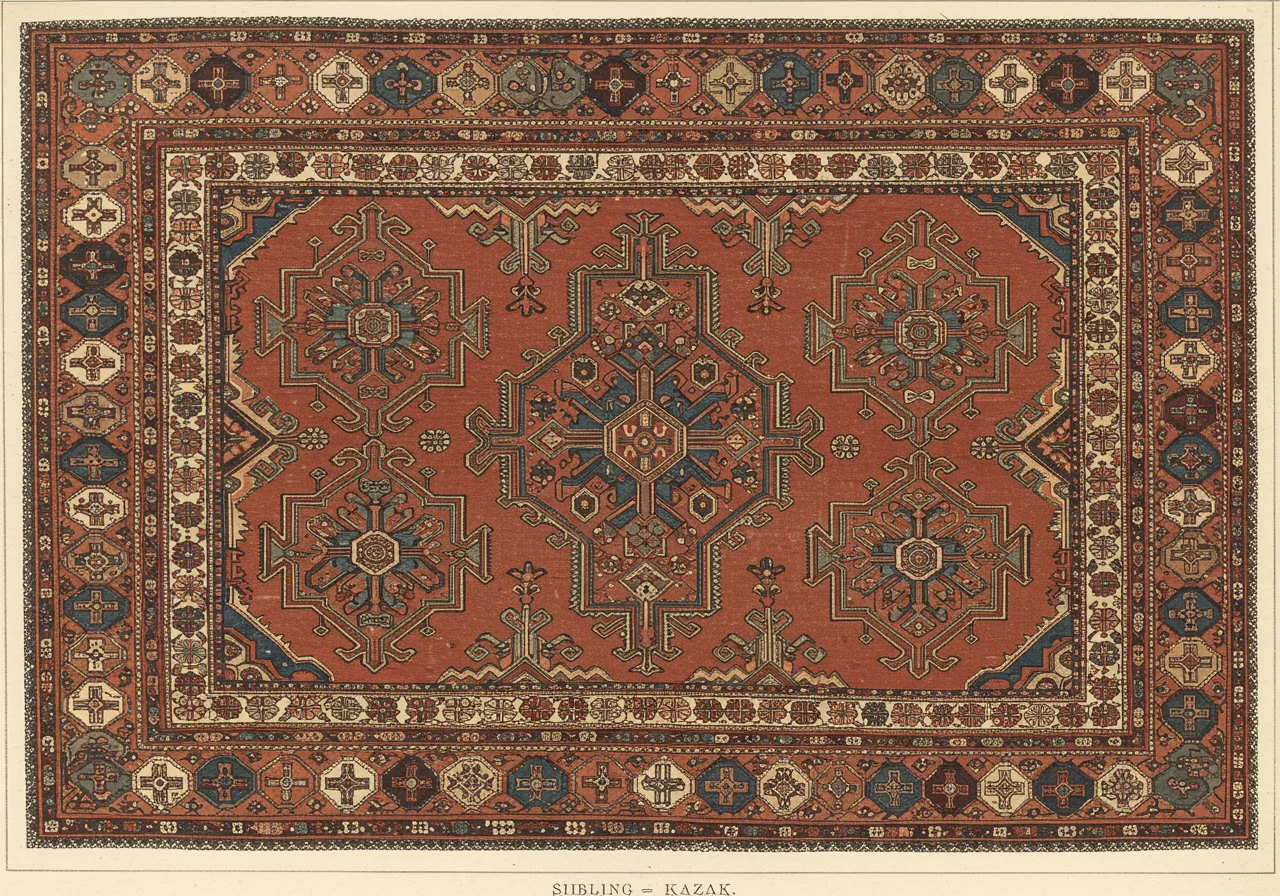
A Caucasian Kazak is the bold geometric rug from north of Heriz, in what is now Azerbaijan and Armenia. Kazak shares Heriz’s geometric design vocabulary and its brick-red-and-navy palette, but the design vocabulary is different — large primitive medallions of “Memling gul” or “lesghi star” type, latch-hook borders, often a row of small geometric motifs in the spandrels, and the foundation is wool rather than cotton. Smaller formats than Heriz, almost never room-sized. A Kazak feels different in the hand — looser, more flexible, the wool-on-wool construction giving it a different drape across one’s lap.
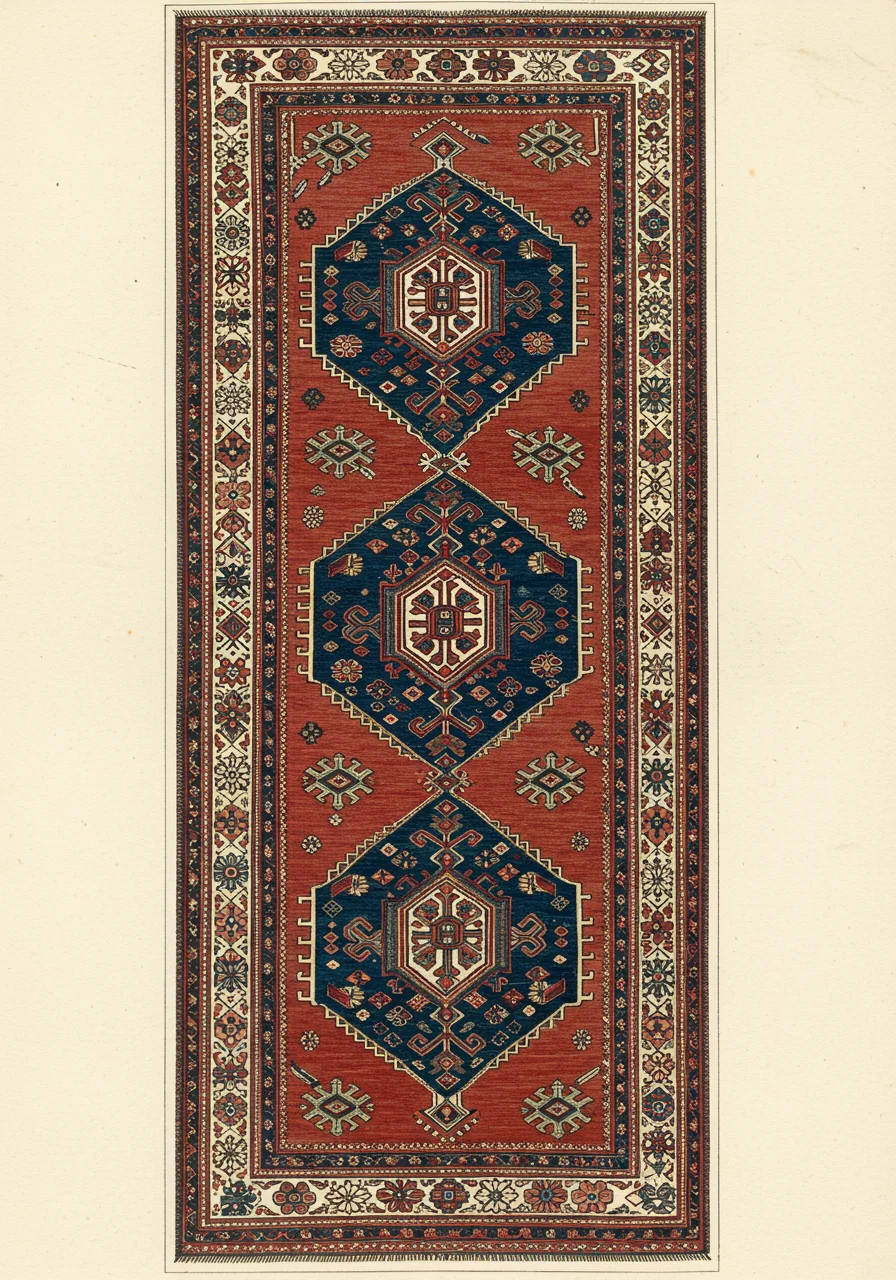
A Karaja is technically a Heriz district rug but is so distinctive in format that it deserves separate mention. Karaja is the runner specialist of the district — long thin pieces with a row of three or five small medallions arranged along the length, often confused with Caucasian work because of the medallion vocabulary. A Karaja is identifiable by its cotton foundation (the Caucasian rugs being wool-foundation), its Turkish knot (consistent with the Heriz district), and the particular character of its small-medallion composition, which one comes to recognise.
A Mahal or Sultanabad is the rug from the workshop tradition of the Sultanabad region in central Iran (modern Arak), organised by Western merchants — Ziegler chiefly — from the 1880s onwards specifically to supply the European and American market. Mahal rugs use the same broad Heriz palette but a different design vocabulary — allover floral in the field rather than medallion-and-spandrel, softer drawing, often a more open ground. The two rug types competed in the same export market and are sometimes shelved together in dealers’ inventories; the design distinction is the easiest separator.
These are the most-confused-with types. There are others — Hamadan, Sarouk, Mahal of various sub-types, Mashad in its larger formats — but the four above account for the great majority of misattributions one will encounter in the wild.
What One Looks At
The practical discipline of identifying a Heriz, when one is standing in front of a candidate rug, comes down to a short ordered checklist.
One looks first at the design vocabulary. Stepped, angular, geometric medallion with mirroring spandrels, brick-red field, navy medallion, walnut border, ivory spandrels — this is the Heriz signature. If the design is curvilinear, it is not a Heriz. If the medallion is a Memling gul or a lesghi star and the field is full of small repeating motifs, it is probably Caucasian. If the field is allover floral with no central medallion, it is probably a Mahal or Sarouk.
One looks next at the foundation. Cotton warp and weft is the Heriz norm; wool foundation makes it a Caucasian piece or possibly a very early Bakshaish. The foundation is visible at the ends and along the selvedges, and on the back of the rug between the knots.
One looks next at the knot. Symmetrical (Turkish) on the back; if asymmetrical (Persian), it is not a Heriz. One looks at the knot density: sixty to a hundred per square inch; if much higher, it is probably a Tabriz; if much lower, possibly a Caucasian piece or a coarser village product from elsewhere.
One looks at the wool — its lustre, its lanolin content, the quality of the pile. Old Heriz wool has a particular sheen that synthetic-dyed and carded modern wool lacks, and a pile that has worn unevenly over decades of household traffic looks very different from a pile that has been chemically aged.
One looks at the dyes. Vegetable dyes age into patina; aniline dyes age into flatness. In the older pieces (pre-1900), one is looking at vegetable dyes throughout. In the post-1900 commercial pieces, one may see a mix; in modern Heriz, frequently aniline throughout. The “abrash” — the slight horizontal banding of colour as the dyer’s batches changed — is a positive sign in an older piece; an absolutely uniform field suggests a single industrial dye-lot, which is the modern signature.
And one looks at the wear pattern. A Heriz that has been in a household for fifty years shows wear in a very particular way — silvery patches in the high-traffic centre, more saturated colour in the protected margins, a softening of the dyes that synthetic ageing cannot reproduce. The wear is, in itself, evidence of provenance.
That is the discipline. With it, one can stand in front of any candidate rug and, in the better part of ten minutes, give a defensible attribution. Without it, one is at the mercy of the dealer’s confidence — which, as the opening of this post observed, is not always reliable.
The next post in the arc will be either Tabriz — to set out the city workshop tradition that Heriz both grew up beside and distinguished itself from — or Bakshaish, the older village tradition out of which Heriz proper grew. The choice will depend on what photographic material is available at the time of writing.