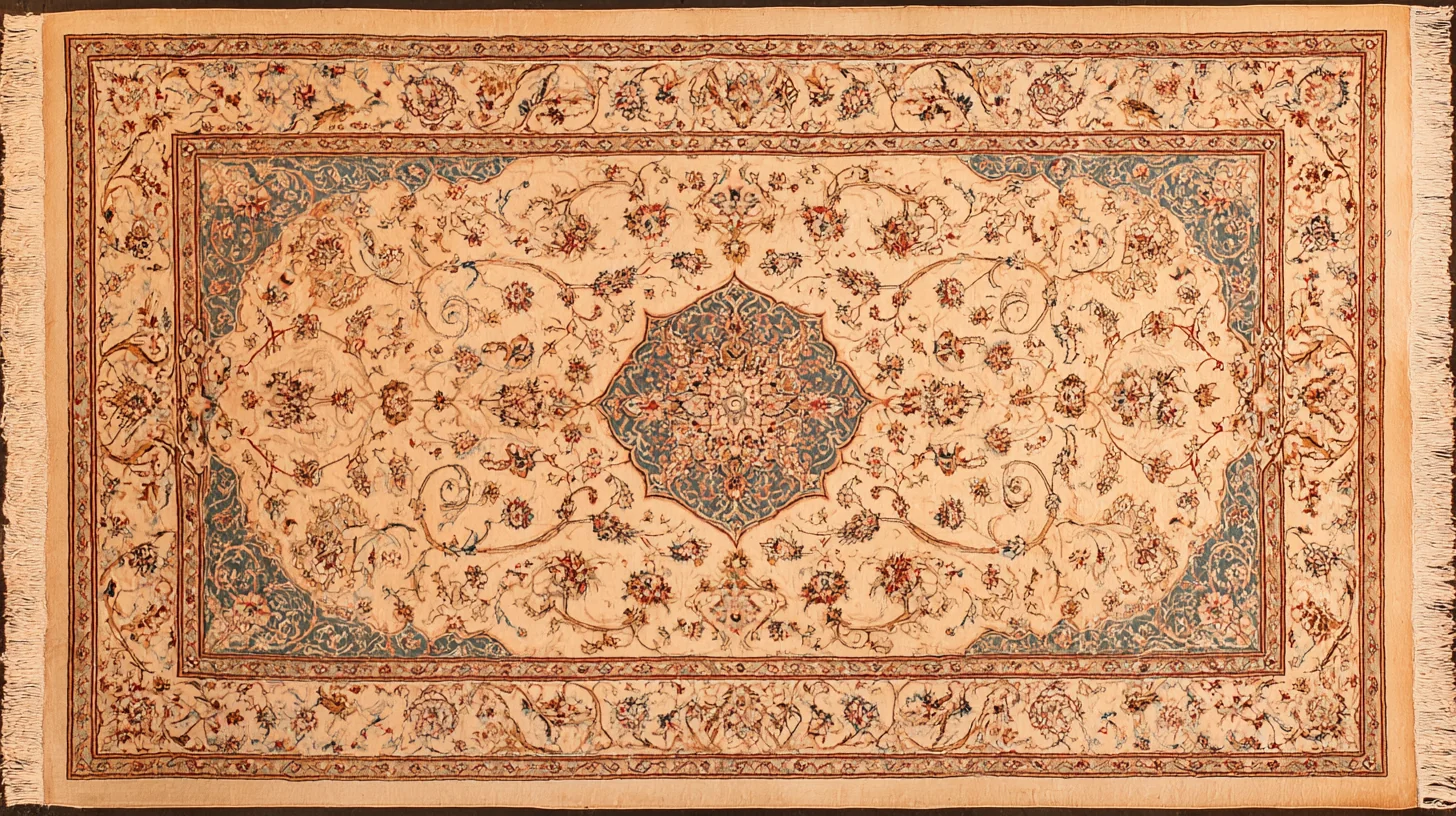
The fifth post in this arc treated Kashan, and it opened the central Persian court register by setting the urban workshop against the village loom — the designed composition against the vernacular one, the fine knot against the moderate, the deep saturated wine-red ground against the soft cream of the village dye-pot. Kashan’s sibling-plate carried, in its first corner, a rug it called the Safavid court rival, and named it Isfahan. The tenth post, on the Oushak, closed by promising that the arc would return to that rival and treat it on its own ground. This is that post. It treats Isfahan in the position the arc has reserved for the central Persian court tradition’s silk-warp apex — the pale-ground city weaving that stands to Kashan’s wine-red as the other half of one tradition, and that carries, more directly than any rug in this account, the freight of a great historical name.
This is the eleventh post in Reading the Antique Rug. The Isfahan is the second rug in the arc that one must hold in two eras at once, and the difficulty is sharper here than it was even for the Oushak. There is a Safavid Isfahan — the court carpet of Shah Abbas, woven in the royal workshops of the late sixteenth and early seventeenth centuries, among the supreme achievements of the loom in any tradition anywhere. And there is a modern Isfahan — the fine city rug of the twentieth-century revival, woven on a silk warp at extraordinary density, which is the rug the word “Isfahan” denotes in nearly every practical case a collector will meet. The post must carry both, and it must keep them firmly apart; that double reading, with the great name standing behind the lesser object, is one of the two load-bearing distinctions here. The other is structural, and one meets it the moment one turns the rug over.
The Specimen
An Isfahan that one will most commonly encounter is a modern rug — a twentieth-century weaving of the revival, and not a Safavid antiquity — and it is, in its commonest form, a piece of moderate rather than grand size: a scatter rug, a four-by-six or a small dozar, a six-by-nine on the larger examples, the format itself a consequence of how the revival workshops sold their work. The Isfahan was woven small because it was woven fine, and a fine rug at room size is an undertaking of years. The first thing to settle, before any motif is read, is the ground, because the Isfahan ground is the type’s signature in the way the wine-red field was the Kashan’s. It is a pale ground — a soft ivory, a warm cream, occasionally a pale and luminous blue — and against that pale field the design is drawn principally in indigo, with accents of a clear soft red, a celadon green, a gold. The palette is restrained and it is luminous, and the two qualities are connected: the Isfahan does not crowd its colours, it spaces them, and the pale ground lets each one register cleanly. One sets an Isfahan beside a Kashan and the relation is immediately legible — the same central Persian court vocabulary, the same designed precision, but keyed to light where the Kashan was keyed to depth. They are the two grounds of one tradition.
The design completes the specimen, and it is the classical shah-abbasi vocabulary, named for the Safavid ruler whose workshops fixed it. The composition is either a central medallion on an open field, or — the more characteristically Isfahan choice — an allover design with no medallion at all: a field covered edge to edge with shah-abbasi palmettes, large lobed flower-forms set on a system of scrolling vinework that runs the whole surface in a continuous, disciplined lattice. There are cloud-bands and fine floral arabesques; there are, on the best pieces, small birds and animals worked into the vinework with a draughtsman’s confidence. The drawing is curvilinear in the strict sense — there is not a stepped or geometric form anywhere in a true Isfahan — and it is disciplined curvilinear drawing, which is the quality that most distinguishes the type. An Oushak medallion was loose by design and admired for the looseness; an Isfahan palmette is taut, exact, and resolved, every lobe drawn to its intended curve, and the exactness is the point.
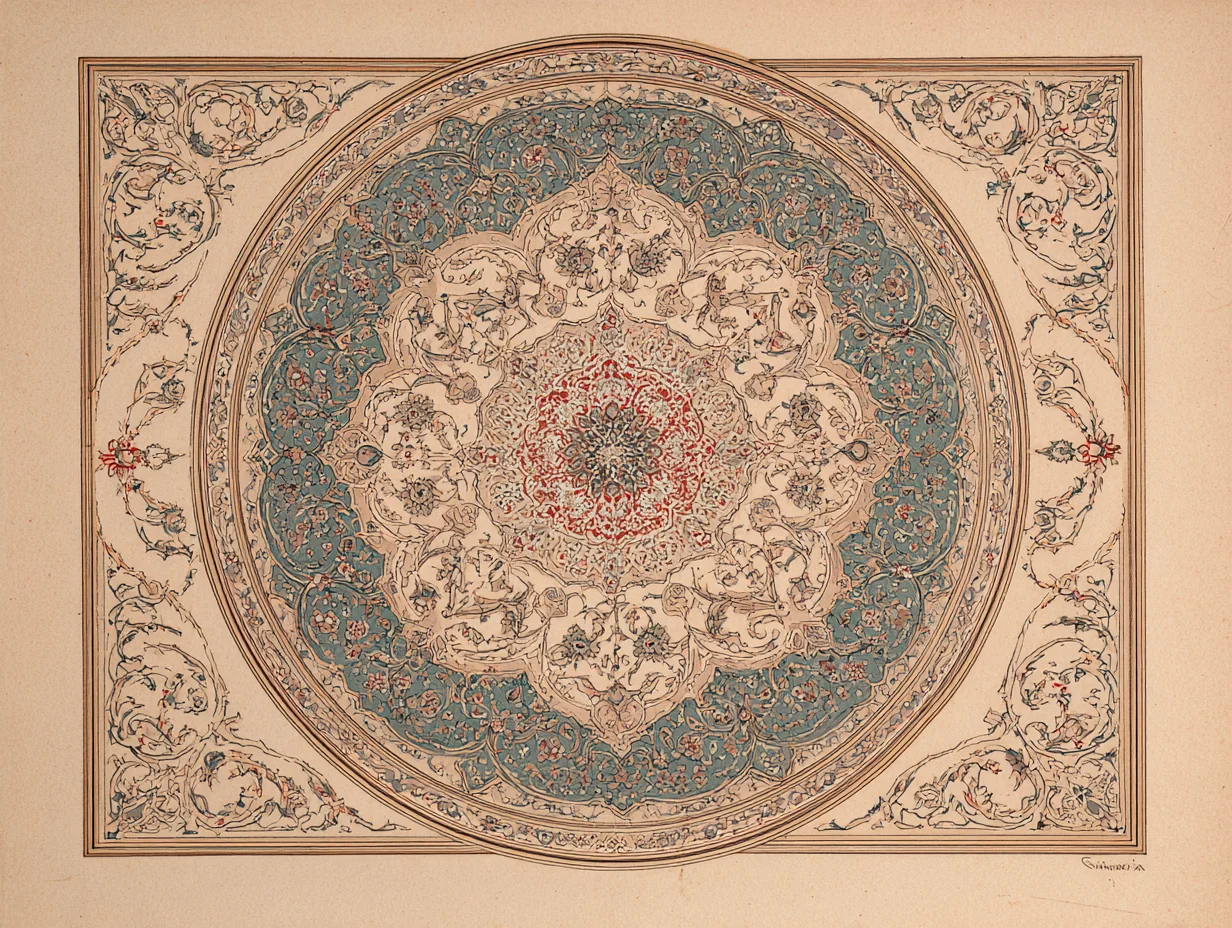
A close detail of an Isfahan central medallion — the fine Safavid-derived court vocabulary on an ivory ground, the silk warp visible where the pile thins.
The Evidence
The foundation is the structural evidence, and for the Isfahan it is the load-bearing fact of the whole post — the single observation that, once made, has settled most of the attribution. The modern Isfahan is woven on a silk warp. One turns the rug over, parts the pile at a worn place or examines the fringe where the warp ends emerge, and the warp threads are silk: fine, strong, faintly lustrous, of a different order altogether from the cotton warp that carried the Kashan and the Tabriz and the whole northwestern Persian district. This is not decoration and it is not a flourish for the eye — silk is invisible underfoot, buried in the structure, doing nothing the buyer can see. It is doing something the buyer can feel. (The more ordinary commercial grades are carried on cotton; it is the fine workshop Isfahan that takes the silk warp as a matter of course, and it is the fine workshop Isfahan this post is about.) A silk warp is finer than a cotton warp and far stronger for its diameter, and a finer warp permits the weaver to set the warps closer together and tie a smaller knot between them. The silk warp is the structural enabling condition of everything else the Isfahan is admired for. It is the reason the rug can be knotted as fine as it is; it is the reason the handle is what it is. One does not buy the silk warp for itself. One buys what the silk warp made possible.
What it made possible is the knot density, and the Isfahan knot density is extraordinary. The rug is tied with the asymmetric Persian knot, as the central Persian court tradition is throughout, and the modern workshop pieces run to a fineness that the village registers of this arc could not approach and that even Kashan reached only at its silk-warp apex — three hundred knots to the square inch on ordinary good work, four hundred and well beyond on the finer workshop pieces, the very finest examples climbing past anything it is useful to quote a number for. The wool of the pile is of the highest grade, soft and tightly spun and clipped low so that the drawing reads crisply; on the best pieces the weaver sets passages of silk pile into the design — a highlight, a flower-head, the heart of a palmette — so that the silk catches light where the wool holds it, and the surface shifts as one walks around the rug. The handle that all of this produces is the practised hand’s confirmation of the practised eye: a true Isfahan is firm, fine, and notably flat — it does not have the supple drape of the wool-foundation Oushak nor the plank-like heaviness of the Bidjar, but a thin, dense, even-tensioned body that the silk warp draws tight and keeps tight.
The last evidence is the signature, particular to the best of the modern Isfahans. The finest twentieth-century workshops signed their work — wove a small cartouche, usually into one end of the field or the border, carrying the name of the master-weaver or the atelier — and the names so woven are real, citable, and known to the trade. The most celebrated is Seirafian: the workshop of Hadji Agha Reza Seirafian and his sons, the most famous Isfahan atelier of the twentieth century, whose signed pieces are the benchmark of the modern type and command the upper end of its market by a wide margin. A signature is not, in itself, a guarantee — signatures are forged, and an unsigned rug from a great workshop may outweave a signed one from a lesser — but a Seirafian cartouche on a rug whose foundation, knot, and drawing all corroborate it is the documentary apex of the modern Isfahan.
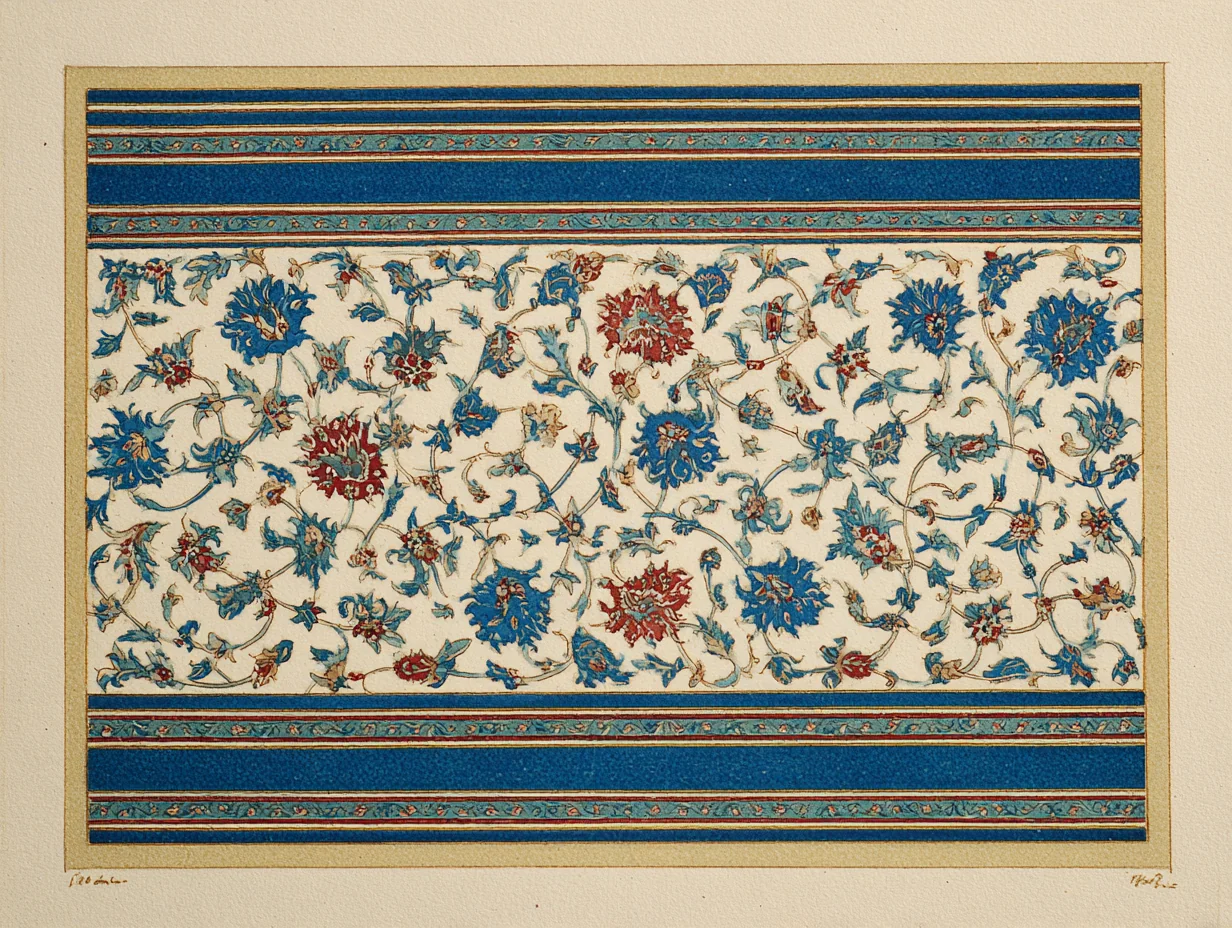
A close detail of an Isfahan main border — the fine palmette repeat in the silk-warp court tradition, drawn at the workshop density that distinguishes Isfahan from Kashan.
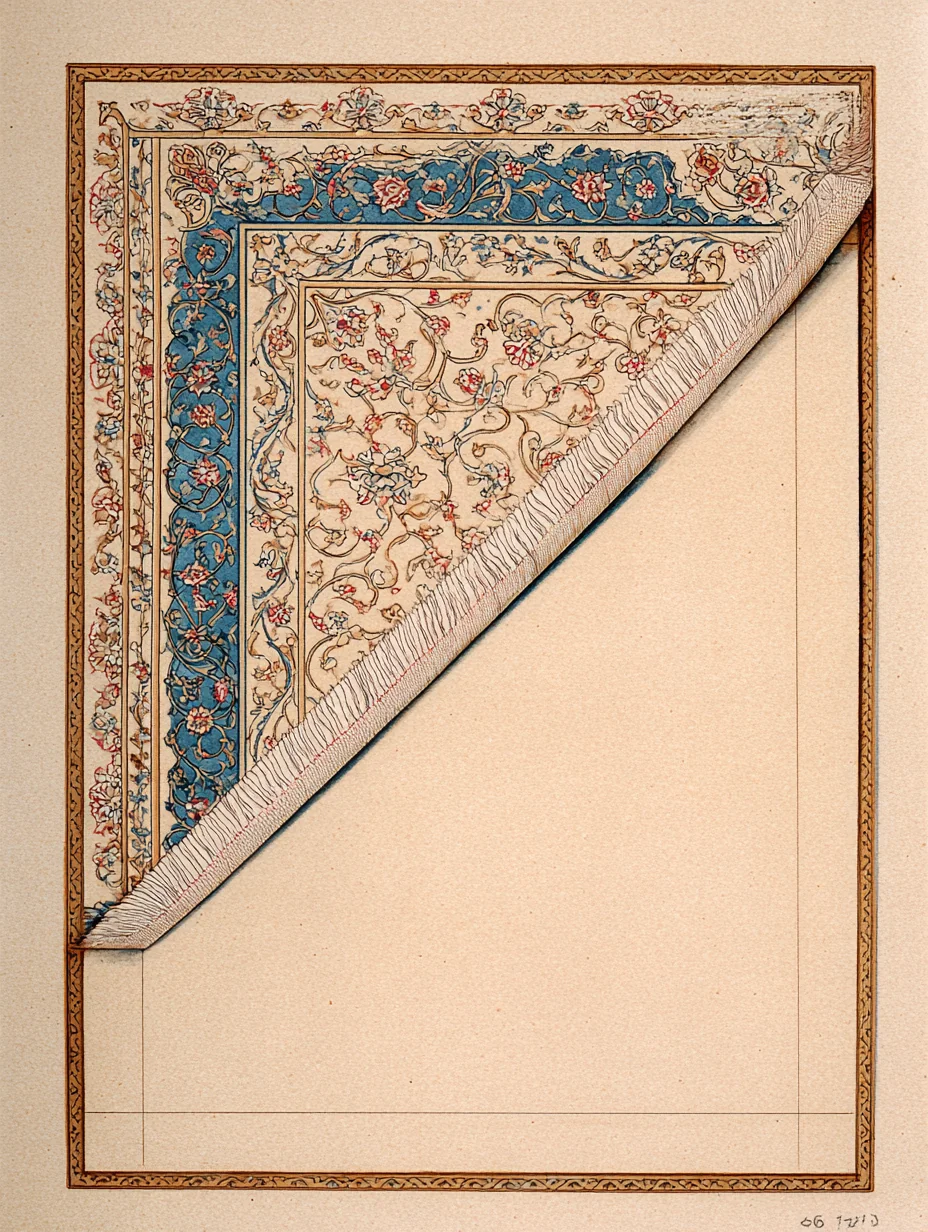
A close detail of the back of an Isfahan rug — the silk warp visible at the foundation, the fine knot density (400+ KPSI), the workshop regularity that the named master-weavers’ workshops achieved.
The Period
Isfahan sits near the centre of the Iranian plateau, on the Zayandeh river, on the old route between the central deserts and the southern provinces; and it carries, as no other rug in this arc does, the weight of having been a capital. In 1598 Shah Abbas I — the greatest of the Safavid rulers, whose reign ran from 1588 to 1629 — transferred the seat of his empire to Isfahan and rebuilt it as the showpiece of his dynasty. The city he made was one of the wonders of the age: its great square, its blue-tiled mosques, its bridges and gardens drew the admiration of every European traveller who reached it, and the proverb the Persians coined for it — that Isfahan was half the world — was not, by the standards of 1600, an extravagant one. Into that capital Shah Abbas gathered the crafts of his empire, and among them, organised under royal patronage, were the carpet workshops. The Safavid court carpet of the Shah Abbas period — the central-medallion and the allover-shah-abbasi designs, woven in silk and in wool-on-silk at a fineness and a chromatic richness that had never been seen before and would not be matched for three centuries — is the deep antecedent of everything this post describes. It is the source of the vocabulary; it is the reason the word “Isfahan” carries what it carries. It is also, one must be plain about it, not the rug a collector buys.
For the Safavid achievement did not last. The dynasty declined through the seventeenth century, and in 1722 an Afghan army besieged and took Isfahan, ending Safavid rule and the royal patronage on which the great workshops depended. The eighteenth century and the early nineteenth were, for Isfahan weaving, a long quiet — the looms did not stop altogether, but the court production that had been the tradition’s glory was gone, and the city wove, when it wove, as an ordinary provincial centre. The grand line was broken for some two hundred years.
The revival is the period the collector actually meets, and it is a twentieth-century event. From the opening decades of the century the Isfahan workshops were re-established — deliberately, and with the Safavid models consciously in view — and over the following fifty years they rebuilt the tradition to a quality that, by the middle of the century, stood comparison with anything the looms of Persia had ever produced. The revival did not copy the Safavid carpets so much as resume their grammar: the shah-abbasi palmette, the scrolling vine, the pale luminous ground, the disciplined curvilinear hand. It did so on a silk-warp foundation at knot densities that the named workshops — Seirafian foremost among them — drove steadily upward, and the finest Isfahans of the 1940s, ’50s, and ’60s are, by broad agreement of the trade, the finest Persian rugs of the modern era. The market for them survived the upheavals of the later century, and a signed mid-century Isfahan in good condition remains one of the most valuable categories of twentieth-century rug. The collector should hold the chronology plainly: the great Isfahan name is sixteenth-century and Safavid; the great Isfahan rug, the one with a price and a place in a house, is twentieth-century and modern. Both are Isfahan. They are separated by three hundred years and by the fall of a dynasty.
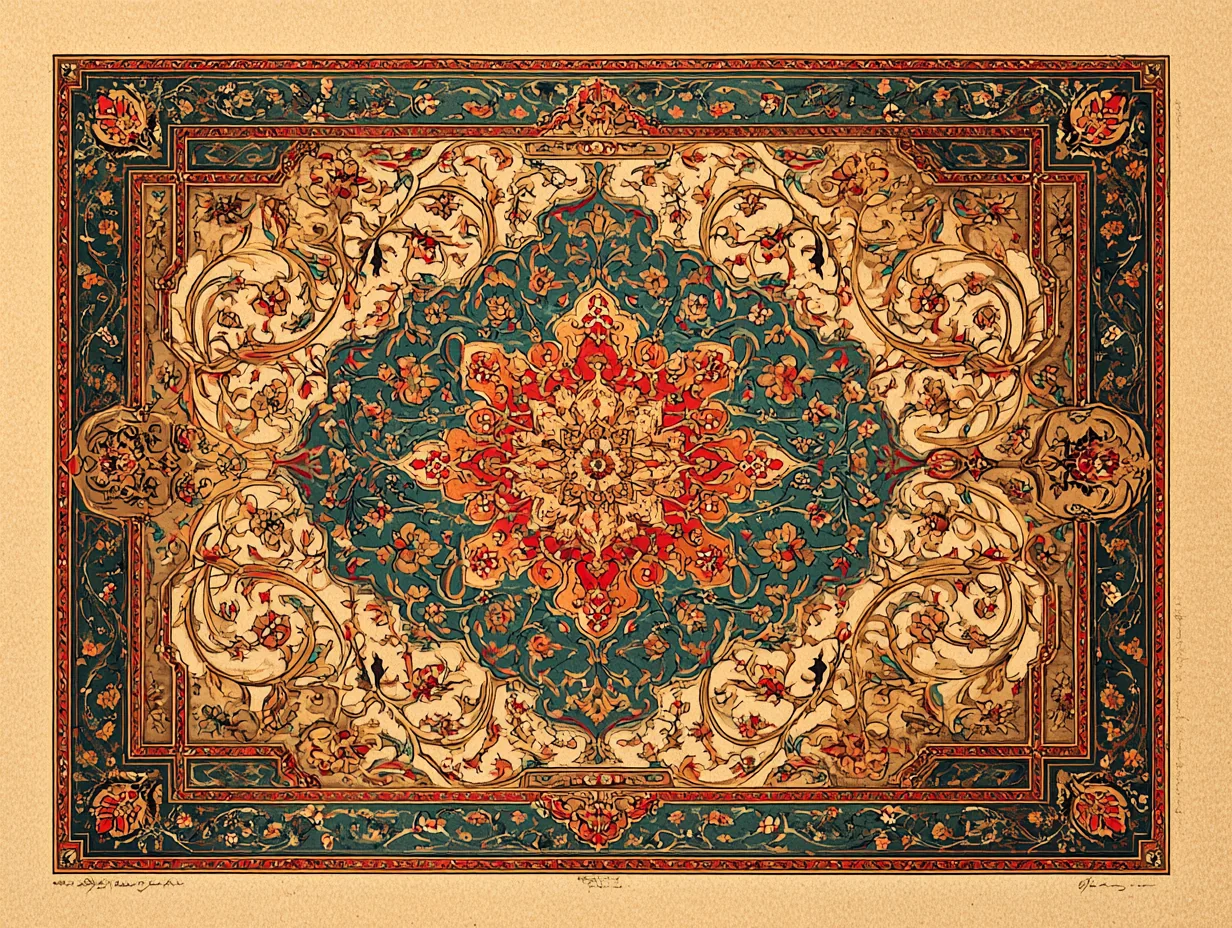
A 16th-c Safavid court carpet from the Shah Abbas Isfahan workshop — the silk-warp court apex that the 1920s revival quoted directly. The classical vocabulary (central medallion, palmette border, cloud-bands) descends from this Safavid source.
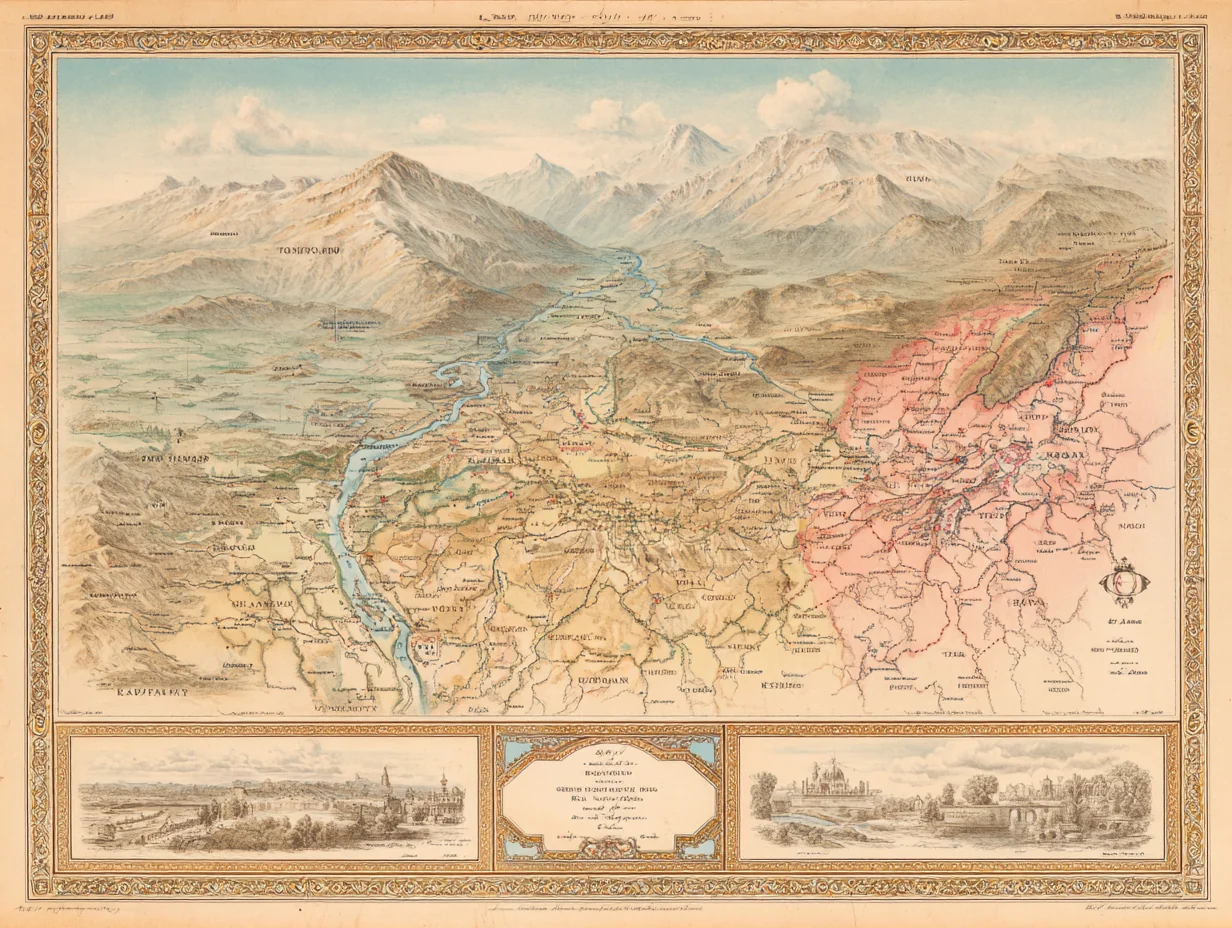
A page from a Victorian connoisseur’s portfolio on the central Persian court workshops — the four principal sites (Isfahan, Kashan, Nain, Qum) located on a central Persia map, with archetype drawings showing the distinguishing vocabulary of each.
What It Is Not
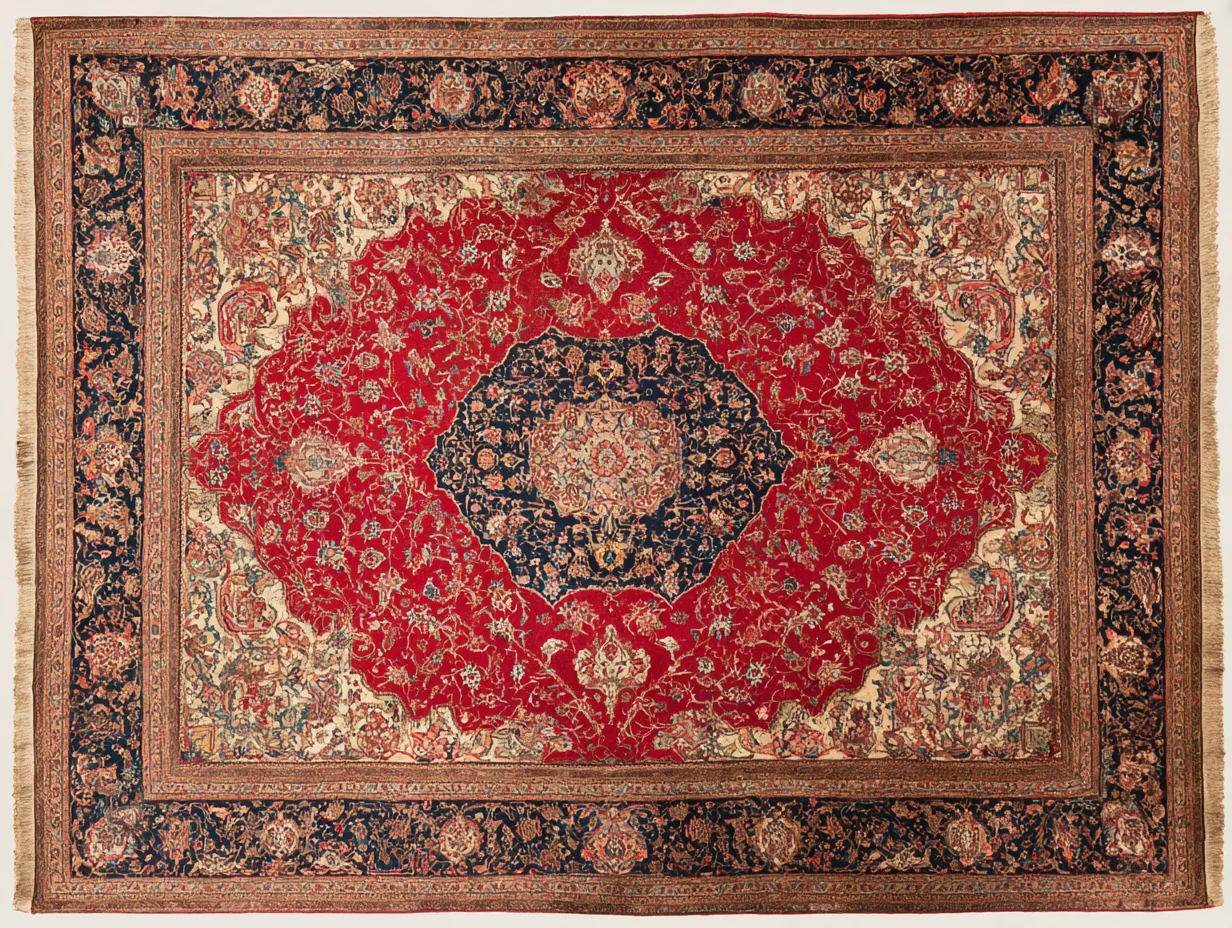
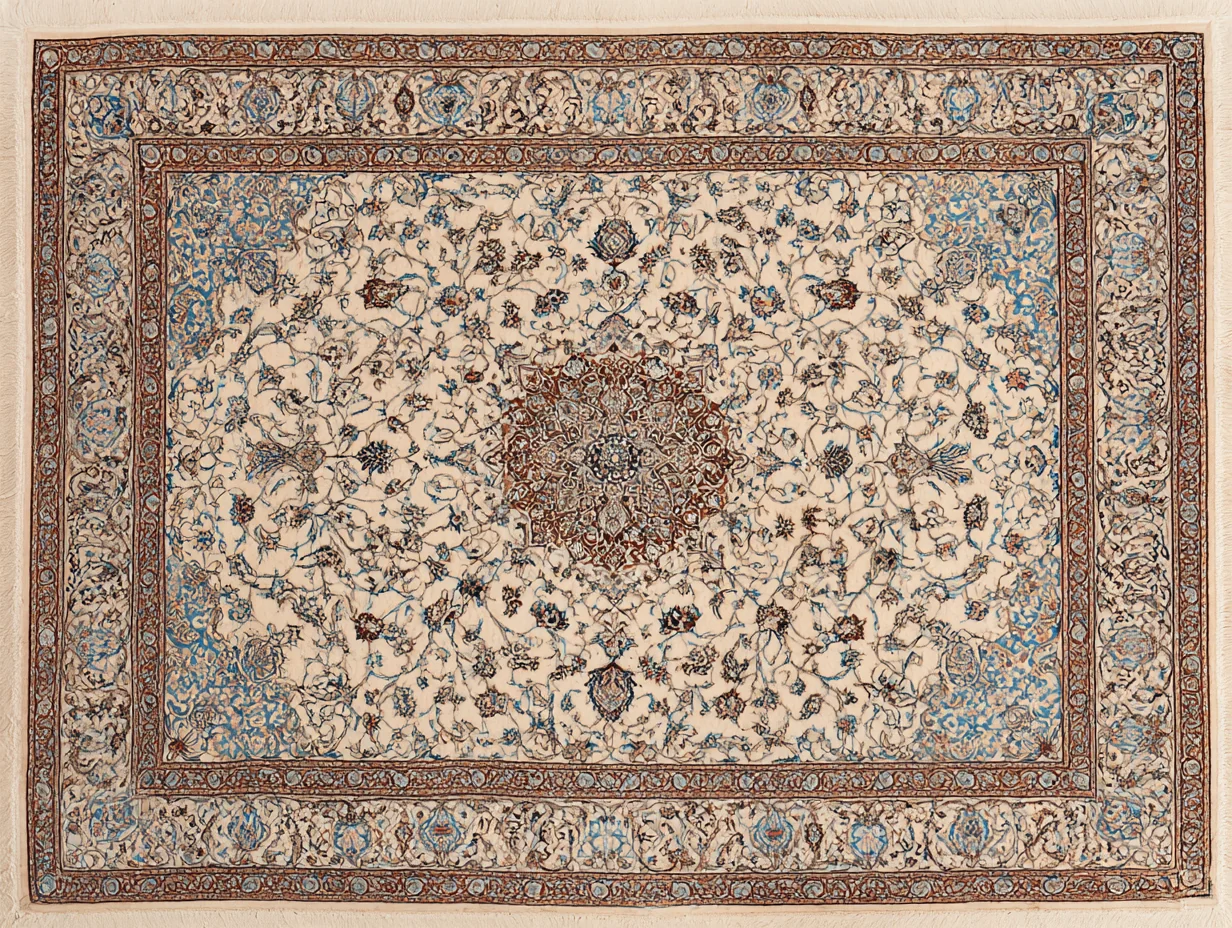
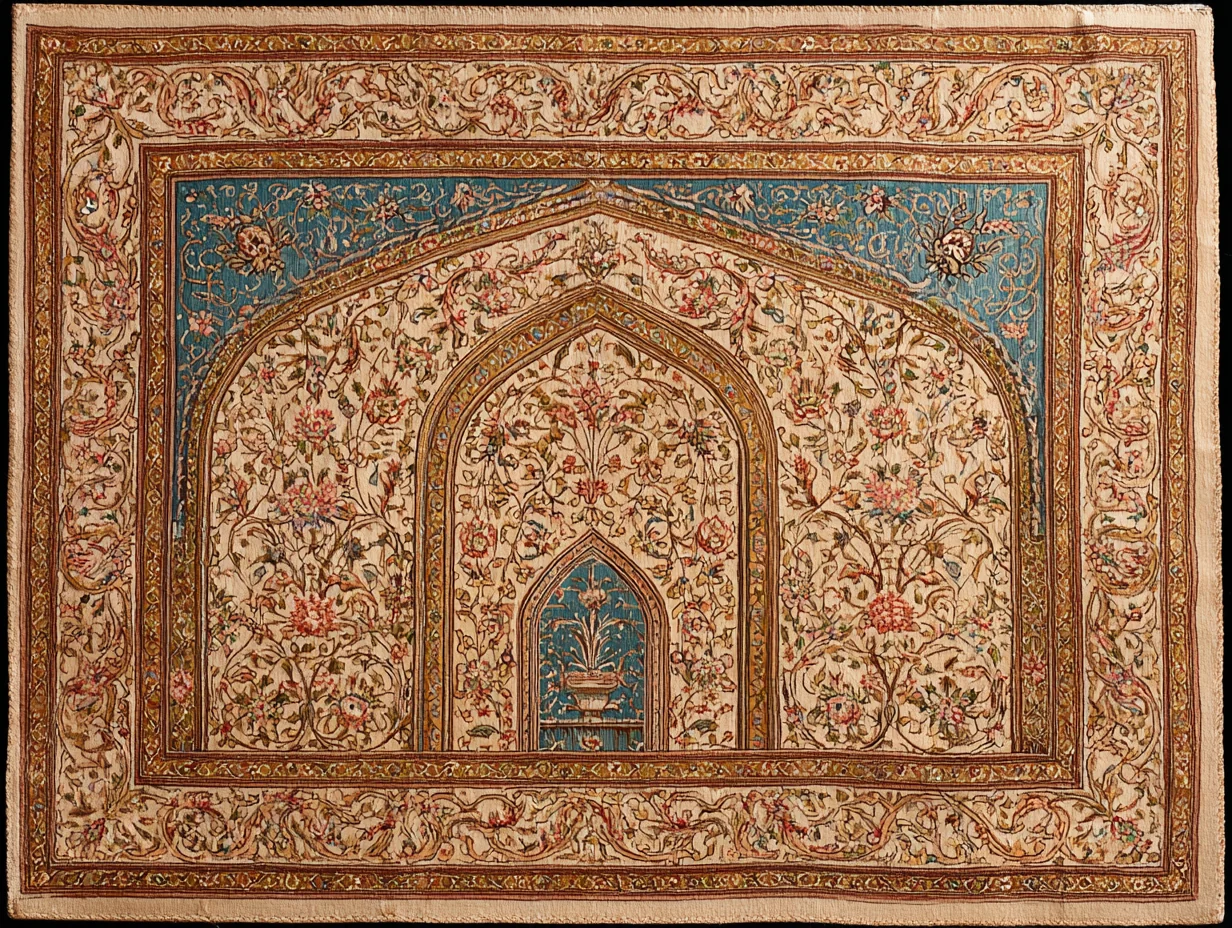
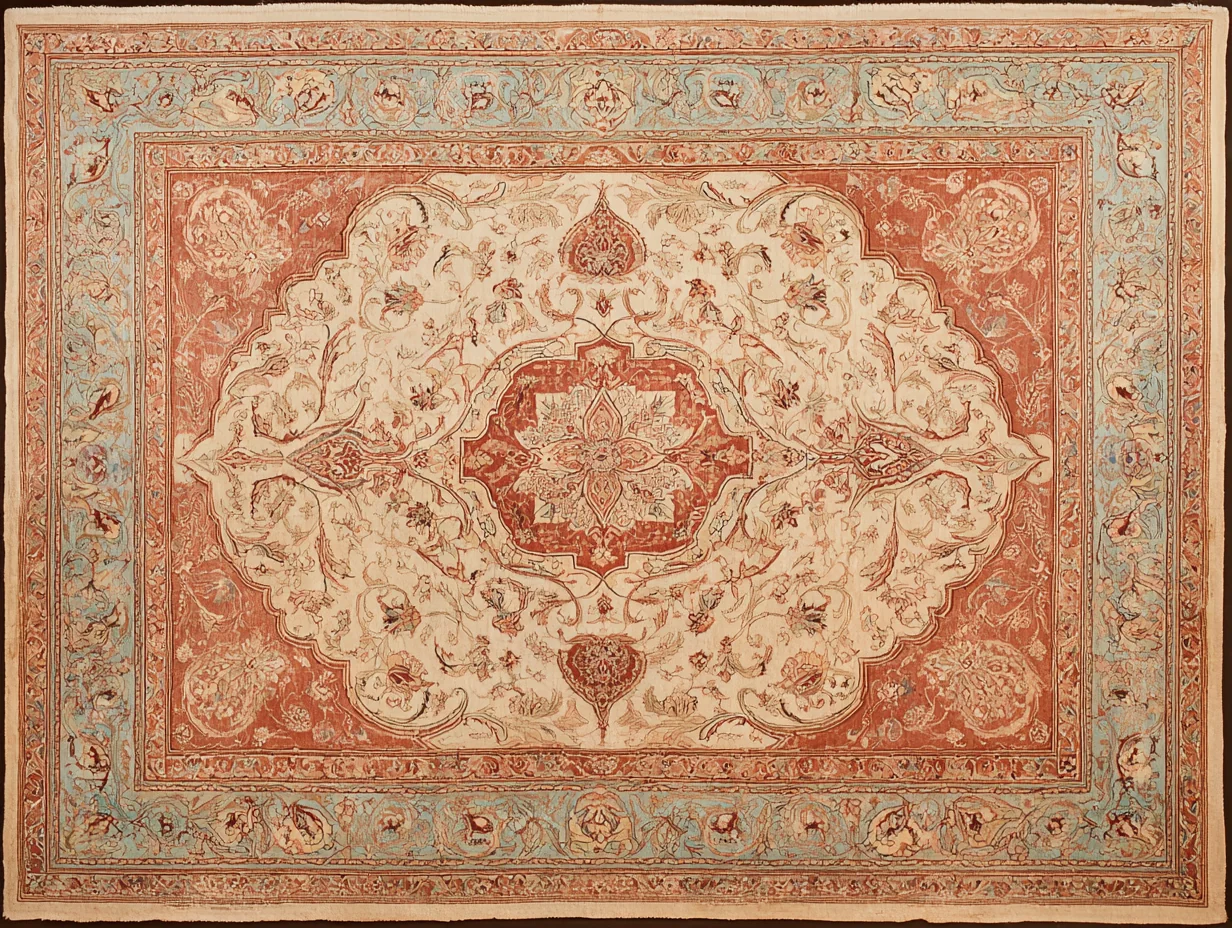
The four types set against the Isfahan are all fine-knot workshop rugs, and three of the four are central Persian — so neither the knot nor the region will separate them, and the practised eye separates them instead by reading ground colour, foundation, format, and the fineness and finish of the drawing together. This is the working skill for the central Persian court district, and it is worth stating as plainly as the Kashan post stated its three-tier rule: the central Persian court rugs are told apart not by their shared vocabulary, which is genuinely shared, but by ground colour, by foundation, and by the particular workshop fineness each centre is keyed to.
A Kashan is the type from which the arc opened this tradition, and the contrast is the cleanest of the four because it is a contrast of ground. The Kashan and the Isfahan share the central Persian court vocabulary almost entirely — both descend from the Safavid silk-warp carpets, both draw the curvilinear floral medallion, both are fine-knot workshop production — but the Kashan is keyed to a deep saturated wine-red field and the Isfahan to a pale ivory or cream one. The foundation parts them further: the Kashan is woven on a cotton warp, while the fine modern Isfahan is woven on a silk warp as a matter of course. The rule of thumb: a deep wine-red ground on a cotton warp is Kashan; a pale ivory ground on a silk warp is Isfahan.
A Nain is the hardest of the four, and the post must take care over it, because the Nain is the Isfahan’s near-twin. Nain lies close to Isfahan; it began weaving fine rugs only in the twentieth century, and it began by doing precisely what Isfahan did — fine knotting, silk warp, the shah-abbasi vocabulary, and very often the same pale ivory ground, sometimes with the pale blue that Isfahan also favours. The two rugs can look, at first encounter, like one rug. The distinctions are real, but they are matters of degree and finish. The Nain palette tends to run cooler and more restricted — it leans hard on ivory and blue, and admits comparatively little of the warm red and gold an Isfahan will use; the Nain drawing, fine as it is, often reads as slightly softer and more open than the Isfahan’s, which is the tauter and more resolved of the two. Nain grades itself openly by the number of plies in its warp, the count quoted as the rug’s quality, and that grading vocabulary is itself a Nain habit. The rule of thumb, offered with the honest caution that this is the one distinction in the post on which a careful reader may still be wrong: a fine pale silk-warp central Persian rug with a cooler ivory-and-blue palette and a slightly softer hand is likely a Nain; the same rug with a marginally tauter drawing and a warmer palette is likely an Isfahan — and where the two cannot be told apart with confidence, the honest course is to say so.
A Qum moves the comparison from ground to material. Qum, like Nain, is a twentieth-century fine-rug centre that took up the central Persian court vocabulary; but the rug Qum is famous for is the all-silk rug — silk warp, silk weft, and silk pile — frequently in a prayer-rug format with a niche, and woven at a jewel-like fineness. The Isfahan, by contrast, is a wool-pile rug; it admits silk only as a highlight within a wool surface. The rule of thumb: a rug whose entire pile is silk, lustrous and shifting under the hand across its whole surface, is a Qum; a wool-pile rug with at most silk highlights is an Isfahan.
A Tabriz carries the comparison out of central Persia altogether, to the northwestern regional capital. The Tabriz is the other great Persian city workshop, and in its finest Hadji Jalili variant it too is woven on a pale ivory ground in a fine curvilinear court manner — which is exactly why the beginner confuses the two. But Tabriz is a northwestern rug of distinct district provenance, it generally carries a cotton warp, and the practised hand reads its handle as a different thing from the silk-warp Isfahan’s. The rule of thumb: a pale ivory court rug from the northwest, on cotton warp, is a Tabriz; the same register on a silk warp, from the central plateau, is an Isfahan.
What One Looks At
The practical discipline of identifying an Isfahan comes down, as in the prior rug posts, to a short ordered checklist — and as the Oushak post began with the move that does the most work for a town carpet, this one begins with the move that does the most work for a court rug. That move is to turn the rug over and read the foundation.
One looks first, and principally, at the warp. An Isfahan of the modern revival is woven on a silk warp, and one establishes that at the fringe, where the warp ends emerge from the structure, or at any worn place where the foundation shows through the pile: silk warp is fine, strong, faintly lustrous, and unmistakably not the cotton of the northwestern district. The silk warp does the largest single piece of attributing work in the whole inspection — it places the rug in the central Persian court tradition, it rules out cotton-warp Kashan and cotton-warp Tabriz, and it confirms that the rug belongs to the fine modern workshop register rather than to any village production. One reads the warp first because the warp settles the most at one glance.
One looks next at the knot density and the drawing together, because in an Isfahan the two are inseparable. The knot is the fine asymmetric Persian knot, set at a density — three hundred a square inch and upward, often far upward — that the silk warp made possible; and the drawing is curvilinear shah-abbasi vocabulary, the palmette and the scrolling vine, rendered with a disciplined exactness in which every lobe is resolved to its intended curve. One looks for that exactness specifically. A loose or approximate hand, however fine the knot, is not an Isfahan; a coarse knot, however careful the hand, cannot draw the Isfahan vocabulary at all. The rug must show both — the high density and the resolved curvilinear drawing — and the two together are the type’s working signature.
One looks at the palette. The Isfahan ground is pale — ivory, cream, or a luminous pale blue — and the design upon it is restrained: indigo principally, with measured accents of soft red, green, and gold, the colours spaced rather than crowded so that the pale field carries each one cleanly. A dark or saturated ground is pointing away from Isfahan, toward Kashan or another type; a pale ground crowded and chromatically busy is pointing away from the discipline that the Isfahan palette is admired for.
And one looks, last, for the signature and the era, holding the two Isfahans firmly apart. The overwhelming majority of Isfahans one will ever handle are modern rugs of the twentieth-century revival, and the best of them are signed — a small woven cartouche, set into field or border, carrying a workshop name, of which Seirafian is the most celebrated. One reads the cartouche for what it is, corroborates it against the foundation and the knot and the drawing rather than trusting it alone, and grades the rug within the modern revival. The Safavid Isfahan, the court carpet of the Shah Abbas period, is a museum object and is read for in museums; it is the great name standing behind the modern rug, and it is not the modern rug. The connoisseur places the Isfahan in its era first and grades it within that era second — and does not mistake a fine revival rug for a Safavid antiquity, nor think the less of it for being, honestly, the apex of the modern Persian loom rather than of the old one.
The next post in the rug arc will be either Karabagh — to return to the Caucasian region with the burgundy / French-rose register — or Qum, to extend the central Persian court tradition into the 20th-c silk-prayer-rug workshop. The choice will depend on what photographic material is available at the time of writing.