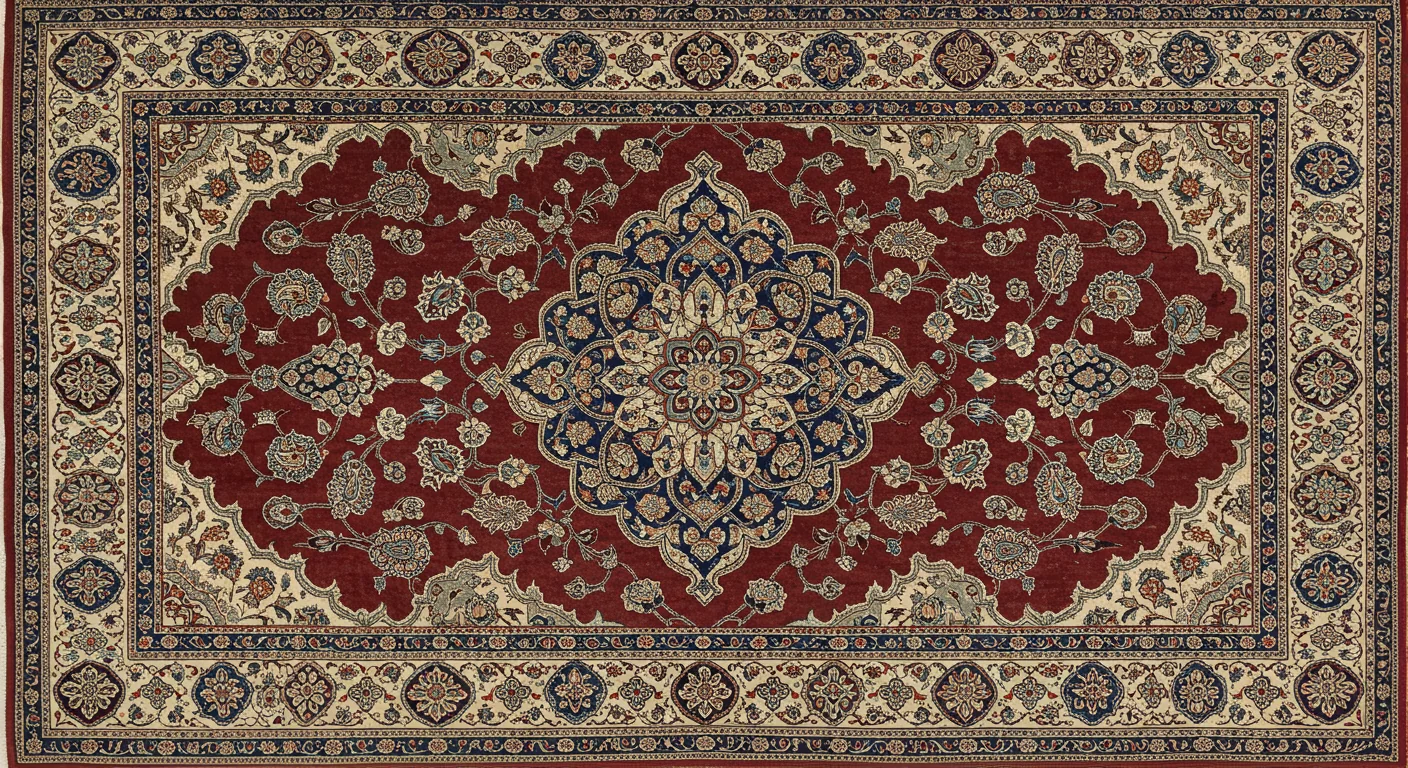
The four prior posts in this arc — Heriz, Tabriz, Caucasian Kazak, and most recently Bakshaish — built the body of antique-rug attribution out along two regional axes and a third structural one: the northwestern Persian district was laid out in three points (Tabriz the city workshop, Heriz the commercial village, Bakshaish the older village antecedent), and the Caucasian wool-warp register was opened at Kazak. What none of those posts had occasion to treat in detail was the other great Persian tradition — the central Persian court workshop register that runs through Kashan, Isfahan, Qum, and Sarouk, and that operates by a different set of premises than the northwestern district altogether. Kashan is the post that opens it.
Kashan is the urban-workshop counterpoint to Bakshaish. Where Bakshaish was a village production on the slope of Mount Sahand, woven at moderate density on a hand-spun warp with the individual weaver’s hand visible in every irregularity of the medallion, Kashan was a fully workshopped urban production from a city that had been a major weaving centre since the Safavid period of the sixteenth century. The composition is designed rather than vernacular; the knot is fine rather than moderate; the ground is deep saturated wine-red rather than the soft cream-and-faded-madder of the village register; and the surviving body of work was produced inside named workshops that operated something close to industrial quality control by the standards of the period. The northwestern district is one tradition. The central Persian court tradition is another. Kashan is its principal entry.
The reader will find that the Kashan post has, for that reason, a slightly different shape than its predecessors. The structural sections (Specimen, Evidence, Period, Sibling, Checklist) are the same; but the load-bearing collector knowledge for Kashan is a three-tier sub-attribution within the Kashan label itself — Mohtasham, standard, and Manchester — rather than the dealer-overlap with a neighbouring type that organised the Bakshaish post around Serapi. The three tiers carry substantial price spread, they are confused by the trade as often as they are correctly read, and learning to distinguish them is most of the practical Kashan attention.
The Specimen
A Kashan that one will encounter is, in its commonest form, a room-size rug in the eight-by-eleven to ten-by-fourteen range, with smaller pieces (four-by-six dozar, six-by-nine kelleyi) considerably more available than at the village register because the workshop produced full size ranges to fixed specifications. The proportions are calibrated; the loom-widths are standard; the rugs of a given dealer batch run within an inch of one another. This is itself the first workshop signature, and the village-loom register cannot produce it.
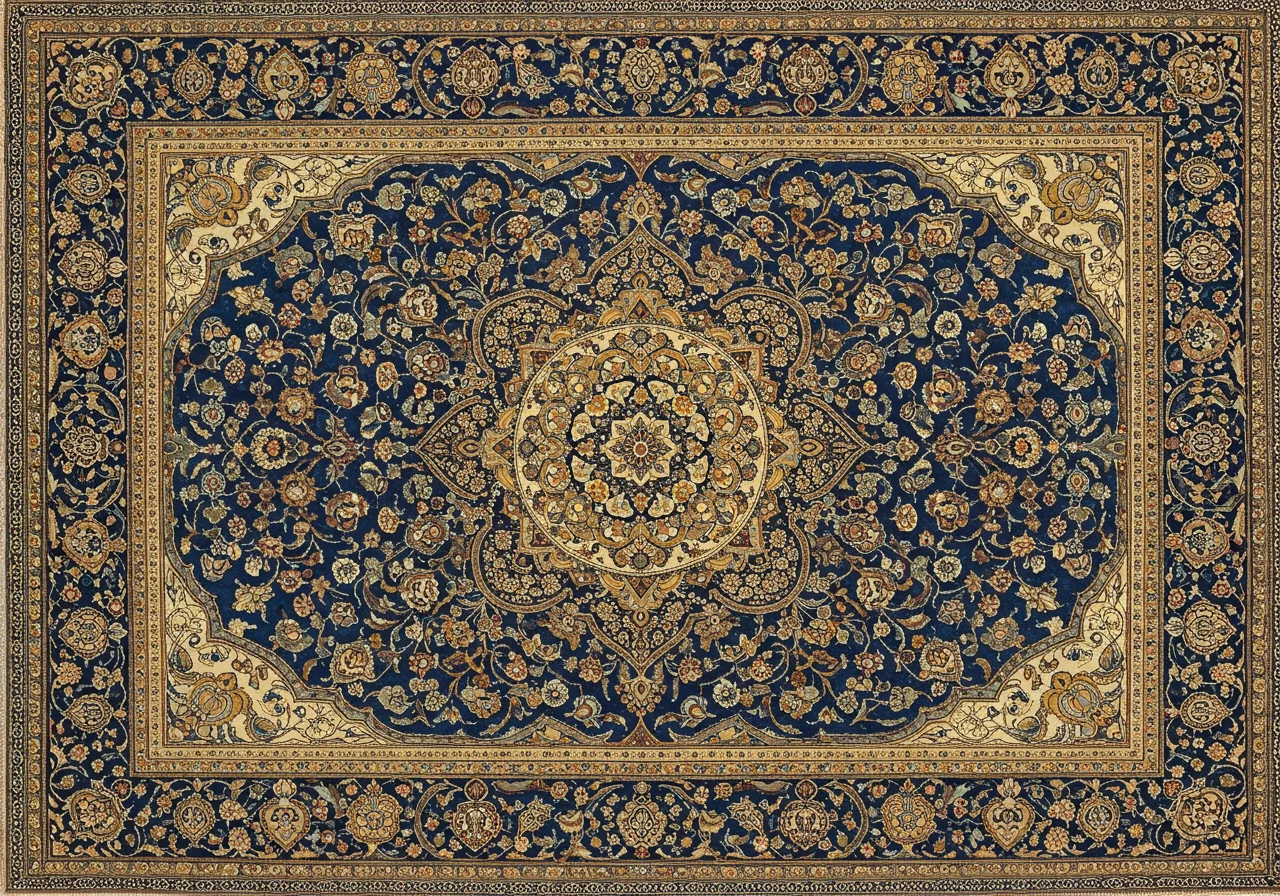
The composition is the central-medallion-on-deep-ground — a single large floral-vocabulary medallion set on a saturated wine-red field, with quarter-medallion spandrels at the four corners that complete the medallion as it would be if the rug were folded onto itself, and a main floral border of palmettes-and-cloud-bands enclosing the whole. The medallion is not the stepped polygonal vocabulary of the northwestern village register — it is a floral medallion, drawn in the court vocabulary of palmettes, cloud-bands, fine floral arabesques, and central rosette, descended directly from the Safavid silk-warp carpets of the sixteenth century that the post will return to in the Period section. The drawing is designed in the strict sense — laid out beforehand on a master-cartoon by a named workshop designer, then woven from the cartoon by graders who match each knot to a numbered square. The irregularities of the village hand are absent. What one is reading is not a single weaver’s hand but a workshop’s quality standard.
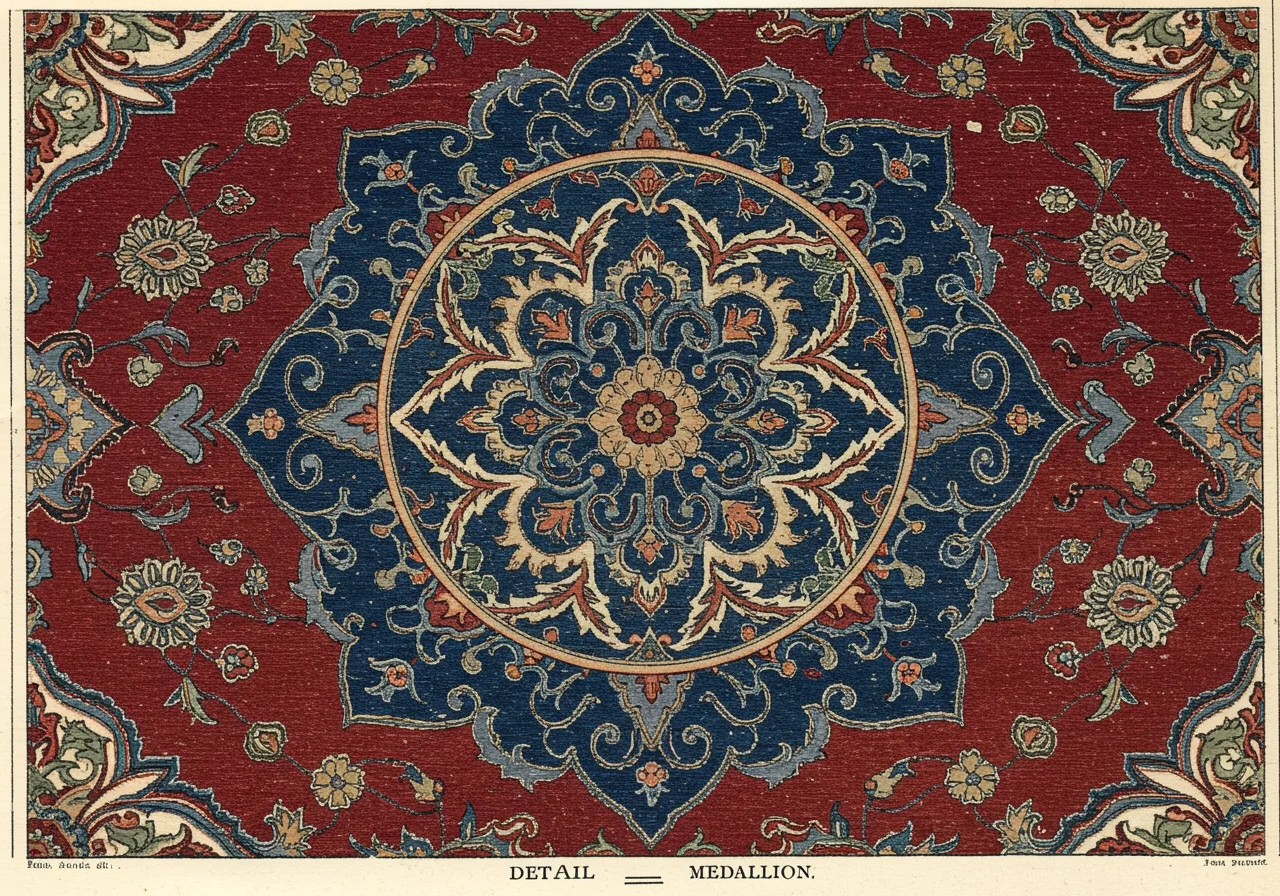
A close detail of a Kashan central medallion — the floral court vocabulary of palmettes, cloud-bands, fine arabesques, and central rosette set on the deep saturated wine-red ground that is the Kashan palette signature. The drawing is designed from a master-cartoon rather than woven from the weaver’s hand, and the regularity is visible at every register: the curve of every petal matches its mirror across the central axis, the spacing of the cloud-bands is exact, and the proportions of the medallion to the field are calibrated rather than felt. The northwestern village register cannot produce this.
The palette is the Kashan’s principal break with the northwestern district, and it is what most separates the central Persian court tradition from the village registers the prior posts treated. The field is deep wine-red — a saturated madder-red on the antique pieces, with the documented use of both madder and cochineal across the Kashan workshops’ red palette — that has not faded down to cream in the way the Bakshaish ground oxidised, because the central Persian climate is drier and the rugs were typically domestic furnishing in shaded urban interiors rather than exposed light-grade field pieces. A Kashan of 1880 in good condition still reads as the wine-red it was woven to be, and the antique character is in the depth and slow chromatic shift of the saturated madder rather than in any fade toward pastel. The medallion is typically deep indigo or ivory; the border ground is usually indigo with ivory floral; the inner-guard borders run through pale ivory, pale gold, and the same wine-red of the field. The whole palette is darker and more saturated than the northwestern register, and the saturation is what one is looking for rather than a defect.
The Evidence
The foundation is the structural evidence that places a Kashan firmly in the central Persian court tradition rather than the village registers the prior posts treated. Cotton warp and wool weft, as in Heriz, Tabriz, and Bakshaish — the central Persian district is Persian-cotton-warp throughout — but on the finest Kashan pieces, including most of the Mohtasham-attributable production, the warp may instead be silk. Silk warp on a Kashan is the structural signature of the apex sub-type, and one of the principal evidences for the Mohtasham attribution; ordinary nineteenth-century Kashan production used cotton warp, and the silk-warp pieces command the upper end of the price range by a considerable margin. The wool weft is fine and even rather than the heavy lanolin-rich village weft, dyed in a single uniform line rather than the alternating bands of Bakshaish, and the back of the rug reads as cleaner and more regular than the village register at the same magnification.
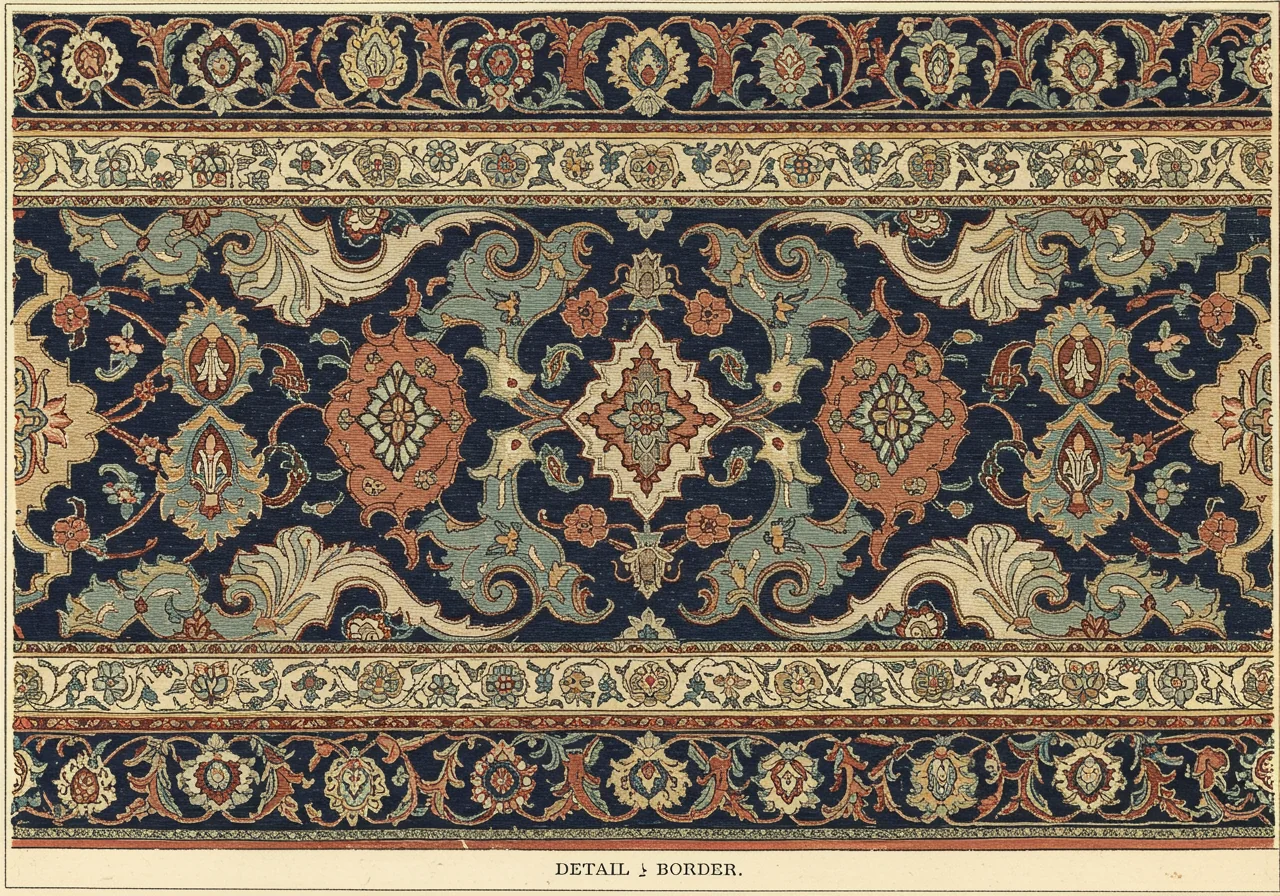
A close detail of a Kashan main border — fine palmettes and cloud-bands in the central Persian court vocabulary, drawn on the indigo border-ground at workshop regularity. The proportions of every motif repeat to within fractions of a knot, and the inner-guard and outer-guard borders carry their own coordinated vocabulary at the appropriate diminished scale. The drawing is designed by a named workshop master and woven from a master-cartoon; the village improvisation of the Bakshaish border is altogether absent.
The knot is the fine asymmetric (Persian) knot, expected for the Persian-speaking urban weaving population of the city, and the knot density is fine to very fine — two hundred to three hundred knots per square inch on standard antique Kashan production, with the Mohtasham-grade pieces reaching three hundred and fifty and the silk-warp apex pieces reaching upwards of five hundred. This is between three and five times the density of the Bakshaish range (sixty to ninety KPSI), and the higher density is the structural enabling condition for the fine floral arabesque vocabulary that the village loom simply could not draw. A Kashan-vocabulary rug at Bakshaish density would be incoherent — the arabesques would dissolve into pixellated blocks at the larger knot scale — and the fine knot and the fine drawing are inseparable structural features of the central Persian court register.
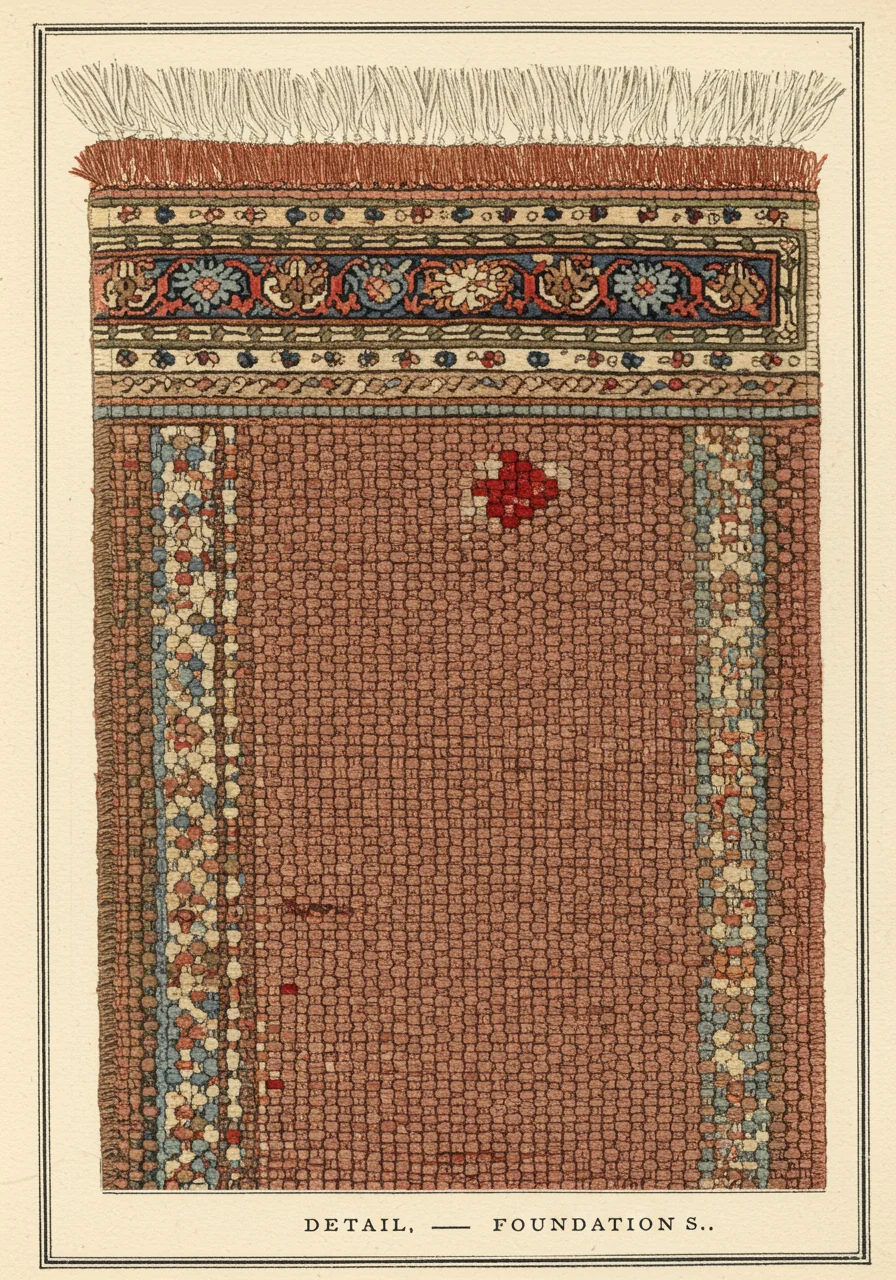
A close detail of the back of a Kashan rug — the fine asymmetric Persian knot at high density (two hundred to three hundred knots per square inch on standard pieces, more on the apex grades), the cotton warp at uniform machine-spun regularity (or silk warp on the Mohtasham and silk-warp pieces), and the fine even wool weft drawn at a single uniform line rather than the alternating village bands. The Bakshaish back read as visibly looser and rougher at the same magnification; the workshop standard of the Kashan back is the structural form of the workshop quality control evident at every register of the rug.
The wool of the pile is the principal material signature, and the source for the standard Kashan production was the lanolin-rich sheep of the Khorasan region in northeastern Persia — high-grade wool transported the considerable distance to the central Persian workshops because the local Kashan-area wool was insufficient to the workshop’s quality standard. The Khorasan wool takes the saturated madder and cochineal dyes deeply, holds its lanolin (the natural sheen of the pile is a Kashan signature that survives well into the rug’s antique life), and ages with the slow tonal shift that the antique market reads as authenticity. The Manchester Kashan production (the post will return to it in the Period section) used a different wool source altogether — kork (merino) wool spun in Manchester, England, then exported as finished yarn to Iran for weaving in the Kashan workshops — and the wool’s particular sheen and lanolin signature, distinct from the Khorasan pile, is distinguishable on close inspection. The dyes are entirely vegetable on the antique pieces: madder and cochineal for the reds, indigo for the navy and blues, isparek and pomegranate-rind for the yellows, walnut hull for the browns, with the synthetic aniline dyes essentially absent before about 1880 and only intermittently present on workshop production even after, because the named workshops maintained tighter dye-control than the village register did.
The Period
The city of Kashan sits on the western edge of the Dasht-e Kavir, the great central Persian salt desert, on the old caravan route between Isfahan and Tehran. The city has been a major weaving centre since at least the Safavid period of the sixteenth century, when it produced the silk-warp court carpets that the V&A’s Ardabil carpet — the most famous Persian carpet in any institutional collection, signed by Maqsud of Kashan and dated 1539-40 — is the documentary touchstone for. The nineteenth-century Kashan production that this post is concerned with is the Qajar-period revival of that older tradition, beginning in the 1860s-1870s as the Persian rug trade re-established its export connections to Europe and the United States. The three tiers the post is about to lay out are not a clean succession — the Mohtasham apex (roughly the 1870s through the 1900s) and the Manchester-yarn production (roughly 1890 through 1930) overlap substantially in time, and the standard nineteenth-century Kashan production runs through both — but the apex tier had largely passed by the time the Manchester-yarn production reached its peak in the 1910s and 1920s, and the antique period closes with the Manchester register on its way out.
The Ardabil carpet, signed by Maqsud of Kashan and dated 1539-40 — the late-Safavid silk-warp Kashan court carpet from which the nineteenth-century Kashan revival descended. The rug is now in the Victoria and Albert Museum and is the single most-documented antique Persian carpet in any institutional collection; its central-medallion-and-floral-arabesque vocabulary is the direct ancestor of the nineteenth-century Mohtasham composition, and the silk warp of the Mohtasham apex sub-type is the deliberate revival of the Safavid foundation.
The load-bearing collector-distinction within the Kashan label, and the practical thing this post most wants the reader to take away, is the three-tier sub-attribution that the dealer trade has applied broadly across the same body of rugs: Mohtasham Kashan, standard nineteenth-century Kashan, and Manchester Kashan. These are not three separate workshops or three separate provenances — they are three price-grade attributions within the broader Kashan production, and the price spread between them is substantial enough that learning to read which tier a given Kashan belongs to is most of the work of buying one. Mohtasham Kashan is the apex sub-type produced in the workshop of Hajji Mollah Mohammad Hassan Mohtasham (or in the closely-associated late-nineteenth-century Kashan production that the dealer trade now classes in the Mohtasham register) — silk warp on the finest pieces, sometimes signed in a small cartouche at the top of the field, knot density above three hundred KPSI, and the apex Persian rug of the entire late-nineteenth-century period; documented Mohtasham-marked Kashan pieces have commanded auction prices in the multi-million-dollar range for the museum-grade examples. What the contemporary trade calls Mohtasham is, in strict attribution, a stylistic register applied to several closely-related late-nineteenth-century Kashan workshops rather than the documented output of a single named master, and the brand-versus-workshop ambiguity is itself part of what the connoisseur is reading for: the signature cartouche is rare even on agreed-Mohtasham pieces, the master’s biography is thinly documented, and the identification is in practice a triangulation across foundation, palette, drawing, and finish rather than a confident workshop attribution. Standard nineteenth-century Kashan is the broader Qajar-period workshop production from the same city at the same period — wine-red ground, fine drawing, two hundred to two hundred and fifty KPSI on the typical pieces, but without the silk-warp foundation, the Mohtasham signature, or the apex condition that the upper tier commands. Manchester Kashan is the late-nineteenth- and early-twentieth-century production (roughly 1890 to 1930) made specifically for the American and European export markets using merino yarn spun in Manchester, England, then shipped to Iran for weaving — distinguishable by the Manchester wool’s particular sheen and lanolin signature, generally a slightly less-saturated palette, and a price and quality position intermediate between the Mohtasham and the standard registers. The Kashan dealer label, in nineteenth-and-twentieth-century commercial practice, was applied across all three tiers without much distinction, and one will still encounter Mohtasham-grade pieces sold as ordinary Kashan and ordinary Kashan pieces sold as Mohtasham. Reading the tier rather than the label is the principal Kashan practical attention.
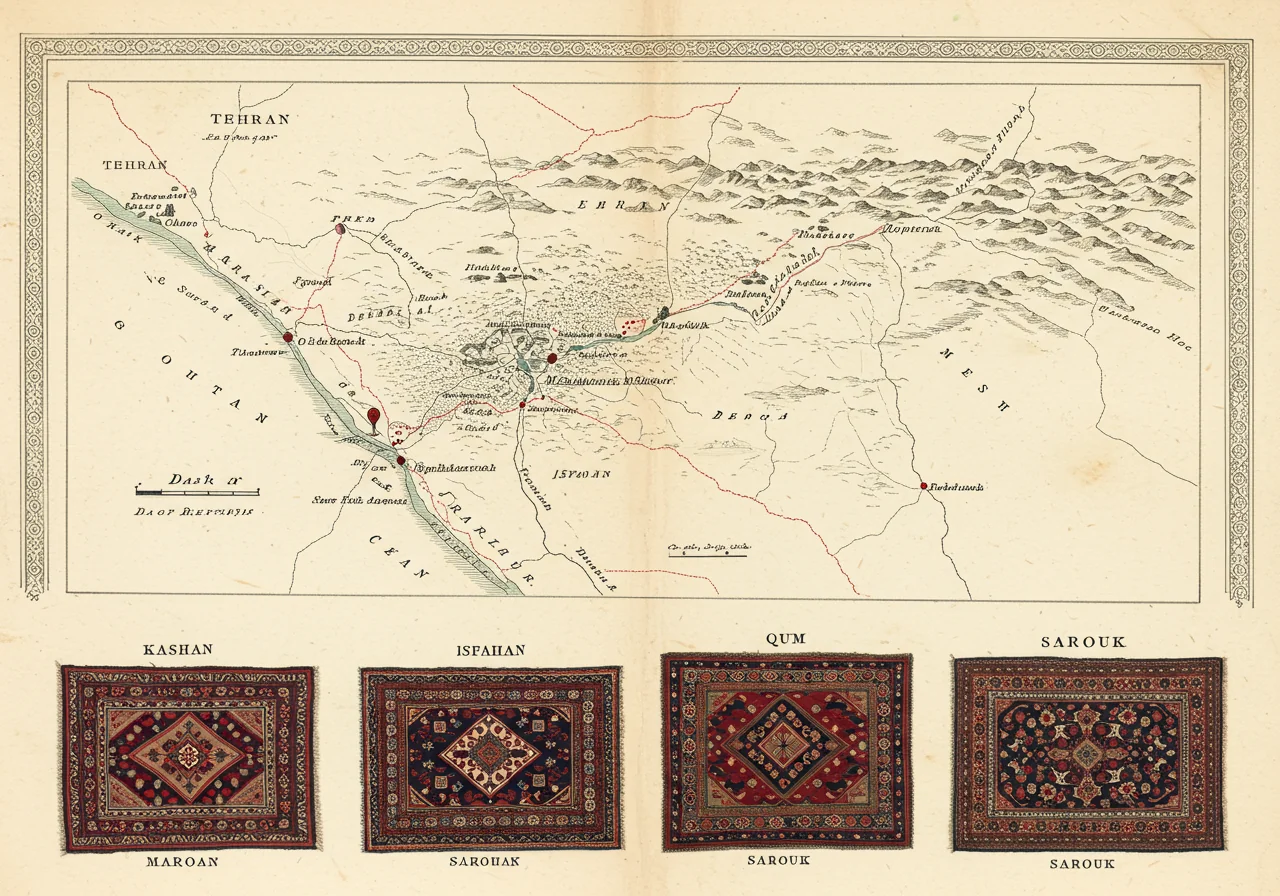
A page from a Victorian connoisseur’s portfolio on the central Persian court workshops — the district map locating Kashan on the western edge of the Dasht-e Kavir, with Isfahan to the south, Qum to the north, and Sarouk to the southwest, the four cities that together produced the central Persian court tradition. The archetype rug drawings at the bottom show the principal compositions: the Kashan central medallion (wine-red ground, palmette-and-cloud-band vocabulary), the Isfahan central medallion (ivory-and-indigo ground), the Qum silk prayer-rug (twentieth-century derivative), and the Sarouk floral spray (deep wine-red, allover floral composition rather than central medallion).
What It Is Not
Four types stand near enough to Kashan that the beginner confuses them with it, and distinguishing them is most of the work of reading the central Persian court district.
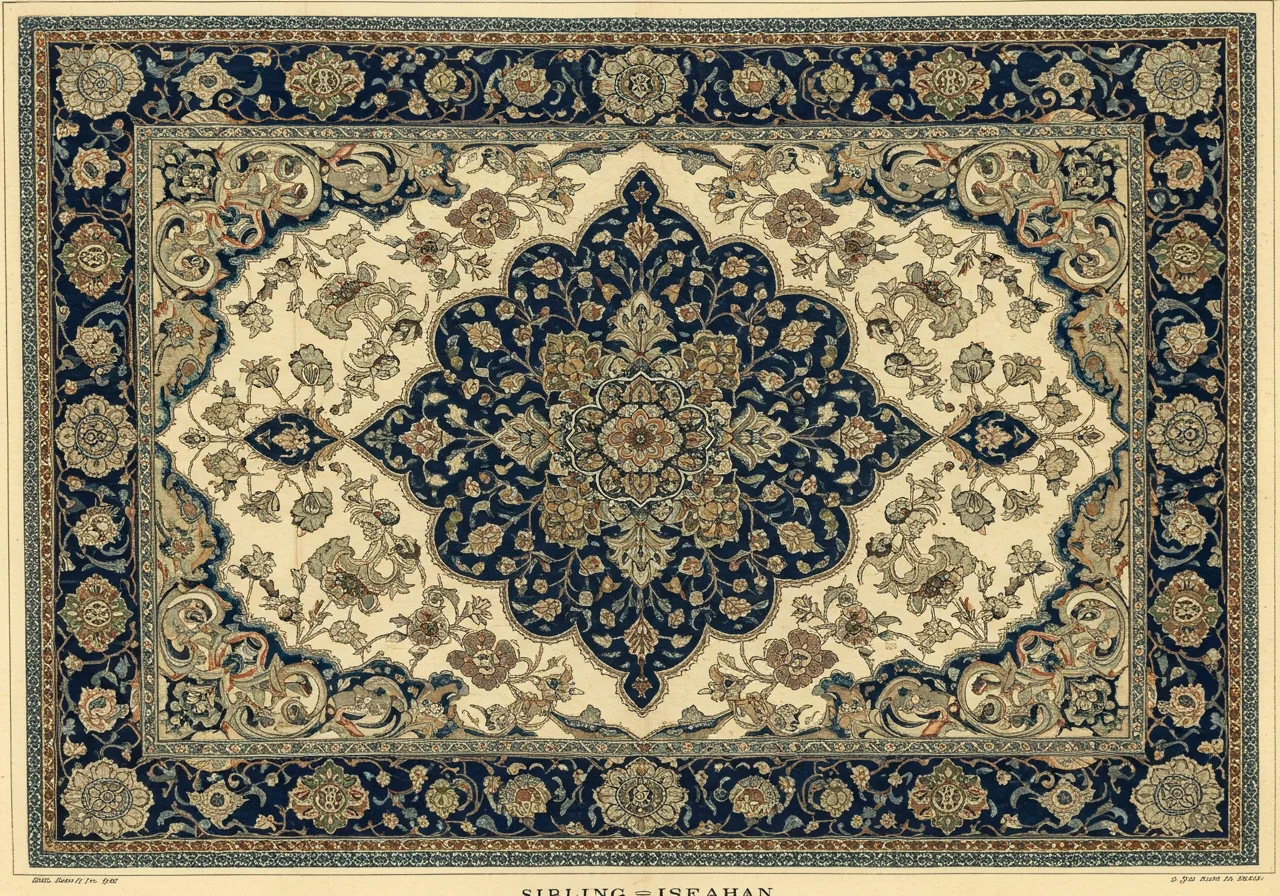
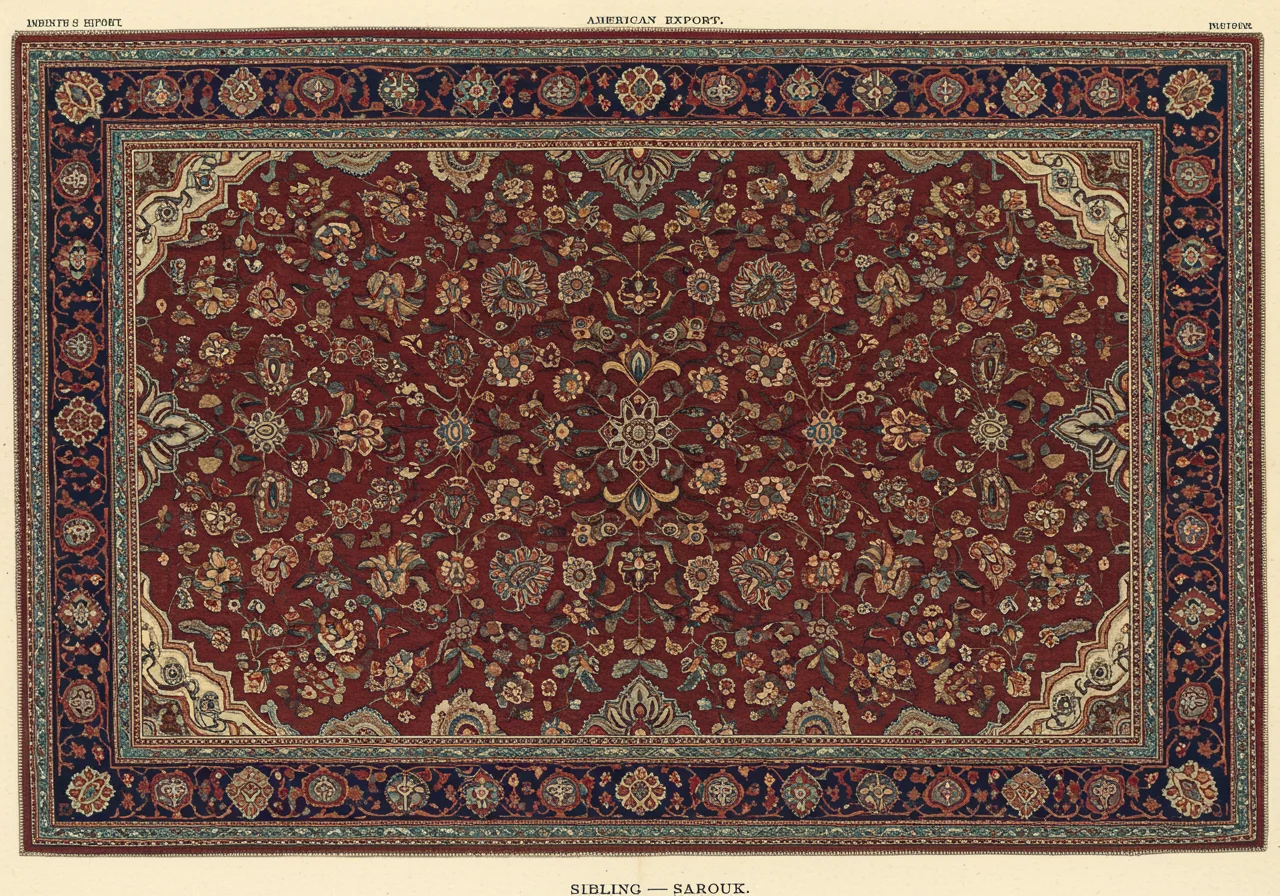
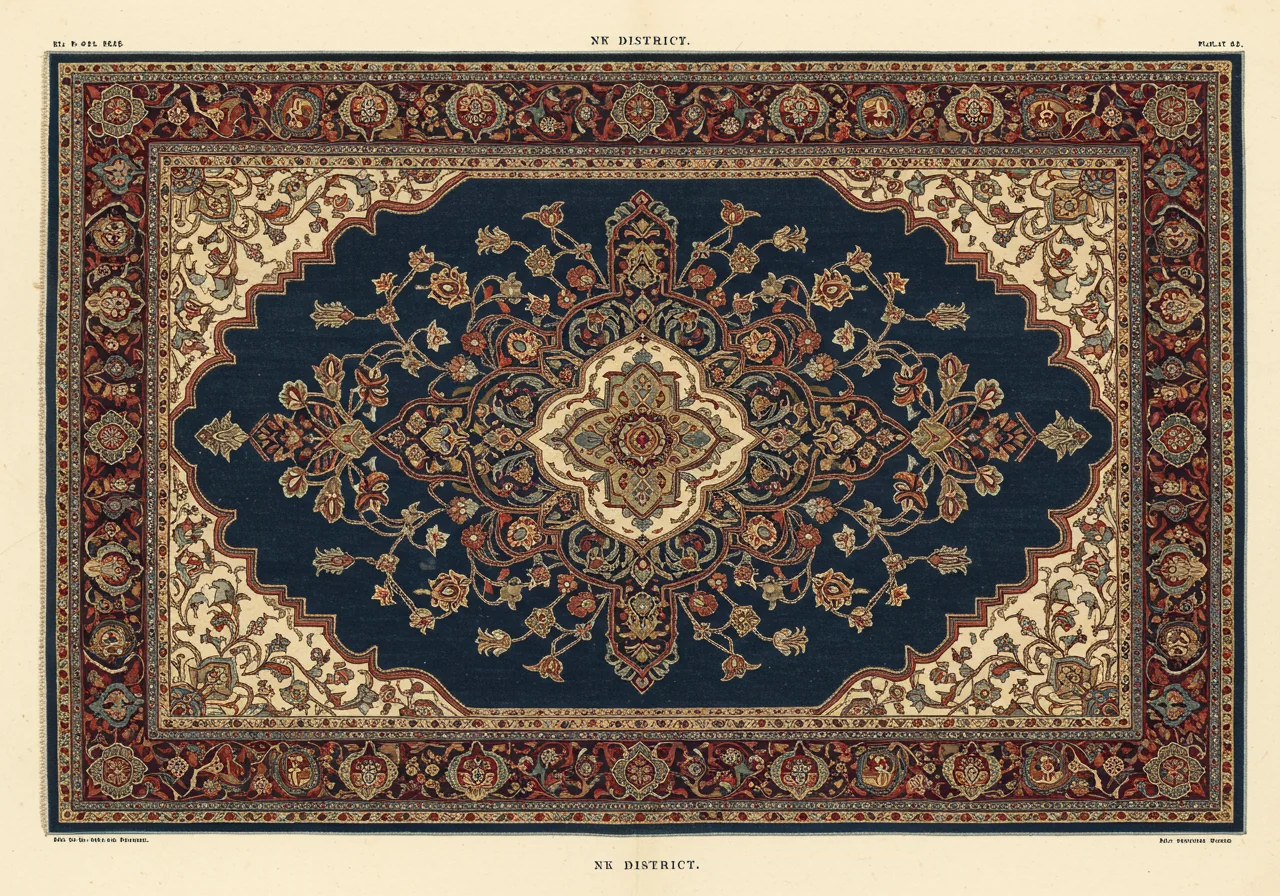
An Isfahan is the Safavid court rival from the city south of Kashan, on the same central Persian plateau and in the same court-workshop tradition. The Isfahan and the Kashan share a great deal of vocabulary — both are central-medallion compositions, both descend from the Safavid silk-warp court carpets of the sixteenth century, both use fine asymmetric knots at high density — but the Isfahan palette runs to pale ivory ground with indigo central medallion rather than the deep wine-red of the Kashan, and the Isfahan workshop tradition descends specifically from the Shah Abbas-period royal carpets of the early seventeenth century rather than the Maqsud-of-Kashan tradition. The rule of thumb: deep wine-red ground with floral central medallion is Kashan; pale ivory ground with indigo central medallion is Isfahan.
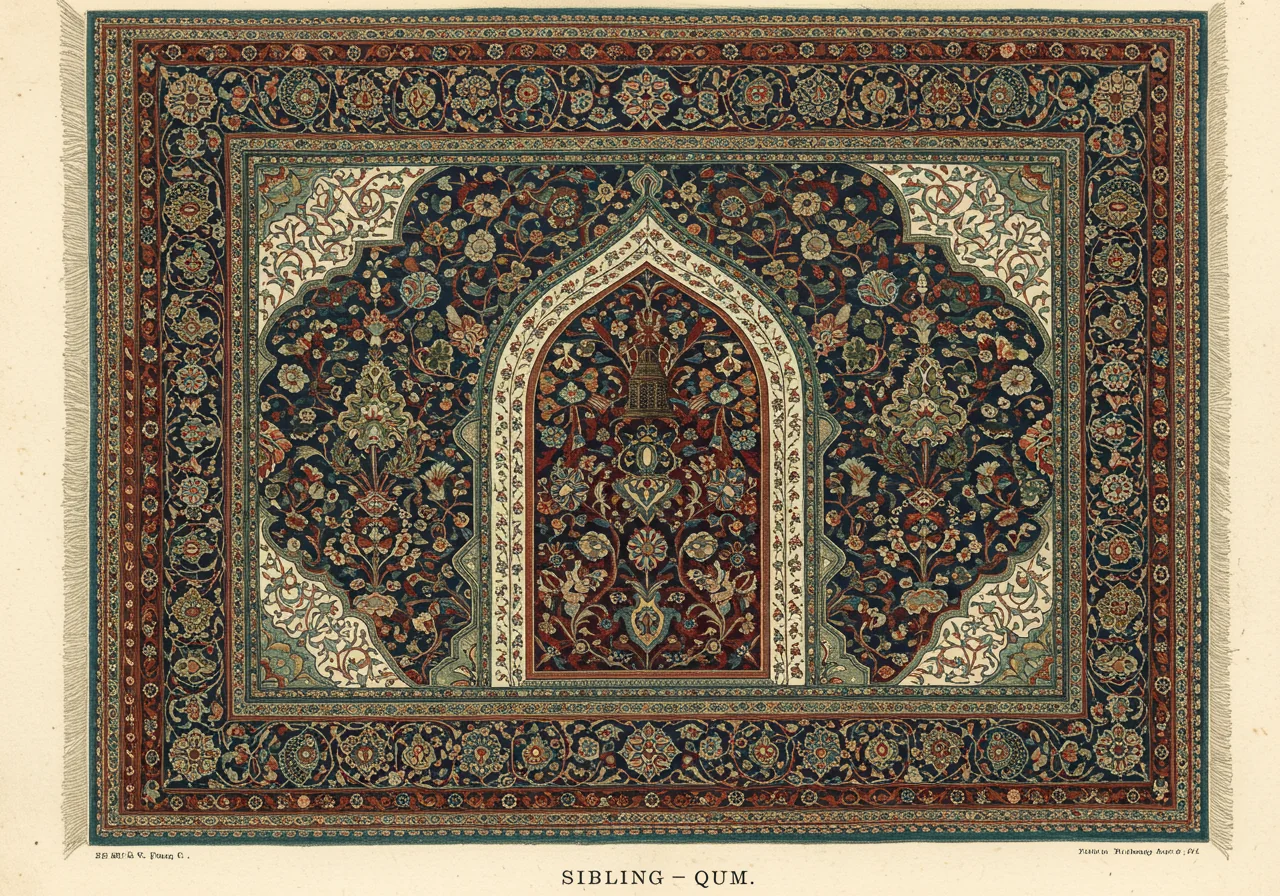
A Qum is the twentieth-century silk prayer-rug workshop production from the city north of Kashan, and it is derivative of the Kashan and Isfahan court tradition rather than coordinate with it. Qum production began in the 1920s and 1930s, when weavers from Kashan began arriving in Qum and establishing workshops there — well after the antique period the prior siblings occupy, and the surviving body is overwhelmingly silk-pile prayer rugs (a niche-composition reading the mihrab arch of a mosque, rather than a central medallion) and small workshop carpets of derivative design. The Qum is collectible as twentieth-century work but it is not antique in the period sense the rug arc has been treating. The rule of thumb: nineteenth-century wool-pile court carpet on wine-red ground is Kashan; twentieth-century silk-pile prayer-rug with niche composition is Qum.
A Sarouk is the central Persian workshop production made for the American export market in the late nineteenth and early twentieth century, and it is the type most often confused with Kashan because the two share the deep wine-red ground that is the central Persian palette signature. The composition is the distinguishing feature: a Sarouk runs an allover floral-spray composition (small detached floral elements scattered across the entire wine-red field, in a pattern the trade calls American Sarouk or Lilihan Sarouk depending on sub-region), rather than the central-medallion-and-spandrel composition of the Kashan. A great many Sarouks were further re-dyed in New York in the 1920s, with the original soft mauve-and-pink palette painted over in saturated wine-red to suit the American taste — a Sarouk with overly-uniform wine-red intensity is often a re-dyed piece, and reading the palette through to the original ground is one of the particular American-export-period collector educations. The rule of thumb: central medallion with palmette-and-cloud-band court vocabulary on wine-red ground is Kashan; allover detached floral-spray composition on wine-red ground is Sarouk.
A Tabriz is the northwestern city-workshop rug of the regional capital that the Tabriz post treated, and it sits at the structural counterpart position to Kashan within the workshop axis: Tabriz is the city workshop of the northwestern district, Kashan is the city workshop of the central Persian district, and the two are the two principal city workshops of the antique Persian production. The two often confuse the beginner because both are fine-knot designed-composition workshop productions on cotton warp. The Tabriz palette runs through the pale-ivory Hadji Jalili variant and a broader range of ground colours, the district is distinct (north-west versus central plateau), and the workshop traditions are independent rather than coordinate. The rule of thumb: wine-red ground with Khorasan-wool pile and central Persian floral medallion is Kashan; pale-ivory ground with Hadji Jalili palette and northwestern district provenance is Tabriz.
What One Looks At
The practical discipline of identifying a Kashan, when one is standing in front of a candidate rug in the dealer’s storeroom, comes down to a short ordered checklist that the reader of the prior rug posts will find familiar in structure but adjusted for the workshop register the central Persian court tradition operates in.
One looks first at the knot density and the foundation. For Kashan, knot density is the principal threshold rather than (as it was for the village-register posts) the medallion drawing. A Kashan runs two hundred KPSI or finer, and a candidate rug below that threshold is almost certainly not a Kashan regardless of what the dealer label says — the central Persian court vocabulary requires the fine knot to draw at all. Within the Kashan range, three hundred KPSI and above on a silk warp moves the piece into Mohtasham consideration; two hundred to two hundred and fifty on a cotton warp is the standard nineteenth-century register; a slightly looser knot on a particular wool grade is the Manchester Kashan range. The foundation reads as a single number, and the number settles the broad attribution at a single inspection.
One looks next at the ground colour and the dye character. Kashan ground is deep wine-red on the antique pieces, saturated and slowly tonally-shifting rather than faded toward cream the way the village register oxidised. A rug that reads as a pale or faded ground is either not a Kashan, or is a piece that has been chemically washed for the decorator market — neither is what one is looking for. Within the wine-red range, the Mohtasham-register pieces show a particular jewel-toned depth — drawn from the documented use of both madder and cochineal across the Kashan workshops’ red palette — that is itself one of the diagnostic features of the apex tier; the standard register runs a slightly more straightforward madder; the Manchester Kashan ground is often a slightly less-saturated wine-red, reflecting the different wool source. The palette is the second reading, and it triangulates the tier as well as the type.
One looks at the medallion vocabulary and the workshop regularity. The Kashan medallion is floral — palmettes, cloud-bands, fine arabesques, central rosette — drawn from a workshop master-cartoon to the regularity that only a workshop tradition produces. The curve of each petal matches its mirror across the central axis; the proportions of the medallion to the field are calibrated rather than felt; the inner-guard and outer-guard borders carry their own coordinated vocabulary at appropriate scale. A candidate rug whose medallion shows the village hand — irregular stepping, varying proportions, individual weaver’s improvisation — is not a Kashan, whatever the dealer label claims. The workshop regularity is the third reading, and it confirms (or contradicts) the first two.
And one looks at the three-tier reading. Once the broad Kashan attribution is established at the prior three steps, the practical question is whether one is looking at a Mohtasham, a standard nineteenth-century Kashan, or a Manchester Kashan, because the price spread between the tiers is substantial. The Mohtasham reading rests on the silk warp (visible at the cut edge), the knot density at the very fine end (three hundred KPSI and above), the purple silk side-cord finish (the kor — a binding wrap of purple silk applied to the rug’s two long edges as a selvedge, one of the most reliable Mohtasham diagnostics and in practice what an experienced dealer reads first because it survives where the signature does not), the Mohtasham signature cartouche if present (a small woven inscription at the top of the field, often partly obscured by the border and absent altogether on most pieces the trade calls Mohtasham), and the apex wool-and-dye quality across the whole rug. The Manchester reading rests on the wool’s particular lanolin-and-grade signature (different from the Khorasan wool of the standard register), a typically slightly later weave (post-1900), and the dating evidence of the wear pattern and the back. The standard register is the residual — broadly Kashan in vocabulary, palette, and knot, without the apex evidence of either of the bracketing tiers. The dealer label says Kashan across all three; the buyer’s reading is to determine which tier, and the price negotiation is downstream of the determination.
The next post in the rug arc will be either Bidjar — to open the Kurdish northwestern Persian tradition with its dark wine and dark navy palette and its famously heavy-handle construction, the structural opposite to the fine-knot court register Kashan establishes — or Isfahan — to continue the central Persian court arc with the Safavid court rival that Kashan’s sibling-plate referenced. The choice will depend on what photographic material is available at the time of writing.