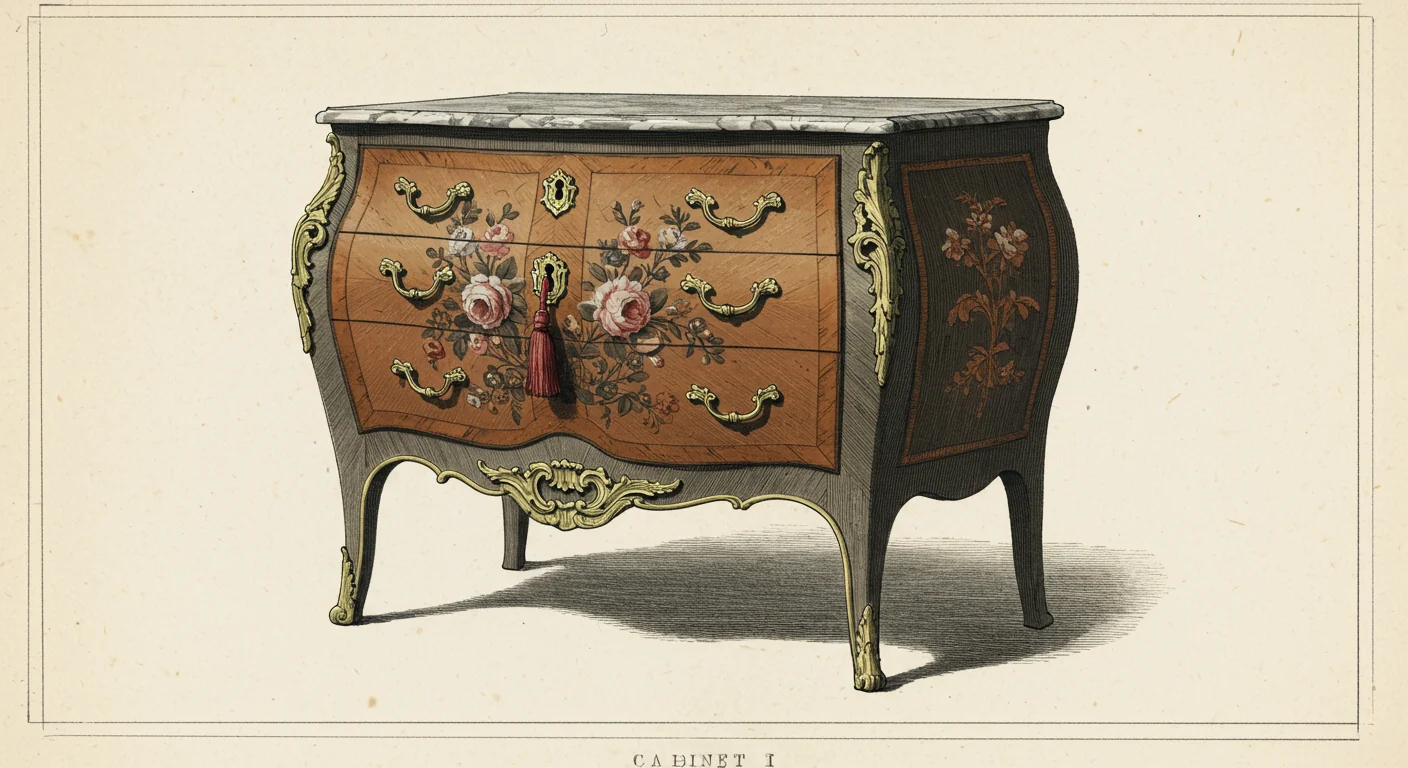
The piece of furniture most often understood as “antique French” in the Anglophone domestic interior — the bombé chest of drawers on small curved legs, fronted in marquetry of pale and dark woods, with a stylised garland of brass mounts across the central drawer face — is, in its essential vocabulary, a Louis XV commode. The actual Louis XV commodes, of which perhaps a few thousand survive in major museum collections and great houses, are considerably more refined, more various, and more particular than the reproduction-furniture trade has ever been able to convey. The reproduction commode, in its various qualities from the 1860s onward, has been so widely produced that it has shaped the popular image of “French eighteenth-century furniture” almost beyond rescue, and one of the small services that may still be done is to explain what the original was actually doing.
This is the first post in Reading the Period Cabinet, the furniture arc of the antiques series, and the companion launch to the Heriz post that opened the rug arc earlier today. It treats Louis XV first because Louis XV is the type that most rewards an opening post — the most encountered, the most often imitated, the most often misunderstood, and the type whose place in the wider history of European cabinet-making makes it the cleanest first specimen against which the others can later be compared. The aim of this post is the aim of every post in the arc to come: to set out what one is looking at, to give the structural and material evidence by which one identifies it, to place it among the styles most often confused with it, and to leave the reader with the trained eye that the arc as a whole is in the slow business of building.
The Specimen
The canonical Louis XV piece, for the purposes of this post and for the purposes of beginning to read the style at all, is the commode. Other forms — the bureau plat, the secrétaire à abattant, the bergère, the fauteuil, the console, the encoignure — carry the same vocabulary in their respective registers, but the commode is the form in which the period’s principal moves are most fully concentrated, and it is the form one most often encounters in any setting where eighteenth-century French furniture is to be seen.
A canonical Louis XV commode, then. It stands on four short cabriole legs — legs that curve outward at the knee, taper inward to the ankle, and end in a small foot, often capped with a gilt-bronze sabot. The foot itself is no more than a few inches above the floor; the leg’s S-curve is the entire vertical interest of the lower part of the piece. Above the legs, the case rises through a serpentine apron and presents itself in a strongly curved silhouette: the front bows outward (the bombé front), the sides curve outward to meet it (the serpentine sides), and the corners are rounded rather than mitred. The case is two drawers tall, sometimes three, and presents a single continuous front rather than the discrete drawer fronts of an English chest of drawers — the marquetry and the ormolu mounts run across the drawer divisions, treating the whole front as one unified decorative field.
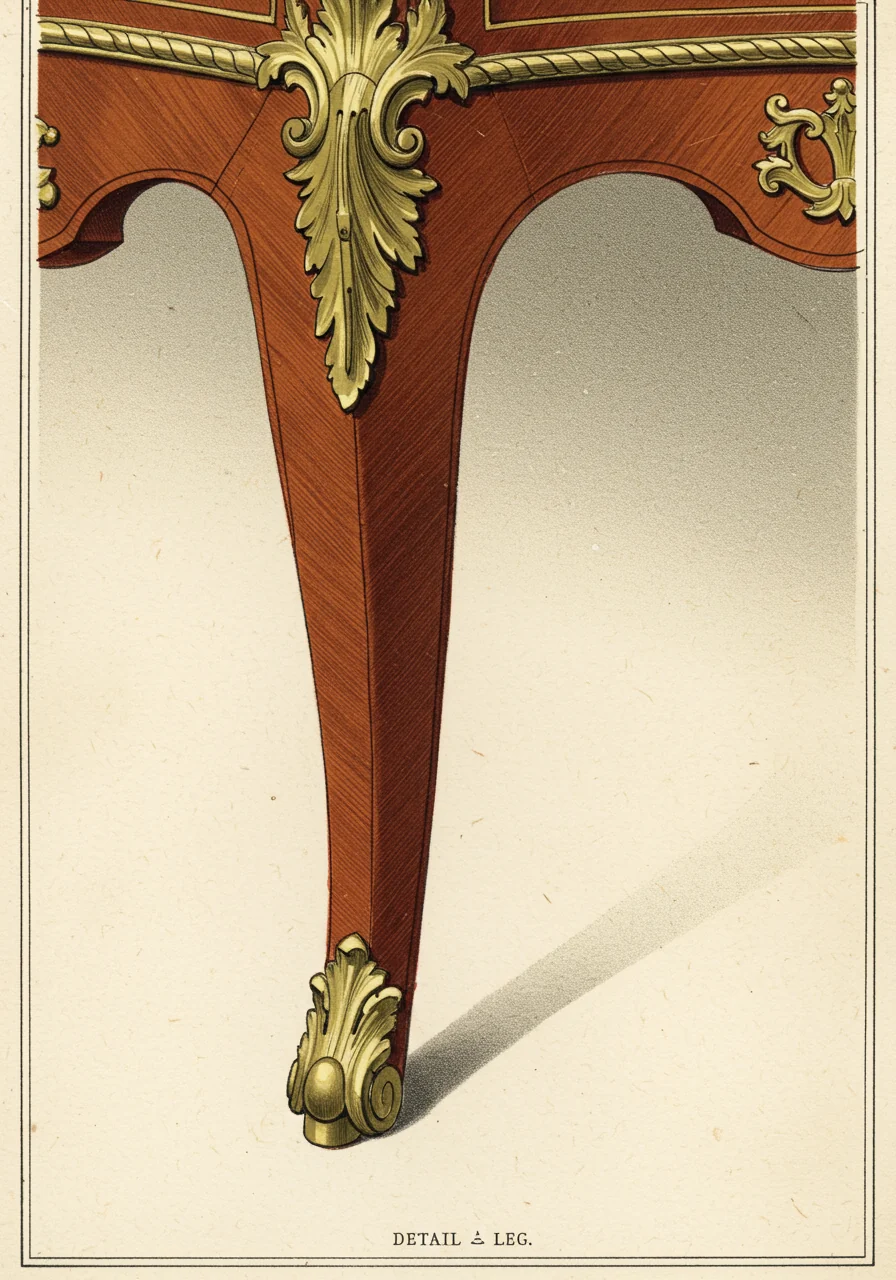
A close detail of a Louis XV cabriole leg — the S-curved profile that defines the period, generous at the knee, tapering through the ankle, and terminating in a small foot capped with a gilt-bronze sabot. The curve is the period: more pronounced than the Régence cabriole that preceded it, less exaggerated than the contemporary German Rococo cabrioles. A Louis XVI piece has straight legs, often fluted and tapered like classical columns; an Empire piece has straight legs with martial gilt-bronze mounts. The leg is the first thing one looks at, and the cabriole settles the period at three paces.
The decorative apparatus has three components in roughly equal measure. The first is the marquetry — the inlay work of pale and dark exotic woods that covers the drawer fronts and the side panels. A typical Louis XV commode of the middle period (1740–1760) carries floral marquetry — bouquets of roses, ribbons, garlands — set against a plain or trellis-pattern ground, in kingwood, tulipwood, rosewood, satinwood, and a half-dozen other tropical species selected for their colour and grain. The great Parisian ébénistes — Bernard II van Risenburgh (BVRB), Charles Cressent, Jean-François Oeben, Antoine-Robert Gaudreau, Jean-Pierre Latz — built their reputations on marquetry of extraordinary subtlety and complexity, in some cases incorporating Chinese or Japanese lacquer panels imported through Holland, or French imitation lacquer (vernis Martin, by the Martin brothers of the Paris workshop), set into the case fronts as decorative reserves.
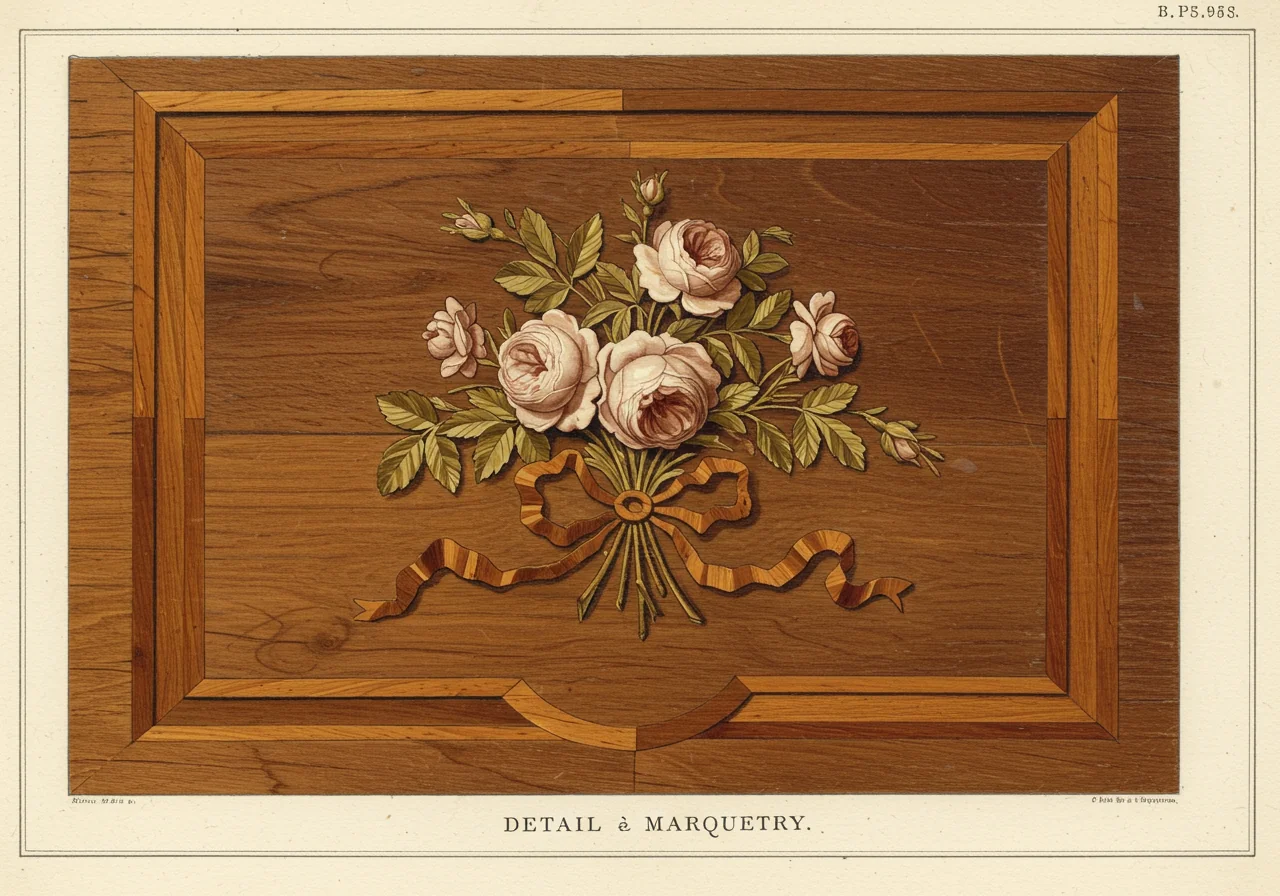
A close detail of Louis XV floral marquetry — a ribbon-tied bouquet of roses in kingwood, tulipwood, satinwood, and pearwood inlay on a plain tulipwood ground. The end-cut wood technique exposes the colour fields across the grain; the assembly is laid by hand in hot animal glue. The compositions of the great Parisian ébénistes are individually recognisable — the rose bouquet of a BVRB commode is not the rose bouquet of a Cressent or of a Latz — and a careful comparative study can attribute a piece to a specific maker on the marquetry alone. The reproduction marquetry of the nineteenth-century revival is generally more rigidly symmetric than the originals, and the species used are often a more limited palette.
The second component is the ormolu — the gilt-bronze mounts applied to the corners, the angles of the cabriole legs, the keyhole escutcheons, the drawer pulls, and (in the high pieces) substantial sculptural mounts at the centre of each drawer or wrapped around the case angles. Ormolu (literally “ground gold,” from or moulu) is mercury-fire-gilded bronze, a process of unusual difficulty and danger — the mercury vapour was understood, even at the time, to shorten the gilders’ lives — that produces a deep matte gold finish that no later technique has been able to reproduce. The mounts began as functional protection for corners and edges that took household wear, but quickly became major sculptural ornament in their own right, with the great bronziers — Jacques and Philippe Caffieri pre-eminent among them — producing mounts of cherubs, female masks, foliage, and elaborate scrollwork.
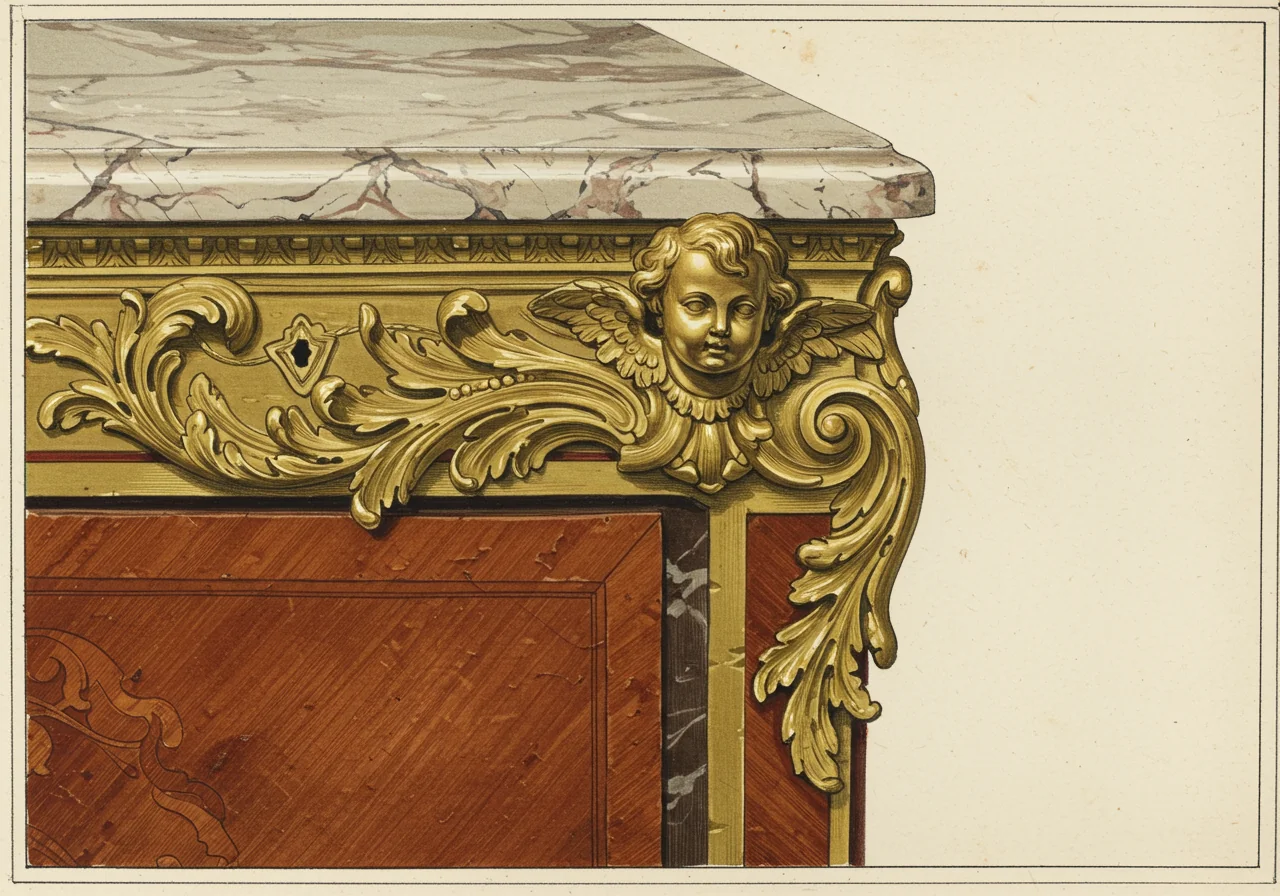
A close detail of a Louis XV ormolu mount — a sculptural arrangement of cherubs, foliage, and scrollwork in mercury-gilded bronze, applied to the upper angle of a commode where the curve of the case meets the marble top. Mercury fire-gilding produces a deep matte finish that is unmistakable beside the brighter, thinner electroplated gilt of nineteenth-century reproductions. The chasing — the hand-finishing of the bronze surface before gilding — is of a quality that does not survive into the reproduction era; on the originals, every leaf and curl bears the mark of the chaser’s tools, while on the reproductions the surface is uniform and the modelling is shallower.
The third component is the marble top — usually a slab of brèche d’Alep or sarrancolin or rouge royal, fitted to the curved silhouette of the case, with its edge moulded to a serpentine profile to match the case below. The marble top is a constant of the form: the case is built to receive it, and a Louis XV commode without its original marble is, in collector terms, a wounded piece. A modern marble replacement, even when carefully made, almost never quite matches the proportions, the edge profile, or the colour relationship to the case that the original mason achieved.
Assembled together — cabriole legs, bombé and serpentine case, marquetry surfaces, ormolu mounts, marble top — these are the canonical components. The variations within the type are considerable; the components themselves do not vary.
The Evidence
Behind the visible composition is the structural and material evidence by which a Louis XV piece is identified at close range and its provenance dated and attributed.
The case construction, first. The carcase of a Louis XV commode is typically built of solid oak (Parisian work) or of pine and walnut (some provincial and German work), then veneered on every visible surface with the exotic woods and marquetry that constitute the visible decoration. The veneers are thick by modern standards — typically a millimetre or more, sometimes two — and were laid by hand with hot animal glue in a process of considerable skill. The carcase joinery is dovetailed, often visible at the back of the case but never at the front. Drawer construction uses through-dovetails at the corners with hand-cut tails, the divisions visible if one removes a drawer and inspects the joinery from inside.
The marquetry, second. The wood species used by the major Parisian ébénistes are well-documented: kingwood (a deep purple-brown), tulipwood (pale rose with strong grain), rosewood (warm red-brown), bois de violette (violet-tinted), satinwood (pale yellow), pearwood (used as a stable ground), holly (white, used for highlights), boxwood, ebony, and a half-dozen others. The marquetry is typically end-cut — the wood sliced across the grain to expose the colour fields — and then assembled in floral or geometric patterns and laid to the case as a unified surface. The marquetry of a fine Louis XV piece, when one has the eye for it, is recognisable by the species used and by the characteristic compositions: the rose bouquet of a BVRB commode is not the rose bouquet of a Cressent commode is not the rose bouquet of a Latz, and a careful comparative study can attribute a piece to a specific maker on the marquetry alone.
The ormolu, third. The mounts of a fine Louis XV piece are mercury-fire-gilded bronze, with the gold layer typically several microns thick and the underlying bronze chased and finished by hand before gilding. The result is a finish of remarkable depth and matte richness that nineteenth-century electroplated reproductions cannot reproduce — the electroplate finish is brighter, more uniform, and visibly thinner. The original mounts of the great pieces are signed or attributed to specific bronziers (Caffieri, Cressent’s own foundry, Jean-Claude Duplessis), and the chasing is of a quality that does not survive into the reproduction era.
The stamp, fourth — and this is the great gift of the period to attribution. From 1751, the Parisian guild of cabinet-makers (the Corporation des Menuisiers-Ébénistes) required all guild members to stamp their work with their name and the guild mark “JME” (jurande des menuisiers-ébénistes, the wardenship seal). The stamp is typically applied to a discreet spot on the carcase, usually at the back or on the underside of the top, in a small rectangular cartouche burned into the wood. A piece stamped “BVRB” with the JME mark is documented as the work of Bernard van Risenburgh and is dated to the post-1751 period. A piece stamped “RIESENER” is by Jean-Henri Riesener, dated post-1768 (when Riesener became a master). A piece without a stamp may be pre-1751, may be a country piece by a maker outside the Paris guild, may be a reproduction, or may be a stamped piece whose stamp has been worn or planed away — but the absence of a stamp is, in itself, evidence to be interpreted, not a verdict to be drawn.
The marble, fifth. The original marble tops of Louis XV commodes are typically of one of a half-dozen French and Italian quarry types — brèche d’Alep, sarrancolin, rouge royal, Carrara, Languedoc, vert de mer — each with characteristic colour and figuring. The marble was selected to complement the wood of the case and the colour of the mounts, and the original marbles can often be identified with confidence. A modern marble replacement is usually in plain Carrara or in a cheaper grey-veined stone, and the proportions and edge profile are often subtly off — a knowledgeable eye picks up the substitution at a glance.
These are the physical facts. They are what one is reading for. None of them, in the older pieces, is concealed; all of them are accessible to anyone who removes a drawer or turns over a leaf of marble or looks closely at the chasing of a mount.
The Period
The Louis XV style proper runs from approximately 1730, when the cabriole leg and the curving case had displaced the rigid rectilinearity of the late Louis XIV, through to roughly 1770, when the neoclassical reaction had begun to reintroduce the straight line and the symmetric composition that would characterise Louis XVI. The named monarch reigned from 1715 (when his great-grandfather Louis XIV died and the five-year-old Louis XV came to the throne under the regency of Philippe d’Orléans) through to his own death in 1774; the style proper is conventionally dated from his majority in 1723, with the early years of the reign — the Régence under Philippe d’Orléans — treated as a separate transitional sub-period.
The Régence (1715–1730) is the bridge from Louis XIV’s monumental baroque to Louis XV’s mature rocaille. Under the regent’s looser court and the relocation of fashionable life from Versailles to Paris, the rigid symmetry of Louis XIV softened: the cabriole leg replaced the straight gaine; the marquetry of Boulle (brass-and-tortoiseshell, classical and architectural in vocabulary) gave way to the floral marquetry in exotic woods that would become the period’s signature; the heavy ormolu mounts loosened into curling foliage and emerging masks. The transitional period is identifiable: a Régence piece typically has a cabriole leg but a still-rectangular case, or a curved case but heavier and more architectural mounts than the Louis XV proper would carry.
The high Louis XV (1730–1760) is the period of the great Parisian ébénistes and of the principal patrons. Madame de Pompadour (Jeanne Antoinette Poisson), the maîtresse en titre of Louis XV from 1745 until her death in 1764, was the period’s most consequential patron of the decorative arts. Her commissions to BVRB, Oeben, and others established the most refined level of the style; her taste — for floral marquetry, for delicate ornament, for the subtlest combinations of colour — set the standard the rest of the period worked toward. Beside her, the Garde-Meuble Royal (the royal furniture warehouse, which commissioned and maintained the furniture of Versailles, Marly, Trianon, Compiègne, and the other royal residences) was the largest single patron, and the Garde-Meuble’s surviving inventory records — preserved in the French national archives — are one of the great gifts to the modern attribution of the period’s furniture.
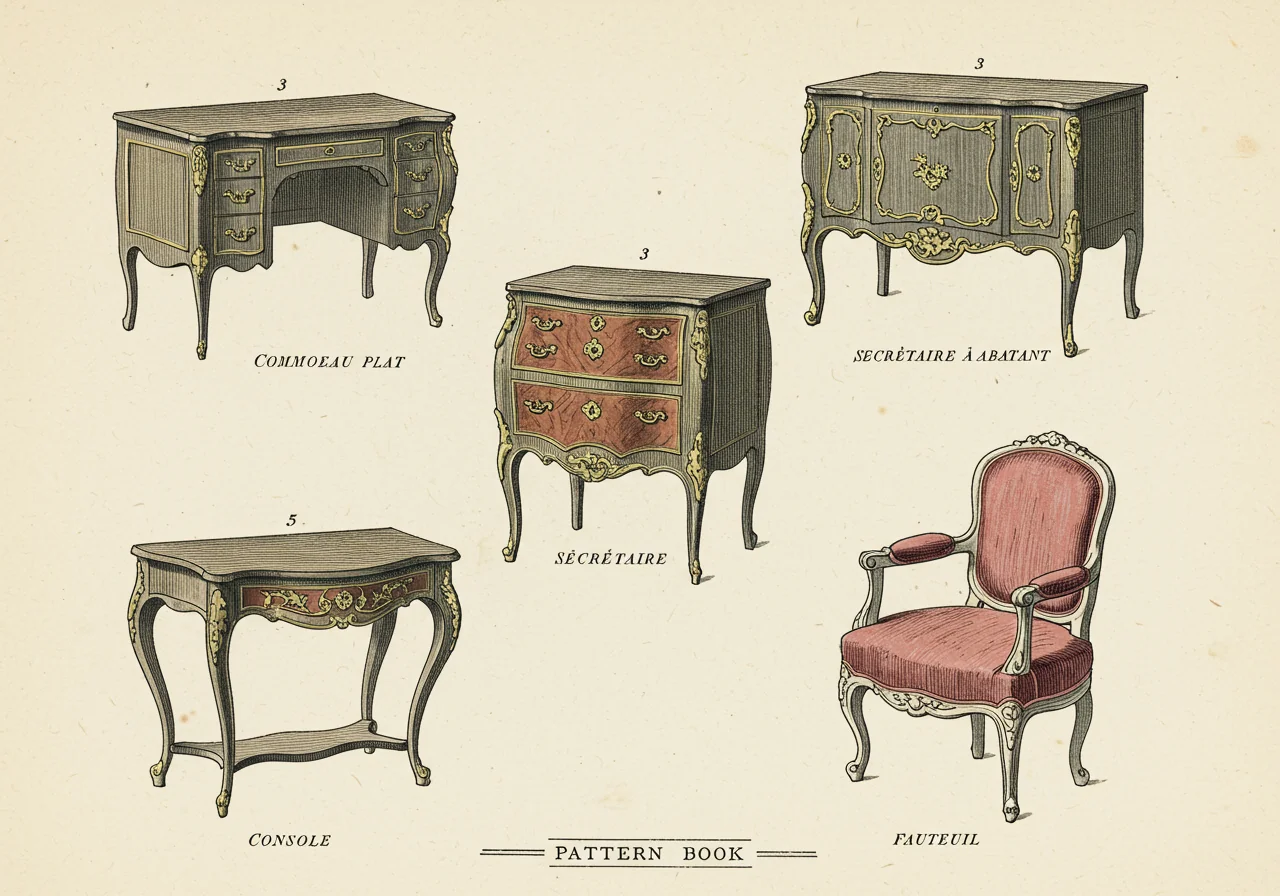
A page from a Victorian connoisseur’s portfolio on Louis XV French furniture — engraved drawings of the principal forms (the commode, the bureau plat, the secrétaire à abattant, the console, the fauteuil) arranged in the manner of a nineteenth-century cabinet-maker’s reference plate, with explanatory annotations on the proportions and the principal ornamental moves. The plate is the kind of reference page that would have appeared in a serious dealer’s portfolio of the period, intended for the customer’s quiet education while the dealer fetched the next piece from the storeroom.
The late Louis XV (1760–1770) shows the early signs of the neoclassical reaction. The cabriole leg straightens slightly; the case fronts become less aggressively bombé; floral marquetry begins to give way to geometric trellis patterns; ormolu mounts incorporate Greek-key and laurel-wreath motifs alongside the older rocaille vocabulary. The transition to Louis XVI — whose proper period begins with his accession in 1774, but whose style is in evidence from the late 1760s — is gradual rather than abrupt, and many pieces of the 1765–1775 period are described in dealer catalogues as “Transition” — meaning Louis XV / Louis XVI transitional — and these pieces, when they are by major makers, are some of the most prized of the period.
A note on the Paris guild system, because it is essential to understanding the period’s attribution. The Parisian cabinet-making trade was organised into two guilds: the menuisiers (joiners), who worked in solid wood — chairs, beds, consoles, frames — and the ébénistes (cabinet-makers in exotic woods), who worked in veneered and marquetry case furniture. From 1751, both guilds required their masters to stamp their work, and the resulting body of stamped work — preserved in collections, sold through dealers, recorded in archives — is the documentary basis for the modern study of the period. Outside Paris, no comparable stamp requirement existed, and provincial work (Lyon, Bordeaux, Nîmes, Provence) is generally unstamped and is attributed by stylistic comparison to the regional traditions.
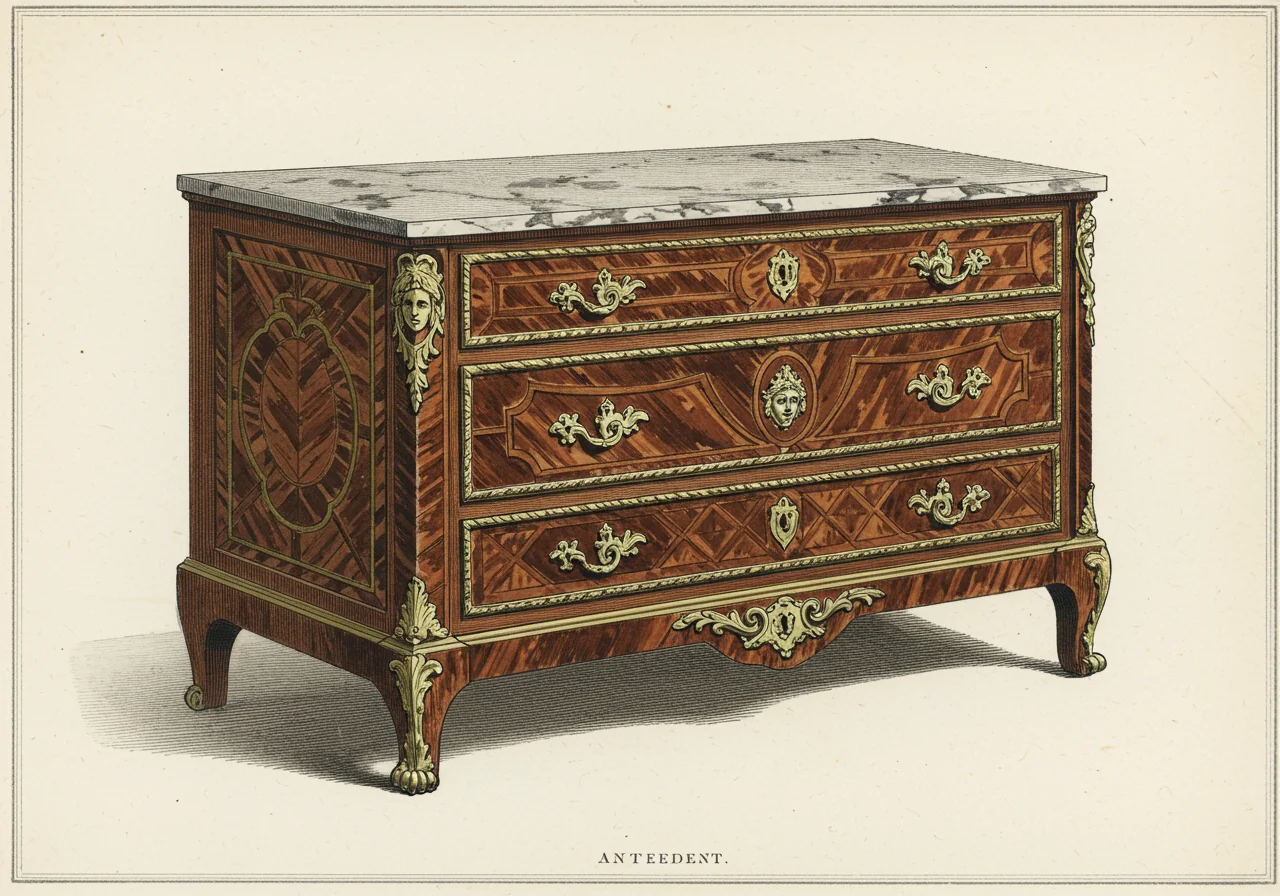
A Louis XIV / Régence commode — straighter case, heavier proportions, Boulle marquetry of brass and tortoiseshell in classical architectural vocabulary, with massive scrolled feet rather than cabriole legs. The antecedent style out of which the Louis XV proper emerged. The Régence — the transitional period 1715–1730 under Philippe d’Orléans — is where the cabriole begins to appear and the marquetry begins to soften from the classical Boulle vocabulary toward the floral exotic-wood marquetry of the high Louis XV. The Régence is short (only fifteen years) and the surviving work is comparatively scarce, but a careful eye distinguishes a Régence commode from an early Louis XV by the still-classical proportions and the more subdued asymmetry of the ornament.
What It Is Not
Several styles stand near enough to Louis XV that the beginner confuses them with it, and distinguishing them is most of the work of reading European eighteenth-century furniture at the upper end.
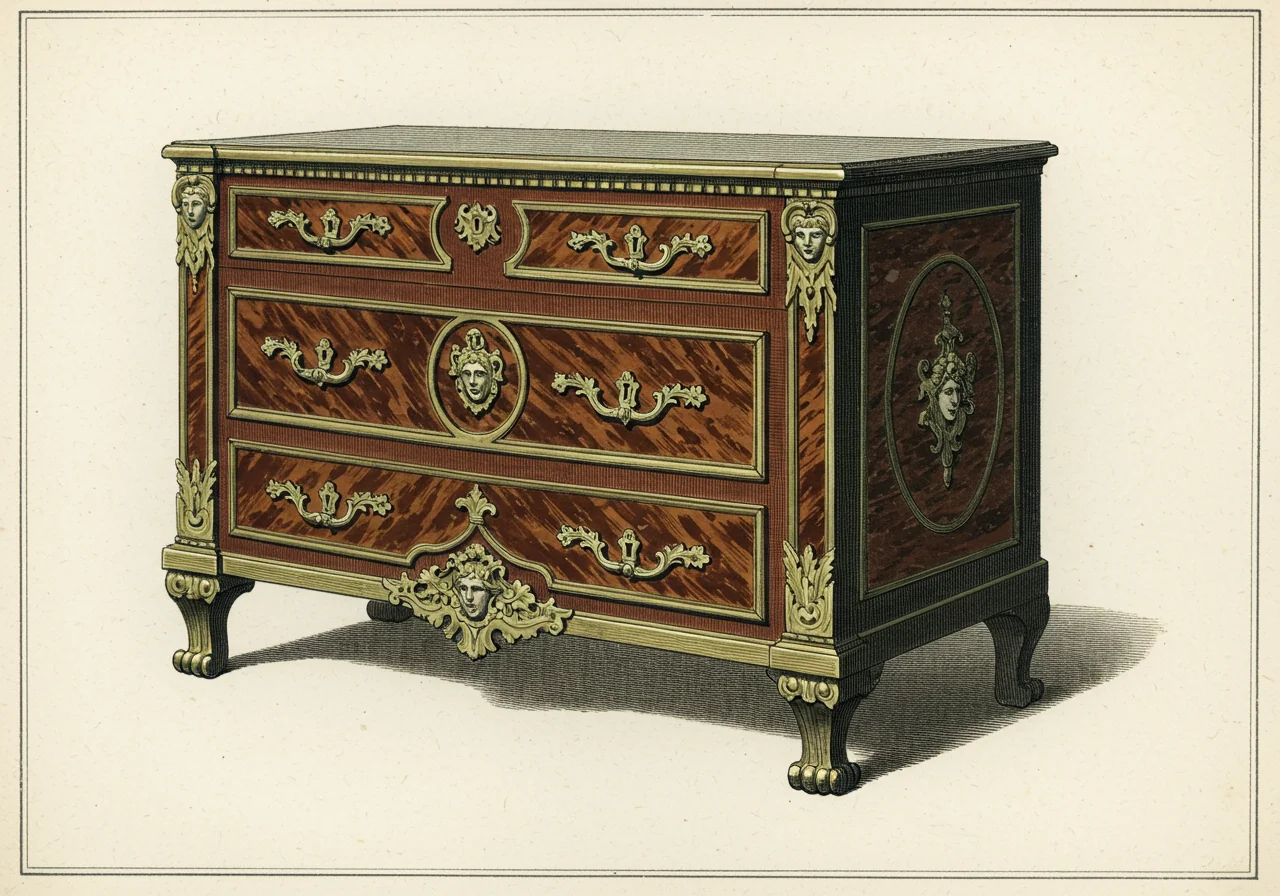
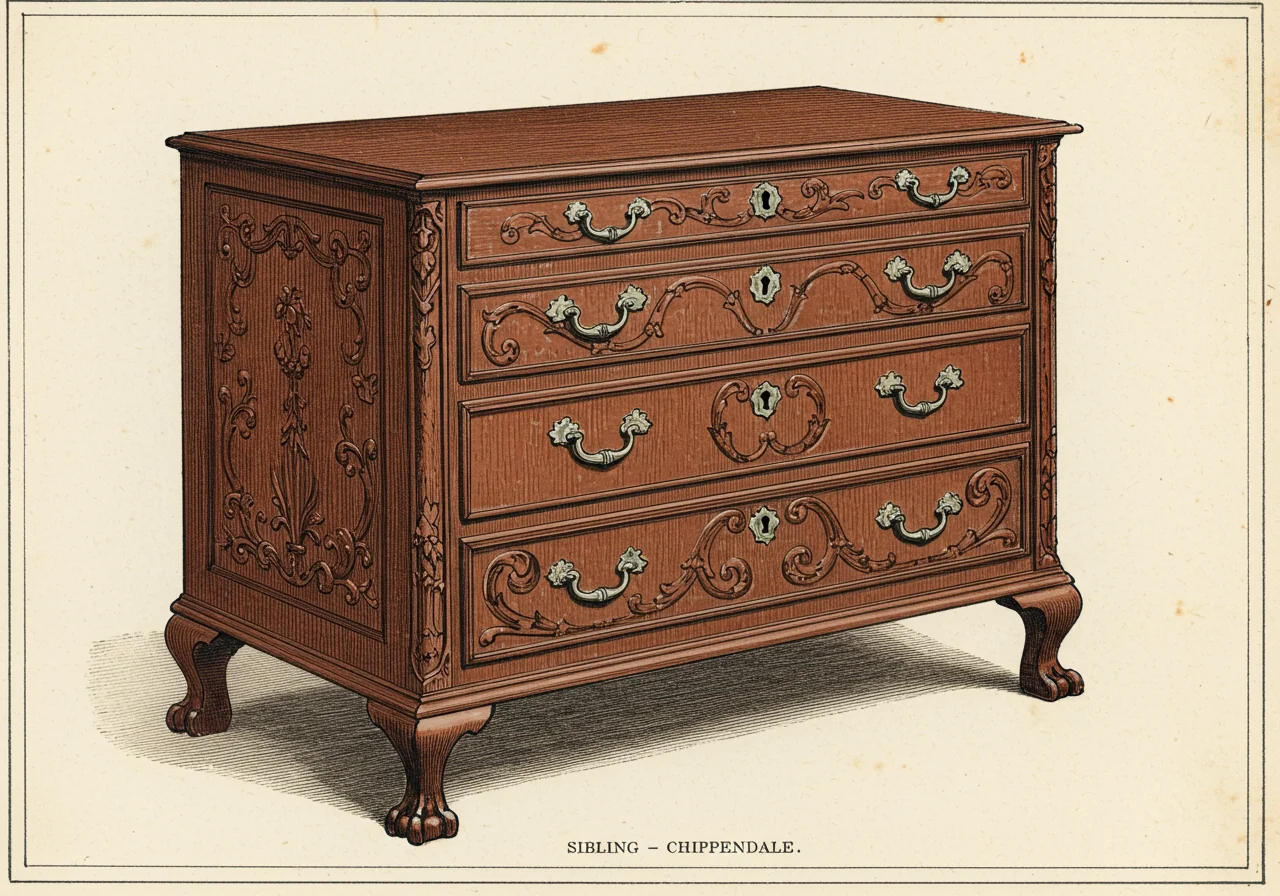
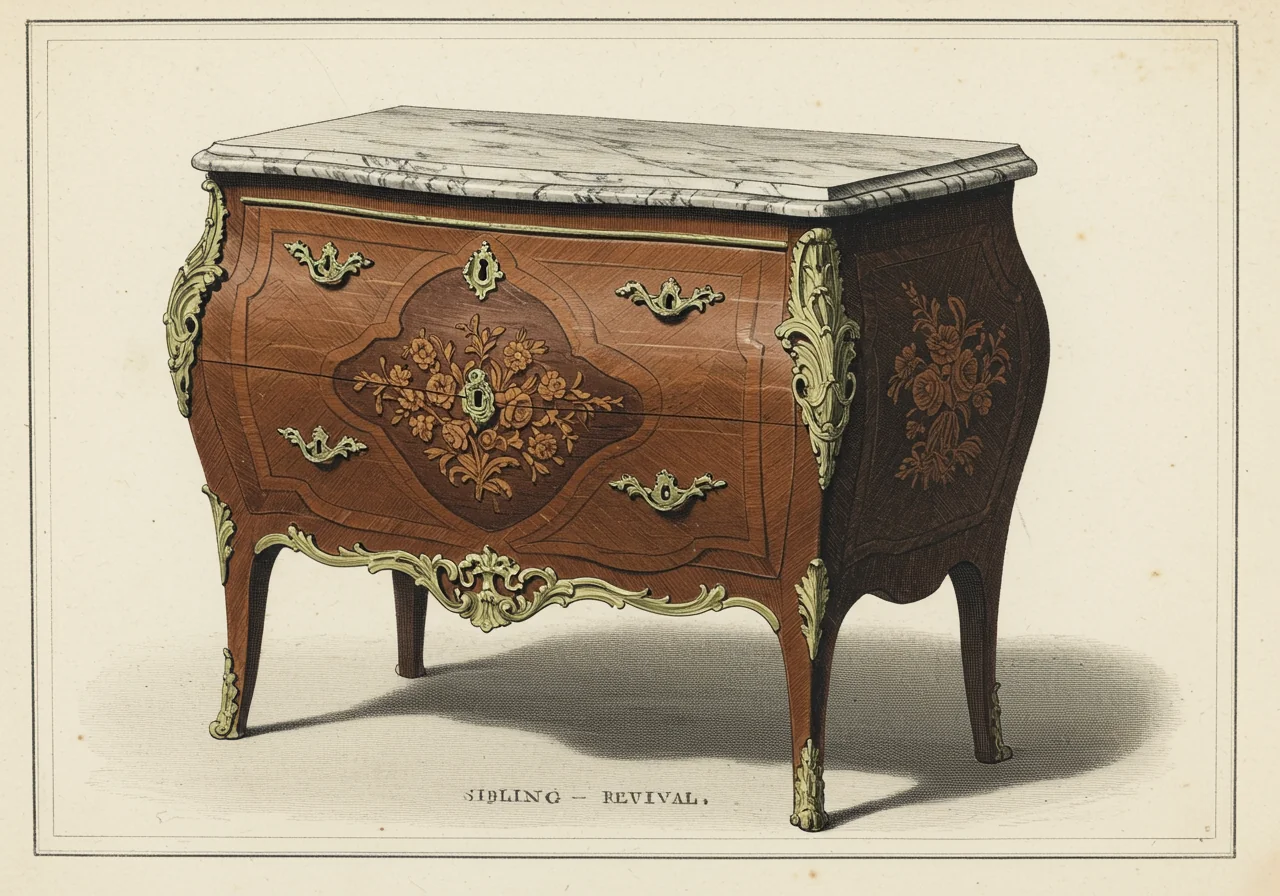
The first is the Louis XIV (1660–1715, antecedent), which Louis XV’s curves displaced. A Louis XIV commode is straighter, more architectural, more heavily symmetric, and typically carries Boulle marquetry — the inlay of brass and tortoiseshell developed by André-Charles Boulle and his sons, with classical and architectural vocabulary (acanthus, masks, scrolls in formal symmetry). The legs are typically straight gaines (tapering rectangular pillars) or scroll-feet rather than cabriole; the case is rectangular and massive; the ormolu is heavier and more sculptural. A Louis XIV piece beside a Louis XV piece reads as a generation older — the proportions, the silhouette, the ornamental vocabulary all differ.
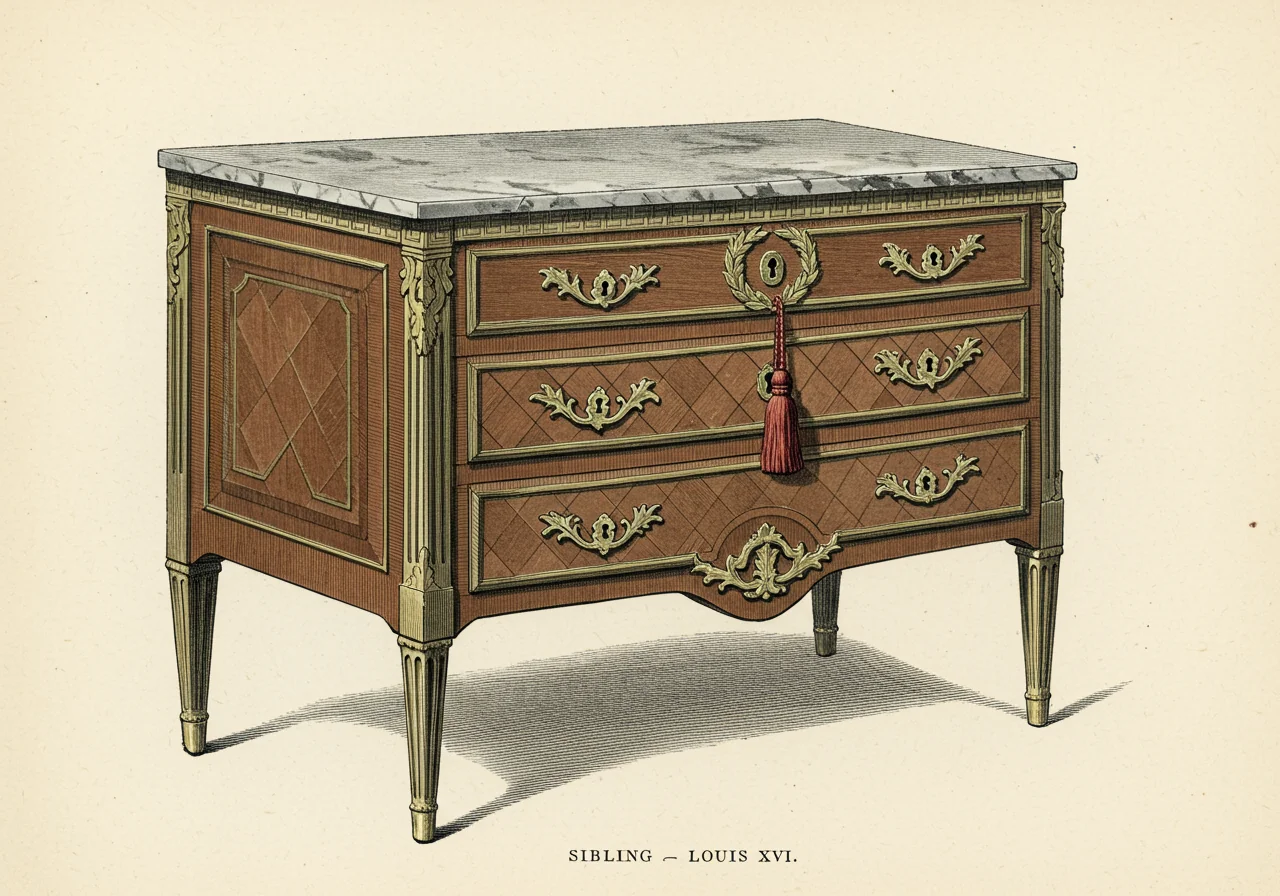
The second is the Louis XVI (1774–1792, successor), which displaced Louis XV. A Louis XVI commode has straight legs, often fluted and tapered like classical columns; the case is rectangular, with corners often canted at forty-five degrees rather than rounded; the marquetry shifts from floral to geometric (trellis, parquetry, classical garlands); the ormolu mounts incorporate neoclassical vocabulary (Greek-key borders, laurel wreaths, urns, ribbons, paterae). The transition from Louis XV to Louis XVI is the move from curve to straight line, from asymmetric balance to symmetric, from rocaille to neoclassical. Many “transition” pieces of the late 1760s and early 1770s carry elements of both, and the dating of these pieces is one of the period’s small pleasures.
The third is the English Chippendale (1745–1775, contemporary across the Channel), Thomas Chippendale’s interpretation of the French Rococo for the English market, published in his Gentleman and Cabinet-Maker’s Director of 1754 and refined across three subsequent editions. Chippendale Rococo borrows the cabriole leg, the curved case, and the asymmetric ornament from the French — but expresses them in mahogany rather than marquetry, with carved decoration rather than ormolu, and with the characteristically English ball-and-claw foot rather than the French sabot. The two styles can superficially resemble each other in silhouette but differ entirely in materials and surface treatment: a French Louis XV piece is veneered, marquetried, and ormolu-mounted; a Chippendale piece is solid mahogany with carved decoration. The English piece, by Chippendale’s own intention, makes a lesser claim to courtly grandeur and a stronger claim to gentlemanly sobriety.
The fourth is the Louis XV revival of the second half of the nineteenth century — the most-deceiving sibling and the one that most often defeats the beginner. The French Second Empire (1852–1870) and the broader European taste of the 1860s through the 1890s produced reproductions of Louis XV furniture in great quantity, often of considerable quality and using authentic-style techniques (marquetry in the same exotic woods, mercury-gilded ormolu, dovetailed carcases). A skilled nineteenth-century reproduction, particularly one that has acquired a century’s patina since it was made, can closely resemble an original at a distance; the distinctions are in the marquetry composition (revival pieces tend to be more rigidly symmetric than originals), in the ormolu chasing (less crisp, with the mounts often cast rather than chased before gilding), in the carcase joinery (machine-cut dovetails on later examples), and in the absence of a period stamp (revival pieces are not JME-stamped, though they may carry their own maker’s mark, such as the well-known “Linke” or “Sormani” or “Beurdeley” marks of Paris cabinet-makers of the 1870s–1900s). The revival pieces are themselves now over a century old, are collected in their own right, and command serious prices when by the major makers; the work is to know what one is buying.
What One Looks At
The practical discipline of identifying a Louis XV piece, when one is standing in front of a candidate cabinet, comes down to a short ordered checklist.
One looks first at the silhouette. Cabriole legs and a bombé or serpentine case is the Louis XV signature. Straight legs and a rectangular case is Louis XVI or Empire or some other later style. Solid wood with carved ornament rather than veneered marquetry is English (Chippendale or its successors). The silhouette is decisive at three paces.
One looks next at the surface. Marquetry of exotic woods (kingwood, tulipwood, rosewood) on a veneered case is Parisian ébéniste work of the high period. Solid walnut with simpler inlays or none is provincial French or German work. Carved mahogany surfaces are English. The surface treatment narrows the geographic and stylistic provenance immediately.
One looks at the ormolu. Mercury-gilded mounts of crisp chasing and deep matte finish, with sculptural detail in cherubs, masks, foliage, and scrolls, is high-period Parisian work. Cast mounts of less crisp finish, electroplated or with bright gilt, is nineteenth-century reproduction. The ormolu is one of the surest separators of original from revival, and the chasing — the surface modelling of the bronze before gilding — is the single hardest thing for a reproducer to fake.
One looks at the marble. Original marble in brèche d’Alep, sarrancolin, rouge royal, or one of the other period quarries, with the edge moulded to the case profile, is a positive indicator. Plain Carrara of incorrect proportions, or marble that does not seat tightly to the case, is a replacement and warrants caution about the rest of the piece.
One looks at the back, the underside of the top, and the inside of the carcase for the stamp. A JME-stamped Parisian piece of the post-1751 period is documented work; the maker’s stamp, where present, settles the attribution. The absence of a stamp does not condemn a piece, but a positive stamp is the strongest single piece of evidence one can hope for.
One looks at the joinery. Hand-cut dovetails of irregular spacing on the drawers, a carcase of period oak with characteristic age and patina, drawer runners of the period type, evidence of period repair (consistent with two and a half centuries of use) — these are the marks of an authentic eighteenth-century piece. Machine-cut dovetails of perfectly regular spacing, a carcase of newer wood, modern hardware, and an absence of period repair are the marks of nineteenth-century reproduction or later.
And one looks at the proportions. The proportion of leg to case to top, the depth of the bombé, the curve of the cabriole, the relationship of the marquetry composition to the case geometry — these are the harder-won judgments, the ones that come only with comparative looking across many examples. A great Louis XV piece has proportions of an immediate rightness that the reproductions almost never quite achieve; learning to see this is the slow work of the trained eye that the arc as a whole is in the business of building.
The next post in the arc is likely to be either Louis XVI — to set out the neoclassical reaction that displaced the rocaille — or English Chippendale, the contemporary across the Channel that translated the Louis XV vocabulary into a different national register. The choice will depend on what photographic material is available at the time of writing.