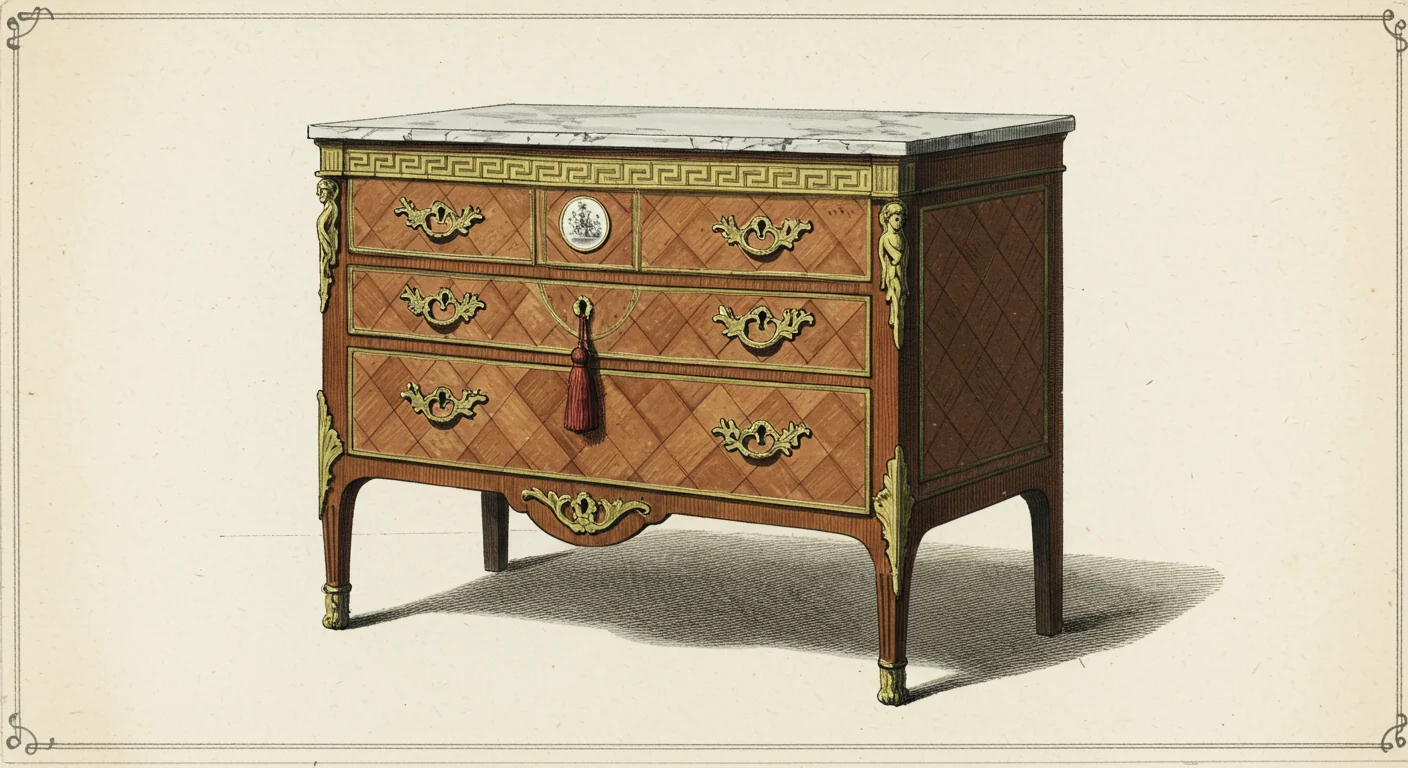
The cabriole leg disappears. The bombé case straightens into a rectangle with canted corners. The floral marquetry bouquet shifts to a geometric trellis. The rocaille scrollwork of the ormolu mounts gives way to Greek-key borders, laurel-wreath swags, and the paterae and urns of the antique Roman vocabulary. The asymmetric balance of the rocaille becomes the rigorous symmetry of the neoclassical. The Louis XVI style, in essence, is the inverse of the Louis XV style across every register in which the cabinet-maker had to make a decision, and the transition between the two — over a fifteen-year period from roughly 1760 to 1775 — is the single most thoroughly documented and most consequential stylistic shift in the history of European furniture.
This is the second post in Reading the Period Cabinet, the furniture arc of the antiques series. It treats Louis XVI second because Louis XVI is the direct successor to the Louis XV the previous furniture post described, and because the two styles together — curve and straight line, rocaille and neoclassical, asymmetry and symmetry — establish the principal stylistic axis along which every other eighteenth-century European furniture tradition can be located. The same logic that put Tabriz immediately after Heriz on the rug side puts Louis XVI immediately after Louis XV on the furniture side; getting the two pairs in place is what makes the rest of the arc legible.
This post follows the same template as the Louis XV: what a canonical Louis XVI piece looks like, the structural and material evidence by which one identifies it, the historical and patron context that produced it, the styles most often confused with it, and the practical identification discipline by which a candidate piece is read.
The Specimen
The canonical Louis XVI piece, as with the Louis XV, is the commode, and the commode is what the rest of the post will principally describe. Other forms — the bureau plat, the secrétaire à abattant, the bonheur du jour, the bergère, the fauteuil, the athénienne, the various console and side-table forms — carry the same vocabulary in their respective registers, and the principal moves of the style are most fully concentrated in the commode.
A canonical Louis XVI commode, then. It stands on four straight legs — most often fluted columnar legs, tapered like classical columns, with vertical fluting (sometimes with the upper third left plain in the manner called stop-fluting), and terminating in either a small turned toupie foot or a square spade foot. The legs may be square in section or round, with the round columnar form being the more characteristically neoclassical and the square form being the more frequently seen in commercial work. The legs are connected to the case by a small chamfered transition rather than the curving apron that characterised the Louis XV. There is no cabriole anywhere on the piece.
Above the legs, the case rises straight and presents itself in a strongly rectangular silhouette: the front is flat or very gently curved, the sides are flat, the corners are canted — chamfered at forty-five degrees rather than rounded as on the Louis XV — and the proportions are taller and more architectural than the Louis XV. The case is two drawers tall, sometimes three, and presents either three discrete drawer fronts (each treated as a separate panel of marquetry) or a continuous front with the drawer divisions rendered subordinately. The continuous-front treatment that the Louis XV preferred is, on the Louis XVI, often broken up by central marquetry panels that themselves frame a Sèvres porcelain plaque or a marquetry portrait medallion.
The decorative apparatus — marquetry, ormolu, marble — continues to consist of the same three components as on the Louis XV, but each component carries an entirely different vocabulary.
The marquetry, first. A Louis XVI commode of the high period (1775–1790) carries geometric marquetry rather than floral. The dominant patterns are: the trellis (a repeating diamond pattern in alternating light and dark woods), the cube (a three-dimensional cube illusion in three contrasting tones), the chevron (zigzag arrangements), and various parquetry patterns of star-and-rosette repeats. Where pictorial marquetry persists — and it does persist, particularly in the central panels of the better commodes — the subject matter shifts from floral bouquets to neoclassical motifs: trophies of musical instruments, garland-tied wreaths, urns with flowers, classical figures in cameo. The species of wood remain those of the Louis XV (kingwood, tulipwood, rosewood, satinwood, sycamore, holly), but the compositions are different.
The ormolu, second. Louis XVI ormolu mounts are unmistakably neoclassical in vocabulary. The signature elements are: Greek-key borders along the upper edge of the case (above the top drawer), laurel-wreath swags draped across the central drawer or framing the central panel, ribbon-tied garlands above the apron, paterae (oval rosettes with radiating petals) at the corners and at the tops of the legs, urns and vases at the centres of side panels, bucrania (ox-skull motifs) and guilloche borders at finer pieces, and acanthus capitals at the tops of the columnar legs. The ornament is rigorously symmetric — every motif mirrored across the central axis of the piece — and the chasing of the bronze is finer and more architecturally precise than the rocaille work of the Louis XV.
The marble, third. Louis XVI marble tops continue from the Louis XV in material (the same period quarries: brèche d’Alep, sarrancolin, rouge royal, white Carrara, Languedoc) but with the edges flat-moulded rather than serpentine. White Carrara becomes more common during the period, in keeping with the neoclassical preference for the Greek-Roman white-marble tradition over the polychromatic French preferences of the Louis XV.
Assembled together — straight fluted columnar legs, rectangular canted-corner case, geometric or neoclassical marquetry, neoclassical ormolu in Greek-key and laurel-wreath vocabulary, marble top with flat-moulded edges — these are the canonical components. The variations within the type are considerable; the components themselves do not vary.
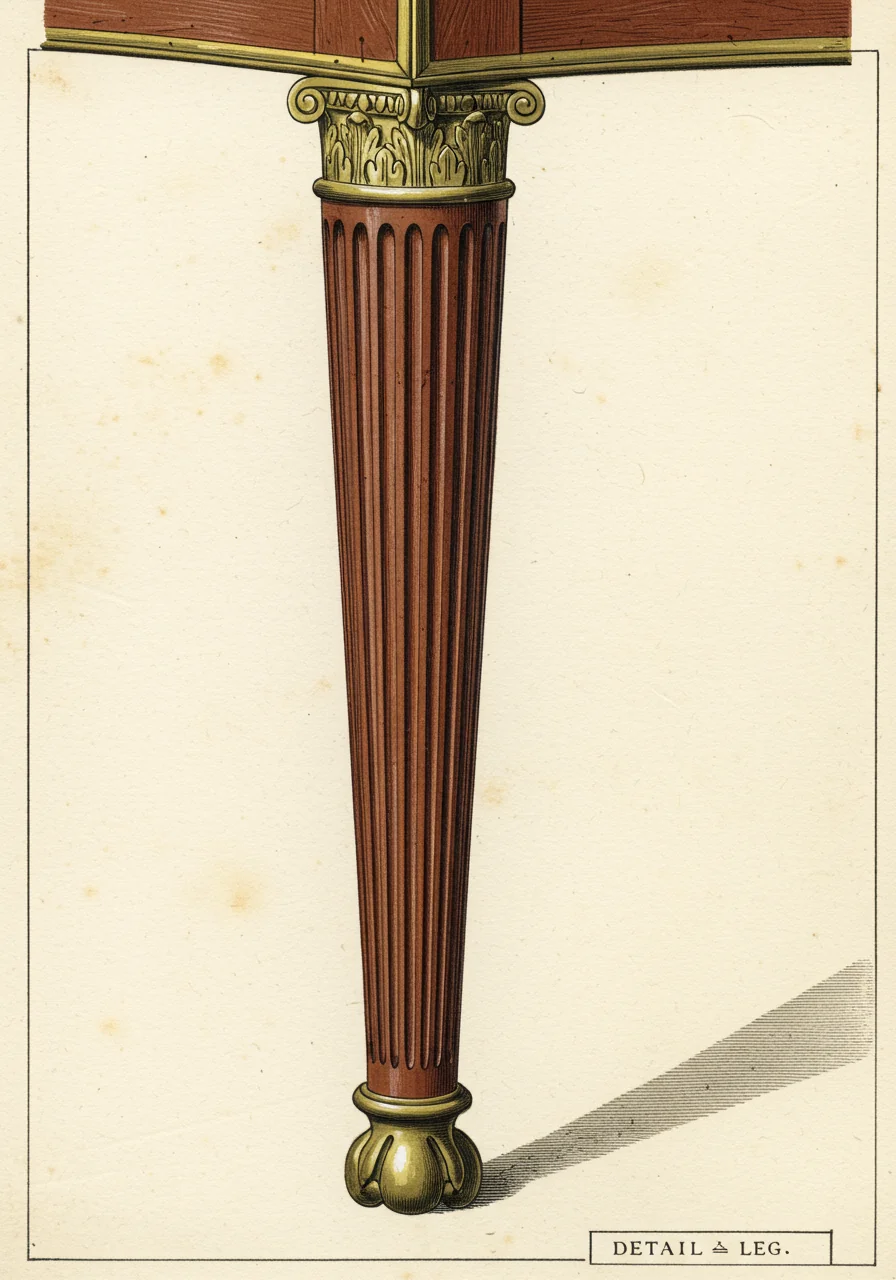
A close detail of a Louis XVI fluted columnar leg — the straight tapered profile that defines the period, with vertical fluting (here in the stop-fluted variant where the upper third is left plain), an ormolu acanthus capital at the top where the leg meets the case, an ormolu base above a small turned toupie foot. The straight columnar form is the inverse of the Louis XV cabriole, and the move from curve to straight line is the single most diagnostic move of the period. A Louis XV commode reads at three paces by its legs; a Louis XVI commode reads at three paces by the same logic, in the opposite direction.
The Evidence
Behind the visible composition is the structural and material evidence by which a Louis XVI piece is identified at close range and its provenance dated and attributed.
The leg, first. The cabriole is gone. A Louis XVI leg is straight, almost without exception — the only variation worth noting is between the fluted columnar leg (round in section, with vertical fluting, terminating in a turned toupie foot) and the square tapered leg (square in section, with no fluting or with a small chamfer at the corners, terminating in a square spade foot). The columnar form is the more characteristically high-Louis-XVI; the square tapered form is more frequently seen in provincial work and in the cheaper Parisian commercial production. Either way, the leg is straight; if it curves, the piece is not Louis XVI proper but Louis XV or a Transition piece or one of the nineteenth-century revivals that intermixed the vocabularies.
The case, second. The carcase construction continues to use solid oak (Parisian work) or pine and walnut (provincial and German), with veneers of exotic woods and marquetry on the visible surfaces. The dovetail joinery of the carcase is identical to the Louis XV in technique and tooling. The drawer construction uses through-dovetails at the corners, hand-cut, with irregular spacing characteristic of pre-machine work. The case proportions are taller and more rectangular than the Louis XV, with the canted corners providing the only curve in the piece.
The marquetry, third. The wood species used by the major Louis XVI ébénistes are the same as those of the Louis XV ébénistes — the period was continuous in its supply chain even as it discontinuous in its decorative vocabulary — and the principal makers (Riesener pre-eminent among them) bridged both periods personally. What changes is the composition. A Louis XVI commode by Riesener of the 1780s will use the same kingwood and tulipwood and satinwood that a Louis XV commode by BVRB of the 1750s used, but in geometric trellis or parquetry rather than in floral bouquets, and often with central panels framing a Sèvres porcelain plaque or a marquetry trophy of musical instruments.
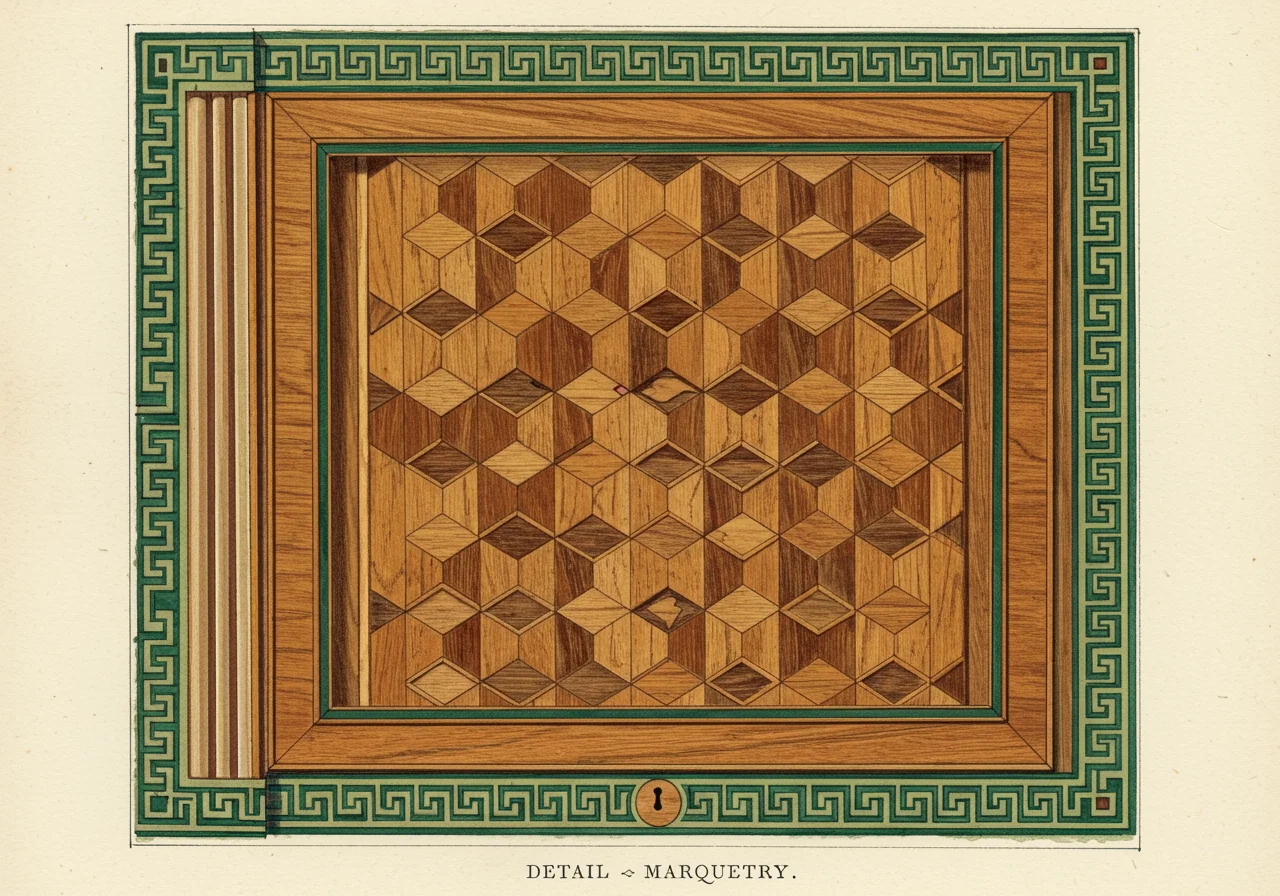
A close detail of Louis XVI geometric marquetry — a trellis of small lozenges in alternating kingwood and tulipwood, framed by a stop-fluted border in pale satinwood and a Greek-key border in stained holly. The vocabulary is rigorously geometric: every motif a mathematical figure rather than a botanical one. Where Louis XV marquetry was a ribbon-tied bouquet of roses naturalistically rendered, Louis XVI marquetry is a parquetry of small geometric repeats — and the same workshop that produced the Louis XV bouquets produced the Louis XVI trellises a decade later, often using the same exotic woods in different arrangement.
The ormolu, fourth. The mounts of a Louis XVI piece continue to be mercury-fire-gilded bronze, and the chasing quality of the high-period work is comparable to or better than the Louis XV — the bronziers of the Louis XVI period (Pierre Gouthière pre-eminent among them) produced ormolu of an architectural precision that was, at its best, the highest-quality bronze decorative work ever made. The vocabulary is unmistakably neoclassical: Greek-key bands, laurel-wreath swags, paterae, urns, ribbon-tied garlands, palmettes. A piece without any of these motifs and with rocaille scrollwork instead is Louis XV; a piece with martial trophies and Egyptian motifs and heavier classical ornament is Empire; a piece with the Louis XVI vocabulary is Louis XVI.
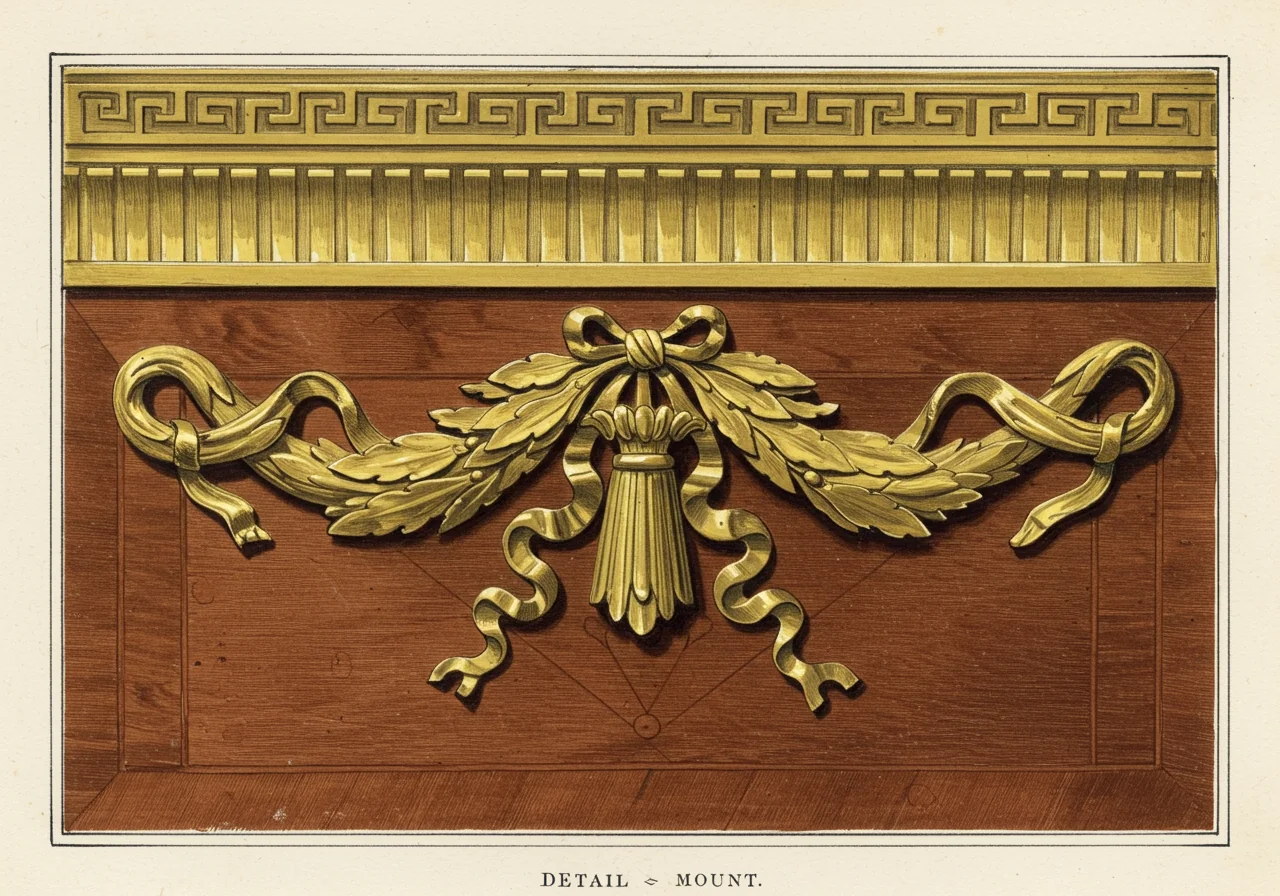
A close detail of a Louis XVI ormolu mount — a laurel-wreath swag tied at each end with a flowing ribbon, framed above by a Greek-key border, set against a ground of vertical fluting. The neoclassical vocabulary is exact: every motif drawn from the antique Roman repertory of architectural ornament. The chasing of the bronze, by Pierre Gouthière or one of his contemporary bronziers, is of an architectural precision the rocaille-period craftsmen had not been concerned with — the laurel leaves are rendered with the regularity of a frieze, the ribbon ties fall in symmetric S-curves, the Greek key is geometrically exact.
The stamp, fifth. The Parisian guild stamp requirement (JME + maker’s name, instituted in 1751) continues unchanged through the Louis XVI period, and the surviving body of stamped Louis XVI work is, if anything, more comprehensively documented than the Louis XV — the period is closer to the modern era and more pieces survive with their stamps intact. Riesener (who became master in 1768 and worked through the 1780s) is the most-documented Louis XVI ébéniste and the maker whose stamp on a piece commands the highest premium. Adam Weisweiler (master 1778), Martin Carlin (master 1766, working through the 1780s), David Roentgen (the German-born master, working in Paris and at the German courts), Bernard Molitor (late Louis XVI / Directoire), Jean-François Leleu (master 1764) are the other principal names whose stamps make a piece documented work.
The marble, sixth, continues from the Louis XV with the noted shift toward white Carrara as the more characteristically neoclassical option, with the colored period marbles continuing in use particularly for the more ornate or more royal pieces.
These are the physical facts. They are what one is reading for. They differ from the Louis XV at every register of decoration but at no register of construction — the cabinet-making craft itself was continuous across the transition, and the same workshops produced both styles.
The Period
The Louis XVI style proper runs from approximately 1760, when the early signs of the neoclassical reaction begin appearing in late-Louis-XV pieces (the Transition period of the late 1760s and early 1770s), through to roughly 1790, when the Revolution effectively ended the great Parisian ébéniste workshops and the Directoire austerity began. The named monarch reigned from 1774 (when Louis XV died) through to his deposition in 1792 and his execution in 1793; the style proper, however, predates his accession and has its origins in the broader European neoclassical movement of the 1750s and 1760s.
The neoclassical movement itself had three principal sources, each documented at the time and traceable in subsequent scholarship. The first was archaeological: the rediscovery and excavation of Pompeii (begun 1748 under Bourbon Naples, with the publication of the Antichità di Ercolano volumes through the 1750s and 1760s), which made the actual visual vocabulary of Roman domestic interiors available to European designers for the first time since antiquity. The second was theoretical: Johann Joachim Winckelmann’s Gedanken über die Nachahmung der griechischen Werke (1755) and his Geschichte der Kunst des Altertums (1764), which articulated the aesthetic argument for the superiority of Greek classical art over the rococo style then dominant. The third was political and cultural: the increasing weariness of the French court and Parisian bourgeoisie with the perceived excesses of the rocaille, and the search for a more restrained and more morally serious aesthetic for the new generation of patrons.
The Transition (1760–1775) is the bridge from the high Louis XV to the high Louis XVI. Pieces of this period — many of them by makers who would go on to be the principal Louis XVI ébénistes (Riesener especially, who became master in 1768 and produced Transition work for several years before settling into the high Louis XVI) — combine elements of both vocabularies in ways that are sometimes labelled as one style and sometimes as the other depending on which elements the dealer wishes to emphasise. A Transition commode might have a still-curved bombé case but with neoclassical ormolu mounts; or straight fluted legs but with floral marquetry; or symmetric composition but with rocaille corner mounts. These pieces are particularly prized by collectors for the documentary evidence they provide of the stylistic shift, and a clearly-attributable Transition piece by a major maker can fetch prices comparable to or exceeding the equivalent high-period work.
The high Louis XVI (1775–1790) is the period of the great workshops at the height of their refinement. Marie Antoinette (queen consort from 1774, the principal patron of the period) commissioned extensively from Riesener, Carlin, Weisweiler, and the other major ébénistes, particularly for her residences at the Petit Trianon and Saint-Cloud. The Garde-Meuble Royal, continuing from the Louis XV period, was the largest single patron and the institution whose surviving inventories provide the documentary basis for much of modern attribution. The wealthy financial bourgeoisie — the fermiers généraux (tax-farmers) and the bankers of the rue Saint-Honoré — were the second-tier patrons, and their commissions sustained the workshops that the royal commissions alone could not have supported.
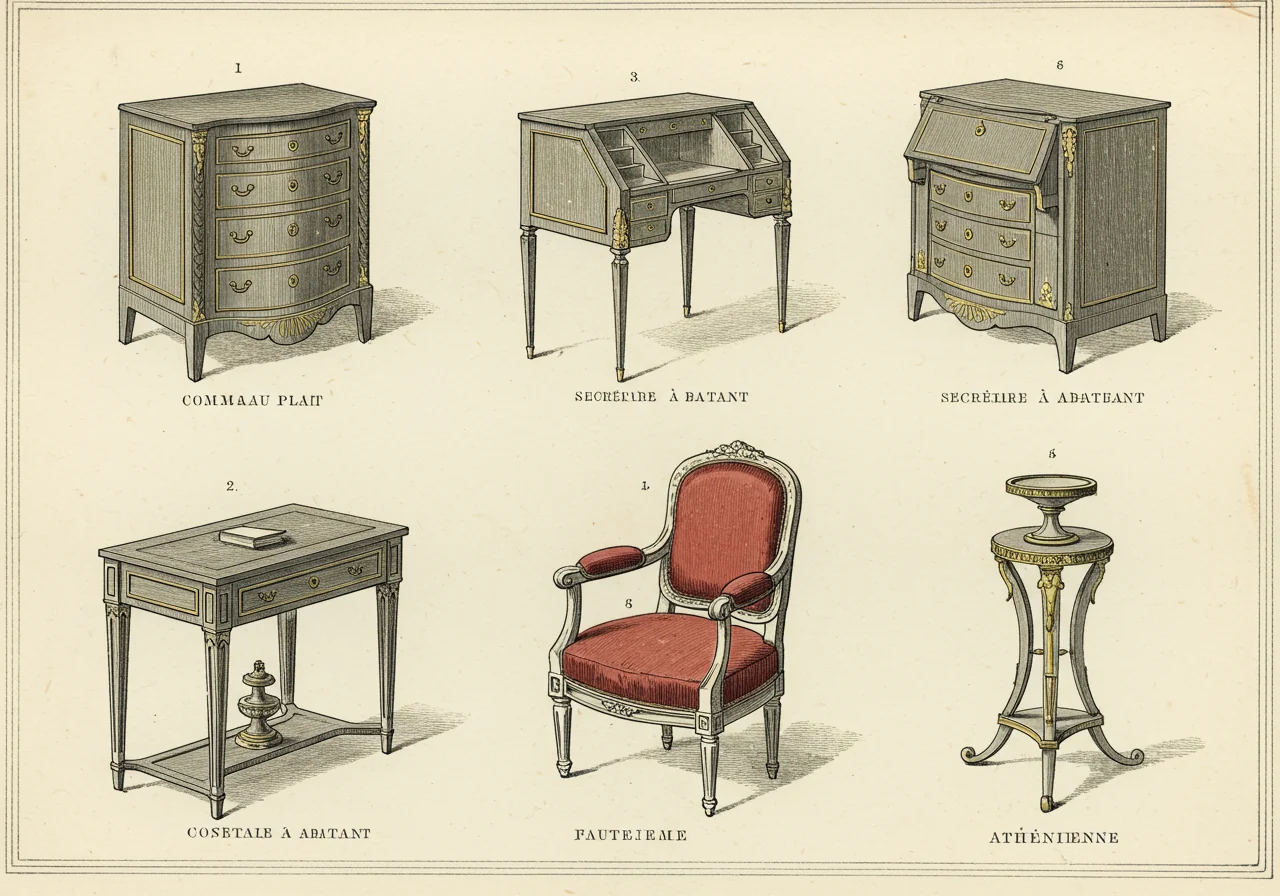
A page from a Victorian connoisseur’s portfolio on Louis XVI French furniture — engraved drawings of the principal forms (the commode, the bureau plat, the secrétaire à abattant, the console table, the fauteuil, the athénienne tripod stand) arranged as a nineteenth-century cabinet-maker’s reference plate, with explanatory annotations on the proportions, the principal ornamental moves, and the rectilinear-and-symmetric composition principles. The plate is the kind of reference page that would have appeared in a serious dealer’s portfolio of the period, and it is what one consults when trying to identify the form of an unfamiliar Louis XVI piece in the dealer’s storeroom.
The late Louis XVI / pre-Directoire period (1789–1795) is the period of the Revolution’s effects on the workshops. The flight of the aristocracy and the dissolution of the Garde-Meuble in 1792 destroyed the principal patronage system; many of the great ébénistes (including Riesener) lost their primary client base and ended their careers in straitened circumstances. The Directoire (1795–1799) that followed continued the Louis XVI vocabulary in stripped-down form: the geometric marquetry persisted, the straight legs persisted, the neoclassical ormolu persisted, but the materials were cheaper, the chasing less refined, the production smaller in volume. The Empire (1804–1815) that followed the Directoire reintroduced opulence in a heavier register.
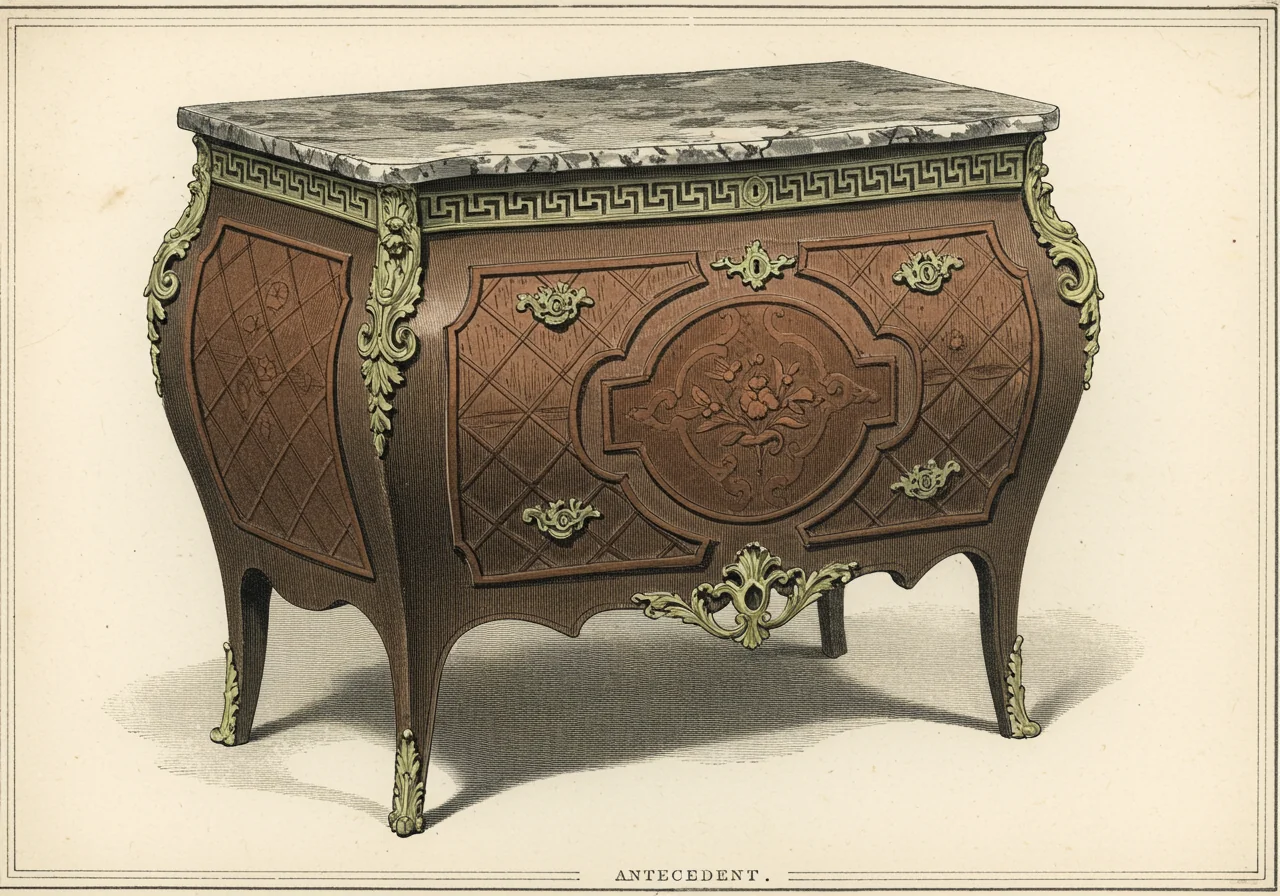
A Louis XV / Transition commode — the bombé case still curving in the Louis XV manner but with early neoclassical ormolu vocabulary appearing in the mounts (a Greek-key border at the top, neoclassical paterae at the corners) and with the floral marquetry beginning to give way to geometric trellis in the side panels. The Transition period (roughly 1760–1775) is where the Louis XV bones meet the Louis XVI surface, and pieces of this period by major makers — Riesener especially in his early career — are among the most prized and most documentary of the eighteenth-century French furniture corpus.
A note on the named ébénistes who bridge the two periods. Jean-Henri Riesener (1734–1806, master 1768) is the principal ébéniste of the Louis XVI period and the maker whose work most clearly demonstrates the stylistic continuity-within-change between the Louis XV and the Louis XVI. Riesener was apprenticed to Jean-François Oeben (the great Louis XV master), inherited Oeben’s workshop on his death in 1763, and produced both Transition pieces in the late 1760s and high Louis XVI pieces through the 1780s. His career spans the entire stylistic shift, and a comparative study of his early and late work is the closest thing to a controlled experiment in the history of European furniture stylistic change.
What It Is Not
Several styles stand near enough to Louis XVI that the beginner confuses them with it, and distinguishing them is most of the work of reading European late-eighteenth-century furniture.
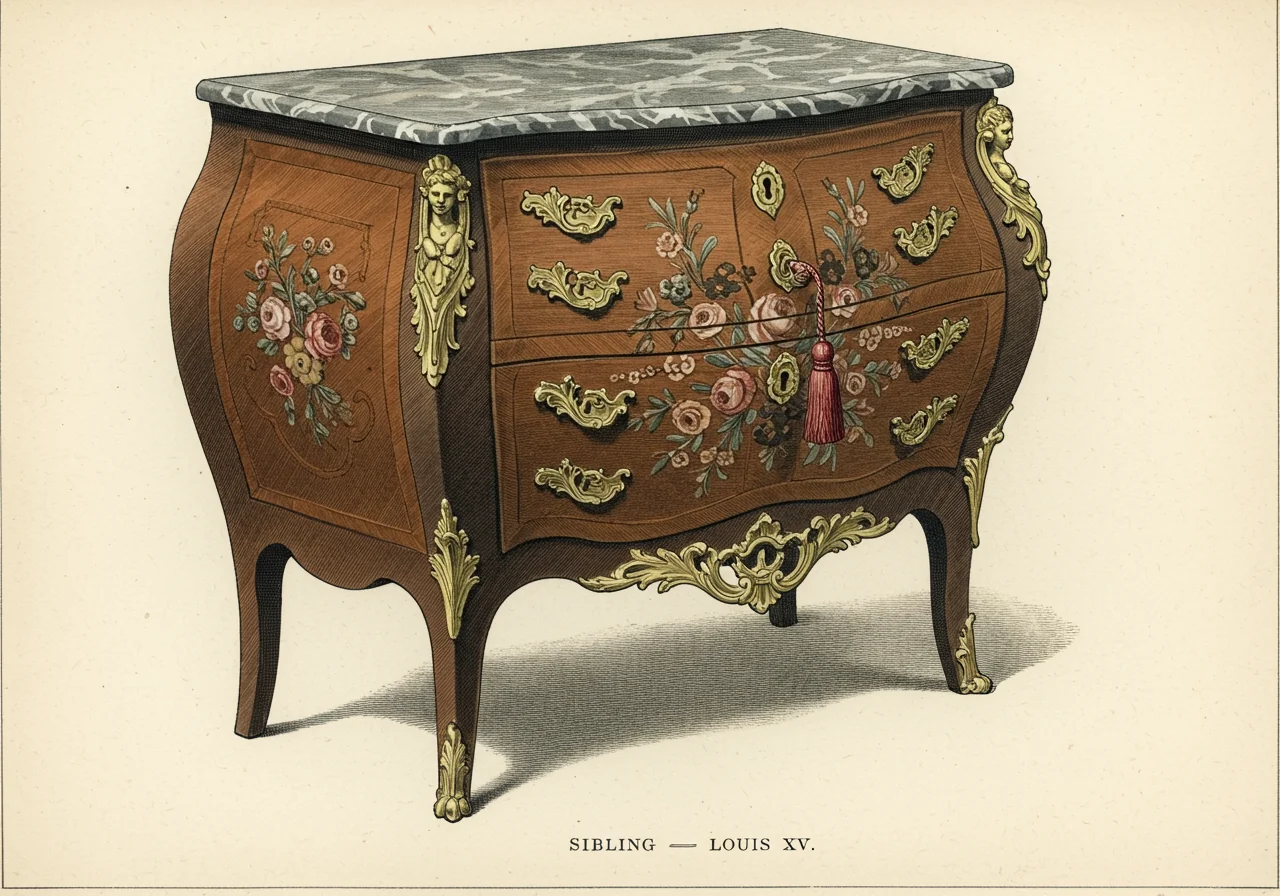
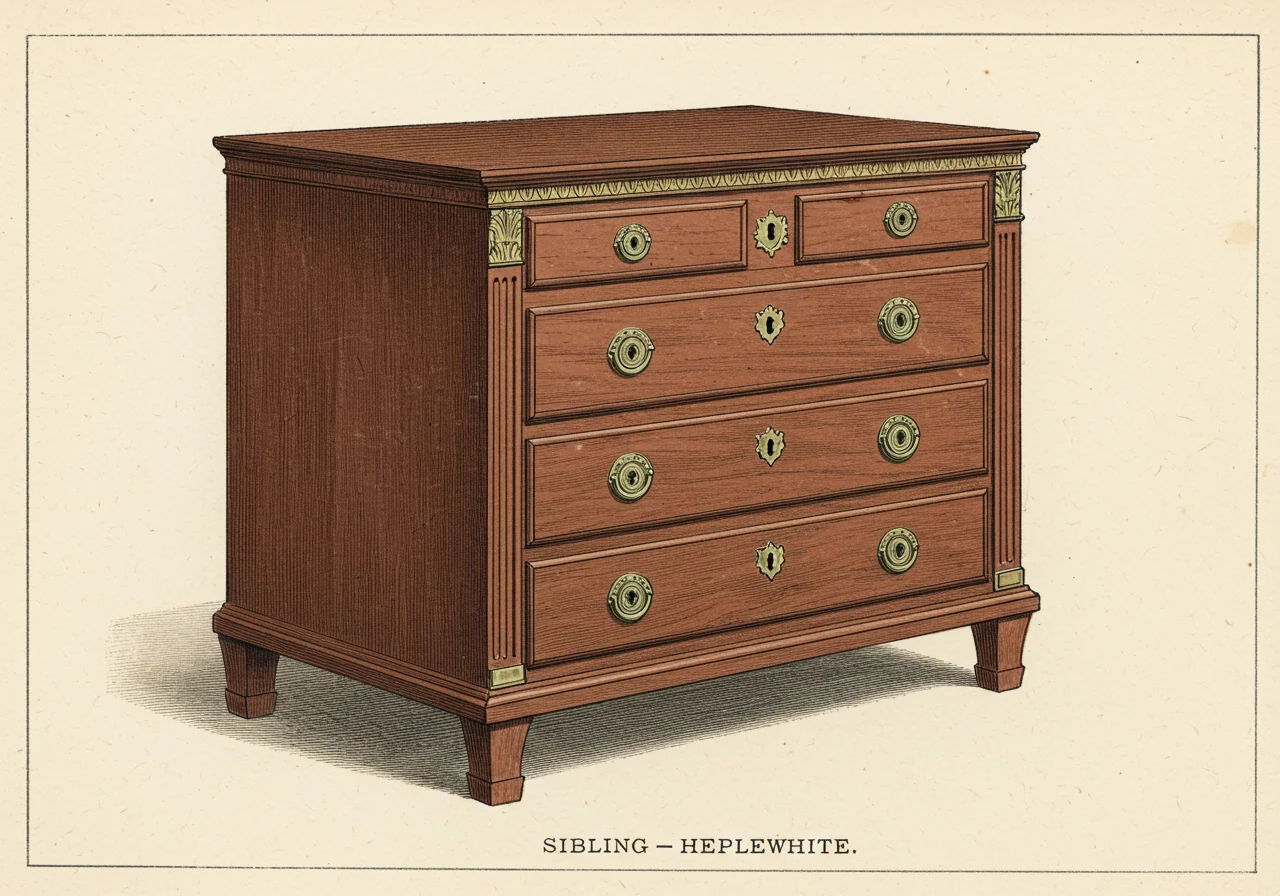
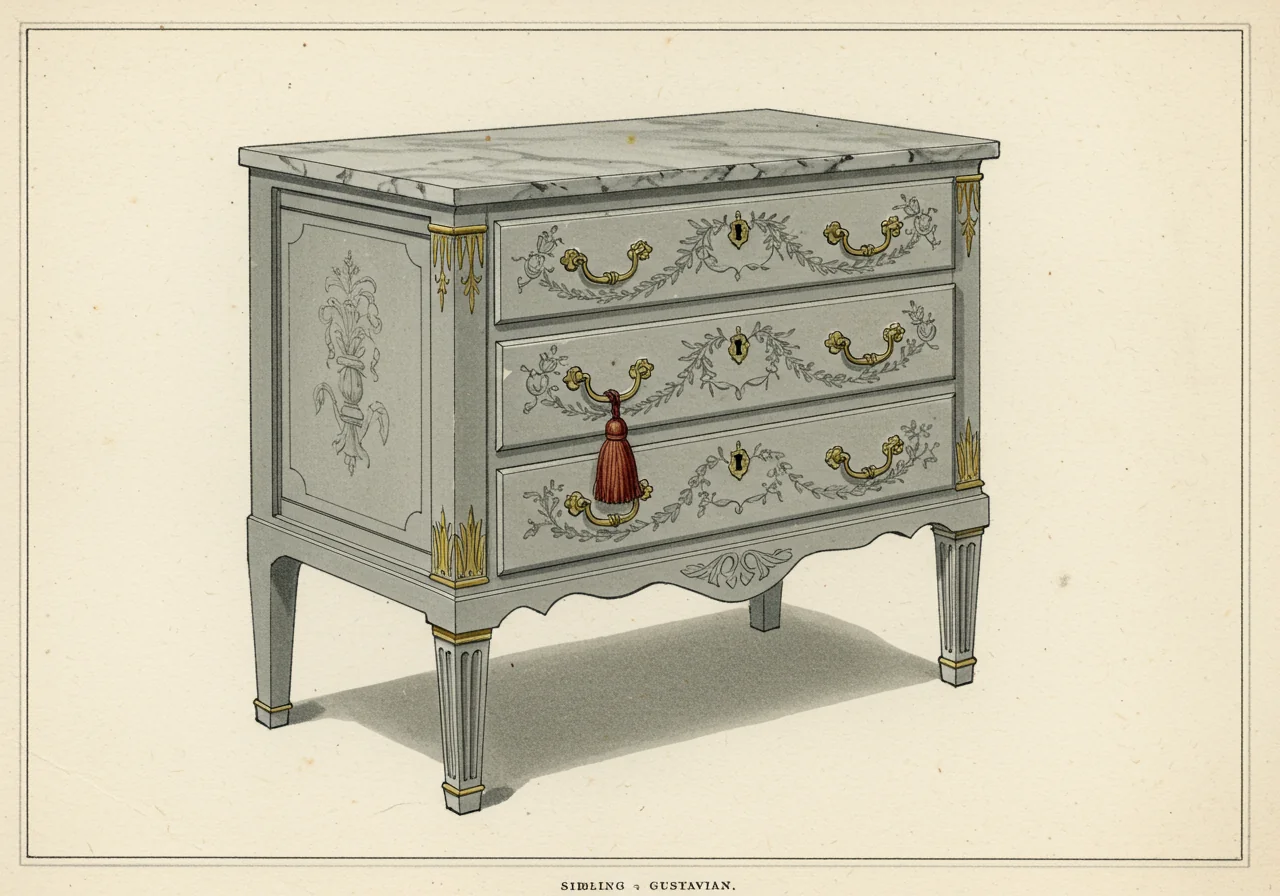
The first is the Louis XV (1730–1770, the immediate antecedent), which the Louis XVI displaced. The principal separator is the leg: cabriole versus straight columnar, curve versus geometric line. The case shape is the second separator: bombé and serpentine versus rectangular with canted corners. The marquetry is the third: floral bouquets in naturalistic rendering versus geometric trellis or neoclassical motifs in symmetric composition. The ormolu is the fourth: rocaille scrollwork versus Greek-key, laurel-wreath, and paterae. Many Transition pieces of the late 1760s and early 1770s carry elements of both vocabularies, and the dating of these pieces is one of the period’s small pleasures.
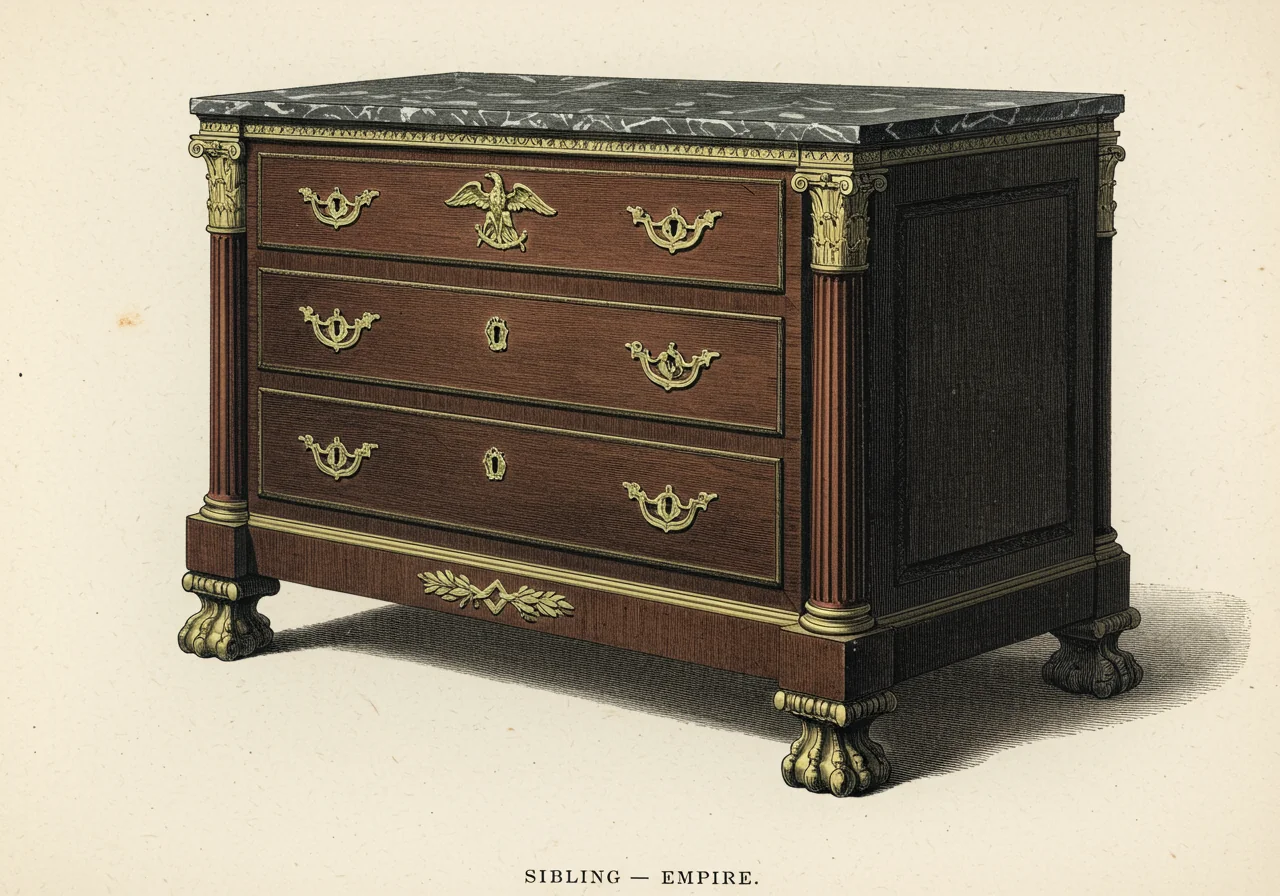
The second is the Empire (1804–1815, the Napoleonic successor), which displaced Louis XVI after the Directoire interlude. An Empire commode is heavier and more massive, almost always in dark mahogany rather than marquetry, with straight columnar legs but with much heavier ormolu mounts in martial vocabulary — eagles (Napoleonic imperial), swords and laurel wreaths in Roman-triumphal arrangement, sphinxes and obelisks in Egyptian-campaign reference, lion-paw feet, the heavier classical vocabulary that Percier and Fontaine codified in their Recueil de décorations intérieures (1801, expanded 1812). A Louis XVI piece beside an Empire piece reads as a generation older — the Louis XVI is more delicate, more domestic, more symmetric-in-restraint, where the Empire is heavier, more imperial, more symmetric-in-grandeur.
The third is the English Hepplewhite and Sheraton (1788–1810, contemporary across the Channel), the English neoclassical interpretation of the same Greek-Roman sources the French Louis XVI was drawing on. George Hepplewhite’s The Cabinet-Maker and Upholsterer’s Guide (published posthumously 1788) and Thomas Sheraton’s The Cabinet-Maker and Upholsterer’s Drawing-Book (1791–1794) were the pattern-book vocabularies through which the English market acquired the same neoclassical ornament that the French court was commissioning. The differences are the familiar ones from the Louis XV / Chippendale comparison of the previous post: the English work is in solid carved mahogany rather than marquetry on oak, with carved decoration rather than ormolu, and with the sober gentlemanly restraint that distinguishes English furniture of every period from its French contemporary. A Hepplewhite chest of drawers and a Louis XVI commode share the same straight-tapered-leg geometry and the same oval-and-classical ornament vocabulary, but in entirely different materials and surface treatment.
The fourth is the Swedish Gustavian (1772–1810, contemporary in northern Europe), the direct Swedish adoption of Louis XVI under Gustav III’s reign. Gustav III had spent considerable time in Paris during his youth and modelled the Swedish court on the French; the Gustavian style is essentially Louis XVI translated into the Scandinavian register, with the principal differences being the painted finish (typically Trianon gris-blanc, a pale grey-white, or pale blue, or muted yellow) rather than the gilt of the French, and a slightly simplified ornamental vocabulary suited to the smaller Swedish court budget. A Gustavian commode beside a French Louis XVI commode reads as the same piece in different paint — and the Gustavian tradition has, partly because of the painted finish that ages well and partly because of the Scandinavian-design renaissance of the past forty years, become particularly fashionable in the modern collector’s market.
The fifth is the Louis XVI revival of the second half of the nineteenth century. As with the Louis XV revival the previous post described, the late nineteenth century produced reproductions of Louis XVI furniture in great quantity, often of considerable quality. The same makers who reproduced Louis XV (François Linke, Henri Dasson, Maison Jansen, Sormani, Beurdeley) also reproduced Louis XVI, and the revival pieces are themselves now over a century old and collected in their own right. The distinctions are the same as in the Louis XV revival case: the marquetry composition is more rigidly symmetric in revival pieces than in originals, the ormolu chasing is less crisp and often cast rather than chased, the carcase joinery is machine-cut, and the period stamp (JME + maker’s name, post-1751) is absent — replaced where present by the revival maker’s own mark.
What One Looks At
The practical discipline of identifying a Louis XVI piece, when one is standing in front of a candidate cabinet, comes down to a short ordered checklist.
One looks first at the legs. Straight fluted columnar legs (or square tapered legs) with no curve anywhere — this is the Louis XVI signature. Cabriole legs are Louis XV. Heavy columnar legs with martial gilt-bronze mounts are Empire. Straight tapered legs in solid mahogany are English (Hepplewhite or Sheraton). The legs settle the period at three paces.
One looks next at the case. Rectangular with canted corners is Louis XVI. Bombé and serpentine is Louis XV. Massive rectangular with heavy mahogany surfaces is Empire. The case shape is the second decisive identifier.
One looks at the ornament vocabulary. Greek-key, laurel wreath, paterae, urn, fluting, ribbon-tied garland, acanthus capital — this is the Louis XVI vocabulary. Rocaille scrollwork, asymmetric c-scrolls, cherubs in foliage — Louis XV. Eagles, swords, sphinxes, lion paws — Empire. Carved fretwork in mahogany — English Chippendale. Painted pale-grey vocabulary similar to Louis XVI — Gustavian.
One looks at the marquetry. Geometric trellis, parquetry, neoclassical motifs (musical-instrument trophies, ribbon-tied garlands) is Louis XVI. Floral bouquets in naturalistic rendering is Louis XV. No marquetry, solid carved wood is English. Painted finish over solid wood is Gustavian or provincial.
One looks for the stamp. A JME-stamped Parisian piece of the post-1751 period is documented work; a Riesener stamp on a Louis XVI piece is the strongest single piece of evidence one can hope for. The absence of a stamp does not condemn a piece, but a positive stamp is decisive.
One looks at the joinery. Hand-cut dovetails of irregular spacing, period oak with characteristic age, evidence of period repair — these are the marks of an authentic eighteenth-century piece. Machine-cut dovetails of perfectly regular spacing, newer wood, an absence of period repair — these are the marks of nineteenth-century revival or later.
And one looks at the proportions. The relationship of leg to case to top, the precision of the canted corners, the balance of the ornament across the central axis — these are the harder-won judgments. A great Louis XVI piece has an architectural precision of proportion that distinguishes it immediately from the cruder revival work; learning to see this is the slow work of comparative looking that the arc as a whole is in the business of building.
The next post in the furniture arc will be either English Chippendale — to set out the Anglophone Rococo that competed with the Louis XV vocabulary across the Channel — or German Biedermeier, the short-arc nineteenth-century counterpart that combined neoclassical bones with bourgeois sobriety. The choice will depend on what photographic material is available at the time of writing.