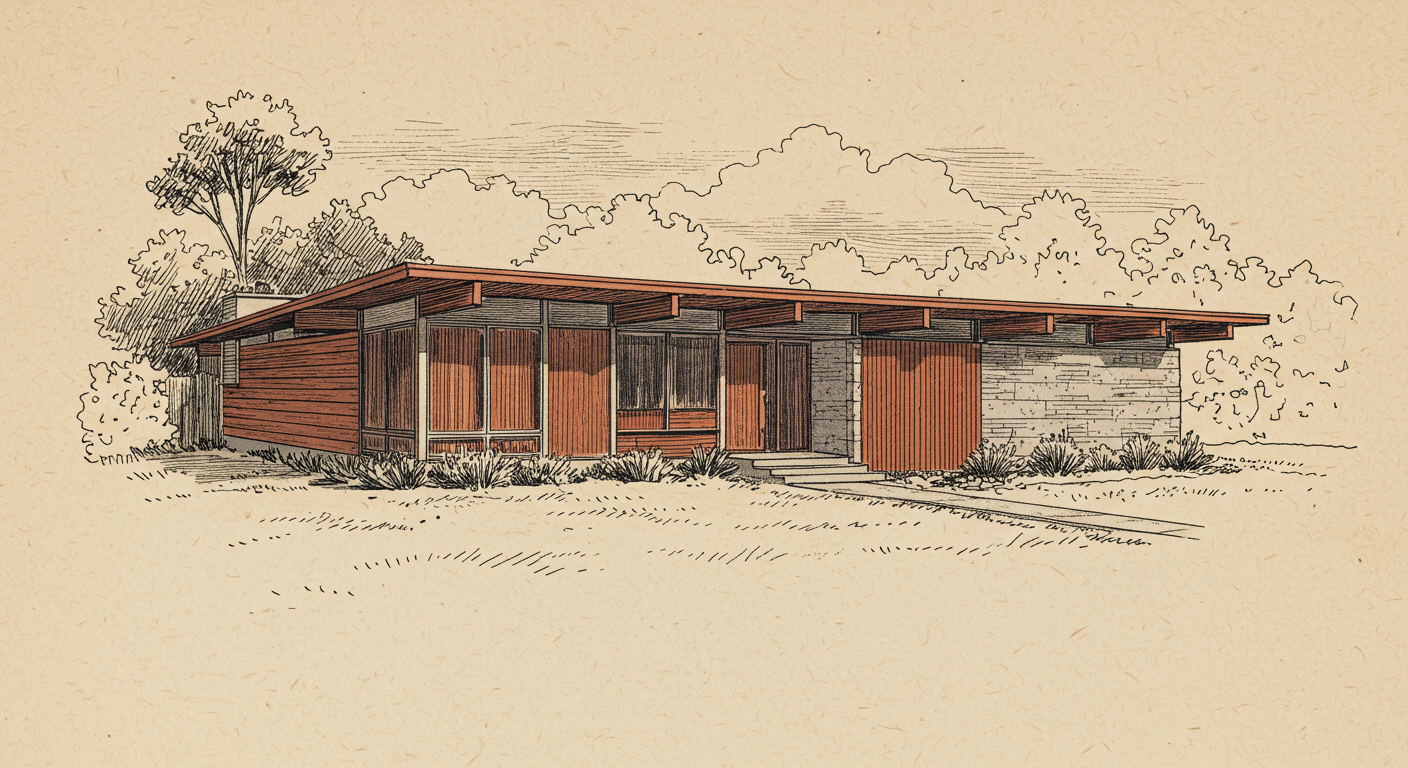
The California Ranch of three posts ago described the post-war American suburb in its dominant Western residential form, and the Split-Level of the previous post described what that suburb produced when its lot supplies and its family sizes outgrew the forms it had begun with. Both posts treated the builder’s house — the mass-market production form, designed by a development firm’s draughtsmen for a price point and a mortgage specification, repeated across a subdivision in the thousands. The Mid-century Modern this post takes up ran alongside that builder’s settlement through the very same years, and was its opposite number in almost every particular: a named-architect form, designed one house at a time for a particular client and a particular site, self-conscious where the tract house was incurious, programmatic where the tract house was pragmatic, and produced — in its canonical examples — in the dozens rather than the thousands. The two tracks of post-war American residential design ran side by side through the same suburban decades, and the architectural histories of the period have, more often than not, read as if only the architect’s track existed.
This is the eighteenth post in Reading the American House. It treats Mid-century Modern in the position the Split-Level post pointed toward — the architect-designed parallel to the builder’s Ranch-and-Cape-and-Split settlement, named at the close of that post and reserved for treatment in this one. Read against its tract contemporaries, the Mid-century Modern is the form in which the modernist program imported into the United States by the European émigré architects of the 1920s and 1930s finally reached the American single-family house at scale — flat or low-slope rooflines, a structural frame of posts and beams left honestly exposed, walls dissolved into floor-to-ceiling glass, the interior thrown open into a single continuous volume, and the whole arranged to open directly onto the landscape rather than to face the street. It is also the form on which this series’ load-bearing collector confusion sits, because what is loosely called Mid-century Modern is in fact two quite different things wearing one name — the architect-designed Mid-century Modern, a deliberate and argued modernist program, and the builder’s tract version, the “contractor modern” that took the flat roof and the picture window and the carport into the mass subdivision and dropped the program on the way — and the distinction is the one most American readers do not carry but most need.
The Specimen
If one is to identify a Mid-century Modern — and one will find them, though in nothing like the numbers the Ranch and the Split-Level run to, concentrated in the regions and subdivisions where an architect or a modern-minded developer found his clients — the exercise begins, as it did for the Ranch and the Split-Level before it, at the silhouette. But the Mid-century Modern silhouette is doing something neither builder form attempted, and the something is the principal architectural fact about the style.
The principal feature is the flat or very low-slope roof carried on an exposed post-and-beam frame, with the wall surface between the posts given over to glass. A Mid-century Modern presents a roof that is either dead flat or pitched so shallowly — three to fifteen degrees, a single plane or a gentle shed or a butterfly folded the wrong way to catch rain at its centre — that the eye reads it as horizontal, projecting well past the wall on all sides in broad flat overhangs that shade the glass below. The Ranch’s low-pitched gable, at fifteen to twenty-five degrees, still announced itself as a roof; the Mid-century Modern roof refuses even that much pitch, and announces itself instead as a plane, a horizontal cap held off the ground on slender supports. Beneath it the structure is not hidden. Where the Ranch and the Split-Level wrapped their stud framing in a continuous skin of mixed siding and brick veneer, the Mid-century Modern leaves the frame standing in plain sight — a grid of timber or steel posts at regular intervals, carrying exposed beams that run to the roof edge — and the wall is no longer a structural thing at all. The wall has become infill: glass where a view or a light is wanted, a panel of wood or block where privacy or a counter is wanted, the two alternating along the structural grid. This is the single fastest way to identify the style from the street, and it is also the deepest: the Mid-century Modern does not merely look different from the builder forms, it is built on a different principle, and the principle is visible.
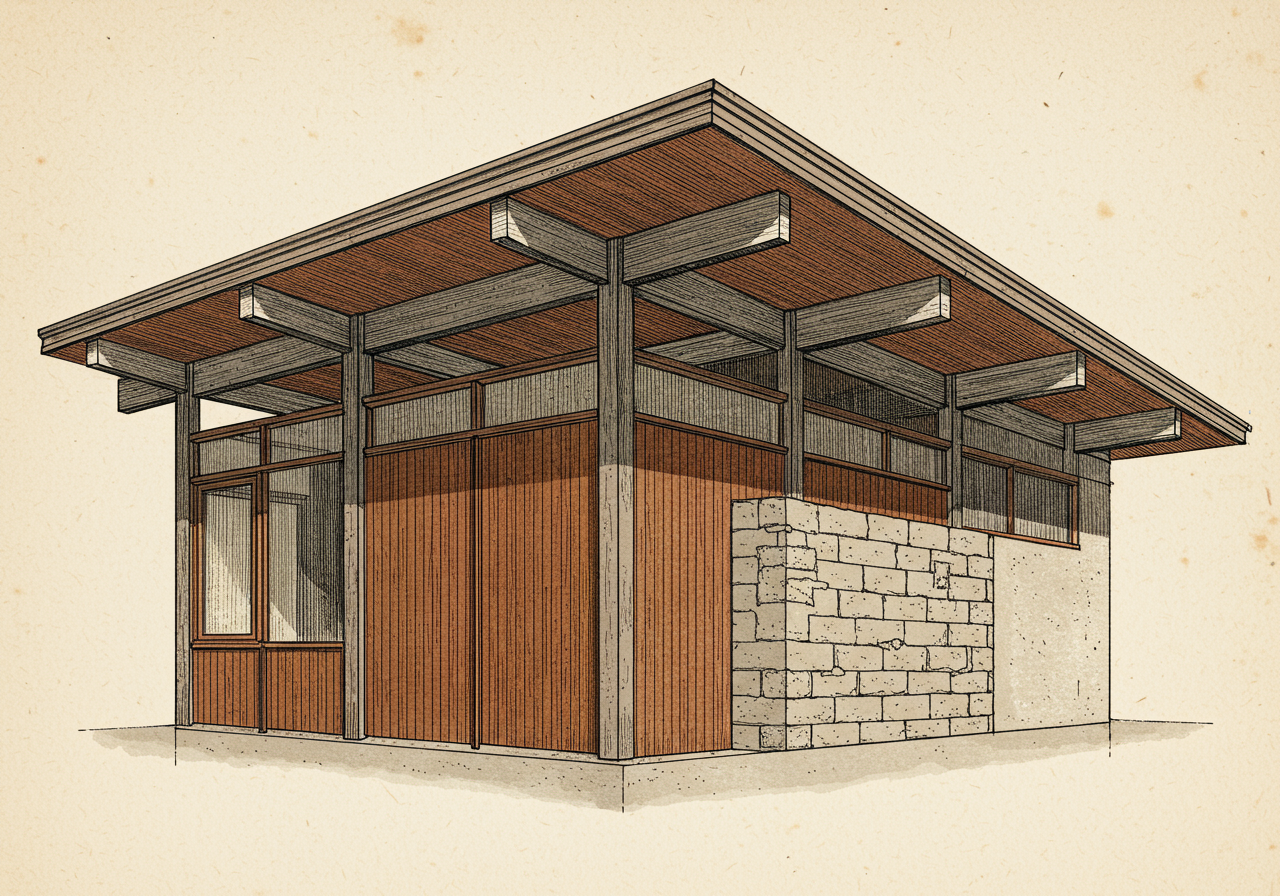
The canonical Mid-century Modern structural move — a regular grid of exposed posts carrying beams that run, unconcealed, to the roof edge, with the wall reduced to infill between the posts. Above the beam line a band of clerestory glazing admits a high, even light that no curtain need ever cover. The frame is not decorated and not hidden; it is simply shown, and the showing of it is the form’s central architectural argument — that a house should declare how it stands up rather than disguise it.
The wall surface, where it is not glass, breaks sharply with the builder forms. The Ranch made a virtue of mixed materials — board-and-batten beside brick beside clapboard, combined for textural variety across a horizontal facade — and the Split-Level inherited the mix and stepped it. The Mid-century Modern reduces the palette and changes its purpose. The materials are few — typically a single wood used throughout (vertical tongue-and-groove redwood, cedar, or fir, left to weather or stained a flat dark tone), a stretch of exposed concrete block or brick used structurally rather than as veneer, a plane of stucco — and they are deployed not for variety but for honesty: each material is shown doing the thing it is good at, plainly, without trim to soften the junction where one meets another. A concrete-block wall is a concrete-block wall, its courses and joints fully visible; a wood panel is a flat unmoulded plane; the steel post is painted but not boxed in. The doctrine of the “honest” material — the material allowed to be itself — was an article of modernist faith, and the Mid-century Modern wall is where it met the American house. Where the Ranch’s wall is mixed-for-texture and the Split-Level’s is mixed-and-stepped, the Mid-century Modern’s wall is reduced, structural, and unornamented, and the reduction is the form’s signature.
The roof, in pointed contrast to everything below it, is emphatic in its horizontality. A Mid-century Modern’s defining gesture is the long flat plane held parallel to the ground and cantilevered well past its supports, so that the house reads from across the street as a horizontal datum floating above a wall that is mostly transparent. The overhang is functional as well as compositional — it shades the south and west glass from the high summer sun while admitting the low winter sun beneath it, a piece of passive environmental reasoning the form took seriously — but its first effect is visual: the roof asserts the horizontal so completely that the house seems pressed down into its site, married to the ground rather than set upon it. The architect’s choice to make the roof a plane rather than a pitched form is the central compositional commitment the style made, and it is what holds the form together — without the long flat cantilevered roof the Mid-century Modern would be merely a glass box, untethered, with no relation to its landscape at all.
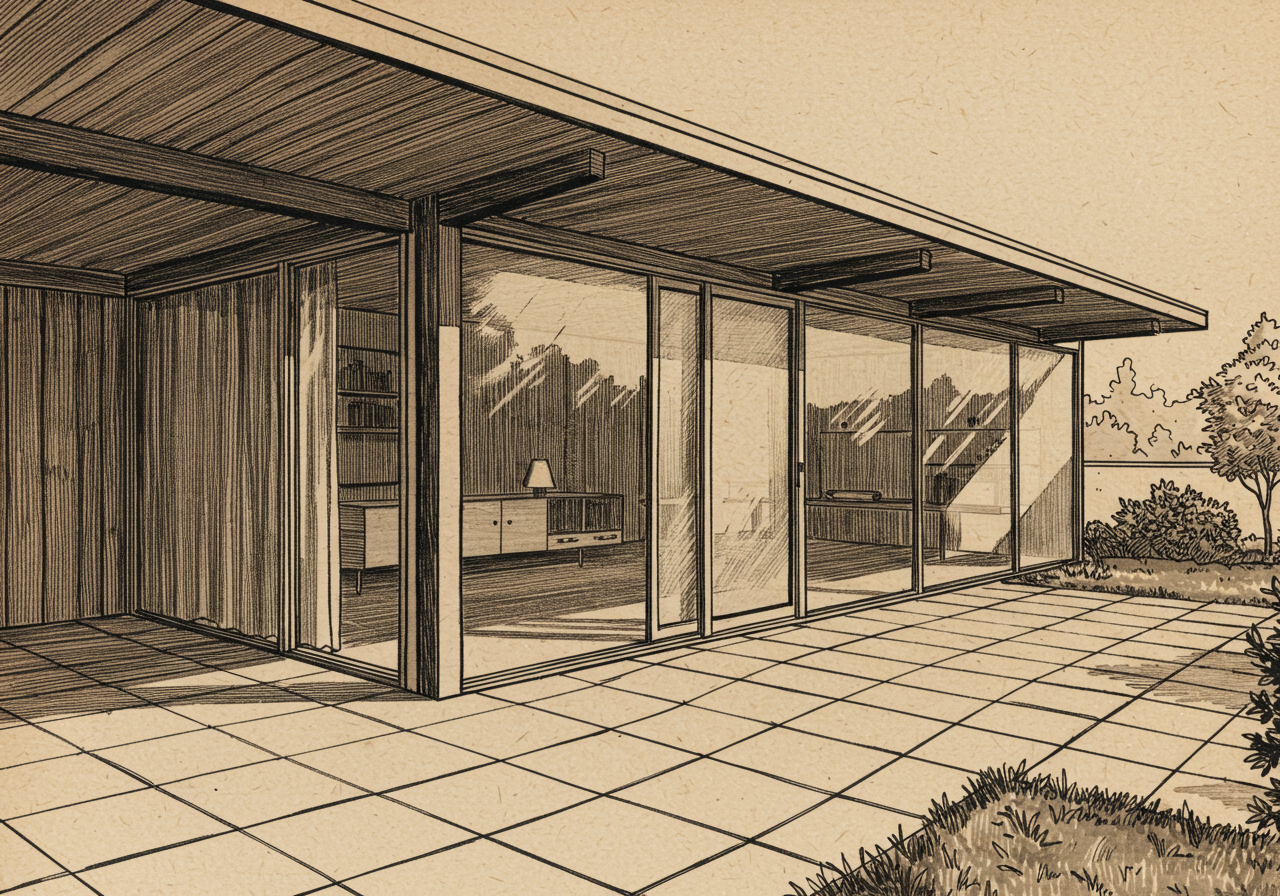
The canonical Mid-century Modern glass wall — floor-to-ceiling glazing and sliding glass doors set as infill between the structural posts, dissolving the boundary between the living room and the terrace beyond. The interior floor material frequently runs straight through the glass line and out onto the paved terrace, so that the eye reads inside and outside as one continuous room. This is the form’s argument about how a house should meet its site: not by facing the street through a single picture window, but by opening a whole wall to the landscape.
Three further features complete the house. The first is the open plan, the interior counterpart to the post-and-beam exterior: with the structure carried on the frame, the interior partitions bear no load and may be placed — or omitted — freely, and the form omits a great many of them, running the living room, dining room, and kitchen together into a single continuous volume articulated by furniture, by a freestanding fireplace mass, by a change in ceiling height, but not by walls and doors. The second is the carport rather than the enclosed garage — an open roofed slab, often simply a continuation of the house roof carried out on the same posts, which shelters the car without enclosing it, in keeping with the form’s preference for the structural plane over the closed box. The third is the integration with the landscape, less a single feature than the organising intention behind all the others: the Mid-century Modern is typically arranged around a private outdoor room — a courtyard, an atrium, a terrace, a pool — onto which its glass walls open and into which its interior floor materials and planting are deliberately continued, so that the boundary between built and planted is treated as a thing to be dissolved rather than defended. The street facade, in consequence, is frequently the blank one — a wall of wood or block presenting little to the public way — while the architectural event of the house is turned inward and rearward, onto the private landscape the glass walls were cut to frame.
The Two Tracks of the Post-war House
The documentary anchor of the Mid-century Modern is not a builder-developer in the way Levitt anchored the Cape Cod, nor is it a common-property form in the way the Split-Level was. It is, in its canonical version, a program — an explicit, published, argued campaign to put modern architecture into the ordinary American house — and the program has a name, a date, and an address.
The name is the Case Study House program. From 1945 to 1966 the Los Angeles magazine Arts & Architecture, under its editor and publisher John Entenza, commissioned a series of model houses from invited architects, each intended as a buildable and broadly affordable answer to the post-war housing demand, each documented in the magazine and several opened to the public. Some three dozen designs were commissioned and rather more than twenty built, the great majority in the Los Angeles region, and the program was — quite deliberately — a piece of advocacy as much as a piece of building: Entenza meant to demonstrate, in full-scale inhabited houses rather than in manifestos, that the modern house was a thing an ordinary family could live in and want. The two most famous of the houses make the point. Case Study House #8, completed in 1949, was the home and studio Charles and Ray Eames built for themselves from off-the-shelf industrial steel components — a frame of standard sections, infilled with a grid of glass and bright coloured panels — and it argued that a catalogue of mass-produced parts could be assembled into a house of real delicacy. Case Study House #22, which Pierre Koenig completed in 1960 on a ridge above Los Angeles, was a steel-framed pavilion whose glass living room cantilevered out over the city lights, and a single night photograph of it — two women seated in a glowing transparent room suspended above an ocean of light — became, and remains, the most widely reproduced image the style produced. The Case Study program was the architect’s track at its most self-aware: a house built to be looked at, photographed, published, and argued from.
Around that program stood the architects who gave the West Coast form its character. The European émigrés came first and seeded the soil: Richard Neutra and Rudolph Schindler, both Vienna-trained, both arrived in Los Angeles in the 1920s, between them established that the steel-and-glass modernism of central Europe could be made to live in the Southern California light and landscape. The next generation built on that footing — Pierre Koenig, Craig Ellwood, A. Quincy Jones, each working the post-and-beam pavilion in steel or in timber — and alongside them Cliff May, who came to the modern house from the opposite direction, out of the Spanish-Californian ranch tradition, and whose low timber-framed houses opening onto courtyards supplied the warmer, woodier strain of the form. The style had its regional capitals: Southern California first and most densely, but also Palm Springs, where the desert and the leisure economy together produced the sun-shaded, pool-centred variant the dealers now call desert modernism; and, on the opposite coast, New Canaan in Connecticut, where a group of Harvard-trained architects built a celebrated cluster of modern houses in the New England woods and proved the form was not merely a creature of the Western climate.
The other track — and this is the load-bearing point — was the builder’s. The single figure who carried the modern house furthest into the mass market was Joseph Eichler, a developer rather than an architect, who between 1949 and his death in 1974 built on the order of eleven thousand houses, principally in Northern California, to modern designs he commissioned from architects (A. Quincy Jones among them) and then repeated across whole subdivisions. The Eichler house brought the post-and-beam frame, the flat roof, the glass wall, the open plan, and very often a glazed interior atrium into a tract-built house at a tract-built price, and it is the proof that the architect’s program could be reproduced at scale by a builder who chose to. But Eichler was the exception that defines the rule, because the general run of post-war tract builders did not commission modern designs and did not reproduce the program. What they reproduced was the look. Through the 1950s and 1960s the ordinary subdivision absorbed, piecemeal, the more salesworthy features of the modern house — the flat roof, the wide eave, the carport, the sliding glass door to a back patio — and grafted them onto a plan that was, structurally and spatially, an ordinary builder’s Ranch or Split-Level. This is the “contractor modern” or builder-tract Mid-century Modern, and it is what most Americans have actually seen. It wears the silhouette and has dropped the argument. The remainder of this post turns on telling the two apart.
What It Is Not
Four styles stand near enough to Mid-century Modern that the beginner confuses them with it, and distinguishing them is most of the work of reading the architect-designed post-war house.
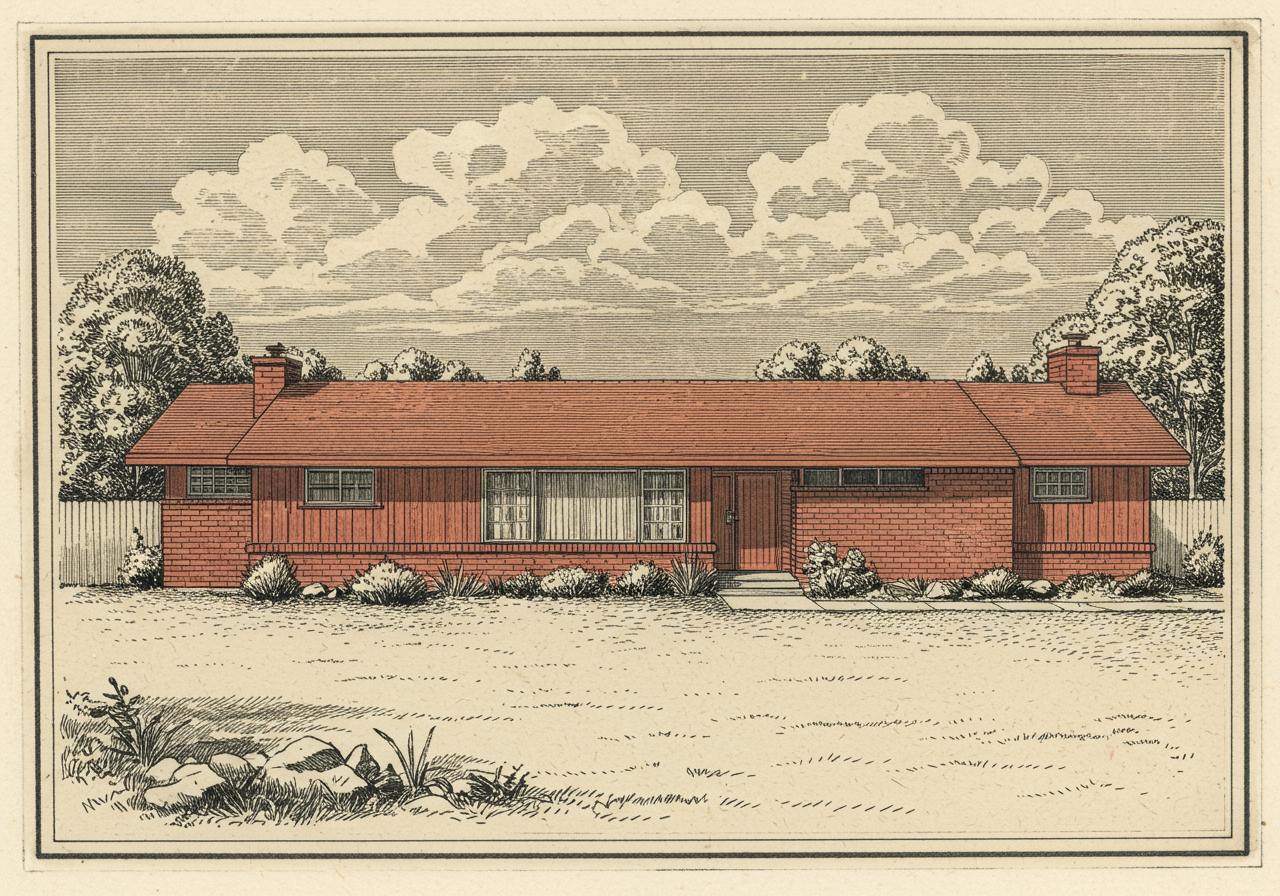
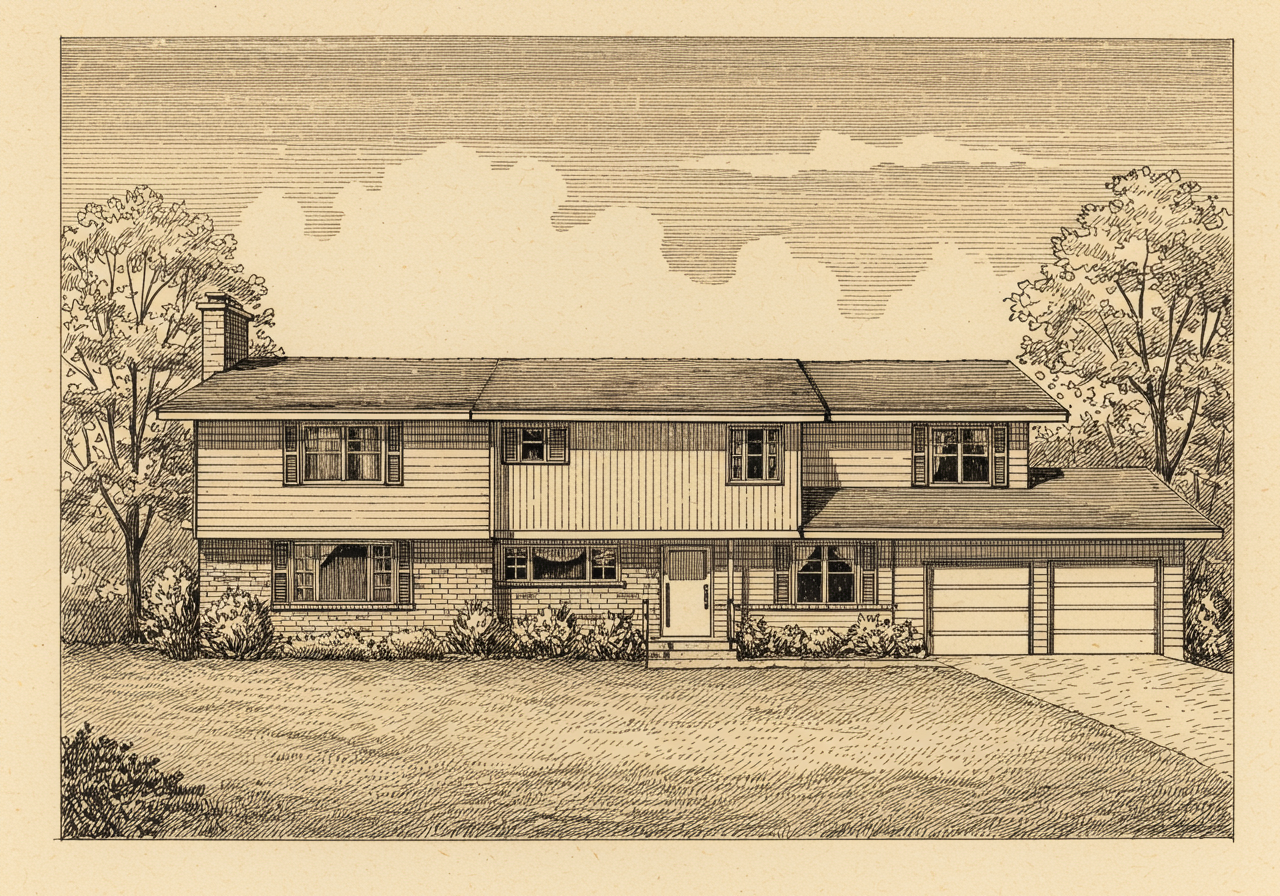
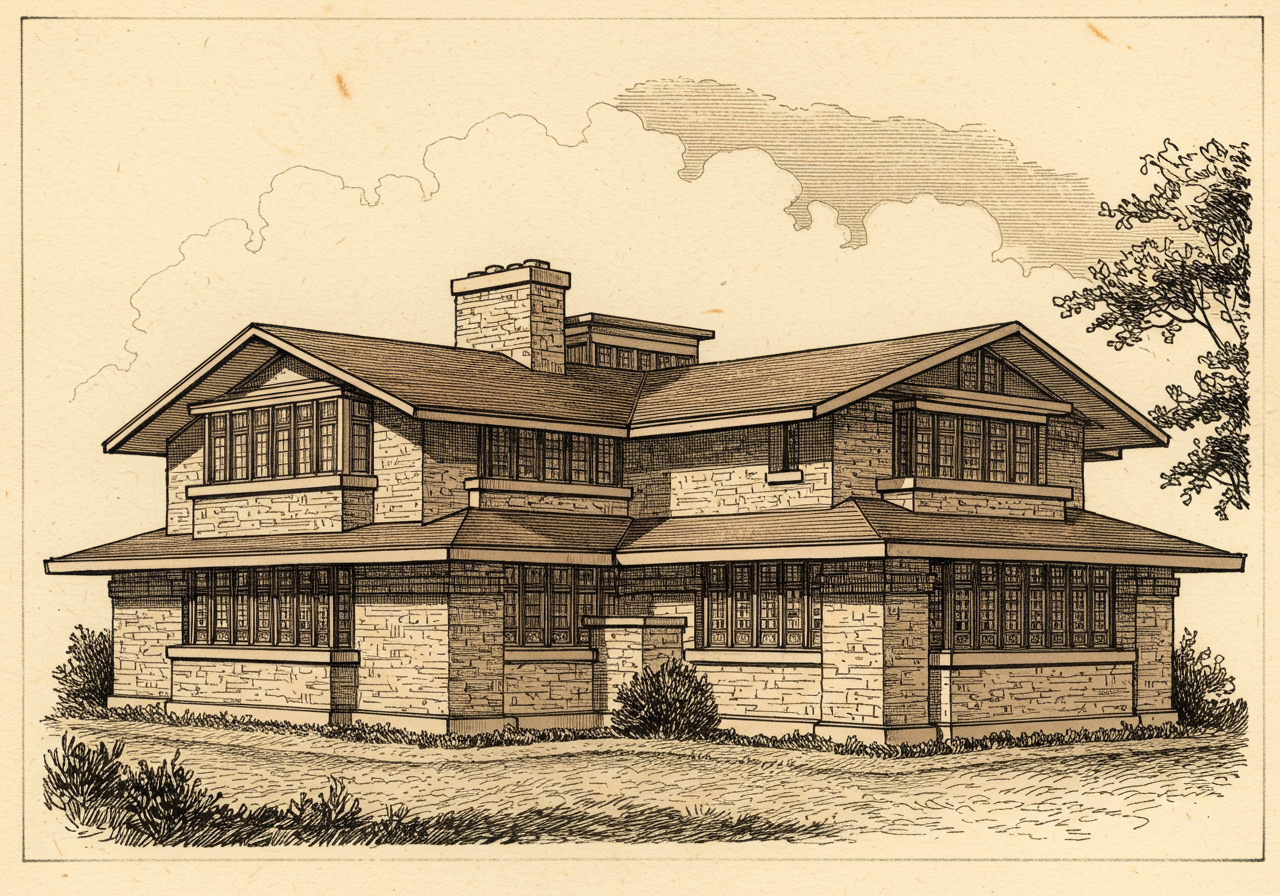
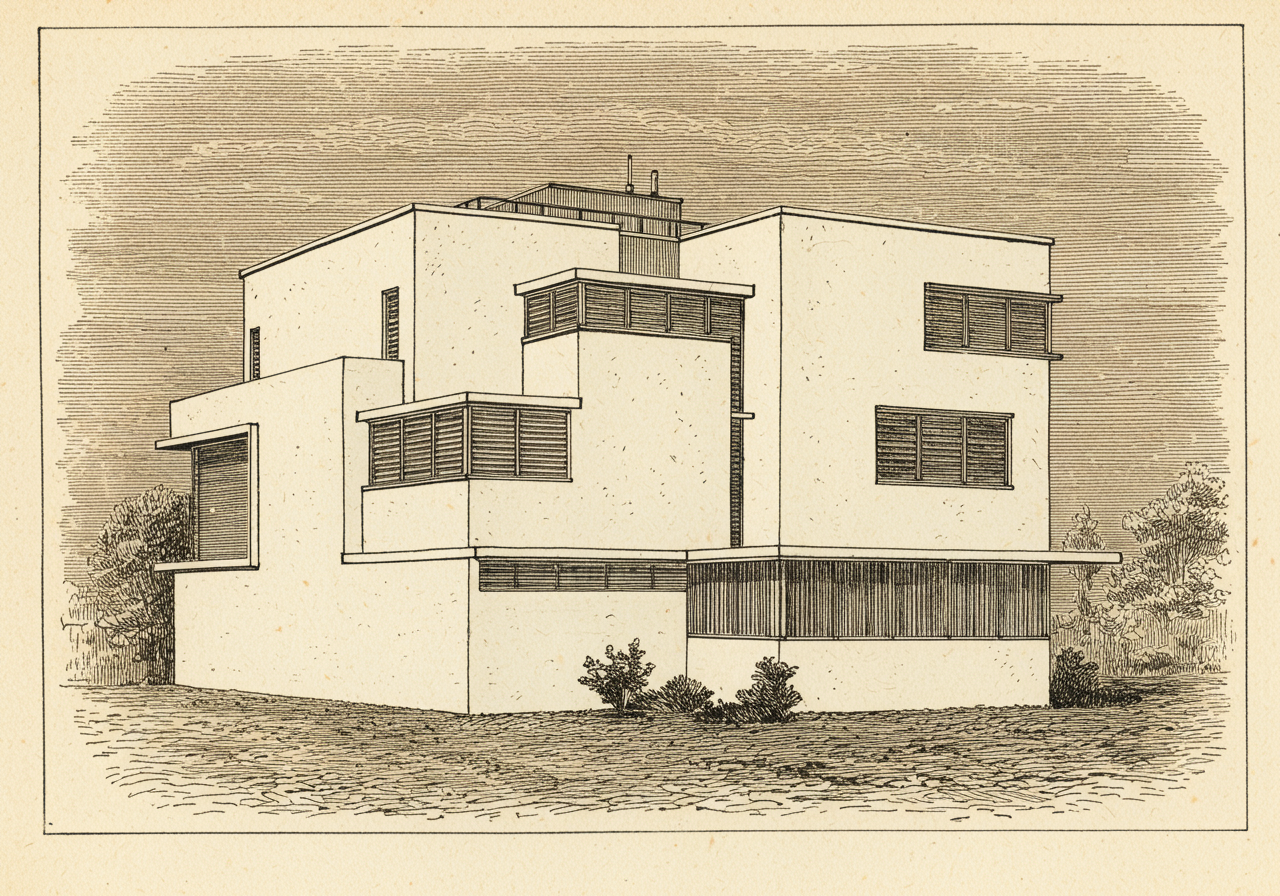
A California Ranch is the contemporaneous tract form and was treated three posts ago — the Mid-century Modern’s opposite number on the builder’s track, built in the same regions in the same years for the family the architect’s house was not, in practice, built for. The Ranch presents a low-pitched gable roof (fifteen to twenty-five degrees, still legibly a pitched roof), a continuously skinned wall of mixed siding and brick veneer with the stud frame entirely concealed, a single picture window facing the street, and an attached enclosed garage. The Mid-century Modern presents a flat or near-flat roof, an exposed post-and-beam frame with glass infill, a whole wall of glazing turned toward a private landscape, and a carport. The rule of thumb: a pitched gable over a skinned wall with one picture window is Ranch; a flat plane over an exposed frame with a glass wall is Mid-century Modern. The builder-tract “contractor modern” is precisely the house that confuses this rule — a Ranch plan that has borrowed the flat roof and the sliding door — and the test for it is structural: ask whether the frame is shown and whether the wall has become infill, and if the answer is no, the house is a Ranch in a modern coat.
A Split-Level is the multi-level tract cousin and was treated in the previous post — again a builder’s house, again on the production track. The Split-Level distributes its plan across three or four staggered half-storey levels under a single continuous low-pitched roof, with a visible vertical step in the wall surface where the floor levels change behind it. The Mid-century Modern is, characteristically, resolutely single-level — its drama is horizontal, not vertical, and where it does change level it does so by a few open steps within a continuous volume, not by the Split-Level’s enclosed half-flights between separate zones. The rule of thumb: staggered half-storey levels with a stepped facade under a low-pitched roof is Split-Level; a single-level open volume under a flat cantilevered plane is Mid-century Modern.
A Prairie School house is the modern ancestor and the most instructive of the four comparisons, because the Mid-century Modern descends from it directly. The Prairie School of Frank Lloyd Wright and his Chicago contemporaries, built in the first two decades of the twentieth century, had already established the long low horizontal house, the deep sheltering overhang, the open flowing plan, and the marriage of house to site that the Mid-century Modern would take up forty years later. But the Prairie house carries broad hipped roofs — sheltering, substantial, emphatically a roof — over a heavy masonry base, and its windows, however horizontally banded, are still windows punched in a wall. The Mid-century Modern took the Prairie program and stripped it: the hipped roof flattened to a plane, the masonry base lightened or dissolved, the banded window opened into a full glass wall, the ornament removed entirely. The rule of thumb: a broad hipped roof over a heavy masonry base with banded windows is Prairie School; a flat plane over an exposed light frame with a glass wall is its stripped Mid-century descendant.
An International Style house is the European sibling — the two are siblings rather than parent and child, both descended from the same 1920s European modernism, and the émigré architects who seeded the Mid-century Modern had practised the International Style in Europe before they arrived. But the styles diverge sharply in temperament. The International Style of the 1920s and 1930s — Bauhaus Germany, Le Corbusier’s France — is a cubic, planar, white-stuccoed architecture: smooth abstract volumes, ribbon windows turning the corner, the structure concealed behind a taut machined skin, the whole reading as pure geometry set down on its site with a deliberate indifference to it. The American Mid-century Modern warmed all of this. It showed the structure rather than hiding it behind stucco; it brought back natural wood and exposed block in place of the white machined surface; and it married the house to a specific landscape and climate where the International Style had cultivated an abstract placelessness. The rule of thumb: a white cubic volume with a concealed frame and a placeless geometry is International Style; a warm, frankly framed, landscape-married pavilion is the American Mid-century Modern that descended from it.
What It Was Trying to Say
What I find most telling about the Mid-century Modern, taking the Specimen and the two-tracks account together, is that the form was, almost uniquely among the styles this series has treated, a house with a thesis — and that the thesis is exactly what the builder’s tract version was obliged to leave behind. The Ranch and the Split-Level were pragmatic forms: they solved a price problem, a lot problem, a family-size problem, and they were content to look casually modern while doing it. The architect-designed Mid-century Modern was an argued form. It was built to demonstrate something, and it has three demonstrations to make.
The first is the structural-honesty argument, and it is the principal architectural fact about the style. The modernist conviction the émigré architects brought with them held that a building ought to declare its own construction — that the way a house stands up should be visible in the house, not concealed behind a decorative skin that pretends the wall is doing structural work it is not. The Mid-century Modern is that conviction made domestic. The post-and-beam frame is shown because it is the truth of the house; the wall is glass or panel because, the frame having taken the load, the wall is free to be whatever the light and the privacy of the room require. This is why the structural test is the reliable one for telling the architect’s house from the builder’s: the contractor-modern tract house could borrow the flat roof and the wide eave cheaply, those being matters of appearance, but it could not borrow the exposed frame without actually building on the frame, and that cost money the tract budget did not have. The honest structure was the part of the program that did not survive the journey into the mass market, and its presence or absence is therefore the surest single sign of which track a given house belongs to.
The second is the landscape argument, and it is the principal social fact about the style. The builder’s Ranch faced the street through its picture window and kept its life in a fenced rear yard; the Mid-century Modern turned the relation inside out. By dissolving a whole wall into glass and opening it onto a private courtyard or terrace whose paving and planting were continued straight in across the threshold, the form proposed that the proper outlook of a house was not the public way but a private piece of cultivated nature, and that the boundary between the room and the garden was a thing to be erased. This was, in its quiet way, a claim about how one ought to live — informally, in continuous easy traffic between an open interior and an outdoor room — and it is the claim the Southern California climate and the Palm Springs leisure economy were uniquely positioned to make plausible. It is also the reason the form never became the national house. The glass wall and the open courtyard are an argument that the climate must underwrite, and across most of the United States the climate declined to co-sign.
The third is the class-position argument, and it is the fact that most sharply separates the architect’s track from the builder’s. The Case Study program was conceived, sincerely, as an answer to the mass post-war housing demand, and Eichler’s eleven thousand houses are the evidence that the program could, in the right developer’s hands, reach an ordinary middle-class buyer at an ordinary price. But the canonical architect-designed Mid-century Modern — the Koenig pavilion on its ridge, the Neutra house in its desert — did not in the event become the house of the post-war middle class. It became the house of a particular cultivated, design-literate, professional client — the client who had read Arts & Architecture, who wanted the modern program and was prepared to commission and pay for it — and it was built in the dozens for that client while the builders sold the Ranch and the Split-Level to everyone else in the hundreds of thousands. What the mass market took from the modern house was never the program; it was the styling, decanted into the contractor-modern tract house, the flat roof and the carport and the sliding door grafted onto a builder’s plan. And so the form’s afterlife splits cleanly along the same seam as its lifetime. The architect-designed houses became, in time, prized and protected and photographed, the Stahl House a museum piece; the contractor-modern tract houses became simply the unloved older housing stock of a thousand subdivisions, modern in look and ordinary in fact. Reading the Mid-century Modern is, in the end, reading that split — learning to see, in a flat roof over a wide eave, whether one is looking at a program or at the memory of one.
The next specimen I should like to take up depends, as these things do, on what photographic material is available at the time of writing. Should the record of the early Republic’s restrained brick urbanism prove the better furnished, the post will be the Federal, or Adam style — the symmetrical, delicately ornamented house of the new nation’s first decades, the form against which every later revival measured its idea of “colonial.” Should the documentary supply instead favour the regional vernaculars, it will be the Pueblo Revival — the earth-walled, flat-roofed, vigally-beamed house of the Southwest, a form whose flat roof and landscape-married massing make it, for reasons of climate rather than program, an unexpected near-relation of the very Mid-century Modern this post has just set down. Either choice would return the series from the post-war moment to the longer American argument about what a house should be made to remember.