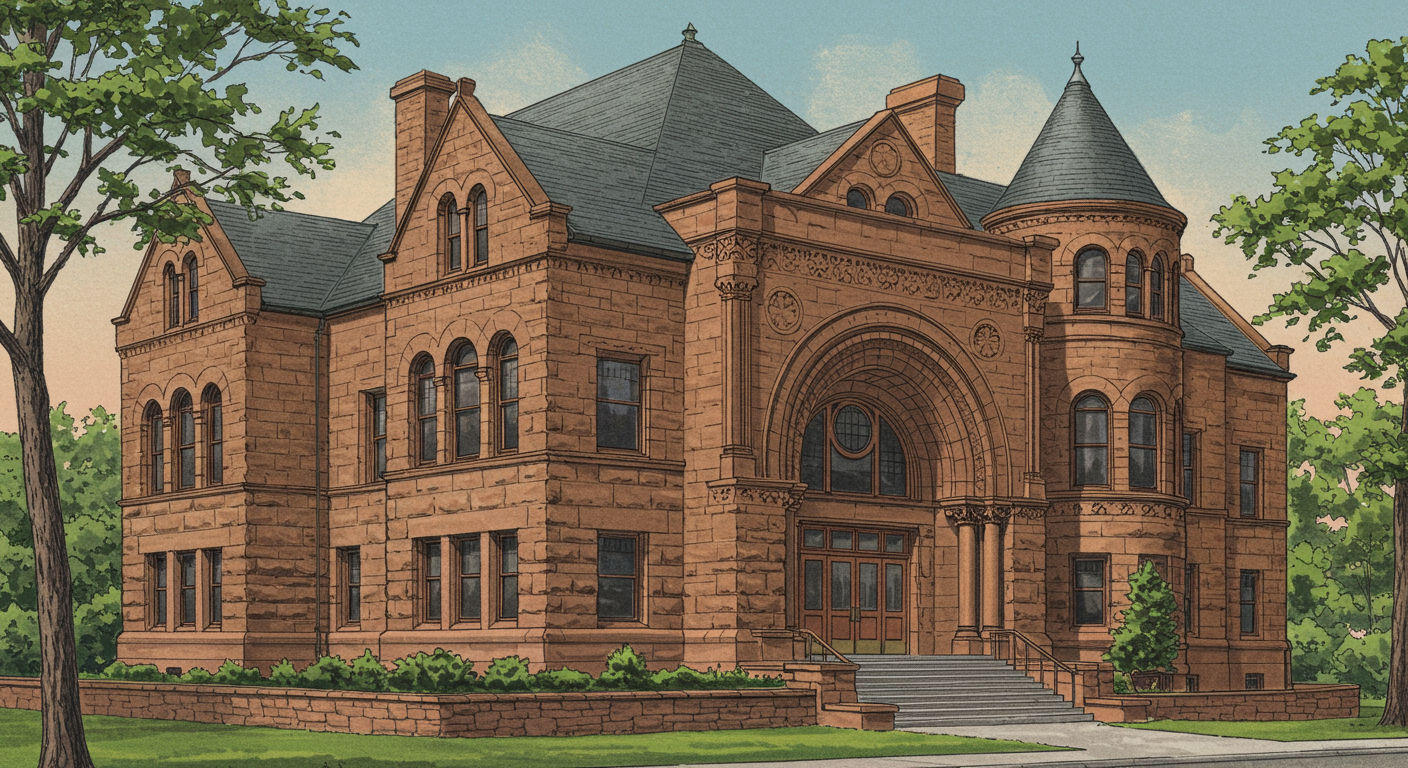
There is a particular kind of weight in the great American public libraries and county courthouses of the 1880s — a heaviness that registers, on inspection, not as bulk but as deliberation. Walls of rough rusticated stone running in long horizontal courses; an enormous deeply recessed round arch rising over the front entry; short, heavy attached columns flanking the upper windows with carved foliate capitals; low broad masses settling onto the ground rather than rising above it. The buildings feel as if they were intended to weigh something. They are not, on close inspection, simply built in stone — they are stone-coloured in a way that announces stone as the whole argument. The civic register of the American 1880s, in masonry, was this. It is, by some considerable margin, the most monumental American style covered in this series.
This is the Romanesque Revival — also called, after the early death of its principal author Henry Hobson Richardson in 1886, the Richardsonian Romanesque — and it is the only style in this series so closely defined by a single architect that the style was renamed in his honour. What follows is the eighth in a series that has been, in a quiet way, trying to read American houses for what they were trying to say. The seven previous posts have read the styles of the 1825-to-1900 sequence: the Greek Revival of the early republic; the Gothic Revival, the Italianate, the Second Empire, and the Stick of the long Victorian century; and the Queen Anne and Shingle of its close. The Romanesque Revival ran concurrently with the late ones — 1880 to 1900 — but stood apart in being civic rather than domestic, and stone rather than wood. It was the answer Richardson gave, in masonry, to the question his Shingle work was answering simultaneously in cedar: what should an American architecture look like?
The Misnomer
The first thing worth knowing about the Romanesque Revival is that the Romanesque in its name is doing only about a third of the actual work.
The historical Romanesque — the architecture of southern France, northern Spain, and Lombard Italy between roughly the year 950 and the year 1200 — was a stone-vaulted, round-arched, heavily walled, small-windowed church architecture that emerged in the centuries before the Gothic and was displaced by it after about 1200. The Romanesque proper had thick rubble-fill walls finished in dressed stone; small round-arched windows set deep in the wall mass; barrel and groin vaults supported by heavy piers; ornament concentrated at portals and capitals in patterns of foliate carving, geometric chip-work, and stylised figural relief. It was the architecture of pilgrimage churches, monastic cloisters, and small French parish naves. The buildings of Auvergne and Burgundy and Catalonia — Conques, Vézelay, Cluny — are the canonical examples.
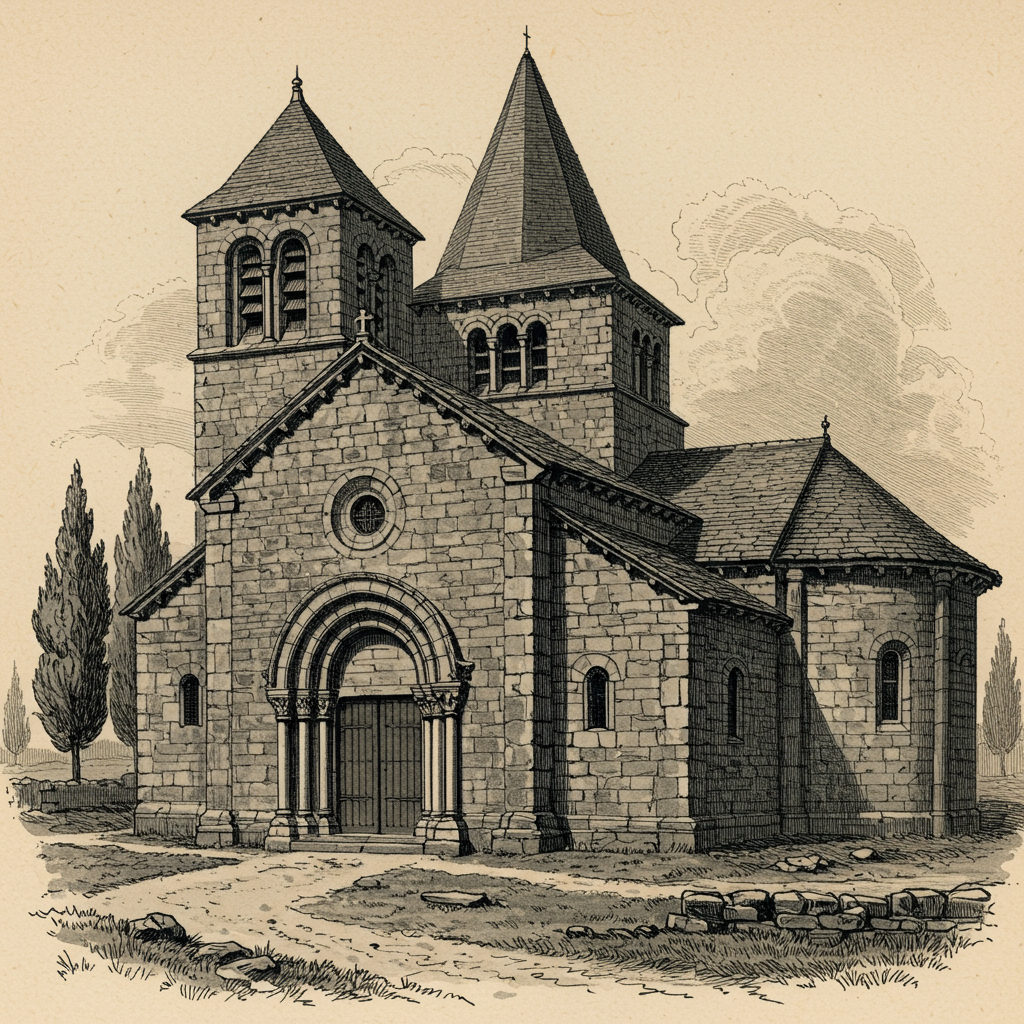
A French Auvergne Romanesque parish church, roughly 1130 — rough volcanic stone laid in horizontal courses, a deeply recessed round-arched portal flanked by short heavy attached columns with carved foliate capitals, small deeply-set round-arched windows, low broad masses sitting on the ground. The Romanesque source from which Richardson took the deep portal, the rough stone, and the gravitas — though he combined them with elements drawn from Spanish Romanesque, English Gothic Revival, and the American Colonial that the textbook account of the style does not always credit.
Richardson’s Romanesque Revival, between 1872 and 1900, drew on all this but quite freely. The deep round-arched portal and the rough stone walls are recognisably Romanesque. The short heavy attached columns and the carved foliate capitals are Romanesque. So far the name holds. But Richardson also drew, in equal measure, on Spanish Romanesque (particularly the cathedrals of Salamanca and Zamora, with their conical tower caps and rounded apsidal forms), on English Gothic Revival theory (the moral arguments about heavy stone and visible structure that Pugin had made for medieval Gothic, applied here to a different medieval source), and on the rough fieldstone vernacular of American Colonial New England (which gave the Shingle’s stone foundation courses and gave the Romanesque Revival’s coursed rubble walls their American grain). The synthesis Richardson produced was not quite Romanesque in any historical sense. It was his, and it was deeply personal to his way of working.
This is why the style was renamed Richardsonian Romanesque after his death. The name change was a recognition, by his contemporaries, that the style as built in America between 1872 and 1900 could not be cleanly attributed to its nominal medieval source. The historians who came after — Vincent Scully, Henry-Russell Hitchcock, Phoebe Stanton — generally use Richardsonian Romanesque now, reserving Romanesque Revival for the broader category that includes earlier antebellum Romanesque experiments (James Renwick’s Smithsonian Institution Building, 1847-55) that predated Richardson and shared the medieval source without sharing his synthesis. The two terms are commonly used interchangeably, and for this post I am using Romanesque Revival to mean Richardson’s mature style as built in the United States between 1872 and 1900, which is what most readers will encounter.
The misnomer here is partial rather than total. The Romanesque was a real source, and Richardson really drew on it. The name simply names one of three or four sources; the synthesis is what matters.
The Specimen
If one is to identify a Romanesque Revival building — and they are, once one has begun looking, the gravest masonry presence in any American downtown that boomed between 1880 and 1900 — the simplest exercise is, as before, to walk around a specimen and assemble the evidence.
Begin at the walls. A Romanesque Revival building is, almost without exception, faced in rough-faced rusticated stone, laid in regular horizontal courses, with the stones themselves heavy and the joints between them deep and shadowed. The stone is usually a warm sandstone — brownstone, Lake Superior red sandstone, or a buff Indiana limestone — rough-finished so the surface of each block bulges outward from the joint plane, catching light along the upper edge and casting shadow along the lower. The wall reads as massive even when it is, on inspection, a thin veneer over a steel or brick frame; this is part of the style’s central argument. The rough rustication is the most reliable identifier in the absence of other features: a heavy stone wall coursed and rusticated in this manner is Romanesque Revival to a strong probability.
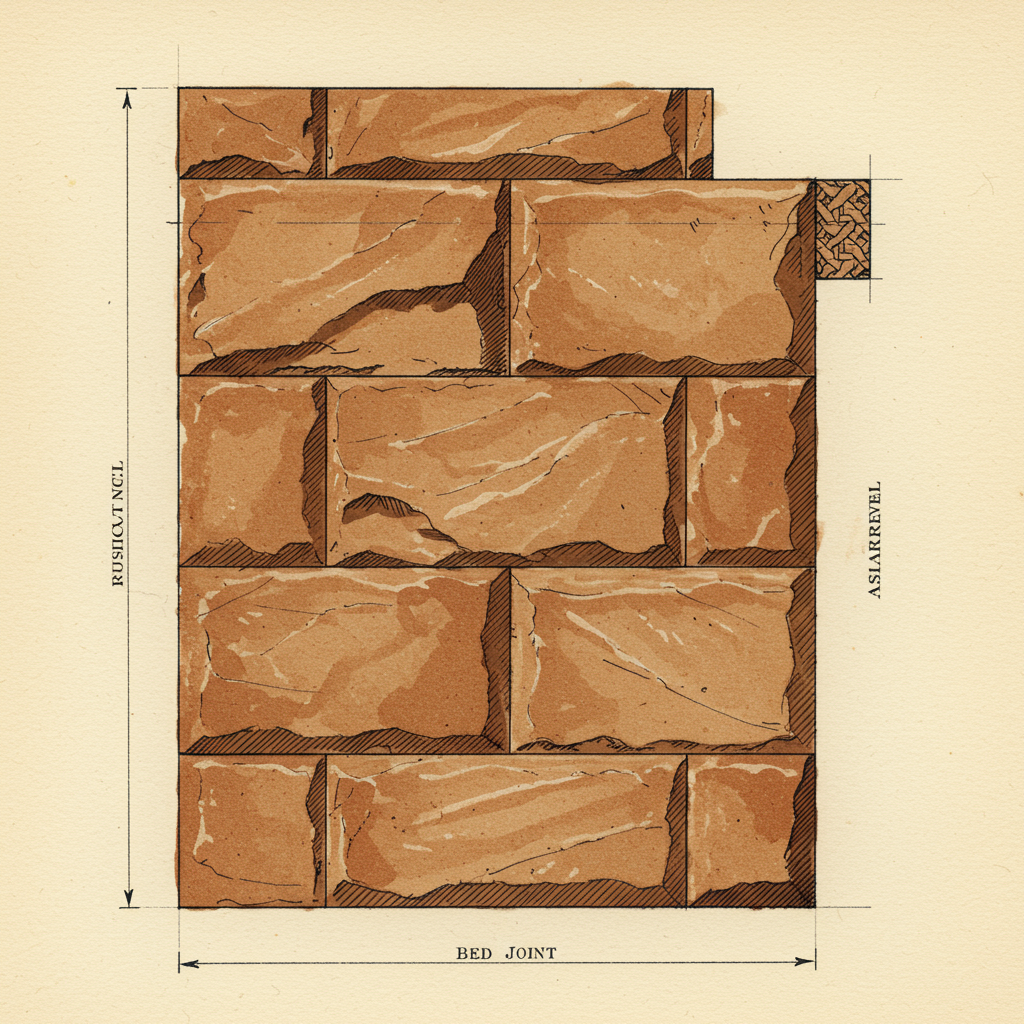
Rough-faced rusticated sandstone, laid in regular horizontal courses, with the face of each block bulging outward from the joint plane. The wall reads as massive whether or not it actually carries the load behind it — the surface texture is the argument. This is the Romanesque Revival’s first identifier, and the surest one.
Now look at the entry. Every Romanesque Revival building of any pretension carries a deeply recessed round-arched portal — a single great arch springing from the wall at perhaps ten feet, recessed back from the wall plane by three or four feet, lined inside with one or two concentric orders of carved-stone archivolt, and flanked at its base by short heavy attached columns with carved capitals. The arch is the building’s centre of gravity, optically and architecturally. The doorway itself, recessed within it, is often small and rectangular by comparison — the arch is doing the rhetorical work; the door is just an entrance. The shadow of the recess is part of the design: one walks toward a dark void in the wall and only at close range discovers the door inside it.
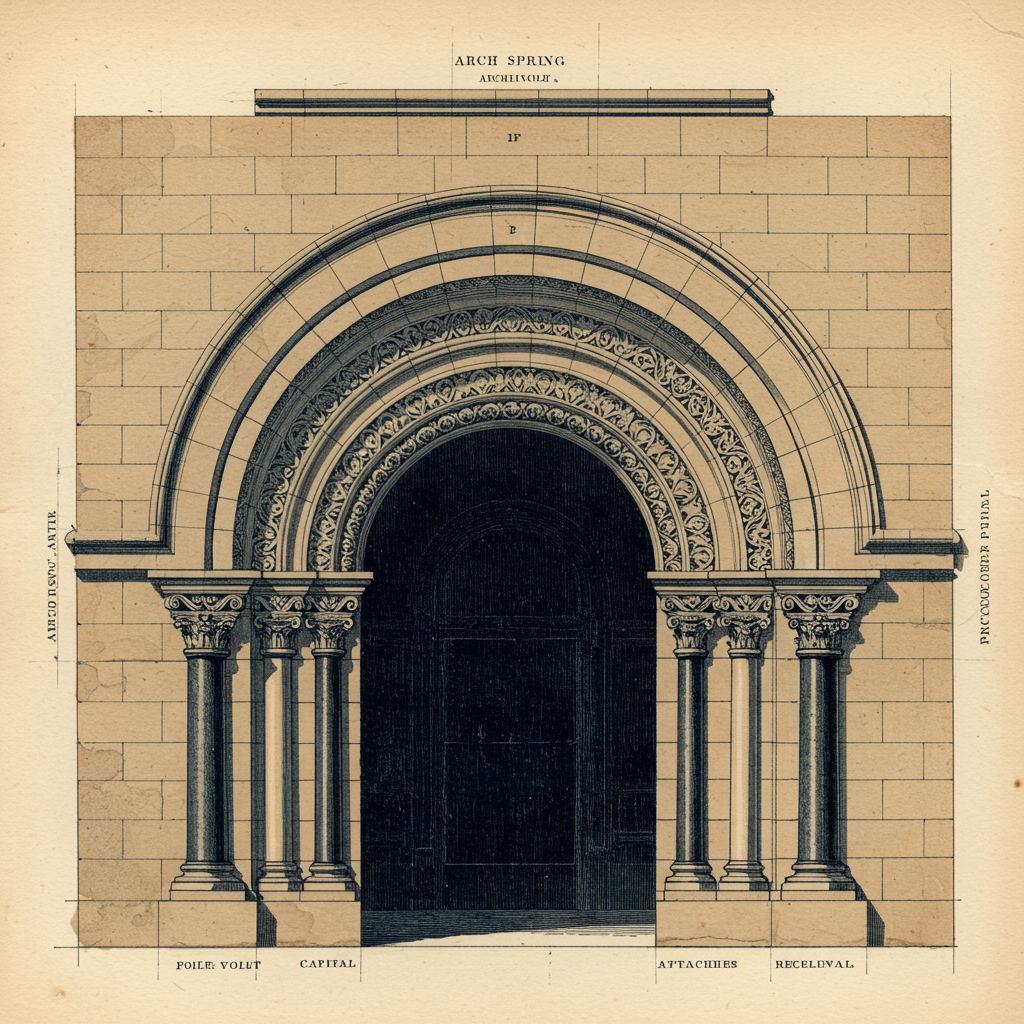
The deeply recessed round Romanesque entry arch — single great arch springing from the wall, two concentric carved archivolt orders following its curve, short heavy attached columns flanking it at the base with carved foliate capitals. The arch is the building’s optical and architectural centre, and the shadow of its recess is part of the design.
Look up. The upper storeys of a Romanesque Revival building carry short heavy attached columns — stout cylindrical or polygonal columns, often in polished granite contrasting with the rough sandstone of the wall, set into the wall plane (rather than freestanding) and grouped in twos or threes to flank window openings. The capitals are carved foliate — stylised leaves, vines, occasionally figures, arranged in the manner of Romanesque cloister capitals. The columns are usually short relative to their thickness, and they read as bearing weight in a way the more elongated columns of Renaissance Revival or Beaux-Arts buildings do not.
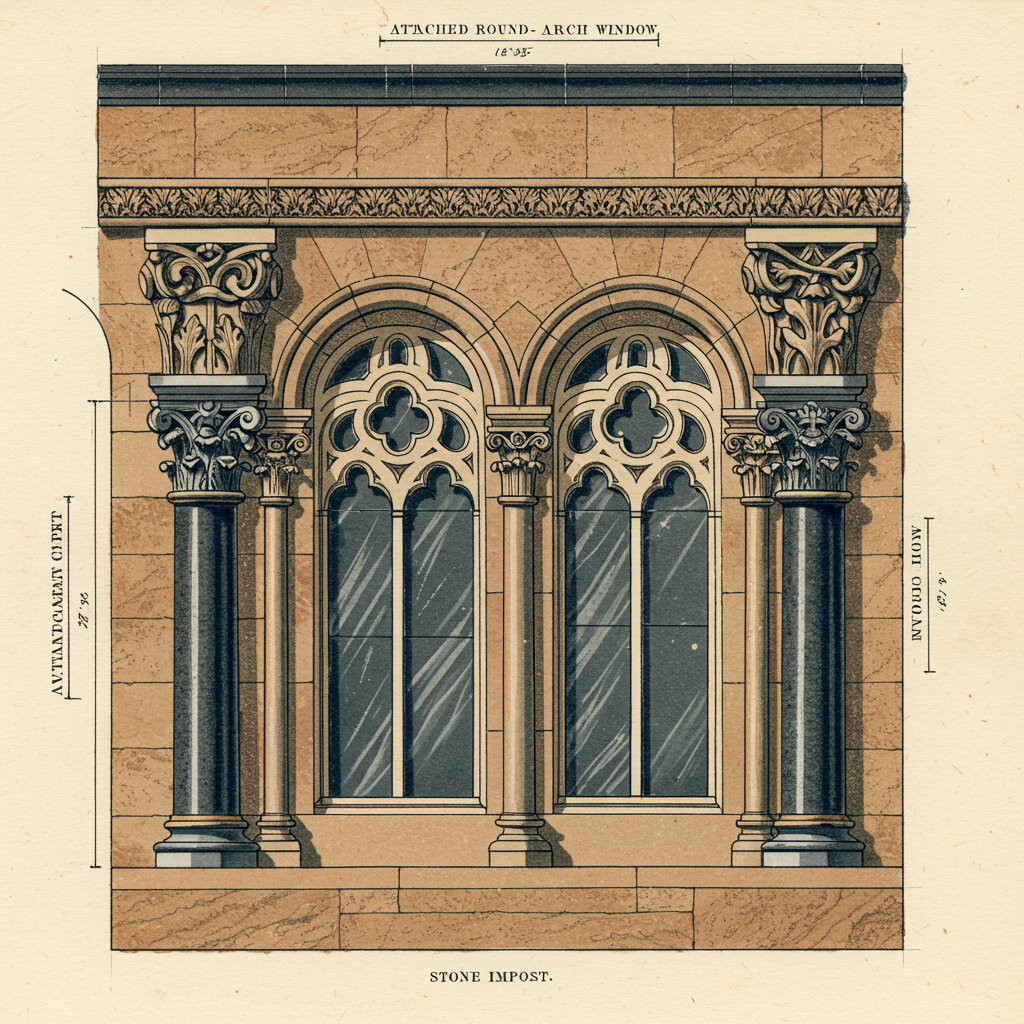
Short heavy attached columns in polished granite, flanking the paired round-arched windows of an upper storey. The capitals are carved foliate — stylised leaves and vines in the manner of Romanesque cloister capitals. The columns are stout rather than elongated; they read as bearing weight.
Examine the windows. Romanesque Revival windows are round-arched at the top, usually paired or grouped in threes, set deep in the wall mass, sometimes subdivided by central mullions into two or three lights under a single arch. The grouping is the standard pattern: a wall plane will carry pairs of arched windows on every floor, with the short attached columns flanking each pair and the rough-stone wall framing it. There are no Italianate hood molds, no Second Empire dormer pediments. The window sits in the wall, ornamented by the arch above and the columns beside it.
Two more details round out the specimen. Romanesque Revival buildings very often carry a short corner tower — a stout stone tower, square or polygonal, rising one storey above the main cornice and capped with a low conical or pyramidal stone or slate roof, drawing on Spanish Romanesque rather than the Italianate’s airy cupola or the Second Empire’s mansard pavilion. And the massing tends toward the low and broad: a Romanesque Revival building sits on its site, with horizontal banding emphasising its length and the cornice never rising as high as a comparable Italianate’s or Beaux-Arts’s. Where the Second Empire was vertical and theatrical, the Romanesque Revival is horizontal and grave.
Assemble these — the rough rusticated stone, the deep round-arched entry, the short heavy attached columns, the paired round-arched windows, the short corner tower, the low broad massing — and one has a Romanesque Revival. A civic specimen with all of them is a Richardson-school courthouse or library; a commercial specimen at the scale of a downtown department store with most of them is the kind of Marshall Field’s Wholesale Store form Sullivan would learn from; a residential specimen (rare but real) is one of the heavy stone mansions Richardson and his followers built for the wealthy of Boston, New York, and Pittsburgh in the 1880s.
Richardson’s Style
The economic and intellectual story of the Romanesque Revival is, more than for any other style in this series, the story of a single architect. Henry Hobson Richardson was born in Louisiana in 1838, trained at Harvard and at the École des Beaux-Arts in Paris between 1860 and 1865, and returned to America to build a private architectural practice that lasted, as it turned out, only twenty years before his death from kidney disease at the age of forty-seven in 1886. In those twenty years he produced almost the entire vocabulary of what is now called Romanesque Revival, and he produced it with such force that his immediate followers — Charles Follen McKim, Stanford White, John Wellborn Root, Daniel Burnham, Louis Sullivan, the young Frank Lloyd Wright — were unable to work outside his shadow until the 1893 Columbian Exposition, seven years after his death, supplied them with a Beaux-Arts alternative.
The defining commission was Trinity Church Boston, designed in 1872 and completed in 1877. The church had been destroyed by the Great Boston Fire of 1872, and the parish committee — looking to rebuild on a new site at Copley Square — held a competition that Richardson won at age thirty-four. The completed building set the Romanesque Revival vocabulary out at full scale: a great central tower modelled on the Salamanca-style Spanish Romanesque, rough-faced sandstone walls in horizontal courses, a deeply recessed round-arched portal, banded apse and chevet projections, paired round-arched windows in regular bays, carved foliate ornament concentrated at the portal and the column capitals. The interior was equally innovative — a centralised cruciform plan rather than the long English Gothic Revival nave, finished in extravagant murals by John La Farge and stained glass by William Morris and Edward Burne-Jones — and the building was, for the next fifteen years, the most influential American building of its decade. Every prosperous American city wanted a Trinity Church, and every prosperous American architect spent the late 1870s and early 1880s answering the question of what one’s own city’s Trinity should look like.
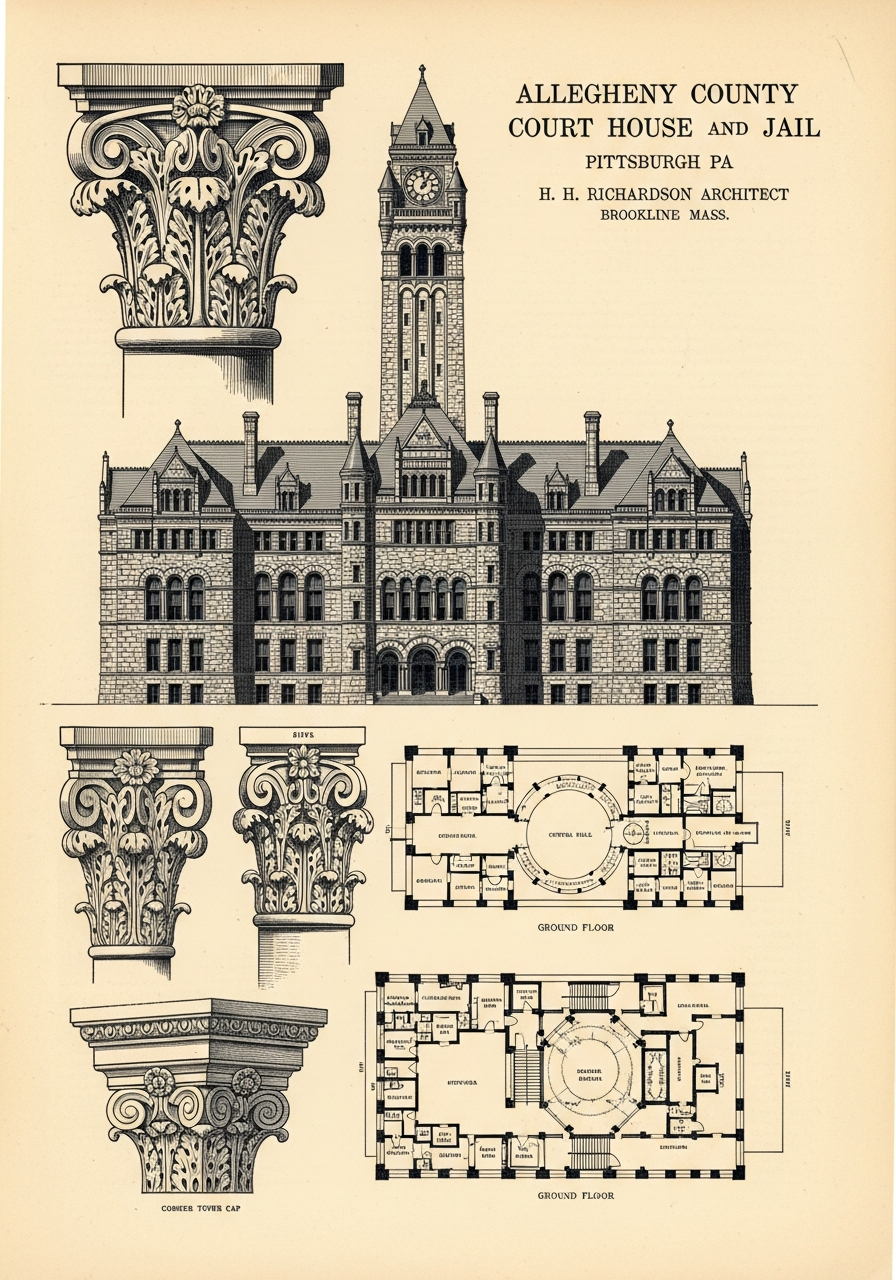
A reproduction of Richardson’s drawings for the Allegheny County Courthouse, Pittsburgh, 1884-88 — front elevation at the top, ground-floor plan below. Unlike the earlier styles in this series, the Romanesque Revival did not disseminate through pattern-books or mill catalogues. It disseminated through individual architect-to-architect attention — the followers studied Richardson’s drawings directly, often in photographs in American Architect and Building News, and adapted his vocabulary commission by commission rather than from plates a carpenter could order parts from.
The civic commissions followed. The Allegheny County Courthouse and Jail in Pittsburgh (designed 1884, completed 1888) was Richardson’s largest and most fully realised civic building — a great rusticated sandstone block rising on Grant Street with a tall central clock tower and a Bridge of Sighs connecting the courthouse to the adjacent jail, all in Romanesque Revival idiom at monumental scale. The building still stands. Most of Richardson’s smaller-town civic commissions also still stand: a sequence of small public libraries built in the 1880s for New England towns under bequests from individual donors — Crane Memorial Library at Quincy, Massachusetts (1880-83); Converse Memorial Library at Malden (1883-85); Ames Memorial Library at North Easton (1877-79); Billings Memorial Library at Burlington, Vermont (1883-86). These libraries were, in their own way, as influential as Trinity. They demonstrated that the Romanesque vocabulary could be brought down to small-town scale — that one did not need a Boston cathedral budget to build a serious civic building — and they trained a generation of small-town American architects in how to compose a stone library, courthouse, or town hall.
The commercial expression came late. Marshall Field’s Wholesale Store in Chicago, designed in 1885 and completed in 1887, was Richardson’s most influential commercial building. It was a vast rough-stone block on Adams Street, seven storeys tall, with paired round-arched windows in regular bays on every floor and a heavy rusticated ground storey carrying the deep entry. The building was demolished in 1930 — a loss that historians of American architecture have not stopped lamenting — but in its decade of life it was the single most studied commercial building in the country, and its lessons descended directly into Louis Sullivan’s early skyscrapers (the Auditorium Building in Chicago, the Wainwright Building in St Louis) and into the work of every American architect of the 1890s who had to design a tall commercial structure.
There was, finally, a small residential strand. Richardson built fewer than a dozen completed houses, but they include the Glessner House in Chicago (1885-87) and the M. F. Stoughton House in Cambridge — the latter, as the Shingle post noted, was the wooden complement to the masonry Romanesque Revival, the same architect’s two answers to the same question. The Glessner House is the canonical urban Romanesque Revival residence: rough rusticated stone walls running around three sides of a Chicago city block, a deep round-arched entry, paired arched windows, a low broad massing, and a hidden interior courtyard turning the house inward away from the noise of Eighteenth Street. The wealthy who could afford a Richardson commission got something quite different from a McKim Mead & White Shingle cottage — they got an urban fortress in stone, defended against the street, organised around a private courtyard, severe and grave.
Richardson died of Bright’s disease at his Brookline office on the 27th of April, 1886, six weeks before his forty-eighth birthday. He left an unfinished practice that was continued by Shepley, Rutan, and Coolidge — his three principal assistants — for another decade. The followers were many, the imitators legion. By 1893 the style had spread to every major American city and to several thousand small towns, and the federal building program (which had moved from Second Empire to Romanesque Revival under Mullett’s successors in the 1880s) had built libraries and post offices and courthouses in the Richardson idiom across the country. The style’s mainstream arc lasted twenty years — almost exactly the length of Richardson’s working life, plus the seven years his followers continued his work after his death — and then was displaced, abruptly and completely, by the Beaux-Arts that the Columbian Exposition introduced.
This is, on inspection, a remarkable historical concentration. Most American styles in this series had a sequence of architects or a pattern-book genealogy. The Romanesque Revival had a sequence of one architect followed by his students, and the students stopped working in the style within a decade of his death. The style died with him as completely as it had lived with him; the renaming, after 1886, to Richardsonian Romanesque was an accurate description of historical fact.
What It Is Not
Four styles stand near enough to the Romanesque Revival that the beginner confuses them with it, and distinguishing them is most of the work of reading the urban American building of 1880 to 1900.
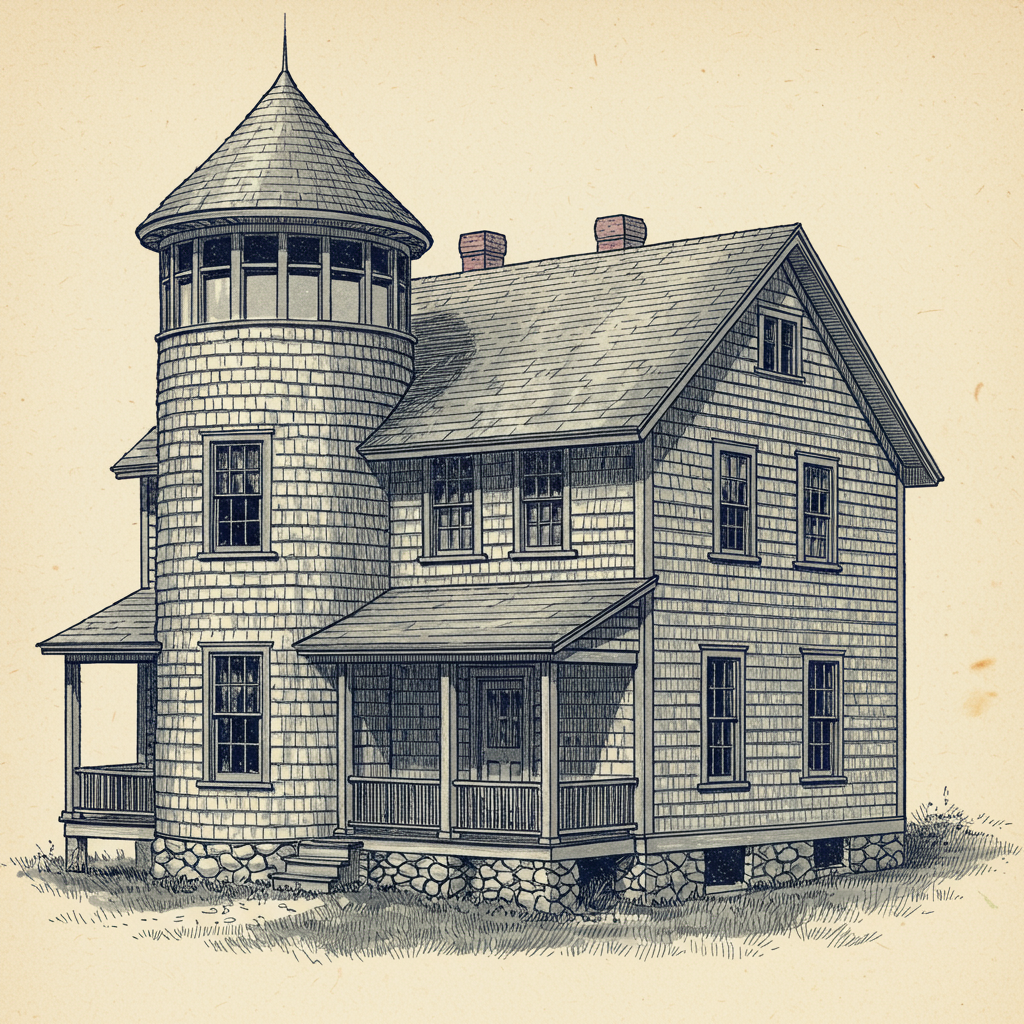
The Shingle — Richardson’s wooden domestic counterpart, examined in the previous post — was the same architect’s parallel answer in cedar to what the Romanesque Revival was answering in sandstone. The two styles share Richardson as their principal author and the same generation of American architects as practitioners, but they take opposite material positions: the Shingle is wood, residential, summer-resort, and quiet; the Romanesque Revival is stone, civic, year-round, and grave. The shared question — what should an American architecture look like? — got two answers from the same hand. (One could read this as an instance of architectural ambidextrousness; one could also read it, more historically, as a generation that had not yet decided whether American architecture should be a refinement of the English Domestic Revival or a deliberate Continental counterweight to it.)
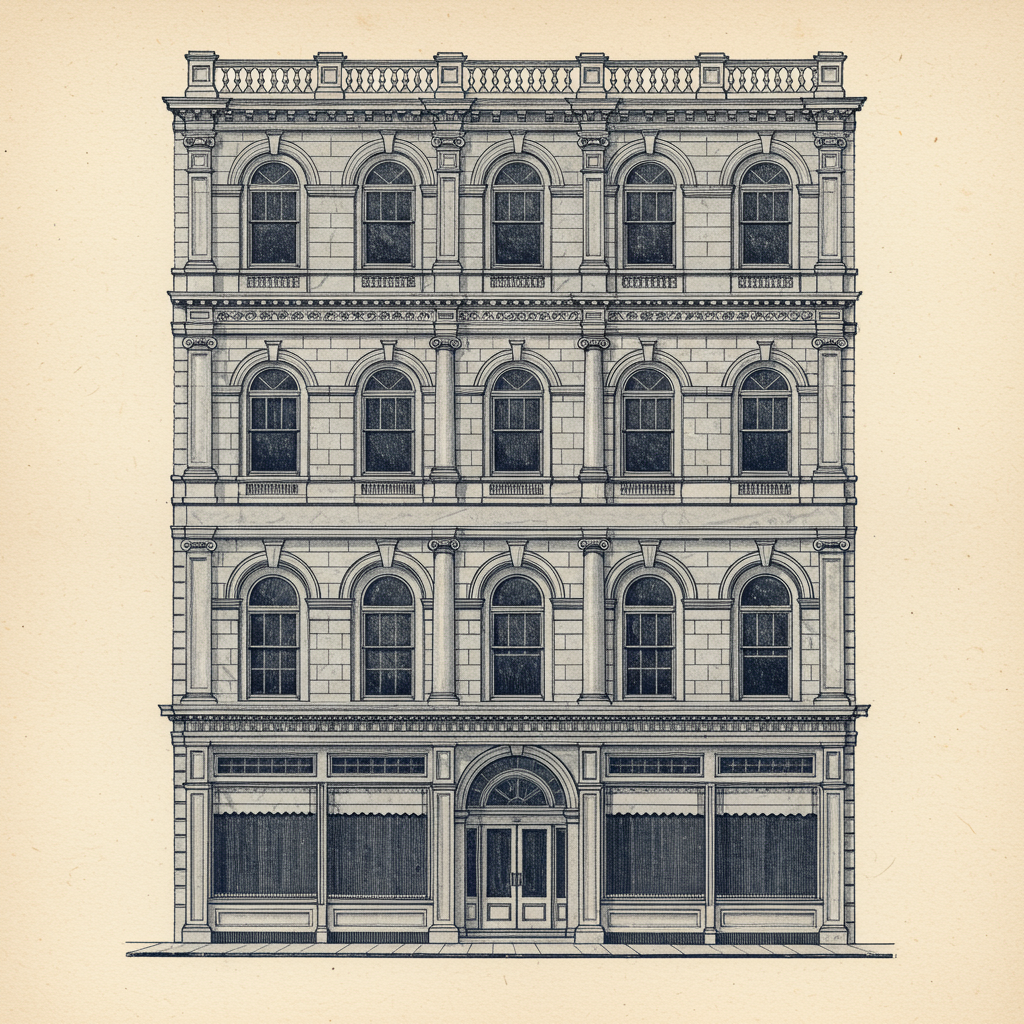
The Renaissance Revival — also called palazzo style, examined briefly in the Italianate and Second Empire posts — was the smooth-masonry alternative to the Romanesque Revival’s rough-stone gravity. A Renaissance Revival building also uses round arches and paired windows, but the stone is dressed smooth (ashlar), the wall plane is finished rather than rusticated, the columns are slender and freestanding rather than short and attached, and the overall register is academic-classical rather than medieval-Romanesque. The two styles compete on the same urban commissions in the 1880s — a downtown bank or insurance office could be either — and the rule of thumb is straightforward: if the stone is rough-faced and rusticated, the building is Romanesque Revival; if the stone is smooth ashlar, the building is Renaissance Revival.
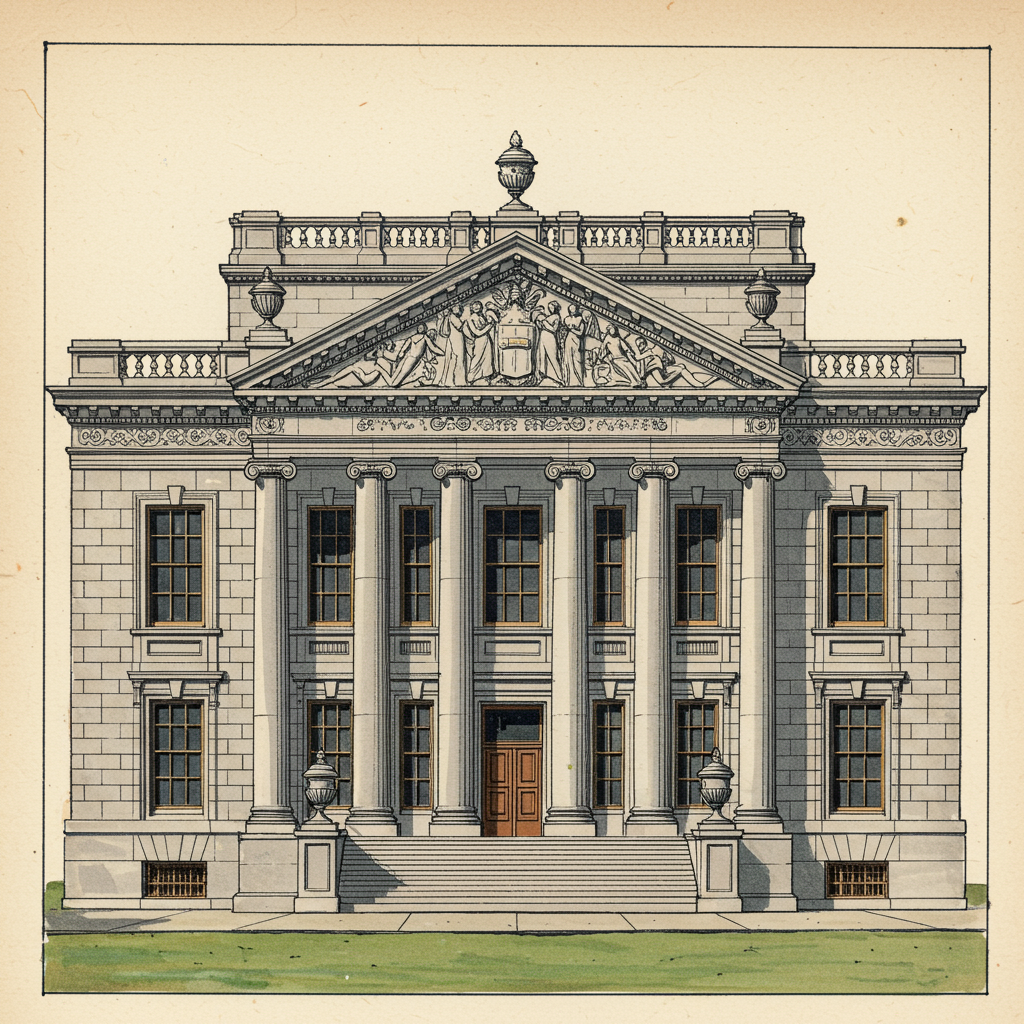
The Beaux-Arts — the academic-classical successor that displaced the Romanesque Revival after about 1893 — replaced the rough-stone heaviness with smooth limestone surfaces, Corinthian colonnades, classical pediments, and elaborate sculptural programmes drawn from the French academic tradition Richardson had studied at the École in the early 1860s. The Beaux-Arts was, in a sense, what Richardson’s training would have produced if he had stuck to academic classicism rather than developing his own Romanesque synthesis; his absence from the practice after 1886 cleared the way for his contemporaries (McKim Mead & White’s later work, Carrère and Hastings, Cass Gilbert, Daniel Burnham) to bring the Beaux-Arts to American shores in his place. By 1900 Beaux-Arts had displaced Romanesque Revival in all the same commission types — civic libraries, courthouses, museums — and the change was rapid and complete.
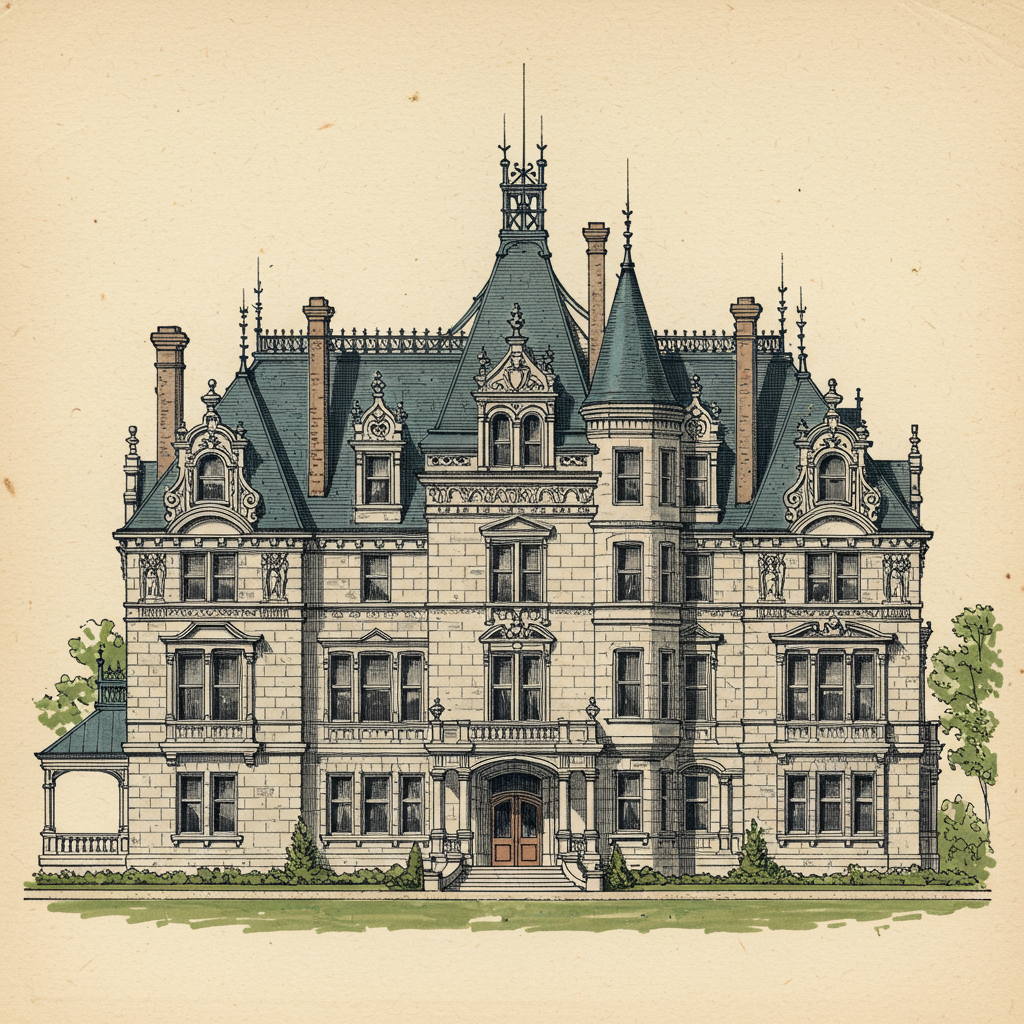
The Châteauesque — Richard Morris Hunt’s aristocratic-residential contemporary, used for the great Vanderbilt mansions of the 1880s and 1890s — drew on French sixteenth-century chateau sources (Chambord, Blois, Azay-le-Rideau) rather than medieval Romanesque, and was distinguished by steep slate roofs, dormer pavilions, French Renaissance ornament, and a deliberate aristocratic-European register that the Romanesque Revival’s American gravity did not aspire to. Hunt’s Marble House at Newport (1888-92), Biltmore House in North Carolina (1889-95), and the Vanderbilt townhouse on Fifth Avenue (1879-82) are the canonical examples. The two styles ran in parallel for fifteen years, occupied different commission types (Châteauesque for plutocratic residences, Romanesque Revival for civic monuments), and shared almost no architects.
What It Was Trying to Say
The Romanesque Revival flourished in America between roughly 1872 (Richardson’s Trinity Church commission) and 1900 (when the Beaux-Arts had fully displaced it). Its peak years were almost exactly Richardson’s mature working years and the decade of his followers’ continuation: 1880 to 1893. After 1895 it was being built only in small towns where the Beaux-Arts had not yet reached; by 1905 even those had transitioned, and the only Romanesque Revival buildings still going up in numbers were small-town Carnegie libraries built from standardised plans that derived, three generations down, from Richardson’s small-library work of the 1880s.
What it was trying to say is best taken, again, as the sum of two arguments running in parallel.
The first is the civic-gravity argument. The Romanesque Revival was the first American style that pursued gravity as its central architectural value — a sense of weight, deliberation, and historical depth that registered, on inspection, as the building taking itself seriously. The republican Greek Revival had been monumental but not heavy; the imperial Second Empire had been theatrical but not grave; the Italianate had been cosmopolitan but not solid. Richardson’s stone was heavy in a way the earlier American styles had not been, and the heaviness was the point. American cities were building libraries and courthouses and town halls at unprecedented rates in the 1880s — the post-Civil-War republic discovering, with some embarrassment, that it had become permanent — and the buildings these institutions wanted were buildings that did not look provisional. The Romanesque Revival, with its rough rusticated stone and its short heavy attached columns and its deeply recessed portals, looked like an institution that had been there a long time and intended to be there longer. That was its argument, made in stone, on every important civic site.
The second is the architect-as-author argument. The Romanesque Revival was the first American style in which an individual architect’s signature was the style’s most reliable identifier. Earlier styles had been disseminated through pattern-books, mill catalogues, and the work of carpenters and small-town builders; the Romanesque Revival was disseminated through the photographic record of an architect’s commissions, and the followers worked directly from his drawings rather than from plates ordered with brackets-by-the-foot. This was new in America. It marked the moment when the American architectural profession arrived at the European understanding of architecture as a fine art — produced by named individuals, attributable to specific authors, evaluated as creative statements rather than as builders’ work. The renaming to Richardsonian Romanesque after 1886 was the historical recognition of this fact. The style was the architect, and the architect was the style.
What I find most telling about the Romanesque Revival, taking these two arguments together, is its brevity. Like the Second Empire (also a fifteen-year style), the Romanesque Revival was concentrated in time: its mainstream arc ran almost exactly between Richardson’s first major commission and the death of his style after his own death. Architecture is normally slower than this. A style usually outlives its principal architects by a generation or two; the Romanesque Revival barely outlived Richardson’s seven assistants. This is, on inspection, the deep cost of authorship: a style that is one architect’s dies when he dies. Other American styles in this series have authors — Downing for the Gothic Revival, Vincent Scully retrospectively for the Stick — but their authors are pattern-book writers, historians, or theorists, not the working architects who built the houses. The Romanesque Revival had a working architect, and the working architect was mortal. He died, and the style died, and the lesson is somewhere in the closeness of those two events.
The next specimen I should like to take up is the Colonial Revival — the residential style that displaced the Shingle in the 1890s and remained dominant through the first half of the twentieth century, which translated the Shingle’s loose American vernacular into an academically literal Anglo-American Georgian, and which spoke, in clapboard rather than in stone, of the same generation’s discovery that the American architectural conversation could be, at last, historical — the country old enough by 1890 to have a domestic past worth reviving rather than only a European past worth borrowing.