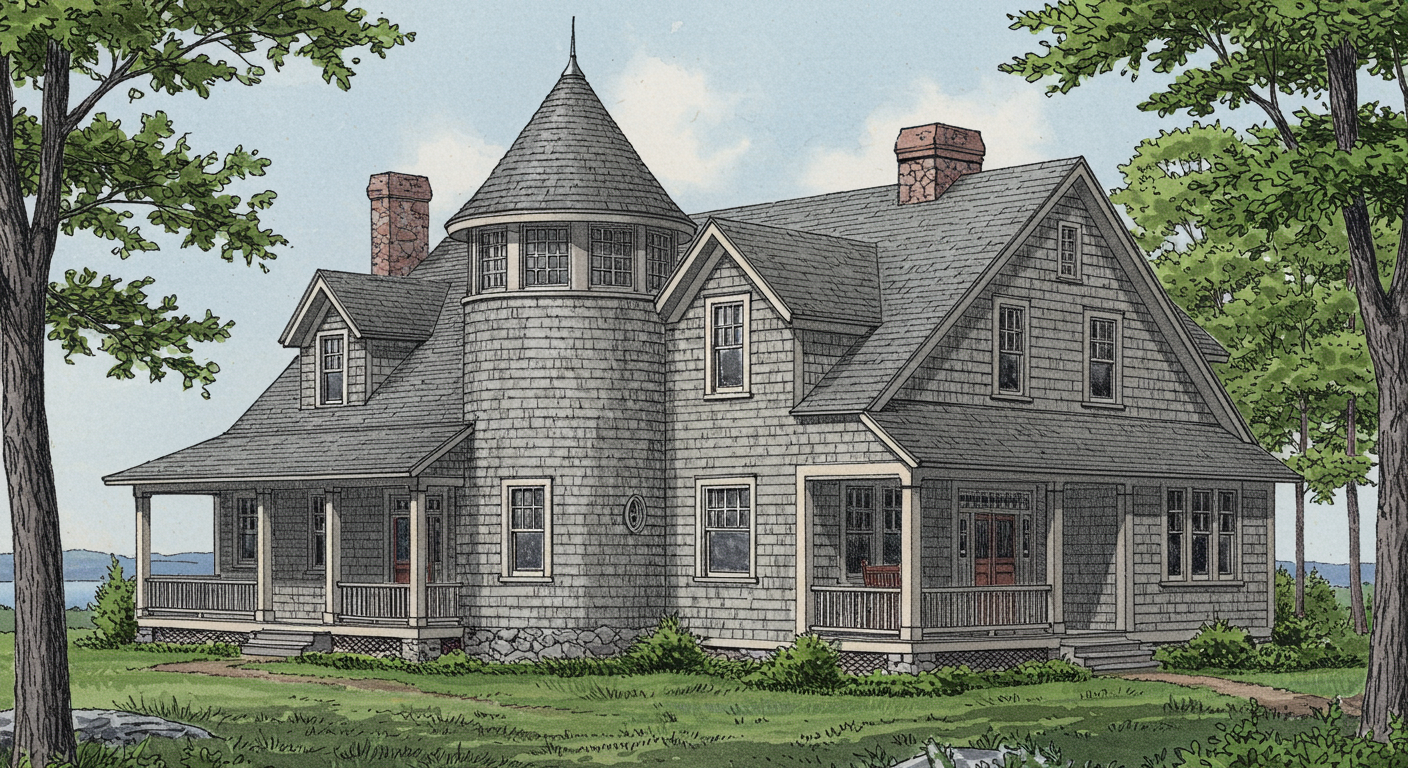
The Shingle style is, on inspection, the first American architectural style that did not claim to be a revival of anything. Every previous style covered in this series — the Greek Revival reviving Athens, the Gothic Revival reviving medieval England, the Italianate reviving Tuscany, the Second Empire reviving (or rather translating) Haussmann’s Paris, the Queen Anne reviving (badly) the actual Queen Anne, even the Stick reviving the moral seriousness of mid-Victorian English Gothic theory — had built its claim to legitimacy on a European source, named or unnamed. The Shingle did not. By 1885, against the apparent grain of the post-Civil-War American architectural conversation, the Shingle had become an American style that simply was one. It looked at the early Colonial saltbox, the Cape Cod cottage, and the New England farmhouse — and at certain English Domestic Revival sources from Norman Shaw’s circle, which it kept quiet about — and produced a wooden vernacular that no longer required the metaphor of a European temple, cathedral, villa, or chateau to justify itself.
This is the Shingle, and the absence of a European pretext is the joke at its centre. What follows is the seventh in a series that has been, in a quiet way, trying to read American houses for what they were trying to say. The Queen Anne (the first post) said the middle class has arrived. The Greek Revival, we are the new Athens. The Gothic Revival, we are a Christian republic. The Italianate, we should like to imagine ourselves on a hilltop above Florence. The Second Empire, we are a great power and should look like Paris. The Stick, the bones of the house should be visible on the outside. The Shingle said something quieter than any of these and more particular: the house should belong to its landscape; the cladding should be a single skin; the metaphor should be local. It was the first American style that argued for itself rather than for an idea of Europe, and it was — perhaps for that reason — also the first that the English took seriously enough to study in return.
The Misnomer
The first thing worth knowing about the Shingle is that it is not, in fact, named for a material. It is named for a use of a material.
Shingles — small overlapping wooden tiles, split or sawn from cedar or pine — had been used on American houses since the seventeenth century. The Queen Anne used them, often elaborately, in fish-scale bands or polychromed panels, set in registers between bands of clapboard or sawn ornament. The Gothic Revival used them on roofs. The Stick used them in gable peaks. None of these styles is called the Shingle style. What the Shingle did, and what the name commemorates, was use the shingle as the only cladding — applied uniformly to the entire exterior, so that wall, roof, tower, and dormer were wrapped in a single continuous surface. The shingle is the means, not the point. The point is the integration.
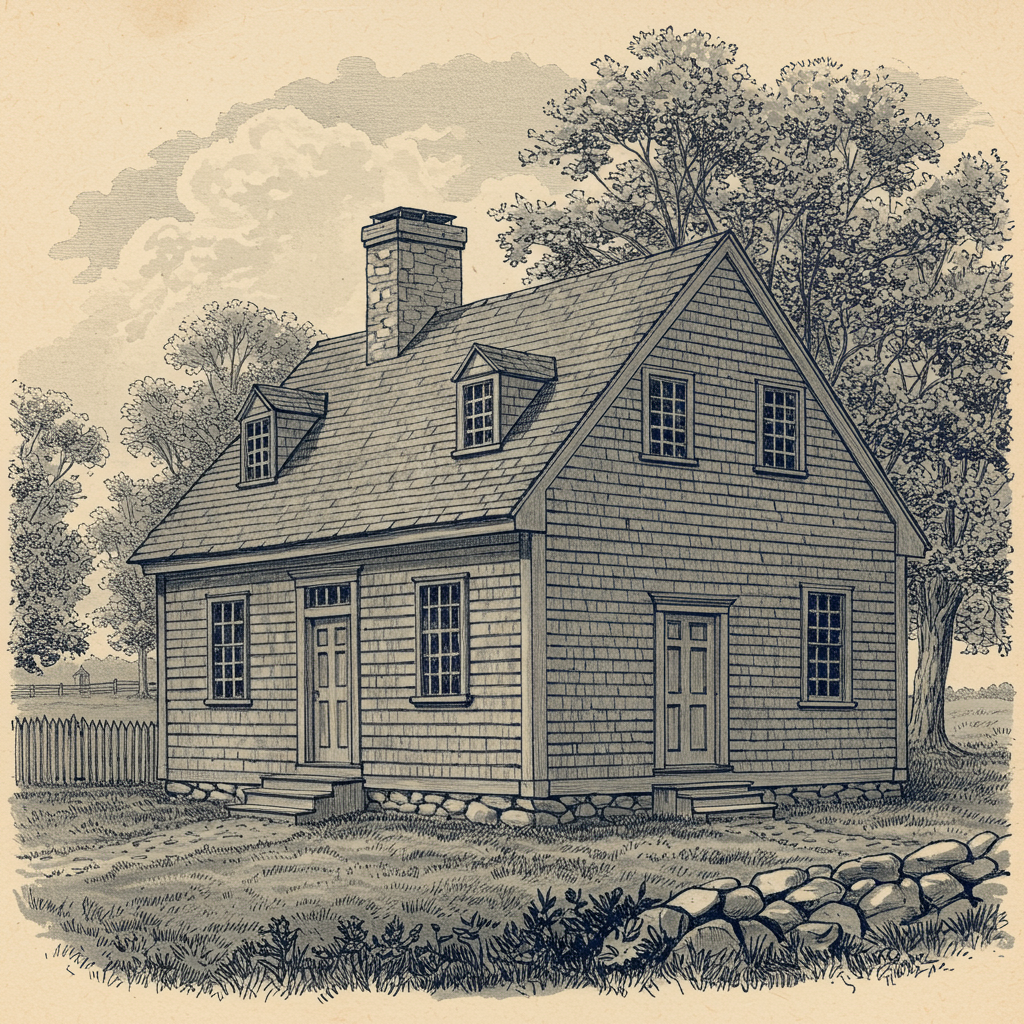
A New England Colonial saltbox cottage, roughly 1750 — weathered shingle cladding running from the foundation to the ridge, the long sloping rear roof descending to a single storey, the whole exterior wrapped in a single material. The Shingle architects sketched specimens like this on tour through New England in the 1870s; the form’s claim to American vernacular descends, in one or two generations of attention, from precisely this.
The name is again a Vincent Scully coinage — the same critic who, in The Shingle Style (1955), named the Stick. Scully drew the line between the two phases at roughly 1880, and the names took. Contemporaries had called the style various things. Modern colonial was the most common in the 1880s, picking up the style’s debt to early American building. Newport style and summer house style named the geography of its origin. American cottage and seaside cottage described the building type. Queen Anne was sometimes used, loosely, by writers who did not yet distinguish the two.
The name has the virtue of pointing at the most distinctive feature, but it has the slight defect of suggesting that the distinguishing fact is the material. It is not. A house clad in shingles in the manner of a Queen Anne — shingles in one band, clapboard in another, sawn ornament in a third — is not Shingle style. A house clad in shingles uniformly, with no ornamental break between wall and roof and tower, is. The grammar of the cladding is the style; the material is incidental.
This is, on inspection, the cleanest counterargument to the Stick that the period produced. The Stick had insisted that the frame of the building should be visible on its exterior. The Shingle replied that the skin of the building should be continuous and the frame invisible underneath it. The two styles share architects, share pattern-books, share a generation of carpenters, and take exactly opposite positions on the relationship between what a house is made of and how it looks. One articulates; the other integrates.
The Specimen
If one is to identify a Shingle style house — and they are, once one has begun looking, the architecture of every old American summer-resort town from Cape May to Mount Desert — the simplest exercise is, as before, to walk around a specimen and assemble the evidence.
Begin at the surface. A Shingle style house is clad, almost without exception, in wooden shingles running over its entire exterior as a single continuous skin. Walls, roof, tower projections, dormer cheeks, even the soffits of porch ceilings — all are shingled, in courses that run in unbroken horizontal lines wherever the geometry permits and turn corners with a slight chamfer where it does not. The shingles are usually cedar or white pine, left unpainted to weather to a soft silvery grey, sometimes stained a deeper rust or umber. There is no clapboard. There are no sawn-wood ornament panels. There are no fish-scale bands set into a different material. The shingle is the entire vocabulary of the wall.
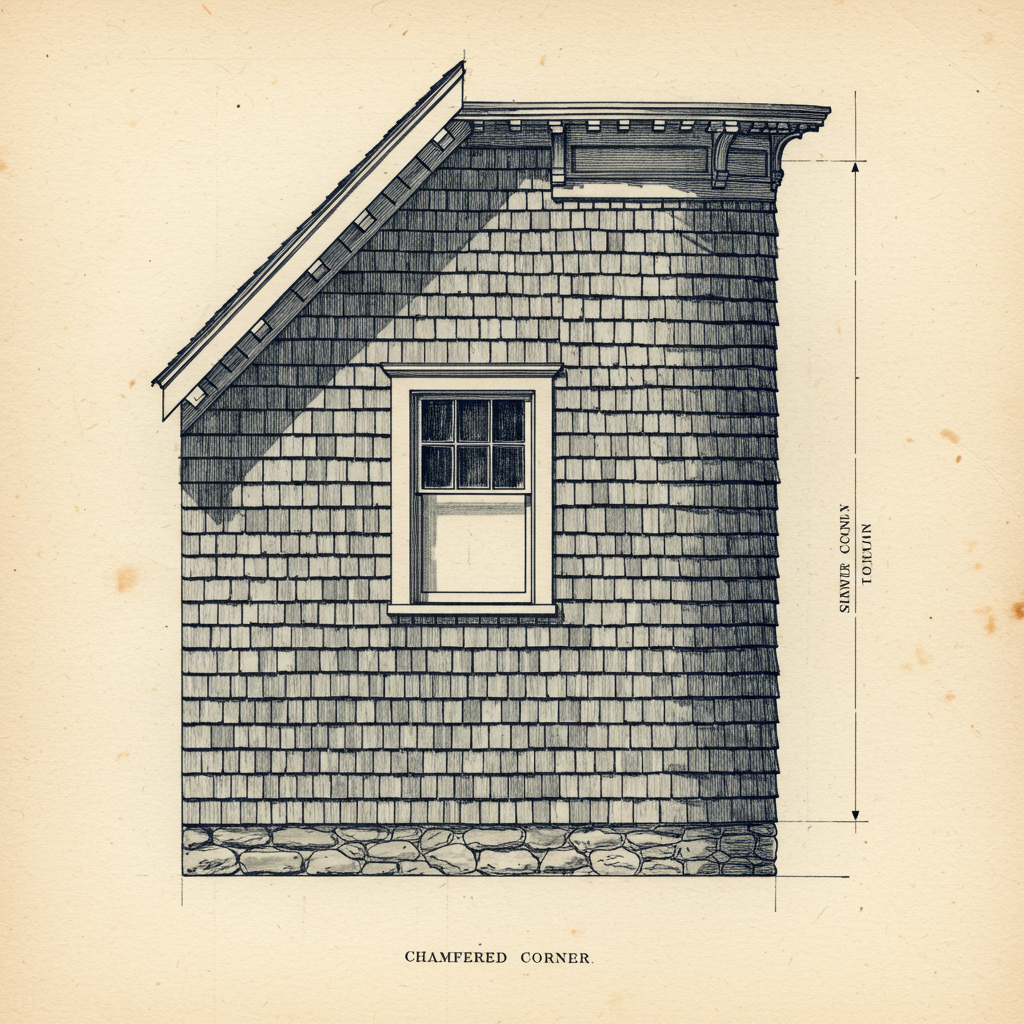
The continuous shingle skin, turning a corner from wall onto a round tower projection. There is no break in the cladding at the corner — no quoin, no corner board, no change of material — and the courses chamfer slightly to follow the geometry. This is the Shingle’s signature, and the entire identification: a house clad uniformly in this manner is Shingle, and a house with the shingles set in bands between other materials almost certainly is not.
Now look at the roofline. Shingle roofs are low, sweeping, and broad. The pitch is gentler than the Gothic Revival’s or the Stick’s, often around thirty degrees, and the eave often runs unbroken for the full length of the front elevation, sometimes dipping below the second-storey window line so that the upper storey reads as tucked into the roof rather than rising above it. Secondary gables, dormers, and shed roofs project from the main slope in fluid asymmetric arrangements, all sheathed in the same shingles, so the roof appears not as a separate plane above the house but as a continuation of the wall. There are very often eyebrow dormers — small dormer windows whose roofs curve down to meet the main roof slope without breaking the line. There are sometimes catslide roofs — long unbroken slopes descending from the ridge nearly to the ground. The horizontal continuity is the design’s central commitment.
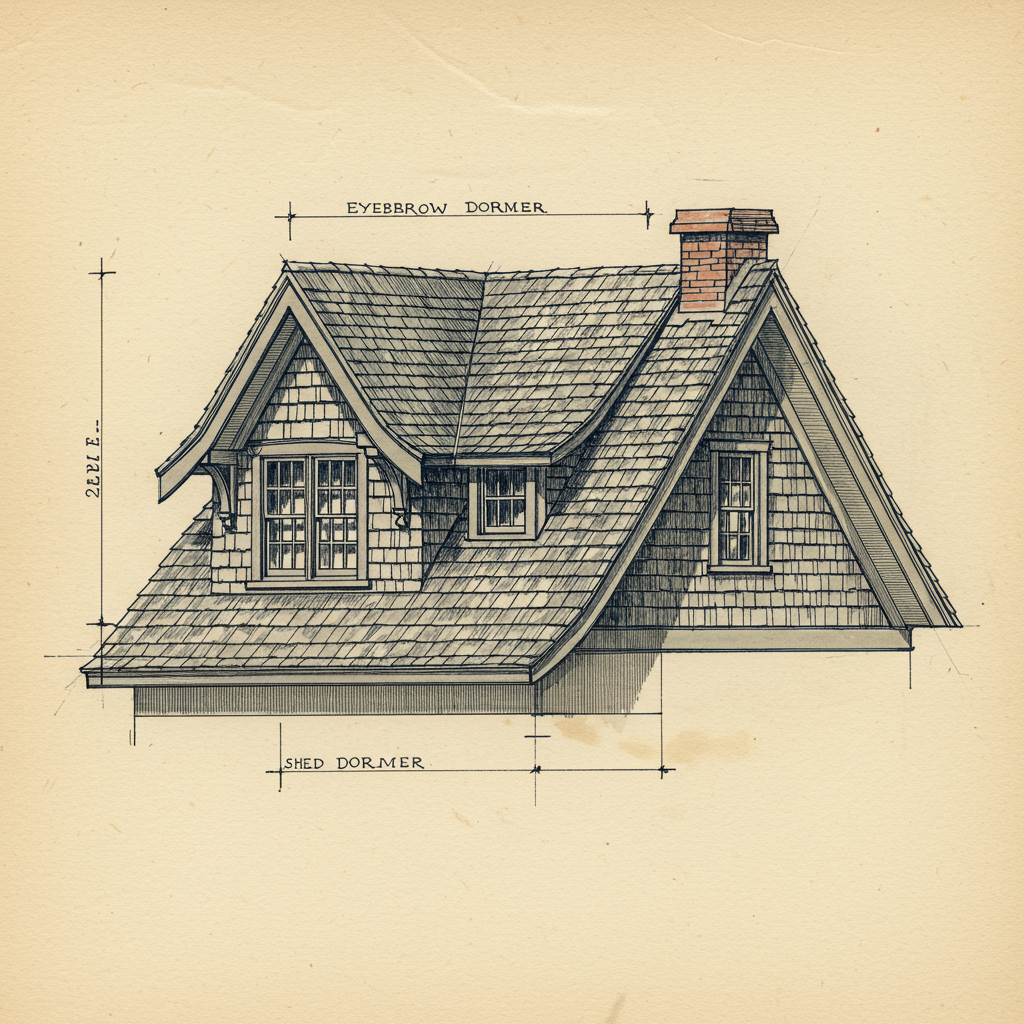
A sweeping Shingle roofline — low pitch, long unbroken eaveline, an eyebrow dormer curving smoothly out of the main slope and back into it without an interrupted edge. The horizontal continuity is the point: where the Stick had articulated every junction, the Shingle dissolves the junctions altogether, so that wall, eave, dormer, and roof read as a single surface bending across the geometry of the house.
Look up. On grand examples, a Shingle style house carries a round corner tower — a circular projection wrapped in the same shingles as the rest of the body, capped with a low conical or shallow domed roof in the same material. The tower is not, on inspection, a Queen Anne tower. A Queen Anne tower asserts itself; it has its own materials, its own ornament, its own register. A Shingle tower is continuous with the house — its shingled cylinder rising out of the shingled wall as if the wall had simply curved at one corner, the cap continuing as a shingled dome with no decorative ironwork or finial above it. The whole composition reads as one volume, articulated by curvature rather than by ornament.
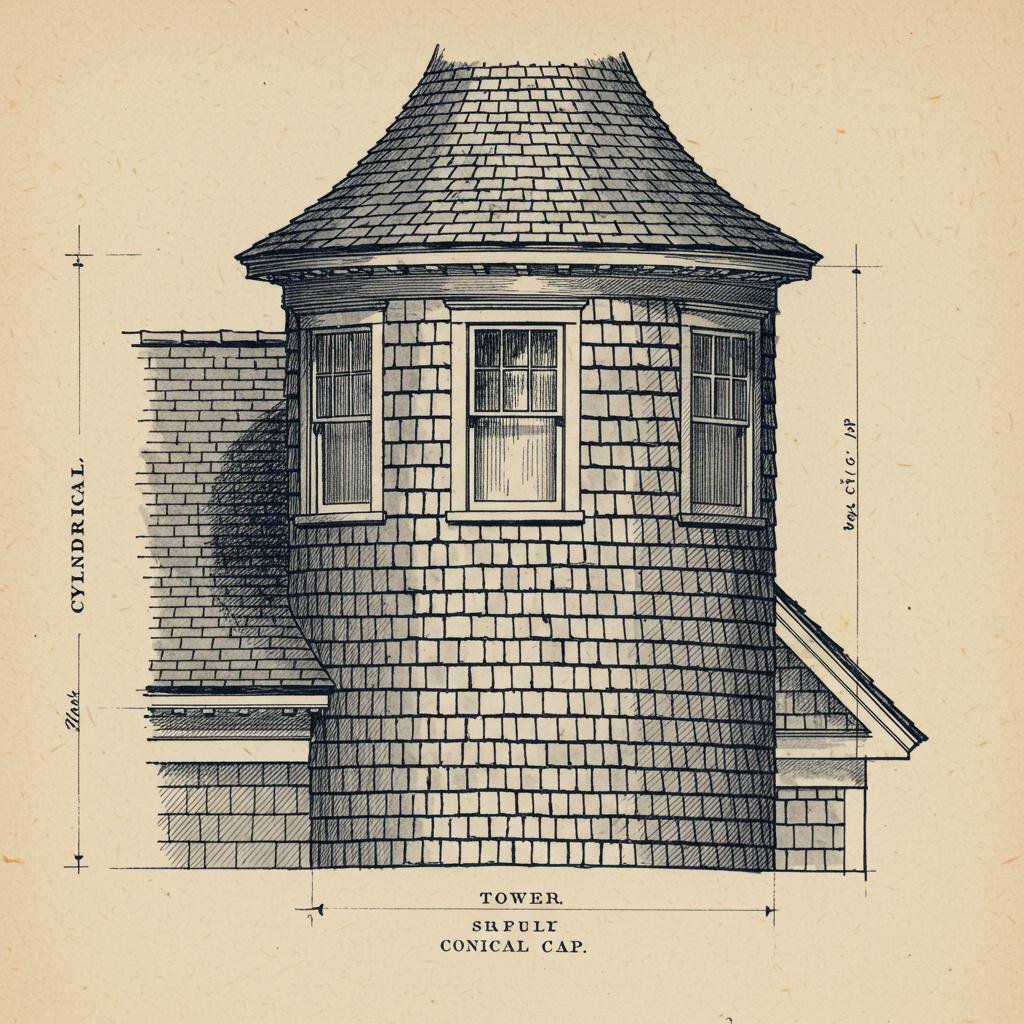
A round corner tower — shingles continuing from wall onto cylinder onto conical cap, no break in the material, no decorative finial. The Shingle tower is the same body as the house, redirected through curvature; one is not meant to read it as a separate composition.
Examine the windows. Shingle windows are plain, rectangular, and grouped irregularly — not in regular bays as on the symmetrical earlier styles, not paired in neat twos as on the Stick or Italianate, but arranged in clusters of two or three or four wherever the interior plan asks for them, with plain wooden frames and simple muntins. The glazing is often small panes in the upper sash, single pane in the lower — a quiet quotation from Colonial Georgian sashes. The trim is restrained: a simple flat board, painted bone-white or stained the colour of the shingles. There is no hood mold; there is no decorative pediment; there is, in many examples, almost no trim at all.
Two more details round out the specimen. Shingle houses very often carry an open verandah wrapping the ground floor on two or three sides — a generous porch on chamfered or square wooden posts with simple horizontal railings, the porch roof a low shed continuation of the main roof, sheltering the ground floor against summer sun and weather. And the foundation is often a rugged stone course — fieldstone or rusticated cut stone running for two or three feet at the base of the wall before the shingle skin begins, planting the house firmly in its site and providing a textural counterpoint to the soft surface above.
Assemble these — the continuous shingle skin, the sweeping low roofline, the round corner tower, the eyebrow dormers, the irregular window clusters, the wraparound verandah, the rugged stone foundation — and one has a Shingle. A small specimen with most of these is a vernacular Shingle cottage; a large specimen at Newport or Bar Harbor with all of them is a Shingle summer house; a Mount Desert lodge with a long catslide roof and minimal ornament is the form at its most integrated. The style does not divide cleanly into vernacular and high-style as the earlier ones do. Its principle of continuous surface scales up and down with equal grace.
The Newport Argument
The Shingle did not emerge from a pattern-book or a federal building program. It emerged from the summer architecture of three or four resort towns on the New England coast, between roughly 1880 and 1885, in the work of about a dozen named architects.
The decisive moment was the Newport Casino, built in 1881 by the firm of McKim, Mead, and White as a private leisure club for the summer society of Newport, Rhode Island. The building combined a shingled main block with a tile-roofed tower and a long shingled court wing, and it announced — in a single complete project — most of the vocabulary the style would settle into: continuous shingle cladding, sweeping low rooflines, asymmetric massing, an open horseshoe of verandah, integration with the site. McKim, Mead, and White had been on a sketching tour of Colonial New England in 1877 — Salem, Marblehead, Newport, Portsmouth — looking at saltboxes and Cape Cods and early shingled farmhouses with the deliberate intention of finding an American architectural vocabulary. The Newport Casino was the first complete realisation of what they had found.
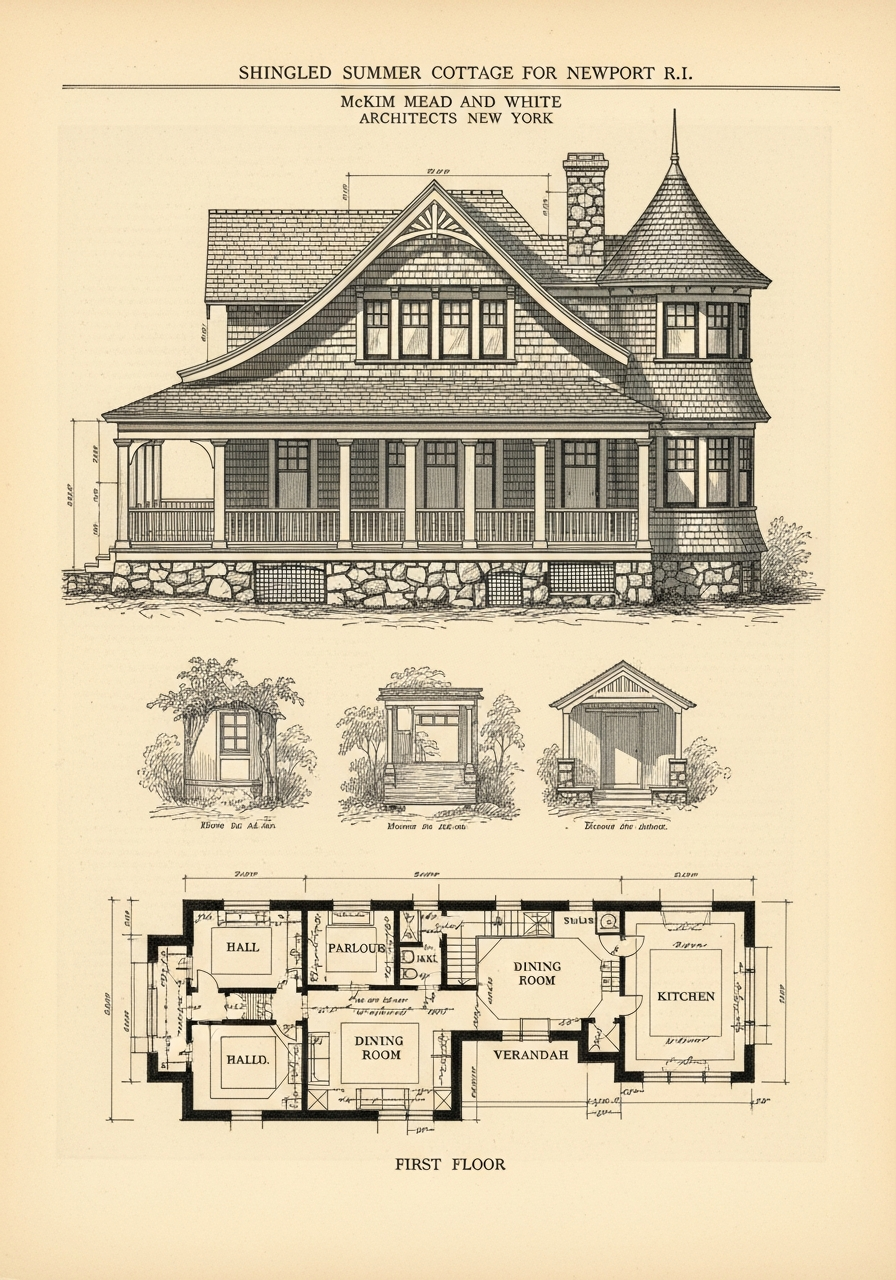
A plate from an 1880s American architectural journal — American Architect and Building News, The Builder, or one of the architectural-press journals through which the Shingle disseminated. The style emerged through professional architectural journals rather than through pattern-books; the architects who built it (Richardson, McKim Mead & White, Bruce Price, William Ralph Emerson) were the first generation of formally trained American architects, and the medium of dissemination was the trade press rather than the carpenter’s manual.
Henry Hobson Richardson — the architect already at work on the Romanesque Revival in stone (Trinity Church Boston, 1872-77) and the Allegheny County Courthouse (1884-88) — produced his first Shingle style residence at almost the same moment. The Watts Sherman House at Newport (1874-75, with Stanford White assisting) had been a transitional Queen Anne; the M. F. Stoughton House at Cambridge (1882-83) was a fully realised Shingle, with continuous cedar shingle skin, sweeping eaves, and a round shingled tower at the front corner. Richardson’s domestic Shingle work and his civic Romanesque Revival work were the same architect’s two answers to the same question — what should an American architecture look like? — pursued in different materials for different audiences. The wooden answer was the Shingle. The stone answer was the Romanesque Revival.
Other architects joined quickly. Bruce Price built Shingle commuter cottages at Tuxedo Park, New York. William Ralph Emerson built Shingle summer houses on Mount Desert Island. Wilson Eyre worked in Philadelphia. Peabody and Stearns worked in Boston. By 1888 every prosperous American summer-resort town from Cape May to Bar Harbor had a Shingle neighbourhood, and the architects of these neighbourhoods were almost all formally trained — most at the École des Beaux-Arts in Paris or at the Massachusetts Institute of Technology — and disseminated their work through American Architect and Building News and The Builder rather than through pattern-books for carpenters. The Shingle was the first American style produced by architects, in the modern professional sense, rather than by builders working from plates.
This had consequences. The style was less easy to vernacularise; one cannot order Shingle parts from a mill catalogue the way one ordered Italianate brackets. The shingle skin, the sweeping roofline, the integrated tower — these required a designer’s eye to compose and a skilled carpenter’s hand to execute, and they did not reduce to a kit. The result was that Shingle houses tended to cluster in resort towns and wealthy suburbs where architects worked, and the style stayed at a higher economic register than the Italianate or Stick had. There are very few small-town vernacular Shingles. There are many small-town vernacular Italianates and Sticks. The difference is the difference between a style developed by architects for clients and a style developed by carpenters from plates.
The English took notice. Norman Shaw, the leading English Domestic Revival architect, had been the prior generation’s source for some of the Shingle’s vocabulary; by the late 1880s the traffic ran in the other direction, and English country-house architects were studying photographs of Newport and Mount Desert Shingles. The American architectural conversation, for the first time, was something Europe was reading. This was the small but real reversal that the Shingle accomplished, and it is, on inspection, the truest measure of the style’s claim to being American: it was American enough that the English imitated it.
What It Is Not
Four styles stand near enough to the Shingle that the beginner confuses them with it, and distinguishing them is most of the work of reading the American summer-resort and late-Victorian house.
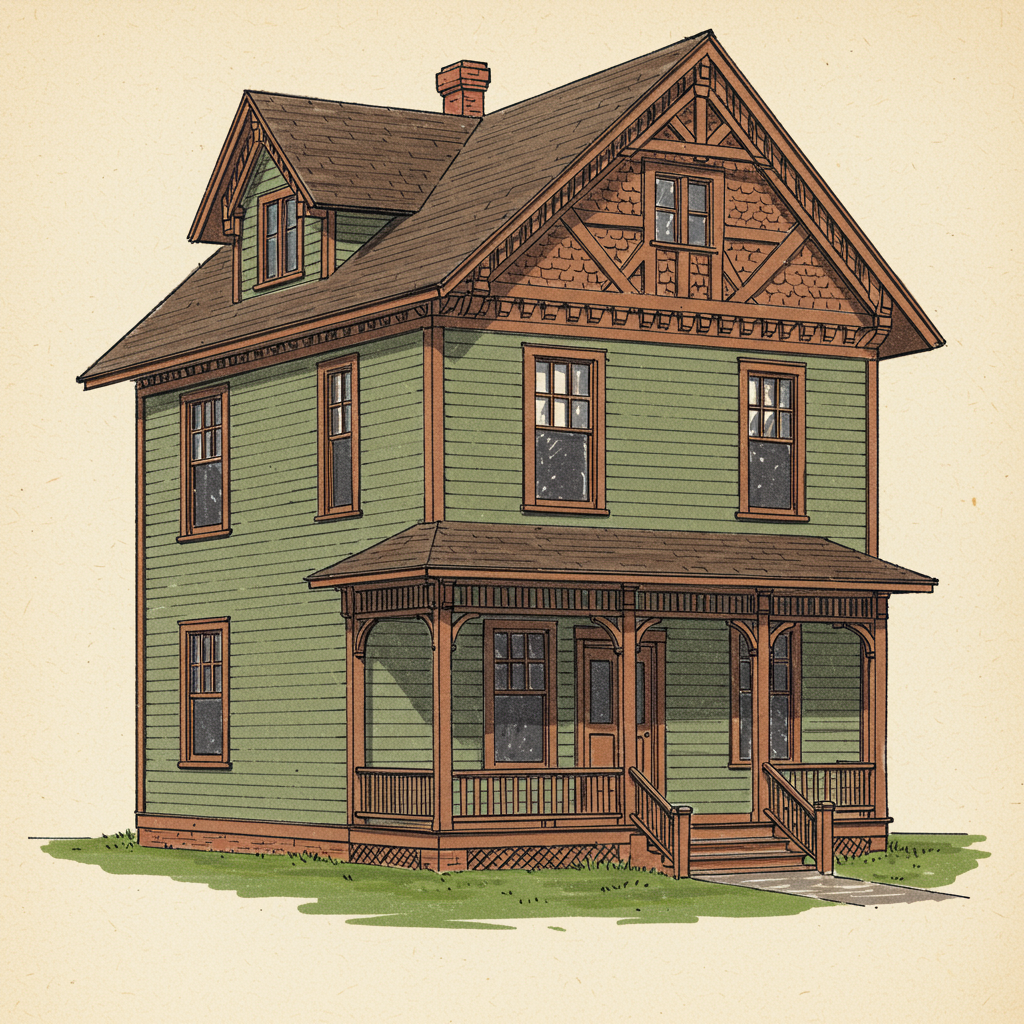
The Stick — the Shingle’s wooden predecessor, examined in the previous post — is the style whose argument the Shingle directly inverted. Where the Stick articulated the imagined frame on the exterior with applied sticks, decorative trusses, and knee braces, the Shingle dissolved the frame beneath a continuous skin. A wooden American house of the 1875-1885 period with applied stickwork across its walls is Stick; the same period and the same materials, with the walls wrapped in unbroken shingles, is Shingle. The two styles overlap in time (1875-1885), share architects, and represent the period’s two opposing answers to the question of what the wall of a wooden house should declare.
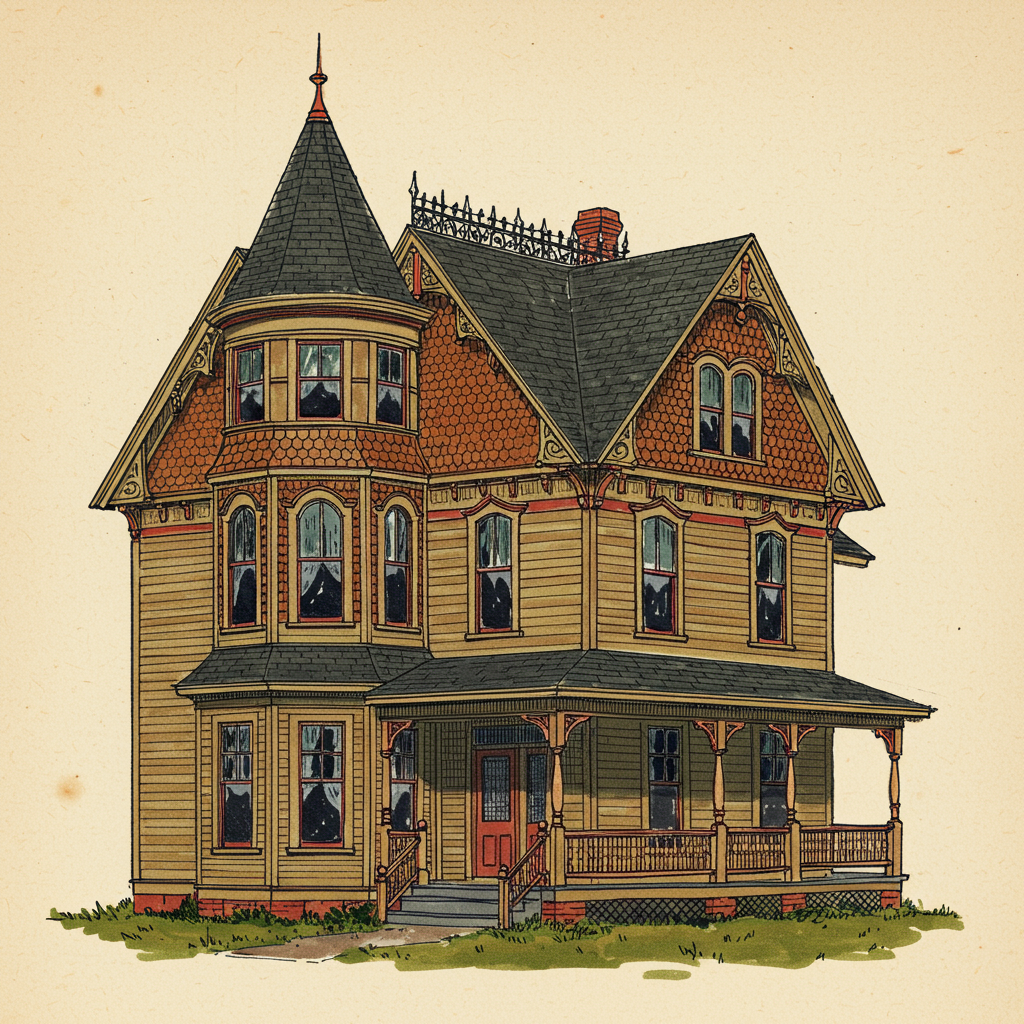
The Queen Anne — the Shingle’s late-Victorian contemporary, examined first in this series — also uses shingles, often prominently, but as one ornamental element among several. A Queen Anne typically combines clapboard at the ground floor, fish-scale shingles in the middle band, sawn-wood ornament panels in the gable peaks, and a varied polychrome paint scheme — the wall is layered with materials. A Shingle uses shingles as the single material running over everything. The rule of thumb: if the wall is broken into bands of different materials with shingles in one band, the building is Queen Anne; if the wall is shingled uniformly with no break, the building is Shingle.
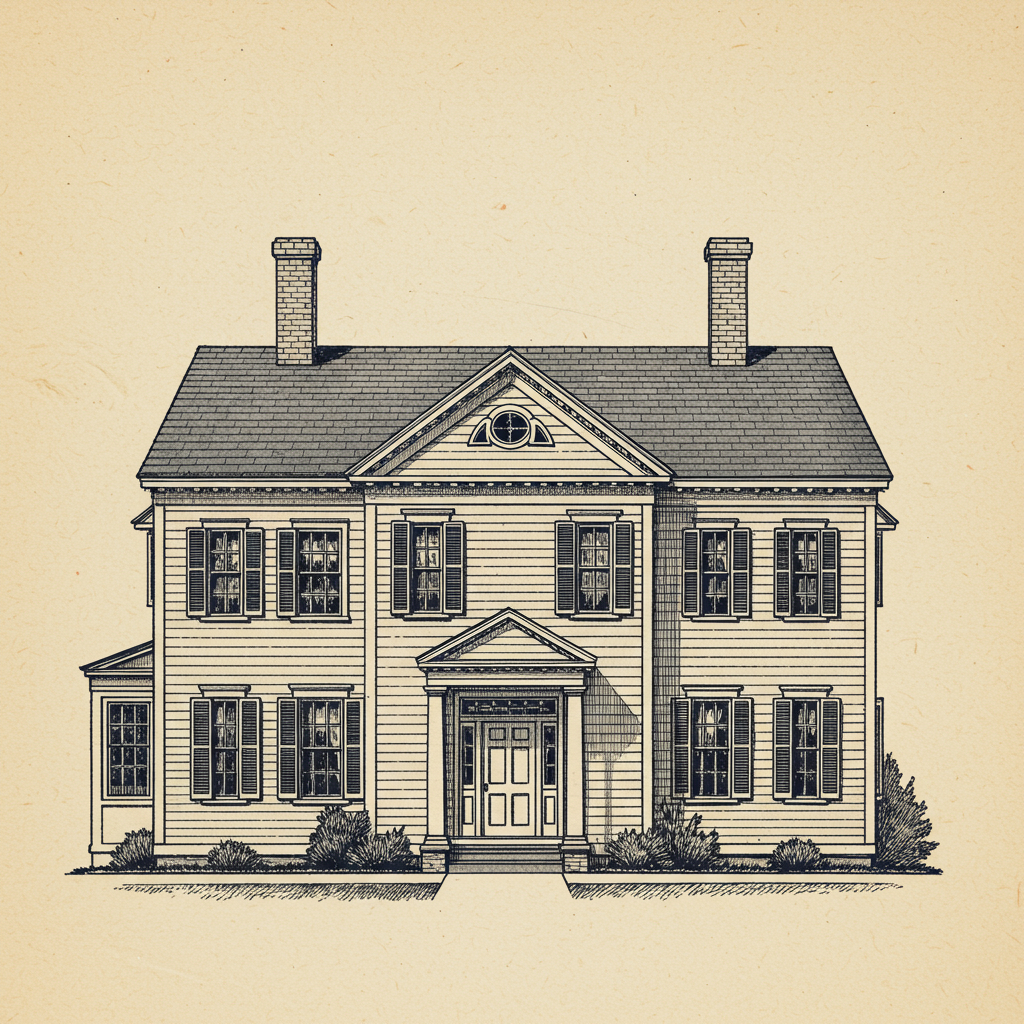
The Colonial Revival — the Shingle’s natural successor, dominant from about 1890 onward — picked up the Shingle’s interest in early Colonial American sources but treated them with a far more literal historical eye. Where the Shingle had quoted the saltbox in feeling and silhouette, the Colonial Revival reproduced the Georgian Colonial in academic detail: strict symmetry, white-painted clapboard, neat sash windows, a centred Palladian fanlight, a pedimented front entrance. A Colonial Revival is what happens when the Shingle’s loose American vernacular is replaced by a rigorous Anglo-American historical reconstruction. The two styles share an interest in Colonial America but take opposite positions on whether the house should be a suggestion of that history or a recreation of it.
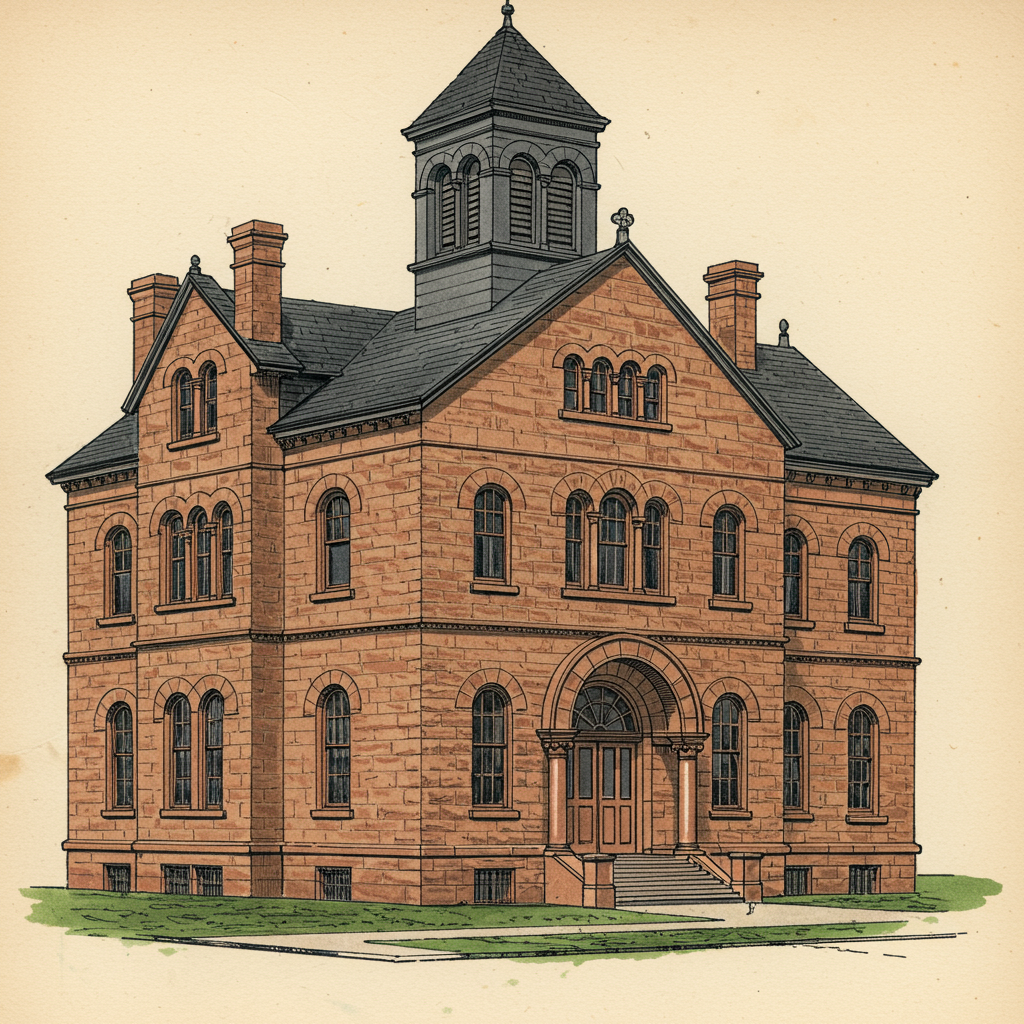
The Romanesque Revival — Richardson’s contemporary stone civic style, also called Richardsonian Romanesque after his death in 1886 — was the Shingle’s masonry counterpart, often produced by the same architect for different commissions. Richardson’s Trinity Church Boston, the Allegheny County Courthouse, and Marshall Field’s Wholesale Store in Chicago set the Romanesque Revival vocabulary: rough rusticated stone walls, deep round Romanesque arches, short heavy attached columns, low broad masses. Where the Shingle was wooden, residential, summer, and integrated, the Romanesque Revival was stone, civic, year-round, and monumental. The two styles together represent Richardson’s complete answer to the American architectural question, expressed in two materials for two purposes; they are, on inspection, the same architect arguing with himself.
What It Was Trying to Say
The Shingle flourished in America between roughly 1880 and 1900, with its sharpest period falling in the decade 1882-1892. After 1895 it began to give way to the Colonial Revival, whose more historically literal Anglo-American vocabulary suited the cultural temper of the 1890s and 1900s better than the Shingle’s looser improvisation; by 1905 the style was old-fashioned, and most of the architects who had built Shingles had moved on to Colonial Revival or to the emerging Beaux-Arts. The style had a twenty-year arc, almost entirely within wooden domestic architecture, and concentrated heavily in summer-resort towns and prosperous suburbs.
What it was trying to say is best taken, again, as the sum of two arguments running in parallel.
The first is the integration argument. The Shingle was the first American style to insist that the house should be of its site rather than on it: low to the ground, broad in profile, clad in a material that weathered with the landscape, sited so that the long horizontal eaveline ran with the contour of the lot rather than against it. The continuous shingle skin was the surface expression of this commitment, but the commitment ran deeper than the cladding. The catslide roofs that descended nearly to the ground; the wraparound verandahs that mediated between interior and landscape; the rugged stone foundations that rooted the house in its specific ground — these were the substance of an architectural argument that the building should belong to its place. This was new in American architecture, and it would matter immensely. Frank Lloyd Wright, who began his Prairie style work in the 1890s, had grown up on the Shingle.
The second is the post-revival argument. The Shingle was the first American style that did not justify itself by reference to a European source. The Greek Revival had needed Athens. The Gothic Revival had needed Salisbury. The Italianate had needed Tuscany. The Second Empire had needed Paris. The Queen Anne had needed (the wrong) English Queen Anne. The Stick had needed Pugin. The Shingle simply did not need a European pretext, and the absence of one was, after sixty years of self-justifying revivalism, a remarkable freedom. American architecture had spent the nineteenth century proving to itself that it was a legitimate part of European tradition. By 1885 it had stopped needing to prove this. The Shingle is the architectural register of that confidence — quiet, vernacular, regional, and finally not borrowed.
What I find most telling about the Shingle, taking these two arguments together, is its generosity. No other style in this series so willingly accepted that an architecture might exist for its own pleasure rather than for an argument. The Greek Revival had been making a republican argument; the Gothic Revival a moral one; the Italianate a cosmopolitan one; the Second Empire an imperial one; the Stick a structural one. The Shingle was making the smaller and more honest argument that a house at the seashore, lived in for the summer by a family that had come to swim and read and walk, ought simply to be a beautiful house at the seashore — clad in cedar shingles weathered to silver, with a long porch facing the water, sited so that the wind moved through the rooms in the afternoon. There is, on inspection, no rhetorical position in this. There is only an architectural sensibility resting at last in its own register.
The next specimen I should like to take up is the Romanesque Revival — Richardson’s stone civic counterpart to the wooden residential Shingle, the heavy rough-stone style that produced Trinity Church and the Allegheny County Courthouse and the great public libraries of the 1880s, and which spoke, in masonry rather than in cedar, of a different but related moment in the same architect’s mind.