The post before this one read the Italian Renaissance, and named the Spanish tradition as a sibling it had not yet reached — one of the national Renaissances that received the Florentine original and married it to an older inheritance of its own. The post before that, on the Italian Baroque, had named the same Iberian tradition in passing and left it for later. This post is the later. It opens the Spanish line, and it opens it not at the Renaissance but at the Baroque, because the seventeenth century is where the Spanish cabinet became most fully and most recognisably itself — and because what it became is, of all the traditions this arc has surveyed, the one that departs furthest from the carved and gilded Continental norm.
For the Spanish Baroque is the great exception. Where every other Baroque tradition this arc will treat ran to carving, to gilding, to colour and movement, the Spanish ran the other way — to darkness, to austerity, to plain severe surfaces of nearly black walnut, and to a hardware not of brass and gilt bronze but of hand-wrought iron. It is a grave and fortress-like furniture, monastic in temper, the Counter-Reformation rendered in the cabinet. The collector who has learned to read the Italian Baroque by its gilt and its carving must, in crossing the Pyrenees, learn to read very nearly the opposite.
This is the twelfth post in Reading the Period Cabinet. As with the Italian Renaissance, the Hepplewhite, and the Sheraton posts before it, it is a taxonomy post — a description of a type and of the evidence by which one reads it, not a personal narrative. Its type-specimen is the vargueño, the Spanish drop-front writing cabinet; its load-bearing distinction is iron and austerity, the matter that sets the whole tradition apart from its Italian and French neighbours; and its antecedent is the Mudejar inheritance — the Islamic-Christian geometric tradition of medieval Iberia — which gave the Spanish piece the geometric register no other European cabinet carries.
The Specimen
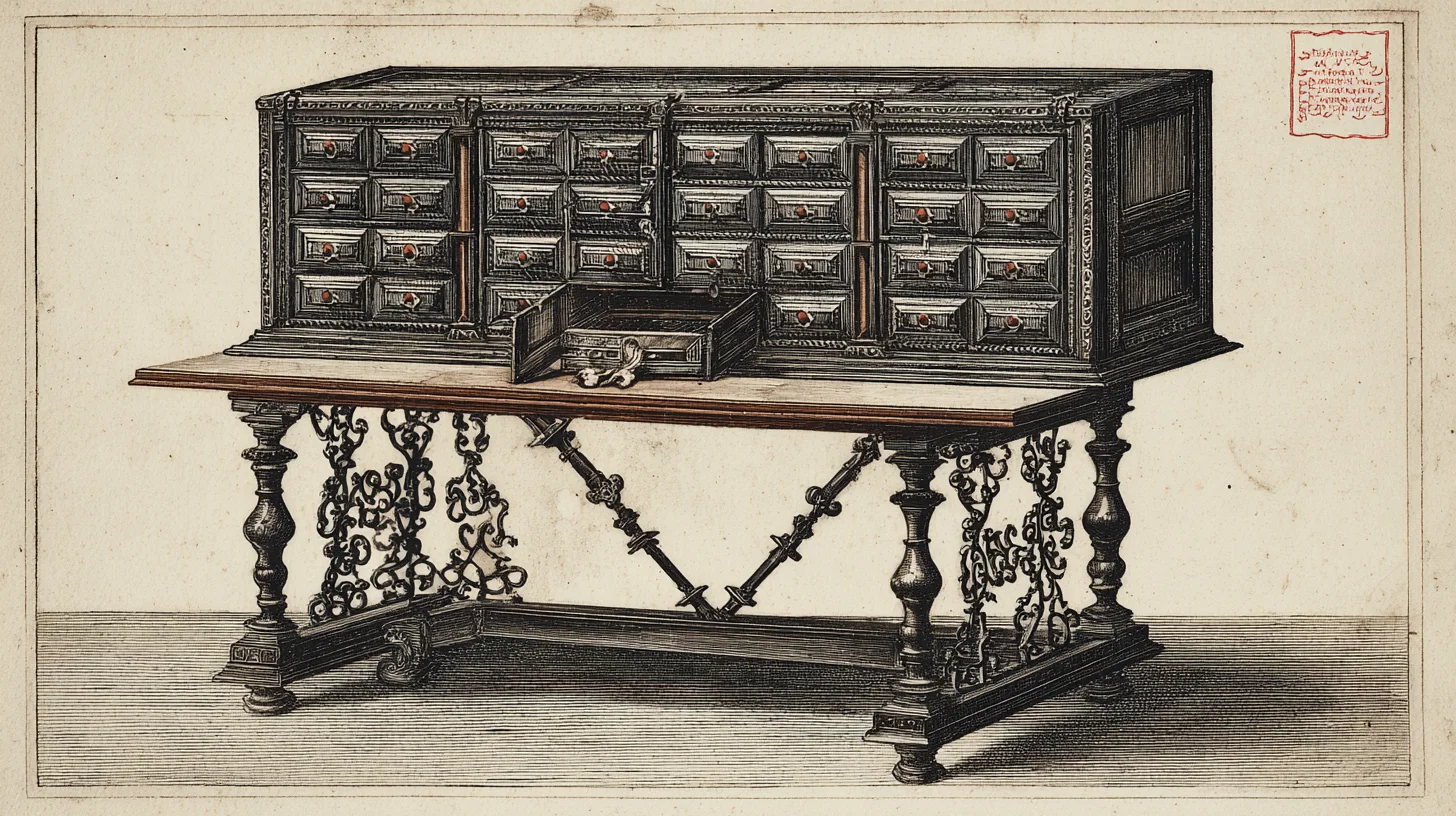
The canonical Spanish Baroque piece, for the purpose of beginning to read the style, is the vargueño — the drop-front writing cabinet. It is canonical for the same reason the cassone was canonical for the Italian Renaissance and the side chair for the Regency: it concentrates the whole vocabulary of the tradition into a single object the eye can take in at once. The iron, the leather, the dark walnut, the geometric inlay, the two-part construction, the contrast of a severe exterior against a lavish interior — all of it is present in the one form, and a collector who has learned to read a good vargueño has very nearly learned to read the tradition entire.
A canonical vargueño, then. It is, in the first place, two objects and not one. The upper part is the cabinet proper: a rectangular case of walnut, dark to the point of being nearly black, whose front is not a fixed panel but a hinged fall-front — a flap, locked shut, that lets down on iron hinges to a horizontal writing surface and discloses, behind it, a façade of many small drawers and pigeonholes. The lower part is a separate stand, made to be lifted away from the cabinet, and the Spanish made it in more than one form: the puente, a trestle stand braced and tied across with wrought-iron bars, and fitted with slide-out wooden support bars — often finished with carved shell ends — which were drawn from the stand so the fall-front could rest upon them when open; or the taquillón, a low chest of drawers on which the cabinet simply sat. The cabinet was, by design, demountable and portable — a thing to be carried, with the household, from one residence to another, which is the most Spanish fact about it.
The exterior of the cabinet is plain, or nearly so, and that plainness is deliberate. What ornament the closed vargueño carries is structural and metallic — bands and studs of hand-wrought iron, a pierced iron lockplate of some size set in the centre of the fall-front, iron drop-handles at the ends by which the heavy case was lifted, iron corner-mounts. The lavishness, where the piece is lavish at all, is reserved for the inside. Let the fall-front down and the drawer-fronts of the interior are revealed faced with geometric inlay of bone and ivory, sometimes with tortoiseshell and contrasting woods, set in star and interlace patterns; or the recesses are lined and the small architectural niches fronted with tooled and gilded leather; or the whole interior is treated as a miniature architecture of turned columns and gilded mouldings. The apex examples — the cabinets of the Habsburg court and the great Castilian houses — carry all of this at once, and carry it well. The principle they state is the principle of the whole tradition: severity without, richness within, and the richness kept private.
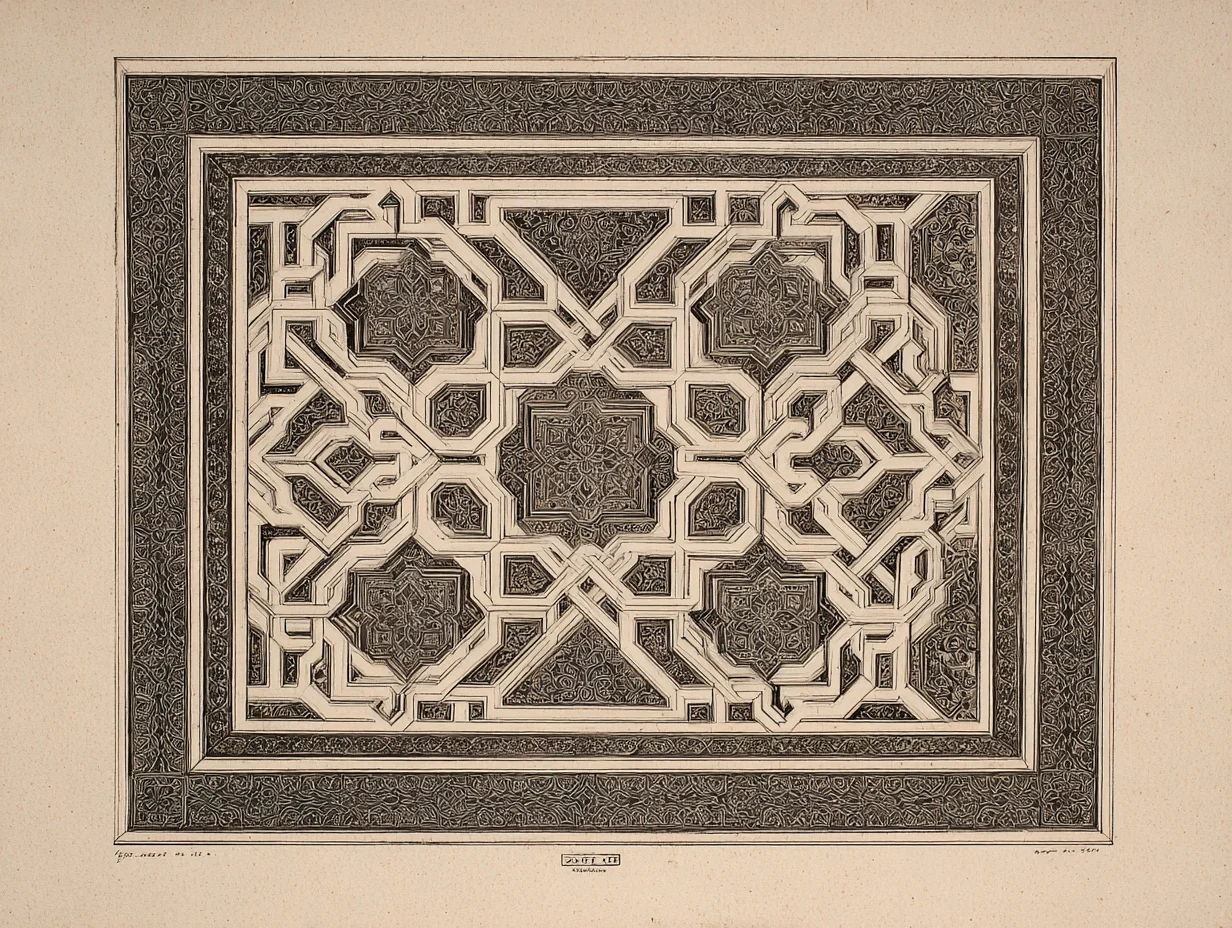
A close detail of Spanish Baroque bone-and-ivory geometric inlay — the Mudejar-derived geometric vocabulary that distinguishes Spanish Baroque from Italian and French traditions. The geometric register descends from the Islamic-influenced pre-Renaissance Iberian tradition.
The Evidence
The vargueño states the principle, but the Spanish Baroque interior held several other forms, and the collector should know them by name before turning to the evidence of the wood. The sillón frailero — the friar’s chair, or monk’s chair — naturalised in Spain as the canonical Spanish armchair: a square, upright, austere seat of walnut, its back and seat formed of single panels of leather, often tooled, slung between the frame and held by large iron nail-heads, and tied across the front by a broad, flat wooden stretcher of walnut, frequently carved or cut in fretwork. What iron the chair carries is confined to those nail-heads — the studs that fix the leather — and the austerity of the piece lies not in metal but in the severe square frame and the plain slung hide. The arca is the Spanish chest, a rectangular boarded box bound with iron straps and fitted with an iron lock — the plain strongbox of the tradition. The mesa de hierro, the iron table, is a plank-top table carried on splayed, raked legs held against collapse not by a wooden stretcher but by scrolled wrought-iron braces running from leg to leg. The papelera is the vargueño’s smaller relation — a writing-box of drawers without a fall-front, made to stand on a table. Every one of these forms is built of dark walnut, and every one depends on iron.
The wood, first. The Spanish Baroque worked principally in walnut — nogal — the dense, hard, dark timber of the peninsula, and worked it dark: the period surface is a deep brown gone nearly to black, the colour partly the natural oxidation of three or four centuries and partly the dark finish the tradition preferred from the outset. Walnut was the cabinet timber; the humbler pieces, and the structural parts, were often of pine, and the colonial and later pieces brought in tropical hardwoods by the Atlantic and Pacific trade. But the register the eye should expect of a Spanish Baroque piece is dark, plain, close-grained walnut — sober where the Italian was warm, severe where the French was bright.
The iron, second, and the iron is the load-bearing evidence — the single register that most reliably separates the Spanish Baroque from every neighbouring tradition. Where the Italian Baroque cabinet carried gilt and the French ran to ormolu and gilt bronze, the Spanish piece carries iron: hand-wrought, hammered out at the anvil, and left frankly visible. It is iron strap-hinges, iron pierced and chiselled lockplates of considerable size and considerable craft, iron bolt-heads and nail-heads used as ornament across a surface, iron corner-mounts, iron drop-handles, and — on the stands and tables — iron tie-bars and scrolled iron stretchers doing genuine structural work. This iron is decoration and it is also engineering; the smith was as much the maker of a vargueño as the joiner. And it is wrought iron, not cast: forged by hand, faintly irregular, the pierced plates cut and filed, never two mounts perfectly identical — which is a point of evidence in itself, cast iron being a later material and a sign of the reproduction.
The inlay, third. Where the Spanish Baroque is decorated with inlay rather than left plain, the inlay is geometric — and that geometry is the tradition’s signature. It is not the figurative pictorial marquetry of the northern cabinet, nor the classical figures of the Italian; it is bone and ivory, with tortoiseshell and pale and dark woods, set into the dark walnut in stars, interlaces, and tessellated patterns. The vocabulary descends, as the next section will set out, from the Islamic decorative tradition of medieval Iberia, and it survives in the Baroque cabinet as a geometric register no other European furniture carries. The collector reading a drawer-front of small bone stars set in walnut is reading, at one remove, the geometry of the Alhambra.
The leather, fourth. Spain was the great European centre of decorated leather — the plain tanned goat leather known as cordobán, and, more particularly, the tooled, embossed, and gilded leather the workshops of Córdoba made of it, called guadamecí and long known across Europe as cordwain or cordovan — and that leather is a structural and decorative material of the Spanish Baroque interior. It lines the recesses of the vargueño; it fronts the small niches; it forms the back and seat of the sillón frailero, slung as a single tooled panel and secured with iron nails. Tooled leather, like geometric inlay and like the iron itself, is a register the Spanish tradition possesses and the others very largely do not.
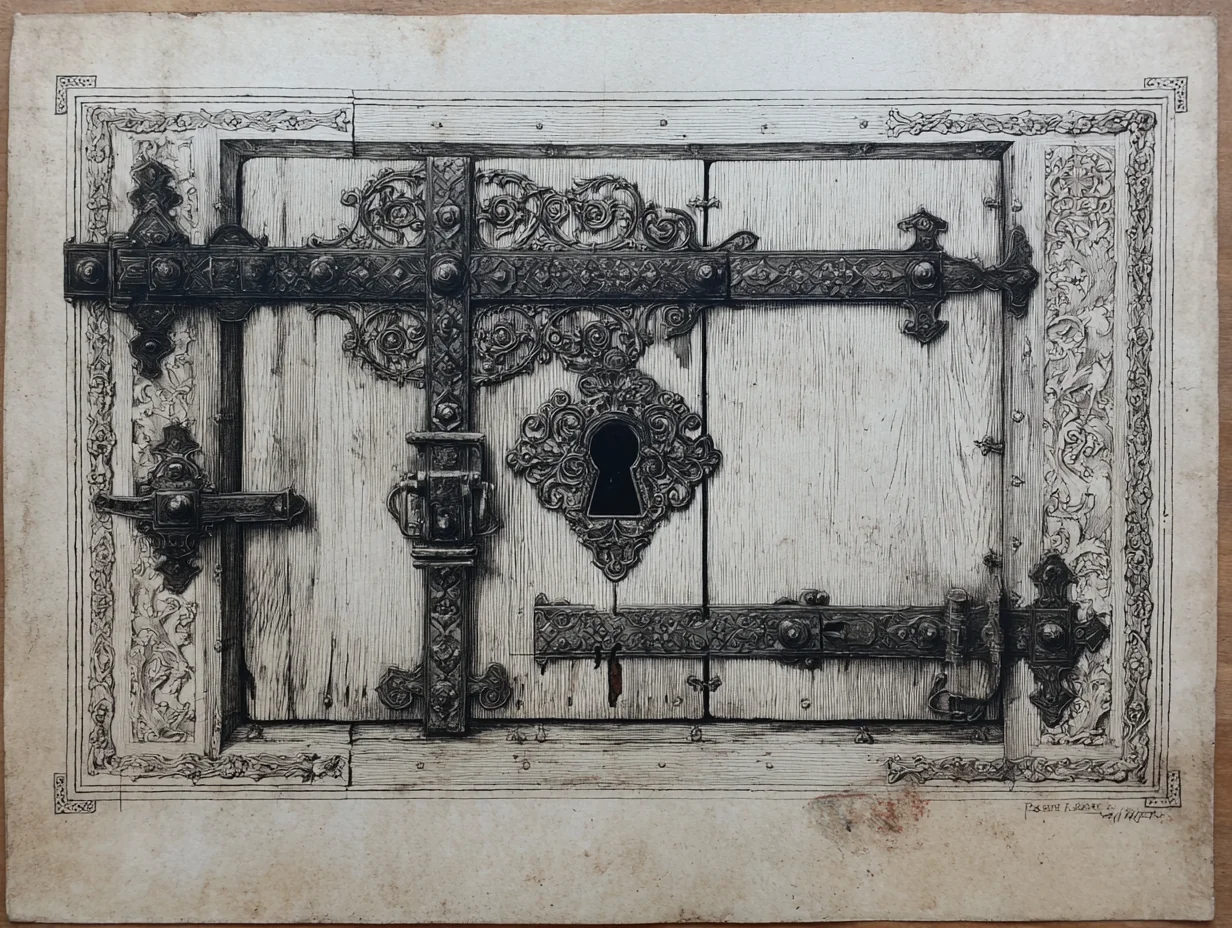
A close detail of Spanish Baroque iron studs and corner-mounts — the heavy wrought ironwork that gives Spanish Baroque its texture-variety distinction from the French ormolu and the Italian carved-giltwood traditions.
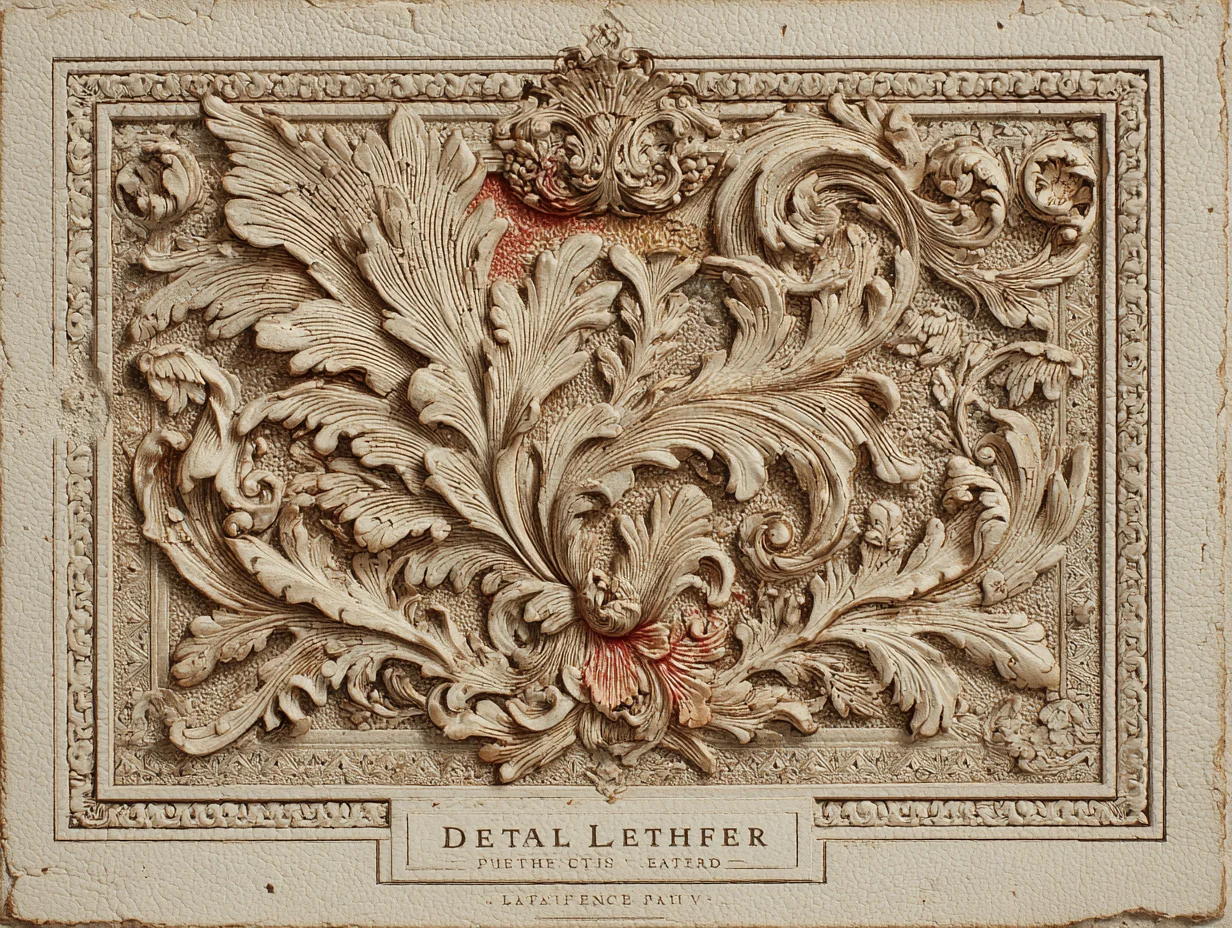
A close detail of Spanish Baroque tooled leather — the cordoban tooled-and-gilt leather that lines the interior of the vargueño writing cabinet, a Spanish decorative-arts tradition descended from the Cordoba workshops.
The Period
The Spanish Baroque, as a furniture period, runs across the seventeenth century — the long reign of the later Habsburgs, of Philip III, Philip IV, and the last of the line, Charles II — until the change of dynasty at the century’s end carried the tradition into something else. It is, by a paradox worth stating plainly, the furniture of a Golden Age that was, in every other respect, an age of decline. The seventeenth century was the century in which Spanish power, having reached its height under the sixteenth-century Habsburgs, began its long contraction — the loss of the Netherlands, the exhaustion of the treasure, the slow political failure of a monarchy ruling more than it could govern. And yet it was precisely this century that produced the Golden Age of Spanish art: the painting of Velázquez and Zurbarán and Murillo, the writing of Cervantes and Calderón, and the grave, austere cabinet that this post reads. The vargueño belongs to that paradox. Its severity is not the severity of poverty; it is the chosen severity of a court that had silver enough and preferred iron.
The workshop centres were the cities of Castile — Toledo above all, the old imperial city and the seat of the cabinet trade, and Madrid, the court capital — with Salamanca and other Castilian towns contributing, and the kingdoms of the periphery keeping their own variants. The patron was, at the apex, the Habsburg court itself, and below it the Castilian nobility, the Church, and the religious houses, whose taste — sober, dark, monastic — the secular furniture so plainly shares. It is no accident that the canonical armchair is named for a friar.
Two larger circumstances shaped the period’s materials, and the collector should hold both. The first is empire and trade. Seventeenth-century Spain stood at the centre of the first genuinely global trading system, and the cabinet shows it: ivory and bone for the inlay, tropical hardwoods, lacquer, and exotic goods came across the Atlantic from the American viceroyalties and across the Pacific by the Manila galleon, which carried the produce of Asia to Acapulco and so into the Spanish supply. The geometric inlay of a vargueño may be of ivory that crossed two oceans to reach the Toledo workshop. The second circumstance is the change of dynasty. The death of Charles II in 1700 without an heir ended the Spanish Habsburg line and brought, after a war, a Bourbon to the throne — and with the Bourbon came the French taste. The eighteenth-century Spanish cabinet turns toward the gilded, carved, French-influenced manner; the dark iron-bound vargueño is, by then, the furniture of an age that has closed. The seventeenth century is therefore the period proper, bracketed at one end by the tradition it grew from and at the other by the French succession that displaced it.
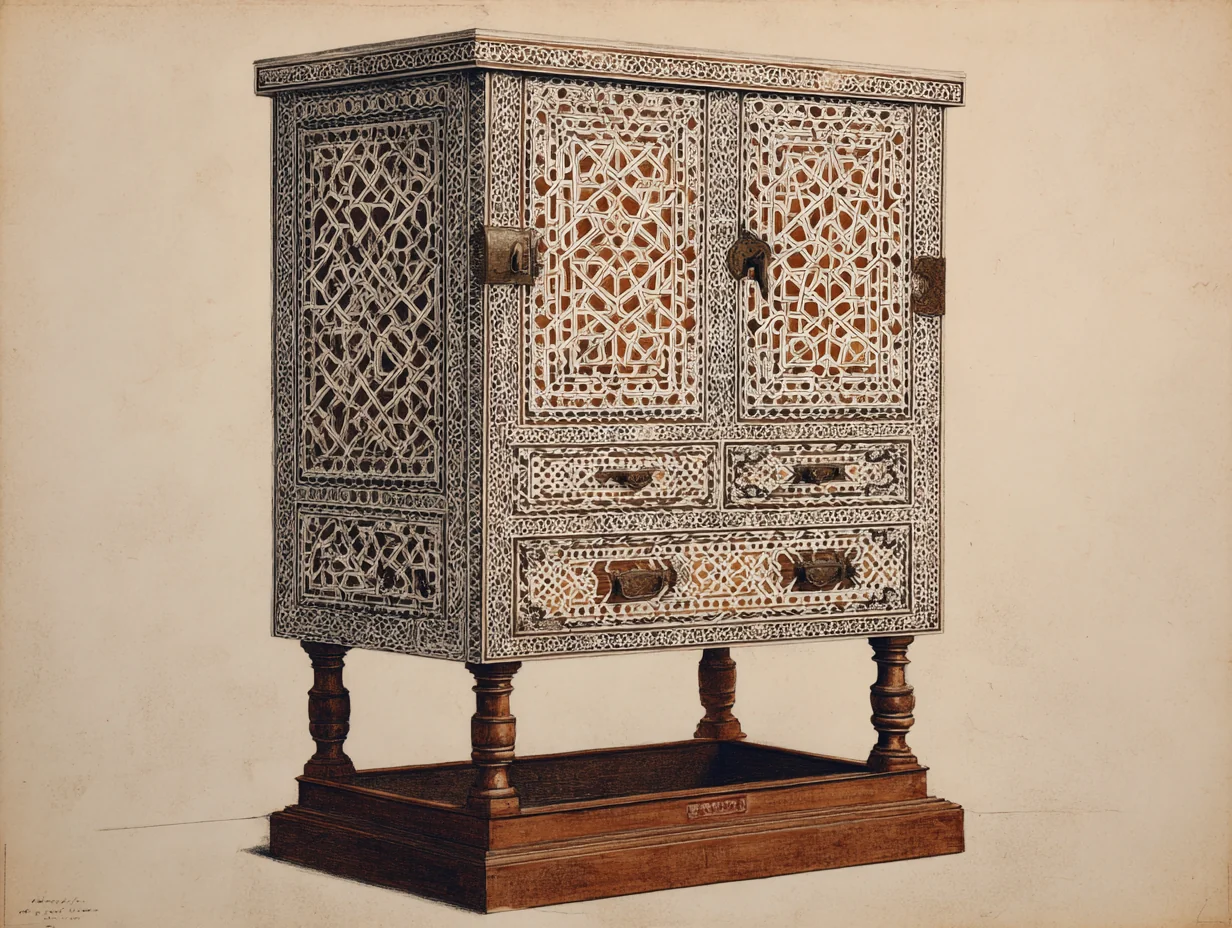
The antecedent the Spanish Baroque grew out of is the Mudejar inheritance — and this is the matter that most distinguishes the Spanish line from every other in Europe. Mudejar names the art of the Muslim craftsmen who continued to work in the Christian kingdoms of Iberia after the long reconquest, and the tradition they carried was, before all else, geometric: the star-and-interlace patterning of Islamic decorative art, executed in tile, in carved and coffered wood, and in fine inlay of bone and contrasting timbers. Medieval Spain produced, in consequence, a furniture unlike anything elsewhere in Christian Europe — cabinets and chests whose surfaces were covered not in figures or foliage but in dense, abstract, mathematical geometry. The Spanish Baroque did not discard this. It kept the geometric inlay as one of its registers, set it now into dark walnut and combined it with the wrought iron and the tooled leather, and so produced a Baroque cabinet that carries, legible beneath the seventeenth-century severity, the geometry of the Caliphate. No other European tradition has an antecedent of this kind, and it is the reason the Spanish piece can never quite be mistaken for the Italian.
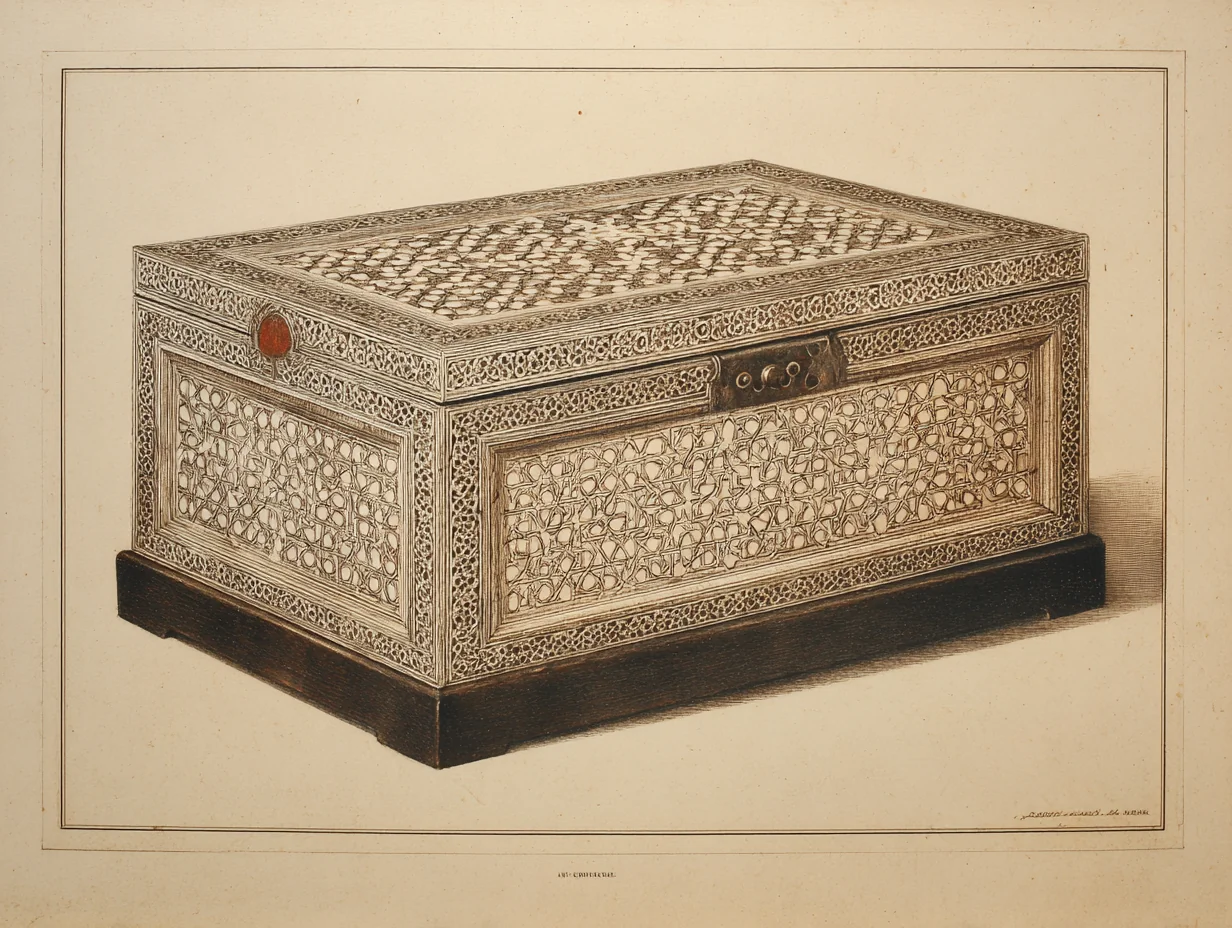
A 15th–16th-c Spanish Mudejar cabinet — the Islamic-influenced Iberian antecedent with denser geometric inlay drawing on the Cordoba Caliphate vocabulary. The Spanish Baroque kept the geometric inlay register but added the heavy wrought-iron and tooled-leather elements that distinguish it from the medieval Mudejar.
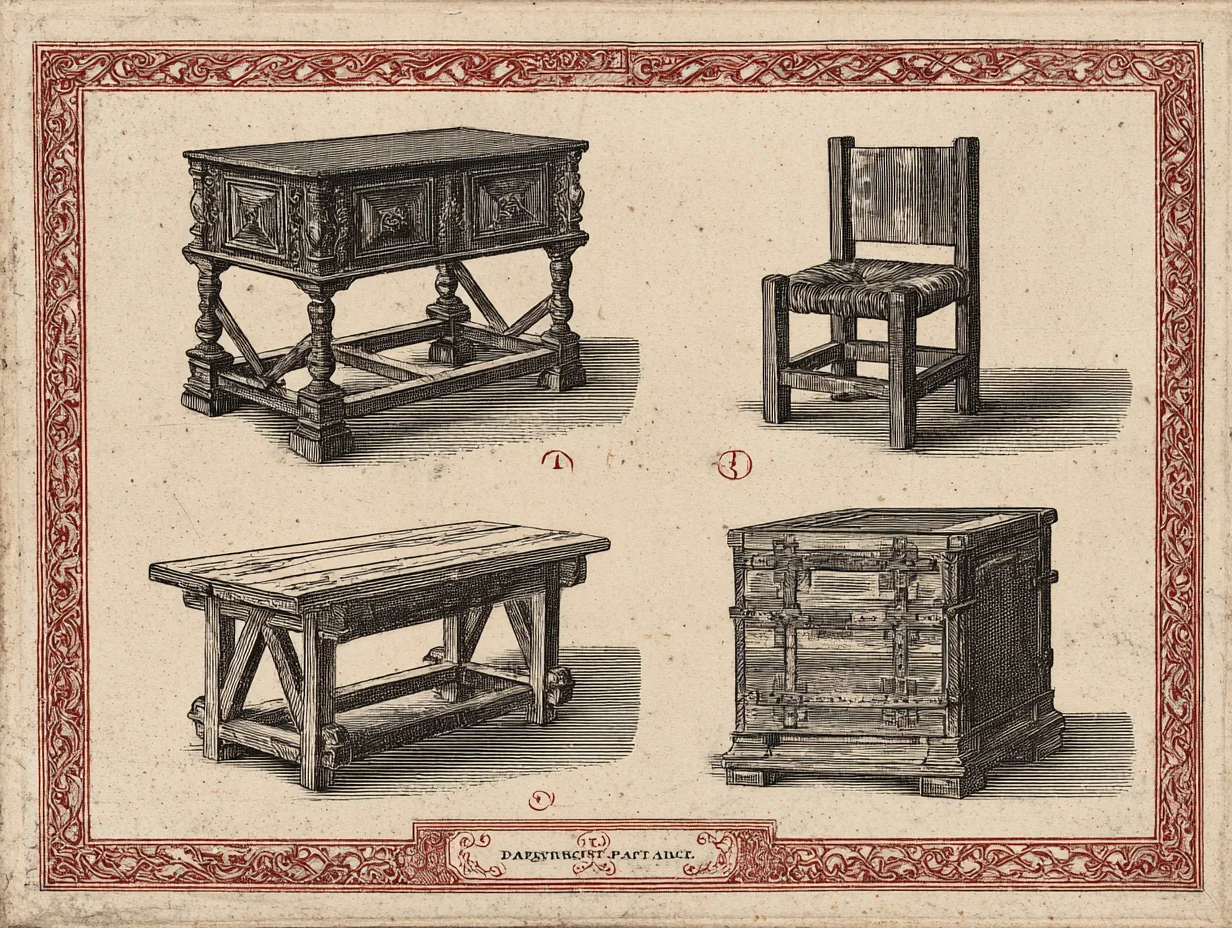
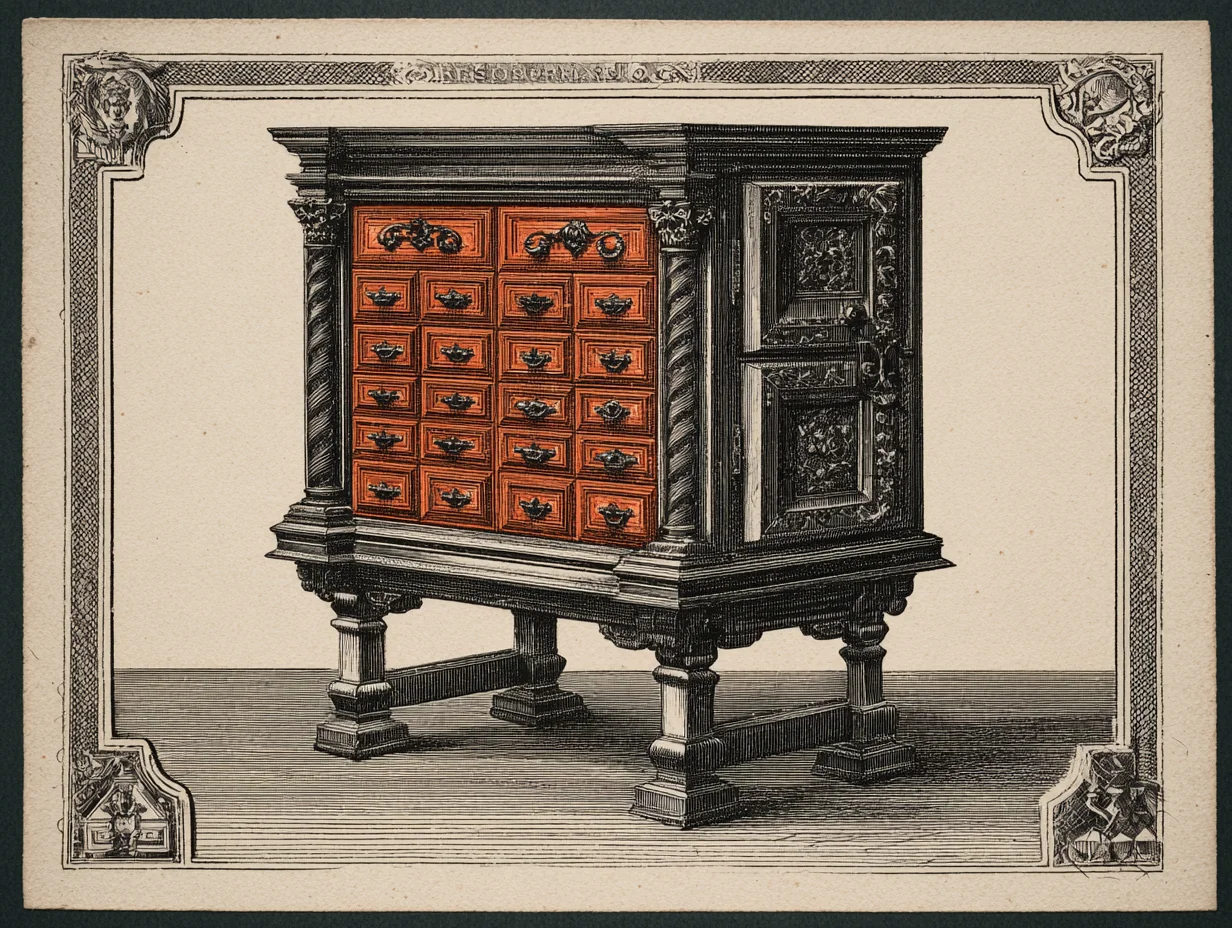
A page from a Toledo cabinet-maker’s pattern book of the 17th c — perspective drawings of the principal Spanish Baroque forms: the vargueño drop-front cabinet, the papelera writing-box, the leather-back sillón armchair, the trestle-base mesa table.
What It Is Not
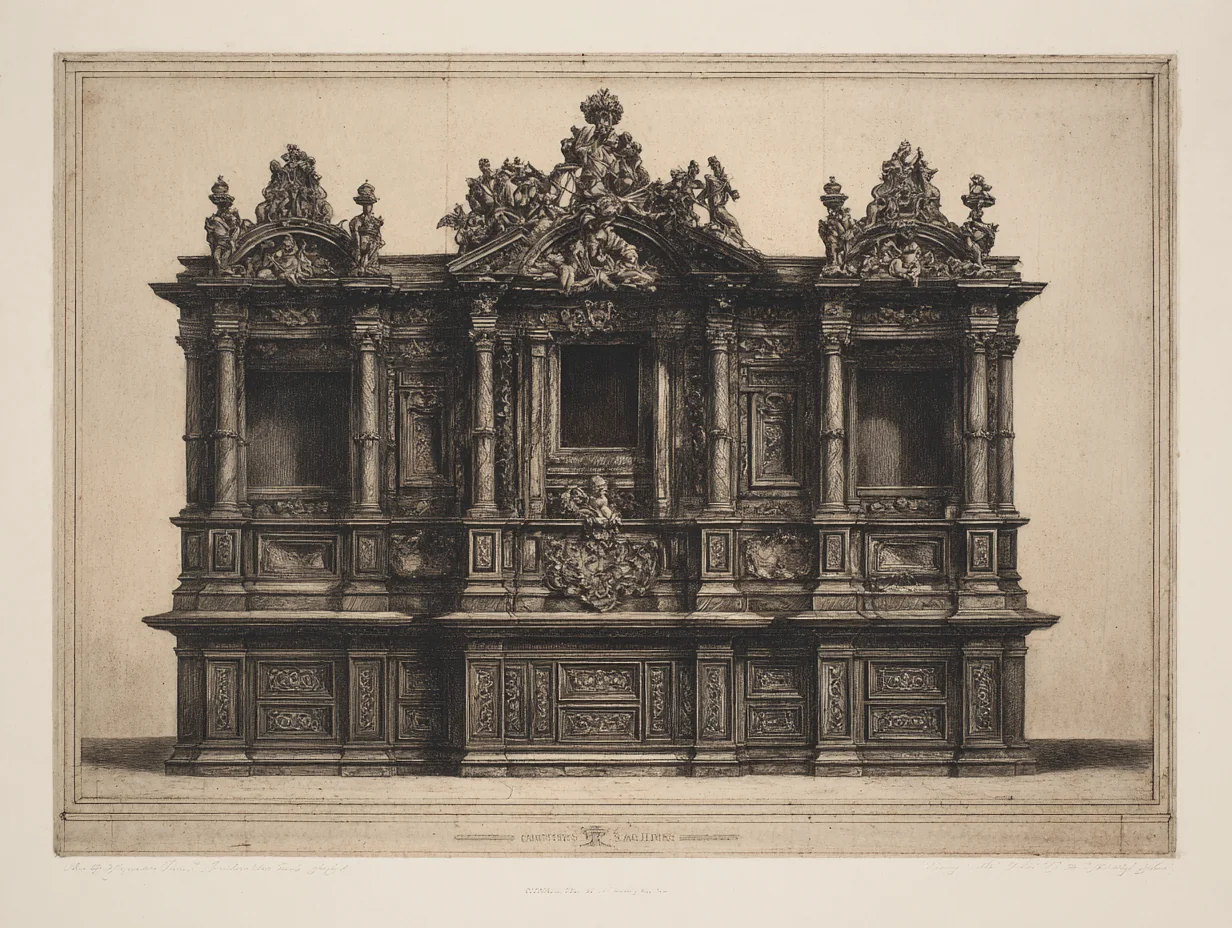
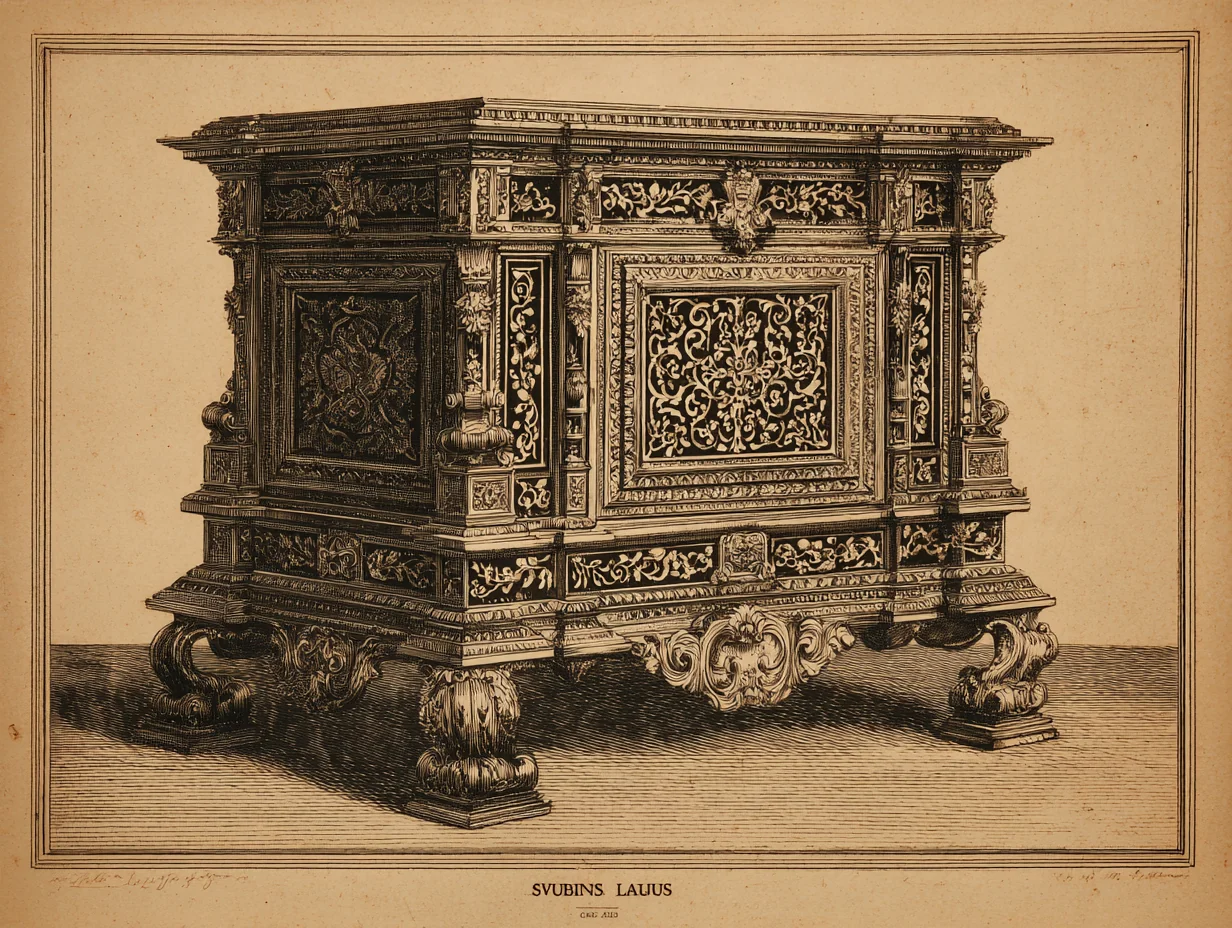
Four styles stand near enough to the Spanish Baroque that the beginner confuses them with it, and they are confusions of two distinct kinds. Two are Baroque siblings of the same century — the Italian and the French — and the confusion there is the confusion of contemporaries. Two are nearer relations still — the Mudejar antecedent that the Spanish Baroque grew directly out of, and the Portuguese Baroque, its Iberian neighbour — and the confusion there is the confusion of close kin. To distinguish the four is to fix what is particular to the Spanish line.
An Italian Baroque piece is the Continental sibling, and the easiest of the four to tell apart, because it states almost the opposite case. The Italian Baroque cabinet — the stipo — was the carved and gilded showpiece: warm-toned walnut and ebony, gilt-bronze mounts, carved giltwood figures, marble and pietra dura panels, the surface elaborated and bright. The Spanish piece runs the other way: a plain dark walnut case, hand-wrought iron where the Italian has gilt bronze, and what richness it has shut away inside the fall-front. The rule of thumb: carved, gilded, and bright on the outside is Italian Baroque; dark, plain, and iron-bound on the outside, with the lavishness reserved within, is Spanish.
A French Louis XIV piece is the French royal sibling, and it confuses the beginner because it too is a great formal cabinet of the seventeenth century. But the Louis XIV cabinet is the most sumptuous object the century produced — veneered in tortoiseshell and brass in the Boulle technique, mounted in heavy chased and gilt ormolu, raised on carved and gilded supports, the whole conceived as an instrument of royal magnificence. There is no austerity in it anywhere. The rule of thumb: tortoiseshell-and-brass marquetry and gilt-bronze ormolu is French Louis XIV; dark walnut and hand-wrought iron is Spanish Baroque — the two seventeenth-century courts could hardly have furnished themselves more differently.
A Mudejar piece is the Iberian antecedent, and the difficulty here is precisely that the Spanish Baroque kept so much of it. The medieval Mudejar cabinet is the source of the geometric register — its surface is geometric inlay, dense and abstract, of bone and ivory and contrasting woods, the Islamic star-and-interlace covering the front. The Spanish Baroque inherited that inlay but subordinated it: it is now one register among several, set into a dark walnut case, and combined with the heavy wrought iron and the tooled leather that the medieval piece does not have. The rule of thumb: a surface that is wholly and densely geometric, with no iron strapwork and no walnut severity, is Mudejar; the same geometry used as inlay within a dark, iron-bound walnut cabinet is Spanish Baroque.
A Portuguese Baroque piece is the Iberian-Atlantic sibling, and the hardest of the four, because Portugal shared the peninsula, a great deal of the temper, and the cabinet form itself. The distinction is one of material, surface, and trade. The canonical Portuguese case-piece is not the vargueño but the contador — a cabinet of drawers raised on a stand — and where the Spanish answer to ornament is dark walnut, visible wrought iron, and geometric inlay, the Portuguese answer is something else entirely. Portugal’s empire ran to Brazil and to the East, and the contador shows it: it is worked in Brazilian rosewood, its drawer-fronts and framing built up with deep-relief carved ripple- and wave-mouldings — the tremidos — and its locks and corners set not with iron but with pierced and chiselled brass. The rule of thumb: dark walnut, severe wrought iron, and flat geometric inlay, Castilian in its plainness, is Spanish; rich rosewood, carved rippling tremido mouldings, and pierced brass mounts is Portuguese Baroque.
What One Looks At
One looks first at the form, because with the Spanish Baroque the form is unusually diagnostic. The drop-front writing cabinet — a rectangular walnut case whose hinged fall-front lets down to disclose a façade of small drawers and pigeonholes — is the vargueño, and it is so particular to this tradition that the form alone places a piece in Spain. One looks, with it, for the two-part construction: a cabinet made to lift away from its stand, and a stand that is one of the Spanish types — the iron-tied trestle of the puente, or the chest-of-drawers base of the taquillón. A demountable drop-front cabinet on a separate Spanish stand is a strong placement before the surface has been read at all.
One looks next, and most carefully, at the iron. It is the load-bearing evidence of the whole tradition. The hardware of a Spanish Baroque piece should be hand-wrought iron — strap-hinges, a large pierced and chiselled lockplate, bolt- and nail-heads used as surface ornament, scrolled iron stretchers and tie-bars doing structural work on the stands and tables — and it should be wrought, not cast: forged at the anvil, faintly irregular, the pierced plates cut and filed by hand, no two mounts perfectly alike. Brass where one expects iron, or the crisp identical repetition of cast iron, argues against the piece or against its period.
One looks then at the combination — for it is the combination, more than any single register, that is the signature of the tradition. A genuine Spanish Baroque piece brings together dark, nearly black walnut; visible hand-wrought iron; geometric inlay of bone and ivory rather than figurative marquetry; and tooled, gilded leather. Any one of these may appear elsewhere; the four of them together, with a severe plain exterior and the richness concentrated inside the fall-front, appear only here.
And one looks, finally, for the temper of the thing — for the austerity that the whole post has carried as its load-bearing distinction. The Spanish Baroque is a grave, dark, monastic, fortress-like furniture, the one Baroque tradition that answered its century not with gilt and movement but with iron and restraint. The collector reads walnut, iron, inlay, and leather not as a checklist but as the evidence of a single temper, and asks of the word Baroque what, in the Spanish case, it must be made to mean: not the carved exuberance of Rome or the gilded magnificence of Versailles, but the Counter-Reformation severity of Castile — splendour shut inside a plain iron-bound box, and the box itself made to be carried.
The next post in the furniture arc will be either Dutch marquetry — to open the Continental marquetry tradition with the pale-walnut northern register — or Mudejar, to backfill the Iberian medieval antecedent more fully. The choice will depend on what photographic material is available at the time of writing.