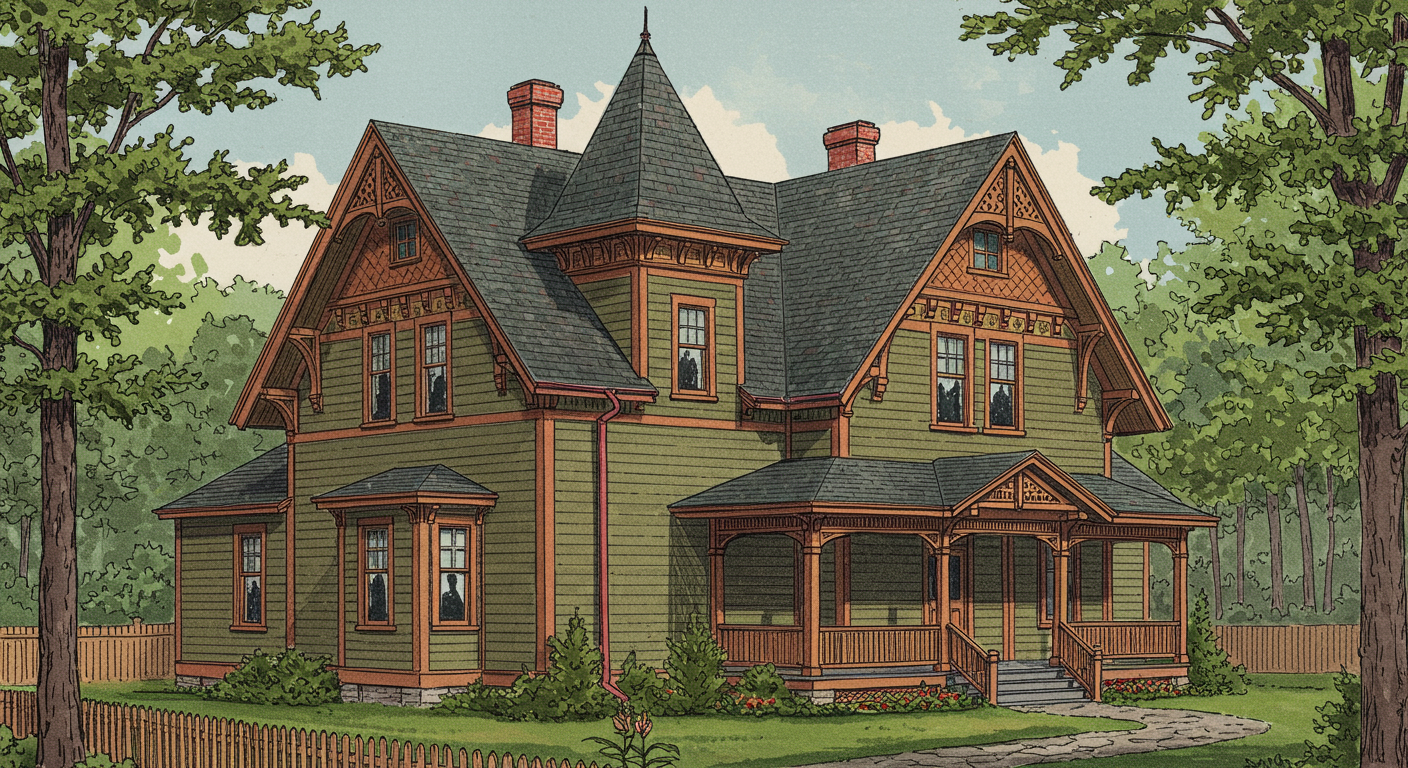
There is, in the sequence of nineteenth-century American architectural styles, exactly one whose name was given to it not by its builders but by a critic, eighty years after the last specimen was put up. The style went up in numbers between roughly 1860 and 1890. Its houses are recognisable on inspection — wooden, asymmetric, steep-gabled, with vertical and horizontal and diagonal boards applied flat to the cladding in a pattern that suggests the timber frame inside the wall — and one finds them on the side streets of small American cities, on the resort cottages of Newport and the Adirondacks and the Jersey shore, and in the back blocks of older railway towns. The carpenters who built them called them, variously, modern Gothic, country-house style, American Eastlake, or simply cottage. The homeowners called them what their builders called them. None of them called them what the architectural historian Vincent Scully named them in the 1950s: the Stick style.
This is the Stick, then, by Scully’s posthumous baptism. What follows is the sixth in a series that has been, in a quiet way, trying to read American houses for what they were trying to say. The Queen Anne (the first post) said the middle class has arrived and is making no apologies. The Greek Revival (the second) said we are the new Athens; please do not look too closely at how we are financed. The Gothic Revival (the third) said we are a Christian republic, and the right house for our family is a steep-roofed cottage among trees. The Italianate (the fourth) said we have read of Tuscany, and we should like to imagine ourselves on a hilltop above Florence. The Second Empire (the fifth) said we are a great power now, and we should like to look like Paris. The Stick said something much quieter than any of these, and much more austere: the bones of the house should be visible on the outside; the building should be honest about what it is. It was, in its way, the architecture of the American merchant class chastened by the Panic of 1873 — a generation that had lost its appetite for imperial slate and gilded ironwork and was looking for an architecture that read as virtuous restraint.
The Misnomer
The first thing worth knowing about the Stick is that no one called it that until 1955.
Vincent Scully, an art historian at Yale, published The Shingle Style in 1955, with a revised edition in 1971, and the book was the first systematic account of the late-1860s-to-1900 wooden American architectural sequence in which the style had been built. Scully named the two phases — the Stick style for the 1860s-to-1880 sequence that emphasised expressed structural framing on the exterior, and the Shingle style for the 1880s-to-1900 sequence that retreated from the sticks into uniform shingle cladding. Both names took. Both were Scully’s coinages, both descriptive of their most distinctive feature, and both have been the standard academic terms ever since. The Stick style is now, by half a century of academic convention, what one calls the wooden American houses of the 1870s with the applied boards across their walls.
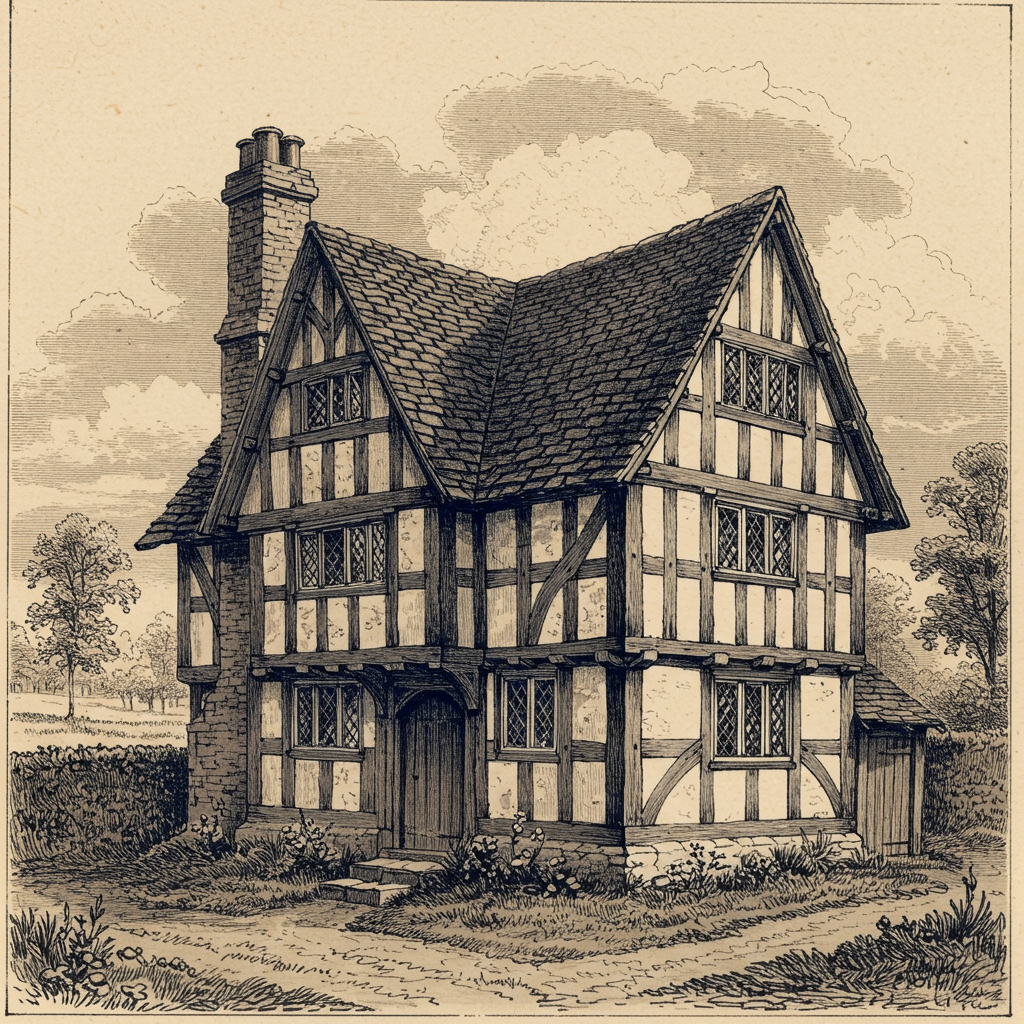
A Tudor half-timbered English cottage, roughly 1500 — heavy oak structural members visibly framing the cladded panels of wattle-and-daub. The Stick style’s applied wooden sticks were not structural in this sense, but the visual logic — that the frame of the building should be expressed on the exterior — was borrowed across four centuries of European building, by way of mid-Victorian English Gothic Revival theory.
The name was not, however, in use during the period the houses were being built. Contemporaries called the style by various other names. Country-house style and cottage style were the most generic, used by the same pattern-book authors who had been writing about Italianate cottages a decade earlier. Modern Gothic was used in the 1860s, picking up the Pugin-era English Gothic Revival’s emphasis on structural honesty. American Eastlake was used after 1872, when Charles Eastlake’s Hints on Household Taste appeared in its first American edition and the architect Henry Hudson Holly began applying Eastlake’s furniture-making principles to whole houses. There were several others, and none of them quite prevailed; the result was that the style — by the 1890s, when it was already old-fashioned — had no settled name at all.
This is, on inspection, the most striking misnomer in the entire American style sequence. Every other style covered in this series was named at the time, by its builders or its critics, in a name that was at least partly fictional but was at least the name. The Stick was named in retrospect, by a single American art historian, picking the most distinctive feature of the wall plane and writing it into the academic record at a stroke. The naming is conventional now, and the convention is not going anywhere; but one is obliged to remember that nobody who actually lived in one of these houses in 1875 would have known the word.
One is also obliged to concede that this is, in its way, the most thoroughly belated possible American thing one could have done with a national style.
The Specimen
If one is to identify a Stick style house — and they are, once one has begun looking, scattered across the side streets of every American town that grew between the Civil War and the turn of the century — the simplest exercise is, as before, to walk around a specimen and assemble the evidence.
Begin at the silhouette. A Stick style house presents a steeply pitched gable roof, often with one or more cross-gables breaking the roofline at right angles to the main ridge. The pitch is closer to the Gothic Revival’s than to the Italianate’s — sharp and acute, often approaching forty-five degrees, sometimes steeper. The gable end faces the street directly, in the manner of the Gothic, but the silhouette as a whole is busier than the Gothic’s: subordinate gables, projecting bays, and an asymmetric tower or wing breaking the front elevation are all standard. The roof is slate or wood shingle, never patterned slate (which would read as Second Empire); never the low Italianate hip; never the Gothic’s elaborate vergeboards.
Set into the peak of every gable sits the second identifying feature, the decorative timber truss. This is a piece of carved or sawn-wood ornament arranged as if it were the structural truss of the gable — a horizontal tie beam, vertical king post, and diagonal struts forming a triangular composition under the gable peak. On a real heavy-timber-framed building, this would be the actual roof truss visible from the gable end. On a Stick style house it is, almost without exception, applied: nailed to the cladding, expressing nothing structural at all. But the visual logic is the point. The truss tells the eye that the building is a frame.
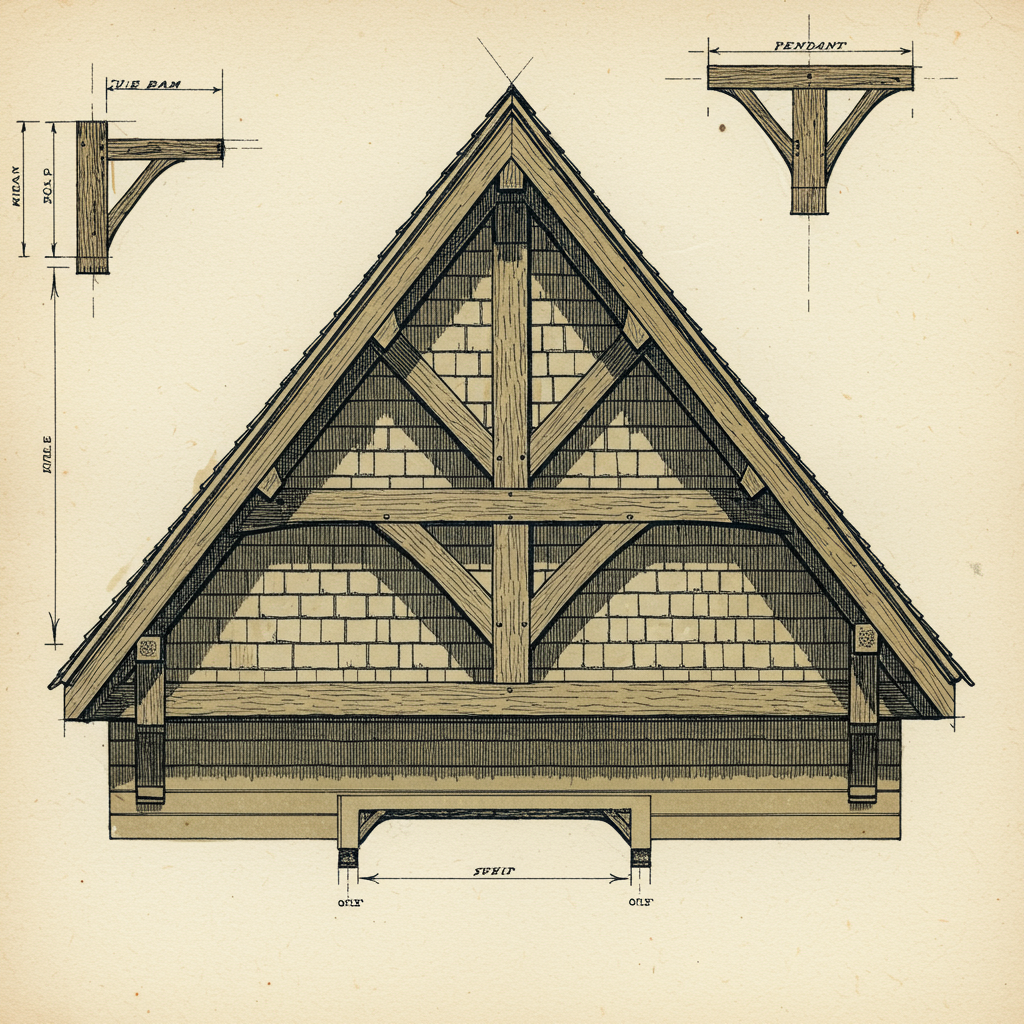
A decorative timber truss in the peak of a Stick style gable — a horizontal tie beam, vertical king post, diagonal struts. On a real heavy-timber-framed building this would be the actual roof truss exposed at the gable end. On a Stick house it is applied to the cladding and expresses nothing structural; the visual claim is the point.
Come down to the wall plane. This is where the Stick announces itself most loudly. Across the field of plain horizontal clapboard run the applied sticks: vertical, horizontal, and diagonal flat boards (typically one-by-fours or one-by-sixes) nailed across the wall plane in an organised pattern. Vertical sticks rise at every storey corner and at intermediate intervals, dividing the wall into bays. Horizontal sticks run as bands at every storey line — the level of the second-floor windowsills, the level of the eaves, the line of the gable spring. And diagonal sticks form X-bracing in the gables and knee braces under the eaves and at the corners of the bay projections. The whole exterior reads as if the timber frame of the house had been sketched onto its skin.
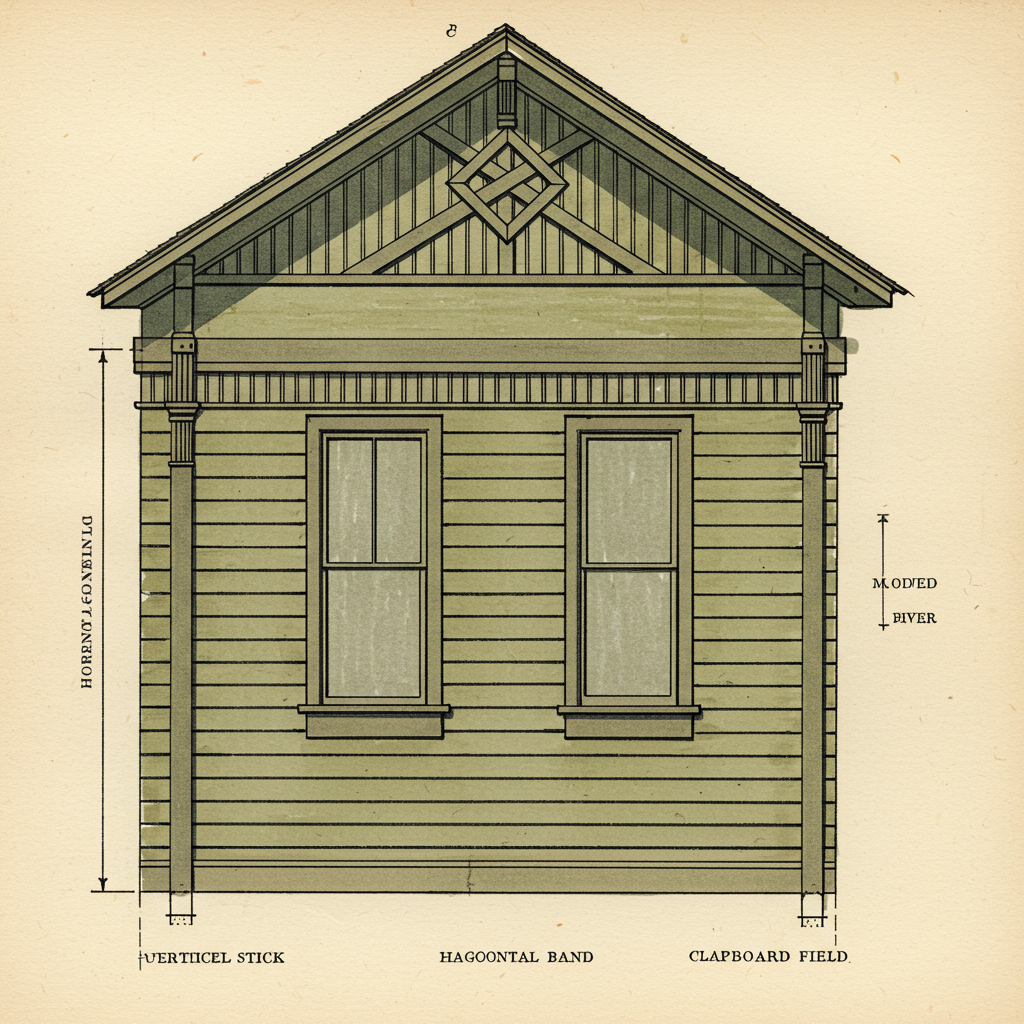
Applied stickwork on the wall plane — vertical sticks at every bay corner, horizontal bands at every storey line, diagonal X-bracing in the gable. The sticks are flat one-by-four and one-by-six boards nailed to the cladding; the cladding underneath is plain horizontal clapboard. The composition reads as a sketched-in timber frame, but no structural member of the house is exposed by it.
Look at the eaves. Here the Stick adds its third identifying ornament: the knee brace. Where the roof overhangs the wall, the underside of the projecting eaves is supported (or appears to be supported) by short diagonal wooden braces running from the upper wall to the underside of the eave — knees at every bay, sometimes simple and rectilinear, sometimes elaborately scrolled. The knee brace is to the Stick what the bracketed cornice was to the Italianate: the ornament that distinguishes a Stick eave from a plain shed-roof overhang, and the small element that signals to the trained eye what the building is.
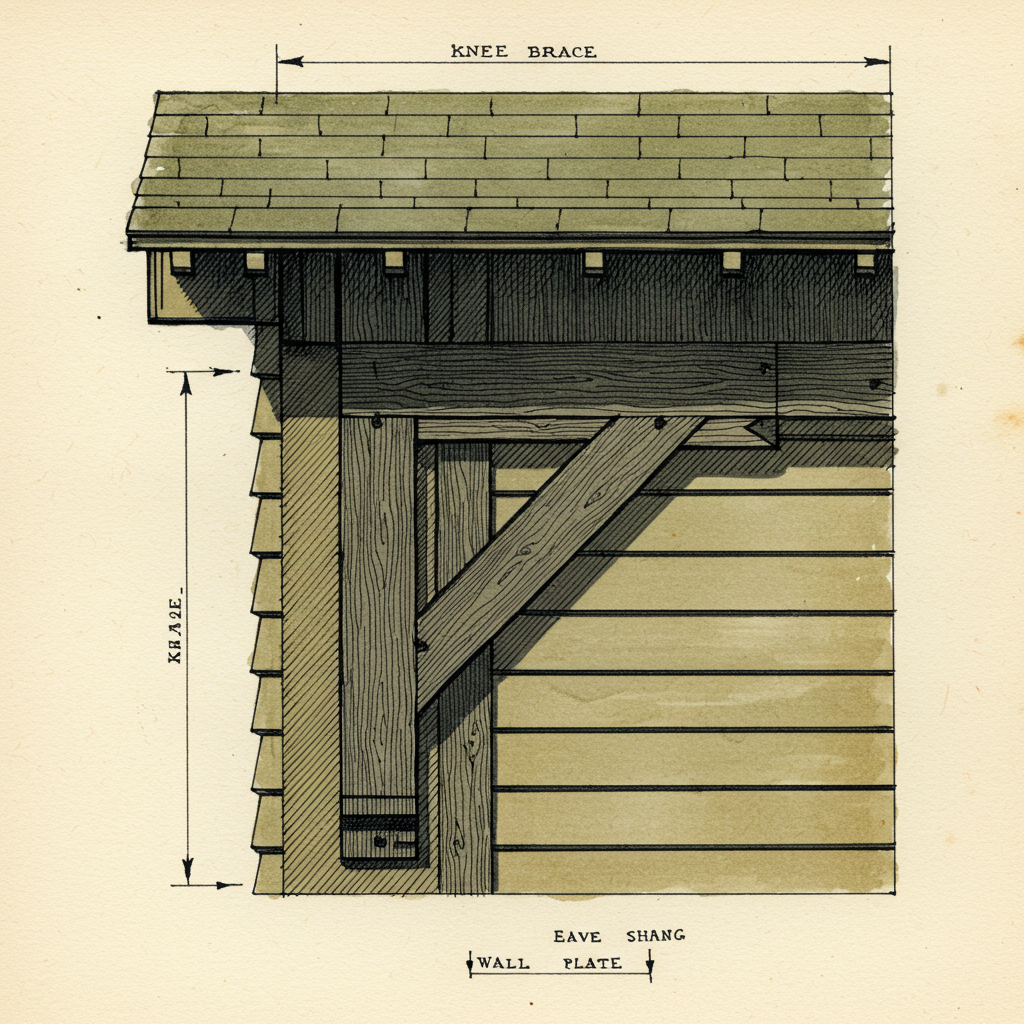
A knee brace under the projecting eave — a short diagonal wooden member running from the upper wall to the underside of the overhang. Like the gable truss and the wall sticks, the knee brace is decorative rather than load-bearing on the typical Stick house; the structural work is done by the balloon-frame inside the wall, and the knee brace expresses the heavy-timber relationship that no longer obtains.
Examine the windows. Stick style windows are tall, narrow, and rectangular — not round-arched (which would be Italianate), not pointed (which would be Gothic Revival). They sit in plain wooden frames, sometimes paired in twos beneath a shared horizontal stick course, and the glazing is usually two-over-two or one-over-one, with the larger panes that the post-1860 glass industry had made affordable. There is no hood mold; there is no decorative pediment; the window is a simple opening trimmed with the same flat-board vocabulary as the rest of the wall.
Two more details round out the specimen. Stick style houses very often carry a narrow porch across the front or wrapping a corner, supported on chamfered or square wooden posts and finished with a stickwork railing — flat boards in horizontal-and-diagonal patterns matching the wall stickwork above. And the paint scheme tends toward muted earth-tones — sage green, rust, umber, dark mustard, occasionally a deep slate-blue — applied in two or three colours that pick out the sticks against the field of clapboard. The polychrome is more restrained than a Queen Anne’s, and far more restrained than the bright Victorian palette one finds on a high Italianate or Second Empire.
Assemble these — the steep gable, the decorative truss, the applied stickwork, the knee braces, the rectangular windows, the stickwork porch, the muted polychrome — and one has a Stick. A small specimen with all of these is a vernacular Stick cottage; a larger specimen with a corner tower and elaborate stickwork is a high-style Stick villa; a resort cottage at Newport or Mount Desert with an open verandah and shingled second storey is a Stick that has begun, by 1880, to slide into the Shingle.
The Honest Frame
The economic and intellectual story behind the Stick is the story of a moral argument about structure, made by Englishmen, translated into the American context, and applied with what one is now in a position to call considerable creative interpretation.
The argument was that architecture should be honest: that a building should reveal its structure, that materials should not pretend to be other materials, and that ornament should declare its method of manufacture. The argument was made first by Augustus Welby Pugin in The True Principles of Pointed or Christian Architecture (1841), in the context of the English Gothic Revival; refined by John Ruskin in The Seven Lamps of Architecture (1849), where the second lamp was Truth; and brought into the American architectural conversation by Andrew Jackson Downing, Calvert Vaux, Henry Hudson Holly, and (most influentially after 1872) Charles Eastlake, whose Hints on Household Taste moved the Pugin argument from cathedrals to drawing rooms by applying it to furniture.
Eastlake’s furniture argument was simple. A chair should look like a chair, not like a column or a leaf or a cherub. The joinery — the dovetails, the mortises, the pegs — should be visible. The wood should not be carved to imitate other materials; the metalwork should not be painted to imitate gold; the upholstery should not pretend to be something more elaborate than what was under it. Machine-made imitation of hand-carved ornament was the enemy of taste. Visible, honest, structural detail was the friend of taste.
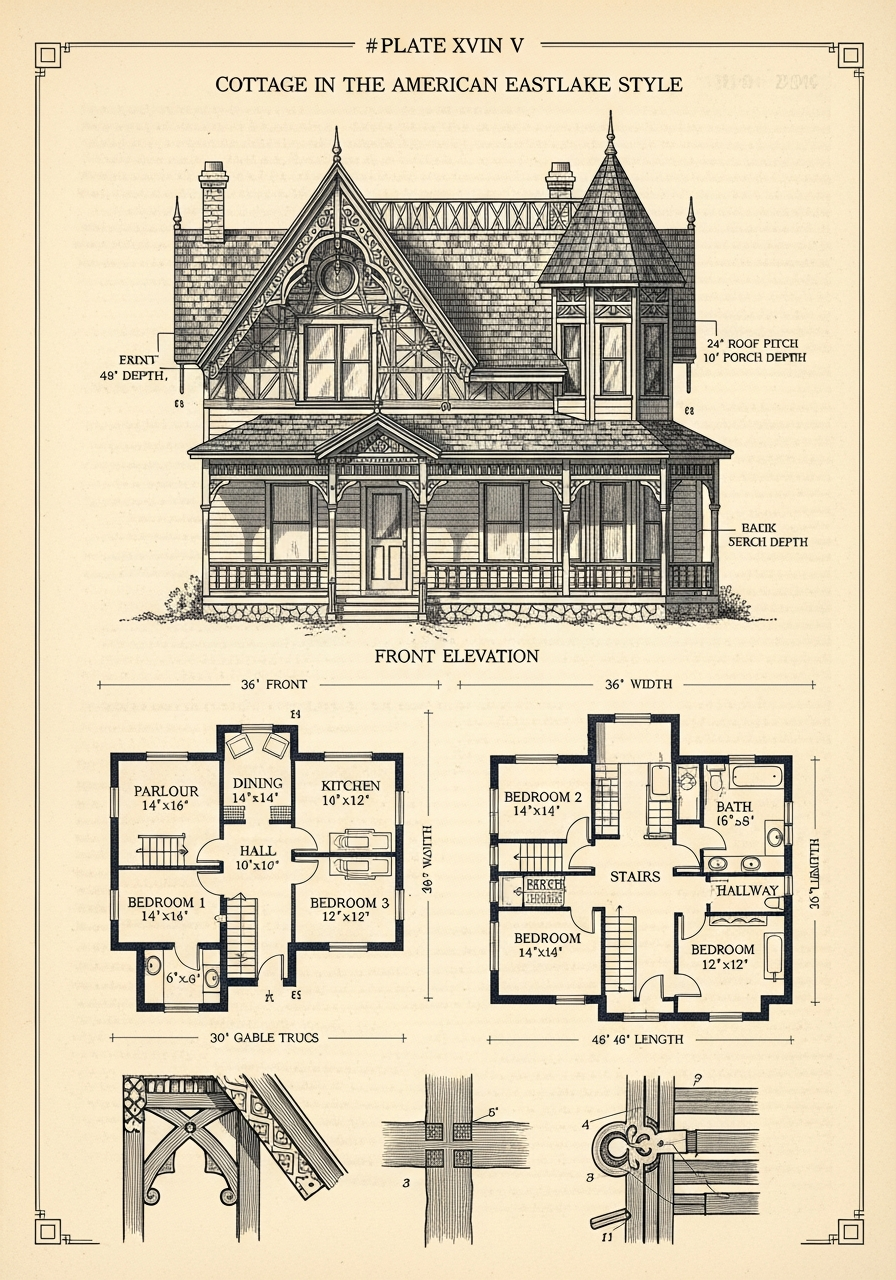
A plate from Henry Hudson Holly’s Country Seats (1863), or one of the period pattern-books that translated the Eastlake argument from furniture to whole houses. By 1870 most American Stick cottages were being built from plates of this kind, and the applied sticks, decorative trusses, and knee braces could all be ordered in standardised dimensions from the same mill catalogues that had supplied the Italianate’s brackets a decade earlier.
Henry Hudson Holly extended this from chairs to houses. Country Seats (1863) and the slightly later Modern Dwellings in Town and Country (1878) argued — illustrating the argument with plates — that a wooden American house should look like a wooden American house: that its frame should be expressed on its exterior, that its wooden ornament should celebrate the fact of its being wood, and that the imperial pretensions of the Second Empire (slate, ironwork, mansard) were a kind of architectural dishonesty for a republican country whose actual building tradition was light wooden frame.
The argument was elegant, sincere, and almost entirely self-defeating. By 1860 the American building industry had moved decisively to the balloon frame — the system of light two-by-fours and one-by-fours, sheathed in horizontal cladding, that had displaced heavy timber framing across the country between 1830 and 1860 — and the structural members of an American house were no longer heavy oak posts and beams visible at the gable end. They were thin pine studs invisible inside the wall. To express the frame of an actual 1875 American house honestly would have meant cladding the wall in nothing — leaving the studs visible — and that no one was prepared to do. What was done instead was to suggest the frame: to nail decorative one-by-fours to the outside of the cladding in patterns that looked like the structural members an honest building would have had, but did not.
The Stick style is, on inspection, an architecture about an idea of honesty rather than a practice of it. The applied sticks are not structural; the decorative truss in the gable is not the truss; the knee braces under the eaves are not bearing the eaves. What the sticks express is the memory of an older heavy-timber tradition, applied as ornament to a balloon-frame building that no longer worked that way. There is something distinctively Victorian about the gesture — the wish to declare a moral position by applying its visible vocabulary to the surface of a house that was actually built on different principles entirely. The architecture is, by its own argument, dishonest. The dishonesty is part of its register.
This is not, however, a damning observation. The Stick style is no more dishonest than any other ornamented architecture in the sequence; it is simply more pointedly so, because the argument it was making about itself was an argument about honesty. The historical interest of the style is precisely the gap between argument and execution — the way an Eastlake-influenced American architect of the 1870s could simultaneously believe in the moral primacy of expressed structure and apply, with absolute consistency, decorative sticks that expressed no structure at all. One reads the houses, today, as documents of a particular Victorian way of arguing with oneself.
What It Is Not
Four styles stand near enough to the Stick that the beginner confuses them with it, and distinguishing them is most of the work of reading the post-1865 American wooden house.
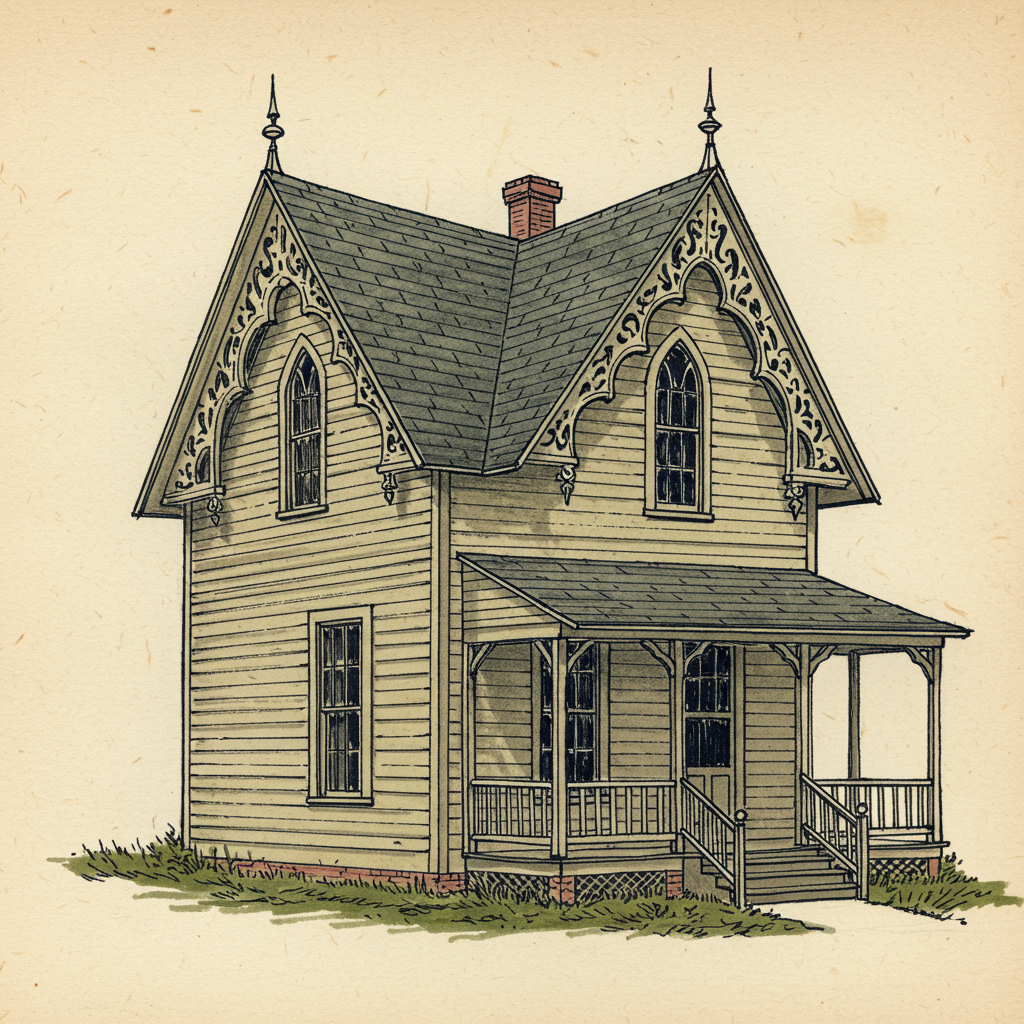
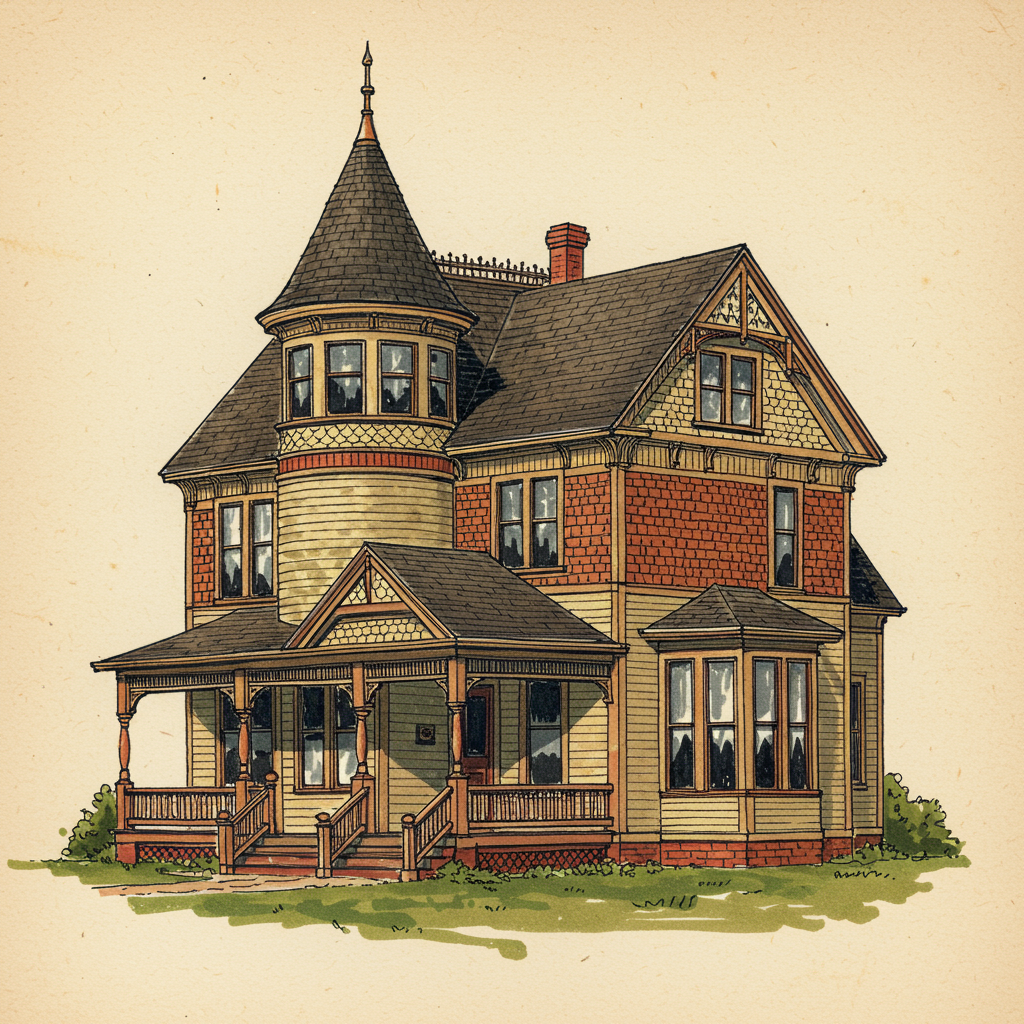
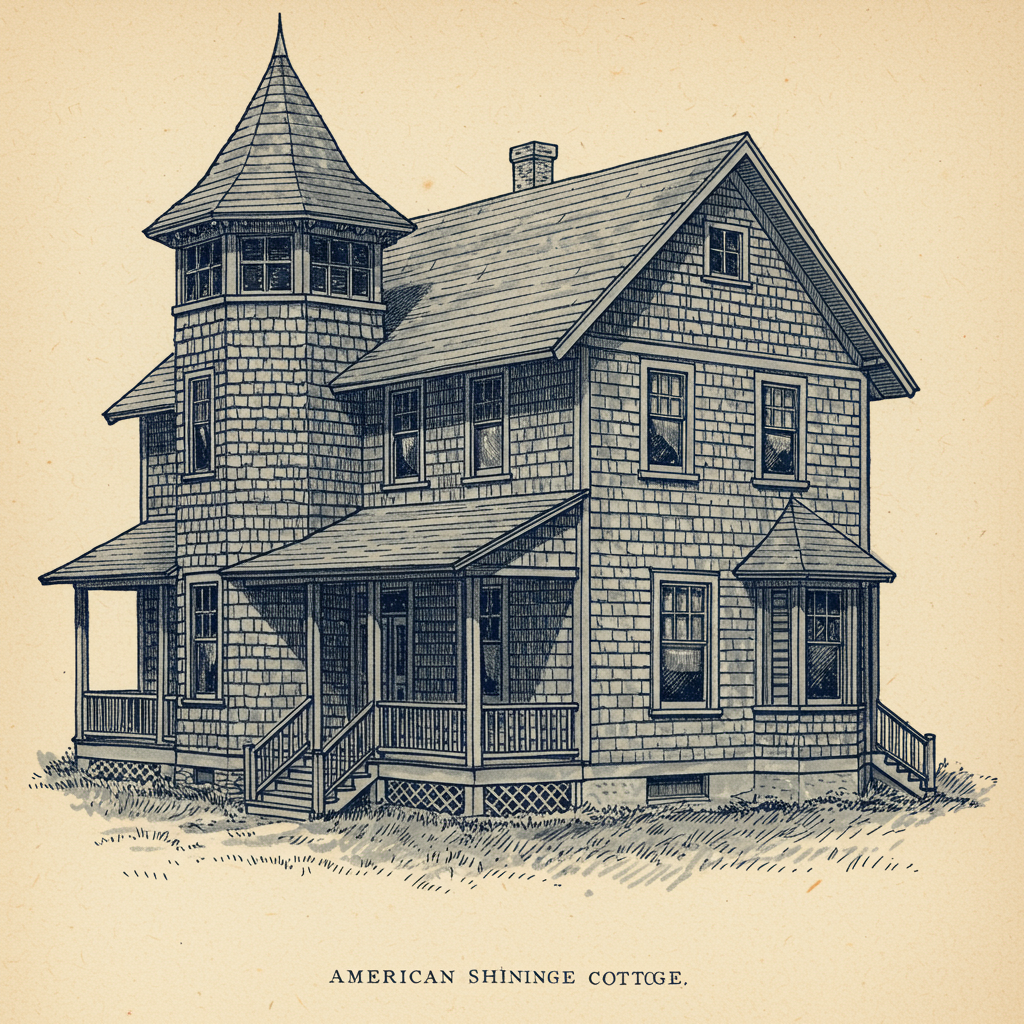
The Gothic Revival — the Stick’s wooden ancestor and direct picturesque source, examined three posts ago — shares the Stick’s steep gable, asymmetric plan, and wooden vocabulary. The visual distinction is in the ornament: a steep gable hung with scrolled vergeboards in trefoils and quatrefoils is Gothic Revival; the same gable with a decorative timber truss in the peak and applied stickwork on the wall is Stick. The two styles overlap in time (Gothic Revival 1840-1880, Stick 1860-1890) and frequently appear in the same small towns from the same carpenters, who simply moved from one ornament vocabulary to the other as the fashion shifted.
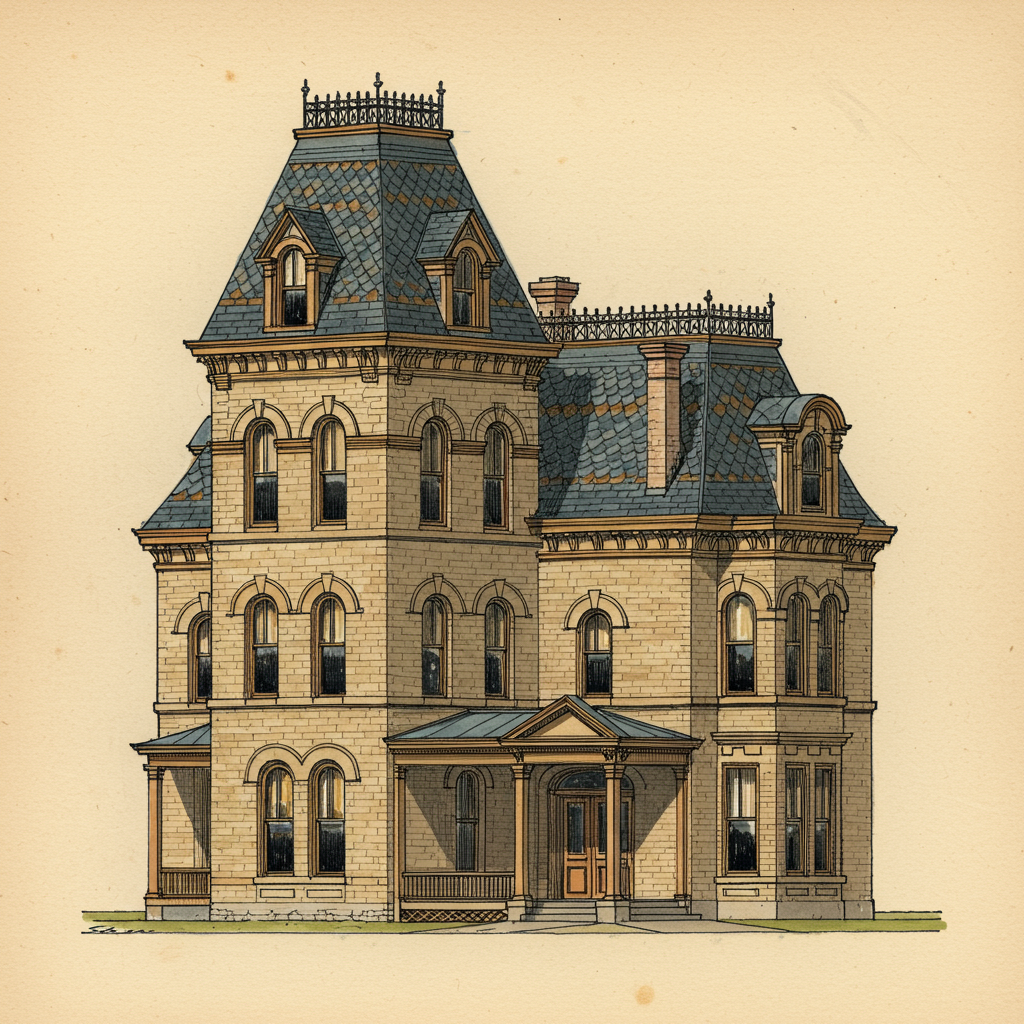
The Second Empire — the Stick’s contemporary and imperial counterpoint, examined in the previous post — is the urban-masonry style that the Stick was most consciously refusing. Where the Second Empire said we are an empire, the Stick said we are a republic of carpenters. Where the Second Empire used slate, ironwork, and mansard, the Stick used wooden sticks, gable trusses, and clapboard. The two styles flourished simultaneously, in the same cities, on different blocks, and represented opposing readings of what a post-Civil-War American house should be.
The Queen Anne — the Stick’s late-Victorian successor, examined first in this series — is the style that absorbed the Stick after about 1880. A high Queen Anne very often carries Stick-style stickwork and gable trusses as one ornamental element among several, alongside fish-scale shingles, sawn spindlework, polychrome panels, and a corner turret. The rule of thumb: if the wall plane is dominated by applied stickwork and the building is austere and skeletal, it is Stick; if the stickwork is one element in a riot of varied ornament and wall textures, the building is Queen Anne.
The Shingle — the Stick’s quieter wooden successor of the 1880s and 1890s, and the style Vincent Scully named in the same book — replaced the Stick’s expressed-frame argument with a uniform shingle cladding running over the entire building like a single skin. Where the Stick celebrated articulated structure, the Shingle celebrated continuous surface. The two styles are wooden cousins, both arising from the same Eastlake-influenced argument about American honest architecture, but they take opposite positions on what that honesty should look like: one expresses the frame, the other dissolves it.
What It Was Trying to Say
The Stick style flourished in America between roughly 1860 and 1890, with its sharpest period falling in the decade after the Panic of 1873 — that is, during the depression years 1873 to 1879 and the cautious recovery of the early 1880s. After 1885 it was already being absorbed into the Queen Anne; by 1890 it was old-fashioned; by 1900 the surviving examples remained but no new ones were being built. The style had a thirty-year arc, with about a fifteen-year peak, and was concentrated almost entirely in wooden domestic architecture.
What it was trying to say is best taken, again, as the sum of two arguments running in parallel.
The first is the moral argument — the Eastlake argument about expressed structure. Reading the Pugin/Ruskin/Eastlake line of thought, an American architect of the 1870s could persuade himself, with full sincerity, that the Second Empire’s slate-and-ironwork imperialism was a kind of architectural deceit, and that an honest American house ought to look like the wooden frame it actually was. The applied sticks and gable trusses were the visible declaration of that conviction. That the sticks were not actually structural was a contradiction the architects of the period either did not notice or did not feel: the gesture toward honesty was the point. (One should perhaps not be too hard on them. Most architectural arguments are gestures.)
The second is the political-economic argument — the post-1873 retrenchment. The Panic of 1873 had ended the post-war boom that produced the Second Empire’s federal mansards and merchant-class urban townhouses. The wealthy who survived the depression turned, by the late 1870s, to architectures that read as restraint and substance rather than as visible expense. The Stick’s austerity was a perfect register for that turn: muted earth-tone polychrome instead of slate-and-gold; wooden sticks instead of cast-iron cresting; a decorative truss instead of a mansard tower. To build a Stick cottage in 1878 was to declare oneself a serious republican householder rather than a Gilded Age plutocrat — even if one had been the latter ten years earlier and would be again, in slightly different costume, ten years later.
What I find most telling about the Stick, taking these two arguments together, is its quietness. No other style in this sequence so deliberately turned down the volume. The Greek Revival argued imperially for classical virtue; the Gothic Revival sentimentally for Christian domesticity; the Italianate cosmopolitanly for leisured cosmopolitanism; the Second Empire bluntly for imperial swagger; the Queen Anne, twenty years later, exuberantly for everything. Between the Second Empire’s swagger and the Queen Anne’s exuberance, the Stick spoke in the lowered voice of a generation that had been chastened — by depression, by political reaction, by the embarrassment of the Grant administration — into wanting an architecture that looked sober. It is the only quiet style in the American sequence between 1825 and 1900, and it is, on inspection, the most honest about what it was doing precisely because the honesty it claimed was the thing it could not quite achieve.
The next specimen I should like to take up is the Shingle style — the Stick’s wooden successor in the 1880s and 1890s, which retreated from the applied sticks into a uniform shingle cladding that ran over the entire building like a single skin, and which spoke, even more quietly than the Stick had, of an American architectural sensibility looking inward toward landscape and away from the imperial vocabulary of the urban styles.