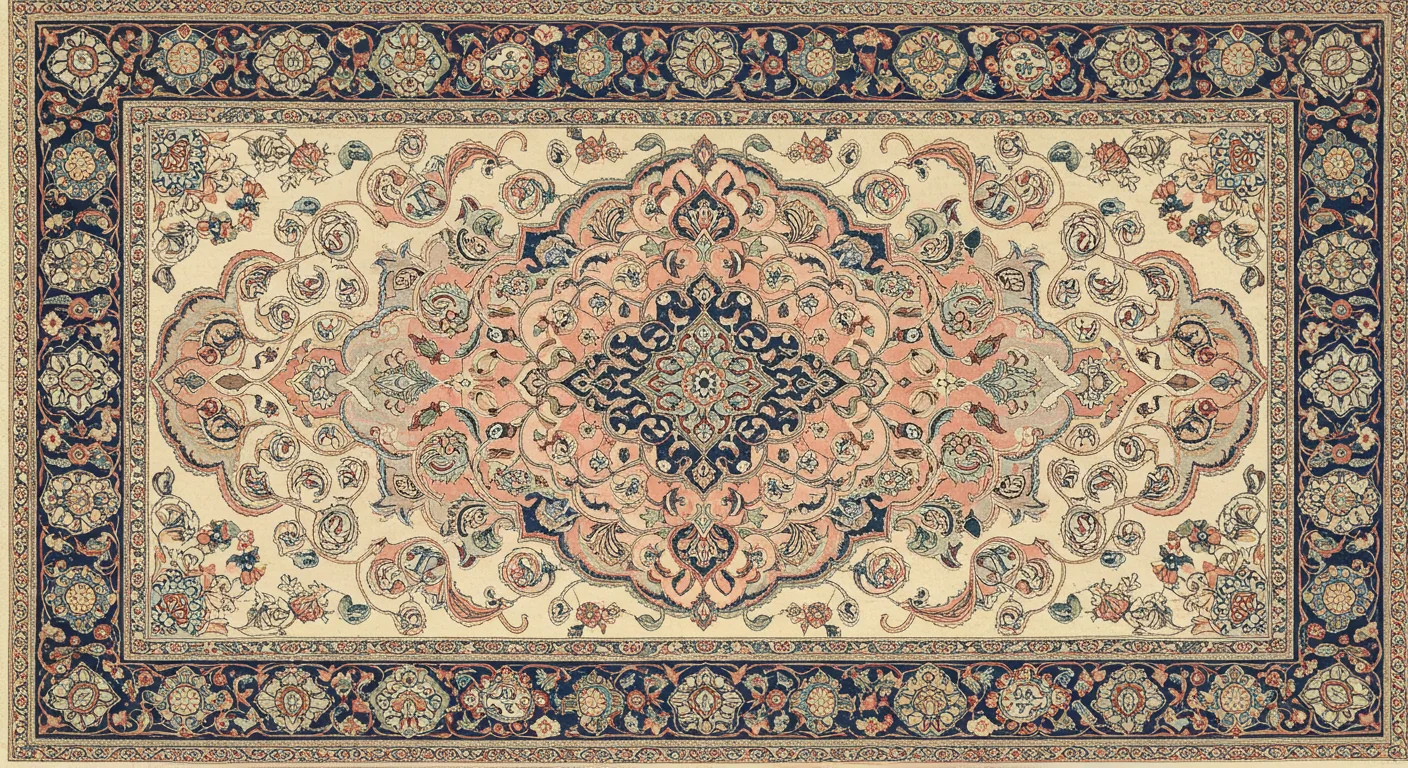
If the Heriz post that opened this arc described the village-workshop tradition of the Iranian Azerbaijani highlands — coarse-knotted, geometric, brick-red, room-sized, made for household use and merchant-export in roughly equal measure — the Tabriz that this post takes up is the urban-workshop counterpart sixty kilometres west of it: finer-knotted by a factor of three or four, curvilinear in its drawing throughout, painted from a substantially wider palette, and made in workshops of named masters whose surviving signed pieces command, in the current antique market, prices that no Heriz of any period approaches.
The two types together — Tabriz and Heriz — establish the basic axis along which every other Persian rug type can be read. Workshop versus village. Curvilinear versus geometric. Fine knot versus moderate. Court antecedent versus tribal. Named master versus anonymous weaver. The axis is not absolute — many Persian types occupy intermediate positions along it, and the city-versus-village distinction is permeable in particular cases — but the axis is the clarifying frame for a beginner’s reading, and getting the Tabriz post written immediately after the Heriz post is what makes the rest of the arc’s siblings legible.
This post follows the same template as the Heriz: what a canonical Tabriz looks like, the structural and material evidence by which one identifies it, the urban and historical context that produced it, the types most often confused with it, and the practical identification discipline by which a candidate piece is read in the dealer’s shop or the collector’s drawing room.
The Specimen
The Tabriz that one will encounter is, in its most common modern form, a substantial room-size rug — anywhere from six by nine to twelve by eighteen feet, with the eight-by-ten and nine-by-twelve formats accounting for the bulk of the late-nineteenth-century and early-twentieth-century export production. Smaller pieces (scatter rugs, prayer rugs, small medallion pieces) and very large pieces (palace-size carpets exceeding twenty feet in length) both exist, but the canonical Tabriz is the substantial room-size piece.
The composition, in the dominant Tabriz format, is the medallion-and-corner — a central curvilinear medallion of intricate scroll-work and arabesque pendants, four corner spandrels with curvilinear floral or arabesque ornament that mirrors the medallion at quarter-iteration, and a field between medallion and spandrels filled with smaller curvilinear vines, leaves, palmettes, and rosettes set against the dominant ground. This is the format the entire post is in some sense about, because it is the format the Tabriz workshop tradition perfected and against which one reads every other Persian medallion design. The variations are considerable — the medallion may be lobed, may be octagonal-pointed, may be stretched into an oval cartouche; the spandrels may be deep enough to meet at the centre of each side, or shallow enough that they merely punctuate the corners — but the basic four-cornered curvilinear-medallion-and-arabesque format is the Tabriz signature.
Beyond the medallion-and-corner, several other Tabriz design vocabularies are common enough to warrant naming. The herati design — an allover repeating pattern of “fish” leaves around a central rosette, named after the city of Herat though woven in many Persian centres — is the most common Tabriz allover field pattern, often without central medallion, sometimes called the mahi (Persian for “fish”) variant when the leaf-and-diamond motif predominates. The garden carpet divides the field into compartments suggesting a Persian garden plan, with cypress trees, water channels, and flowers in each compartment. The pictorial Tabriz — figurative scenes from Persian history (the Shah’s court, hunting scenes, illustrations from Ferdowsi’s Shahnameh) or, in late-nineteenth-century work for the Western market, biblical or Western literary subjects — exists in considerable variety and at considerable quality. The Tree of Life and the vase carpet are further specialty designs the Tabriz workshops produced.
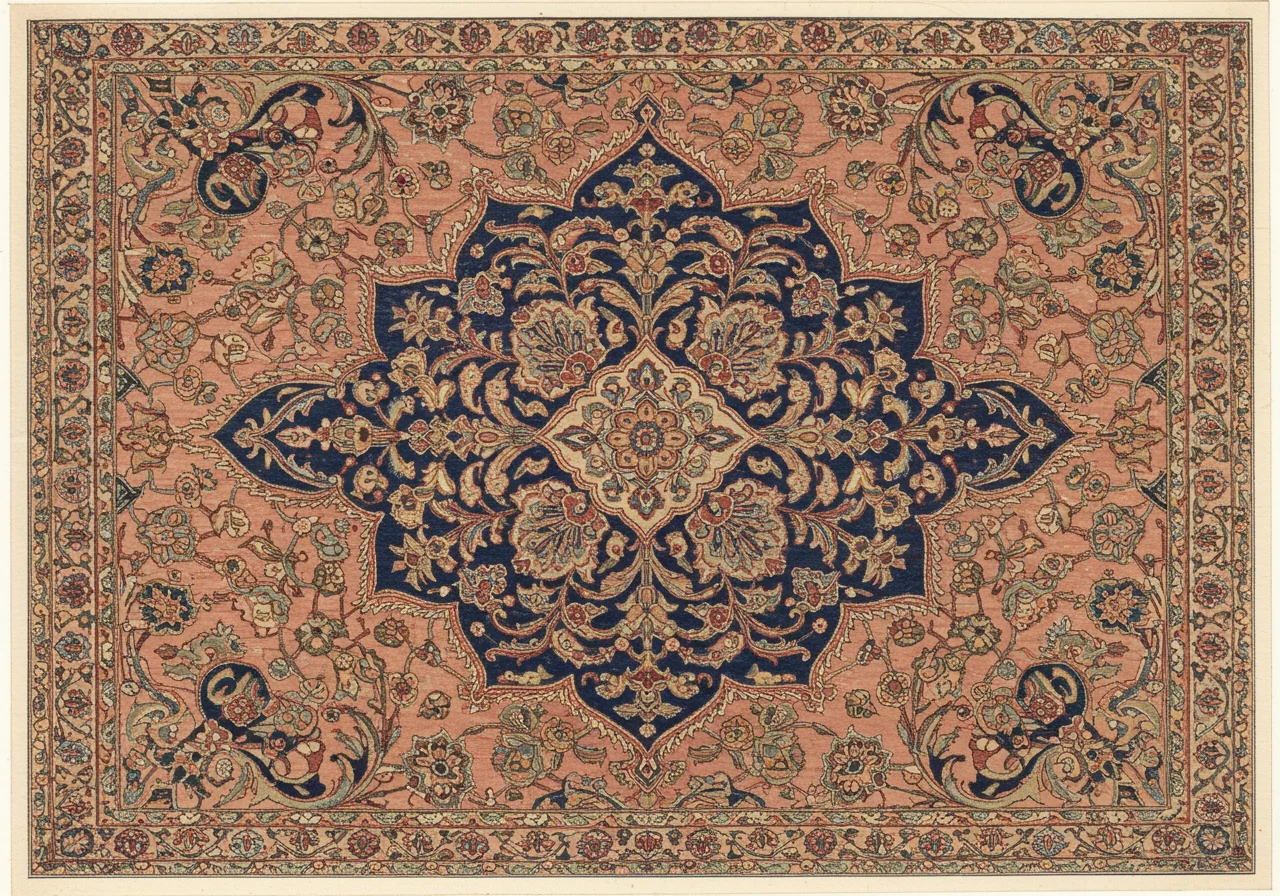
A close detail of a Tabriz central medallion — the curvilinear lobed indigo shape with its arabesque pendants extending toward the top and bottom of the field, surrounded by densely-drawn floral and vine ornament on the rose-red ground. Every motif is rendered curvilinearly: the smooth curves of the medallion outline, the scrolling leaves, the small flowers, the flowing vines. The drawing is the workshop tradition’s principal advantage over the village tradition, and the higher knot count of the workshop is what makes it possible. A Heriz rendering of the same medallion would be stepped and angular; the Tabriz rendering is curvilinear because the workshop’s hundred-and-fifty knots per square inch can draw a smooth curve where the village’s sixty cannot.
The colour palette is wider and softer than the Heriz’s. The dominant ground is, in the most-encountered late-nineteenth-century antique Tabriz, a soft rose-red verging toward salmon or apricot — substantially paler than the Heriz brick-red. Ivory and pale gold are common alternative grounds for high-grade Tabriz, particularly the pieces by the master Hadji Jalili of the late nineteenth century. Indigo and navy serve as the medallion and border colours. Pale greens, soft yellows, and accent reds appear in the floral ornament. The whole palette is anchored toward the European-decorator-friendly end of the Persian range — and was, in the late-nineteenth and early-twentieth-century export market, deliberately tuned for that audience.
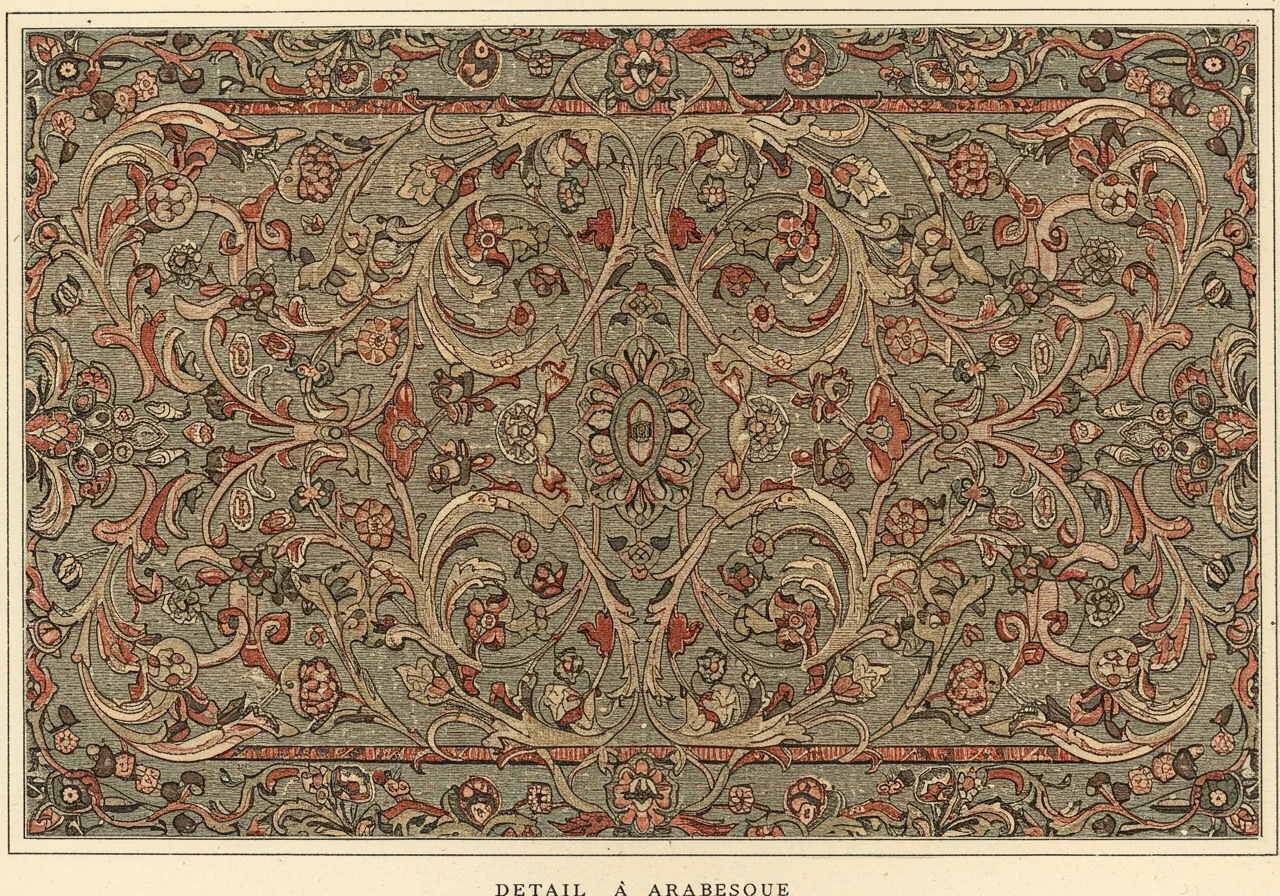
A close detail of the curvilinear arabesque that fills the area between the central medallion and the corner spandrels of a Tabriz field — flowing scrolling vines, curling leaves tapered at the tips, palmette pendants emerging from vine junctions, small rosettes scattered between. Every line a curve. The arabesque vocabulary is what the Tabriz workshop tradition shares with every other Persian urban-workshop tradition (Kashan, Isfahan, Mashad) and what most cleanly distinguishes the urban from the village production.
The construction is sturdy but substantially finer than the Heriz. The foundation is cotton — warp and weft both — with the warps closely spaced and the wefts thin and tightly drawn, allowing the higher knot count that the Tabriz workshop tradition is built around. The pile is wool, occasionally silk in the very finest pieces (an all-silk Tabriz exists, but Hereke is the more famous silk tradition). The knot is historically the symmetrical (Turkish) knot, geographically appropriate to the Azerbaijani region, though some modern Tabriz workshops use the asymmetrical (Persian) knot for the finer drawing it permits. Knot density is the principal differentiator from Heriz: a Tabriz of dealer-grade quality runs from a hundred to two hundred knots per square inch (kpsi), with master-grade Tabriz reaching three hundred to four hundred and the very finest court-grade Tabriz exceeding five hundred. The local trade unit for knot density is the raj — the count of knots in a seven-centimetre width — and Tabriz quality grades are conventionally given in raj (50 raj is medium, 70 raj is fine, 80 raj is very fine, 100+ raj is master-grade).
The Evidence
Behind the visible composition is the structural evidence by which a Tabriz is identified at close range and its provenance dated and attributed.
The knot, as noted, is historically symmetrical (Turkish), with the wool wrapped around two adjacent warps and pulled down between them. A modern Tabriz workshop using the asymmetrical (Persian) knot will typically advertise the fact, since the Persian knot is associated with the central Iranian fine workshops (Kashan, Isfahan) that the Tabriz weavers have, in the modern period, sometimes consciously emulated. The knot is most easily inspected from the back of the rug, where the rows of small bumps reveal the structure plainly. The knot density itself is the principal evidence one is reading for: a count of sixty knots per inch is a Heriz-class piece; a hundred to two hundred is a Tabriz of dealer grade; over two hundred is master-grade; over three hundred is exceptional. The knot count is most easily measured by counting the bumps in a one-inch square on the back and multiplying by itself.
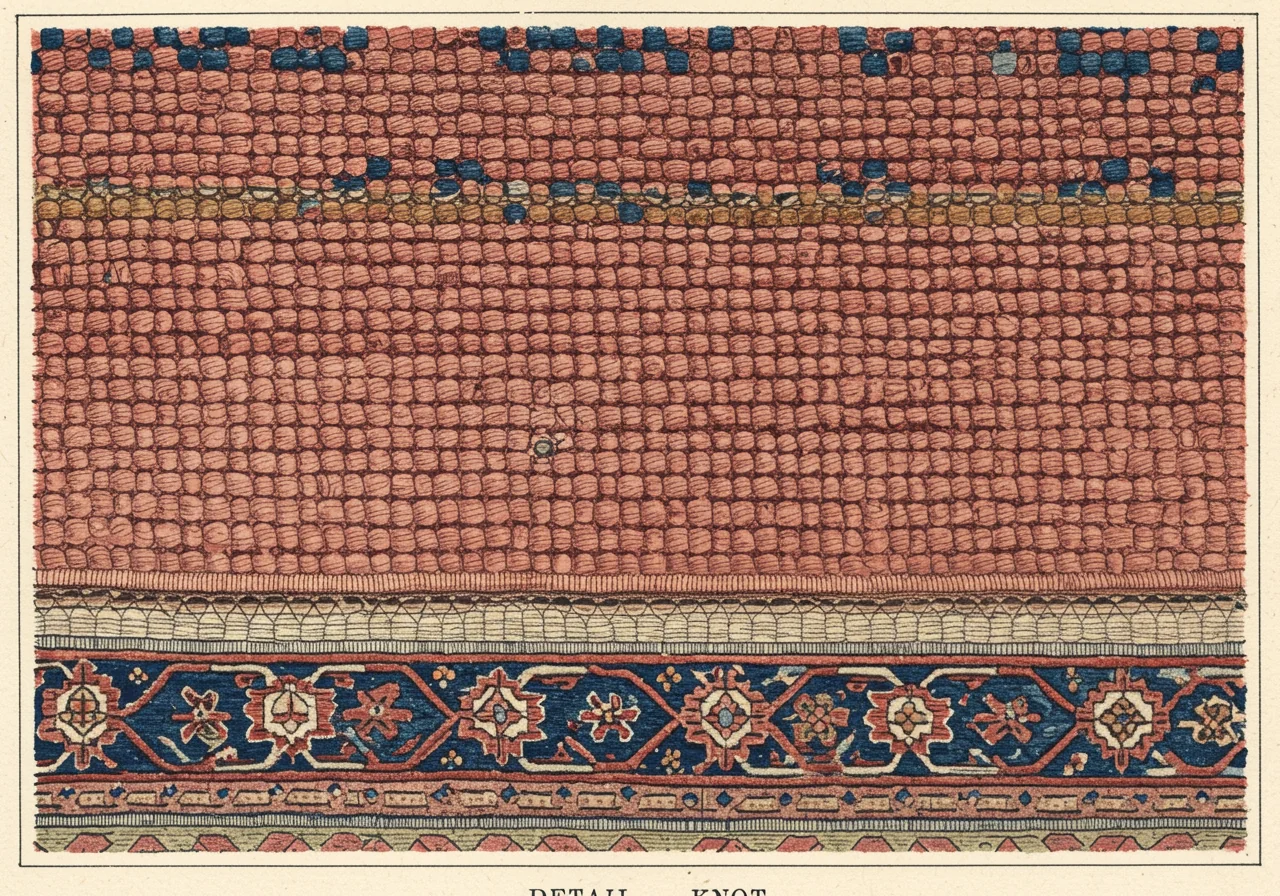
The back of a Tabriz rug at magnification — symmetrical Turkish knots packed densely in regular rows on a finely-spun cotton foundation, the colour of the field showing through the structure. The knot count is visibly higher than would appear on a Heriz back; the cotton weft is more tightly drawn; the workshop quality is apparent at a glance. In the lower portion, the trace of a small Persian (Nastaliq) signature cartouche is faintly visible — a master-workshop attribution that, if legible, would be the strongest single piece of evidence for the piece’s provenance and date.
The wool of the pile is the second physical signature. Tabriz wool comes from the regional flocks (the same Azerbaijani sheep that supply Heriz, in many cases) but is more carefully selected and more finely spun for the workshop tradition than for the village. The pile is denser, the cut is cleaner, and the surface character is more uniform than the Heriz pile. The very finest antique Tabriz uses kork — a high-grade lambswool from the underbelly and chest of the lamb — which gives a particular silky lustre that the Hadji Jalili workshop made its signature.
The dyes, in the older pieces, are entirely vegetable. Madder for the rose-red and the salmon and the apricot; indigo for the navy and the deeper blues; weld and the local pomegranate rind for the yellows; the various plant-derived greens; cochineal occasionally for accent reds. The Tabriz palette is wider than the Heriz precisely because the workshop tradition could afford a more diverse dye supply and a more skilled dyer than the village tradition could maintain. The vegetable dyes age in the same characteristic ways across both traditions — indigo never quite leaves; madder reds soften toward apricot at the worn edges — and a fine antique Tabriz with its full vegetable palette intact and properly aged is among the most beautiful objects of any decorative tradition.
The signature, fourth — and this is the gift of the urban workshop tradition that the village tradition does not provide. The major late-nineteenth and early-twentieth-century Tabriz workshops — Hadji Jalili, Mostofi, Petag (the German-organised firm Persische Teppich AG that established a Tabriz workshop in 1911), the various dealer-houses of the Tabriz bazaar — frequently signed their work in a small cartouche at one end of the field, typically at the bottom border, in Persian (Nastaliq) script. The signature may name the master weaver, the workshop, the dealer-commissioner, or the date in the Islamic calendar. Many Tabriz pieces are unsigned; many of the signed pieces have their signatures abraded by household wear. But a clearly signed Tabriz, where the signature can be read by someone with Persian-language skills, is documented work, and the master signatures (Hadji Jalili in particular) command substantial premiums in the current market.
The selvedges of a Tabriz are wrapped in wool, often of the dominant border colour, and the ends are typically finished with a short kilim section before the cotton-warp fringe. The selvedges and ends are more carefully finished than the Heriz, with the workshop attention to detail visible at every transition. The fringe itself is, in the older pieces, often quite short — old fringe is what household wear takes first, and many older Tabriz have had their fringes substantially shortened in the course of dealer repair.
The City
Tabriz is a city, and the rugs are the workshop output of an urban centre that has been continuously productive in carpet-weaving for at least six hundred years and probably longer. The city sits on a high plateau in the Iranian Azerbaijan, perhaps fourteen hundred metres above sea level, on the historical trade route connecting the Mediterranean and Black Sea ports to the Iranian plateau and beyond to Central Asia. The population is largely Azeri Turkic — which is the explanation for the Turkish knot — and the city has been, at various points in Persian history, both a major commercial centre and a political capital.
The carpet-weaving tradition of Tabriz can be documented to the medieval period. Surviving Persian court carpets of the Safavid dynasty (early sixteenth to early eighteenth centuries) include several attributed to Tabriz workshops on stylistic grounds, and the Ardabil carpet of 1539–40 — woven for the shrine of Shaykh Safi al-Din at Ardabil and now divided between the Victoria and Albert Museum in London and the Los Angeles County Museum of Art — is a Tabriz-tradition piece of extraordinary quality and historical importance. The Ardabil and its surviving siblings establish the high-water mark of medieval Persian carpet weaving and the formal vocabulary on which the modern Tabriz tradition continues to draw.
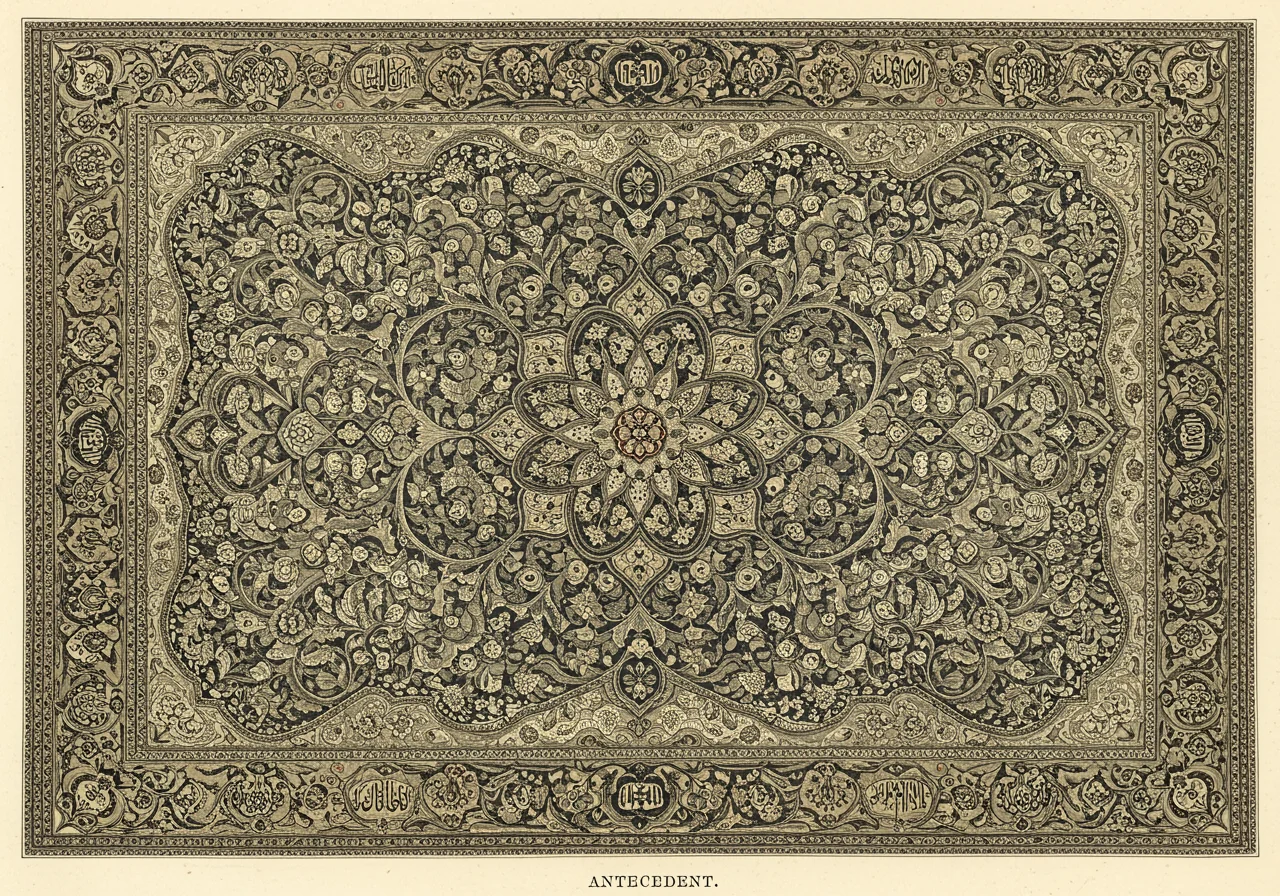
A Safavid-era Persian court carpet in the Tabriz tradition (in the manner of the famous Ardabil carpet of 1539) — an elaborate sixteen-petalled central medallion surrounded by smaller cartouche-pendants extending toward the ends of the field, the entire field densely populated with curvilinear scrolling vines and palmettes on a deep ground, multiple bands of border ornament with cartouche-and-rosette repeats. The Safavid court tradition is the antecedent the modern Tabriz workshops descended from, and the formal vocabulary they have continued to draw on for four centuries.
The modern Tabriz period — the period whose surviving production constitutes the bulk of the antique market — runs from approximately 1870 to 1930. Two factors made this period the great age of Tabriz weaving for export. The first was the post-1860s opening of the Persian carpet to the European and American market, which created a demand for substantial room-size rugs in the European-decorator palette that the Tabriz workshops were already disposed to produce. The second was the emergence, in the same decades, of named master weavers who organised production in a manner more like a Renaissance workshop than a village cottage industry — Hadji Jalili pre-eminent among them, Mostofi a close second, Sheikh Safi-style copyists and others — and whose signed work commanded premium prices in the market from its first appearance.
A note on the named masters, because the named-master tradition is what most distinguishes Tabriz from the village types like Heriz. Hadji Jalili (Persian: حاجی جلیلی, active in Tabriz roughly 1875–1900) was the master weaver whose late-nineteenth-century pieces in soft pastel palette, often on ivory grounds with rose medallions, are now considered the high-water mark of antique Tabriz production at the workshop scale. A signed Hadji Jalili can fetch, in the current market, ten to thirty times the price of a comparable unsigned Tabriz of the same period. Mostofi worked in a similar period and register. Petag — the Persische Teppich AG, organised by German importers in 1911 — produced Tabriz rugs of consistent quality and decorator-friendly design through to the inter-war period; Petag pieces are documented and signed and are themselves a collected category. The Tabriz tradition of named workshops contrasts with the anonymous weaving of every village type covered in the Heriz post and, by extension, with the great majority of Persian rug production outside the major urban centres.
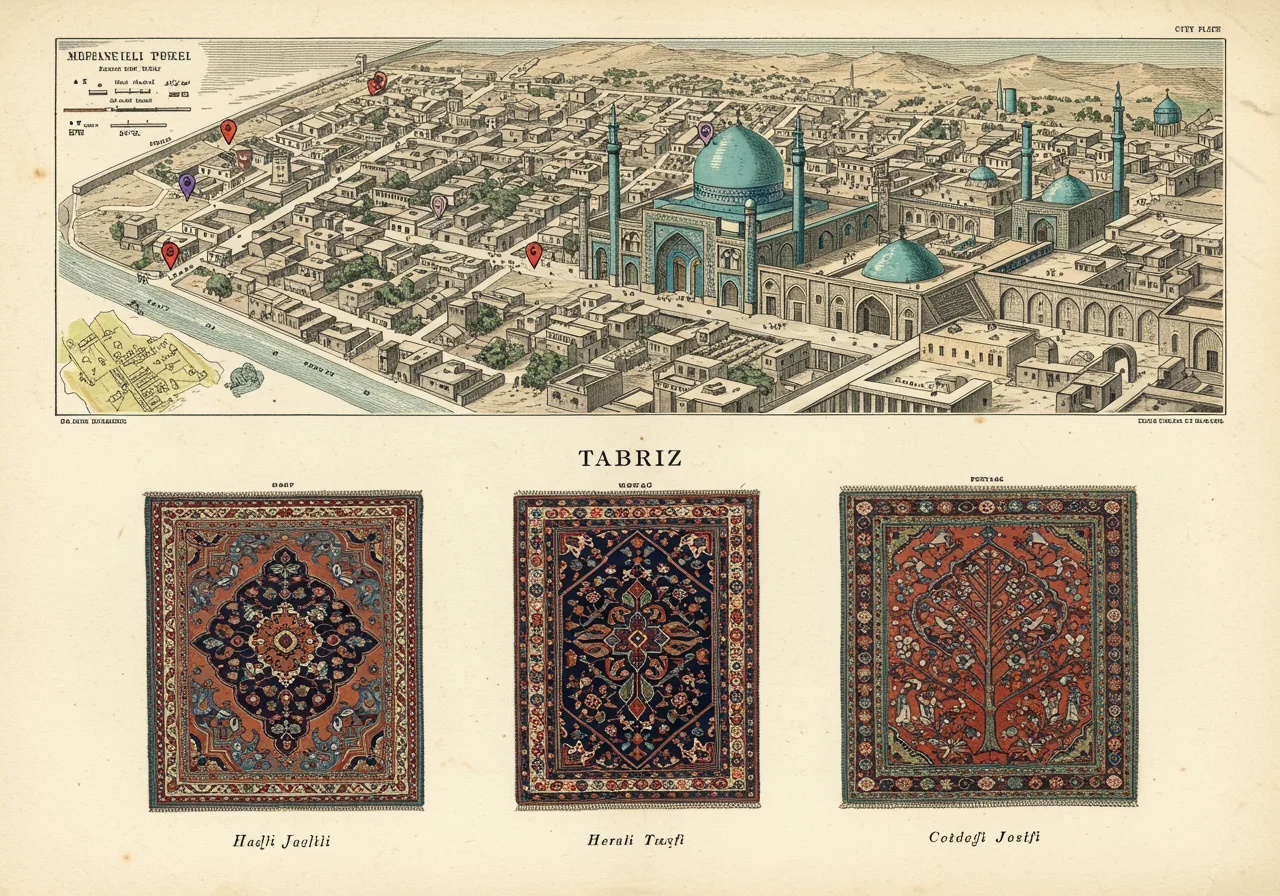
A page from a Victorian connoisseur’s portfolio on Tabriz — the city map at the top locates the principal workshops within the Tabriz bazaar district (Hadji Jalili, Mostofi, Petag, and several unnamed dealer-houses); the lower half shows three small archetype drawings (medallion-and-corner, herati allover, pictorial Tree of Life) and the master signatures of Hadji Jalili and Mostofi in Persian Nastaliq with Latin transliteration. The plate is the kind of reference page that would have appeared in a serious dealer’s portfolio of the period, and is what one consults when trying to read a candidate signature in the lower border of an unfamiliar Tabriz.
What It Is Not
Several Persian rug types stand near enough to Tabriz that the beginner confuses them with it, and distinguishing them is most of the work of reading the Persian urban-workshop tradition.
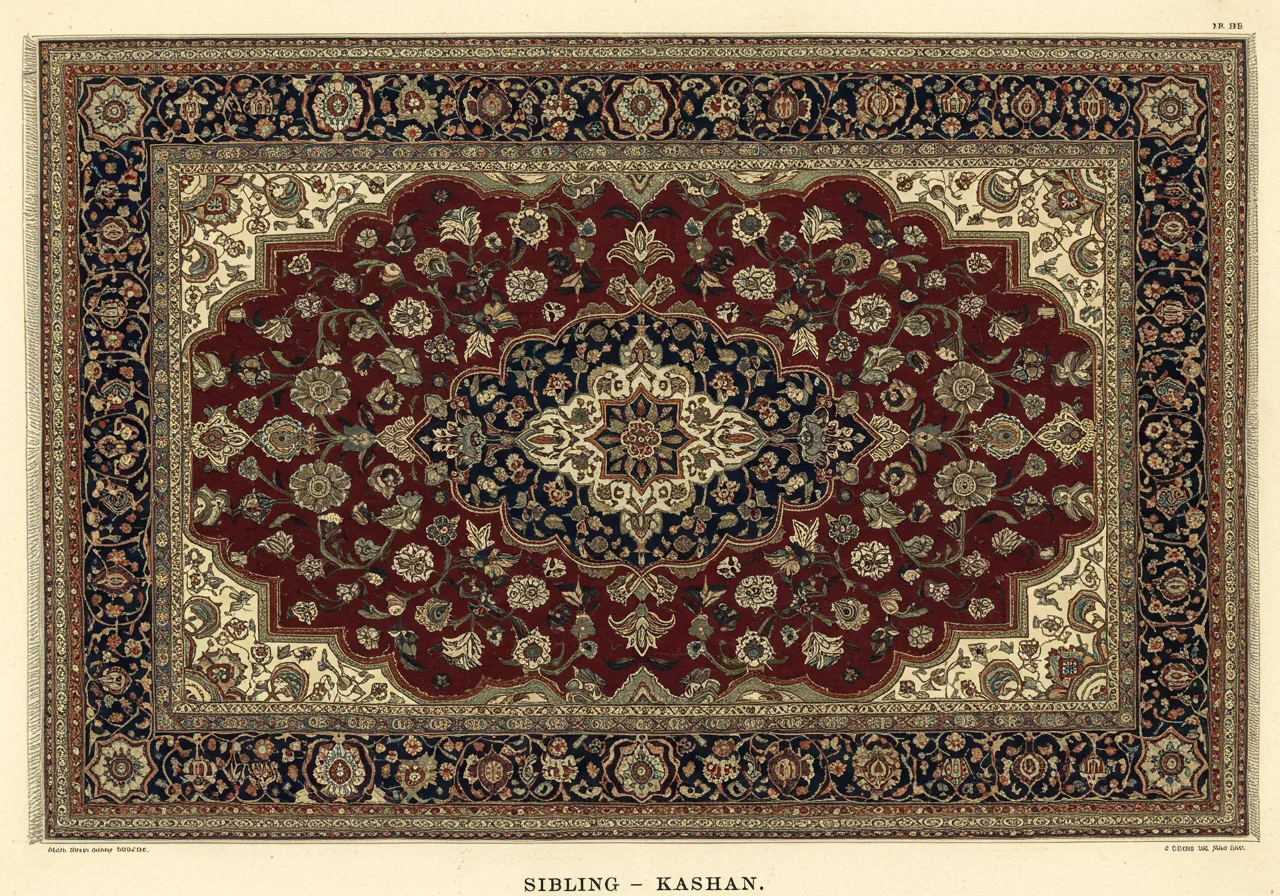
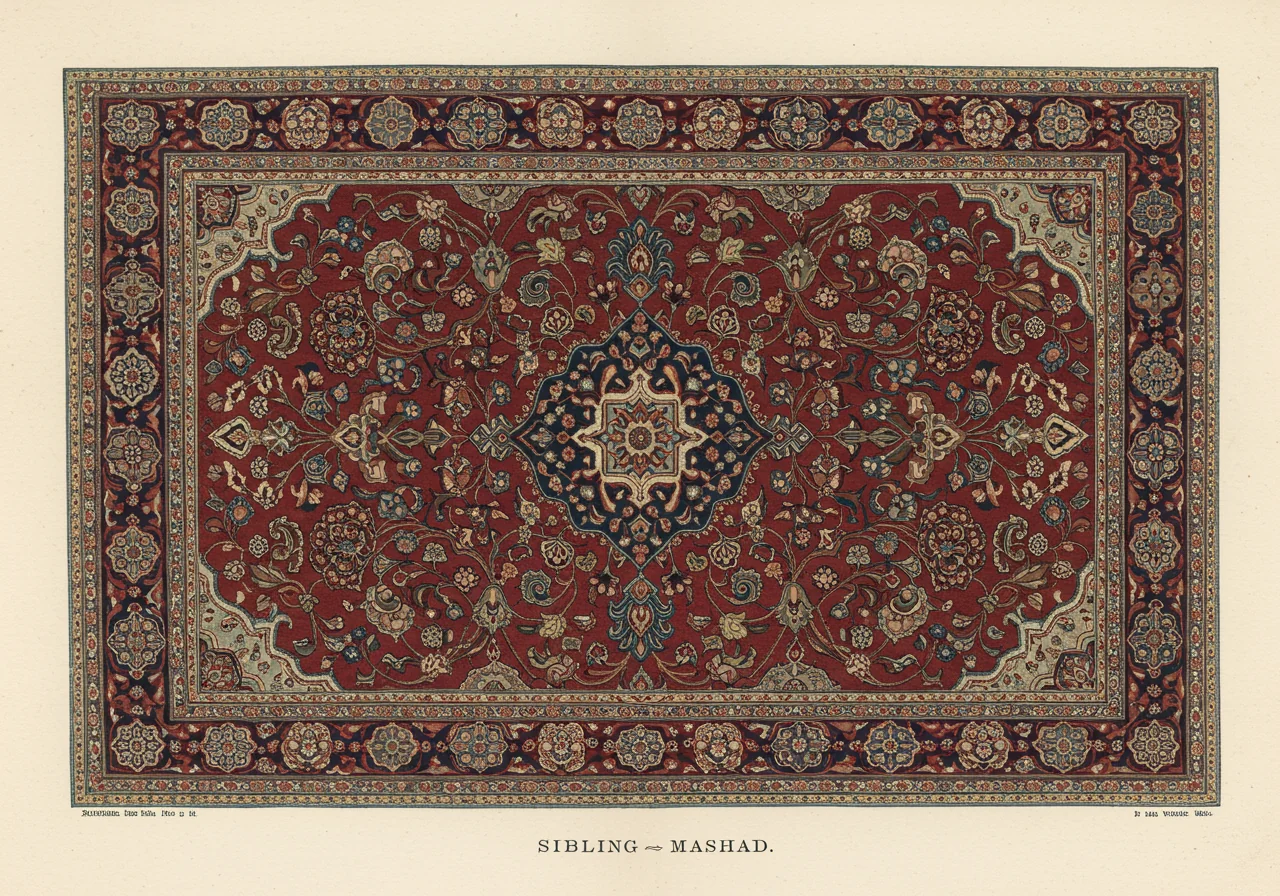
A Kashan is the carpet of the central Iranian city of Kashan, which has been a major workshop centre since at least the seventeenth century. Kashan rugs share Tabriz’s curvilinear vocabulary and medallion-and-corner format but differ in palette and execution: a Kashan is typically denser, with a more saturated deep-red ground (verging toward burgundy rather than Tabriz’s softer rose), navy medallion, and a more rigorously formal symmetric composition. The Kashan knot count is comparable to or higher than Tabriz, and the wool is of comparable fineness. The two types compete in the same upper-tier Persian rug market and are sometimes hard to tell apart — but the deeper saturated red of the Kashan, the more rigid symmetry of the design, and the central Iranian rather than northwestern provenance separate them on close inspection.
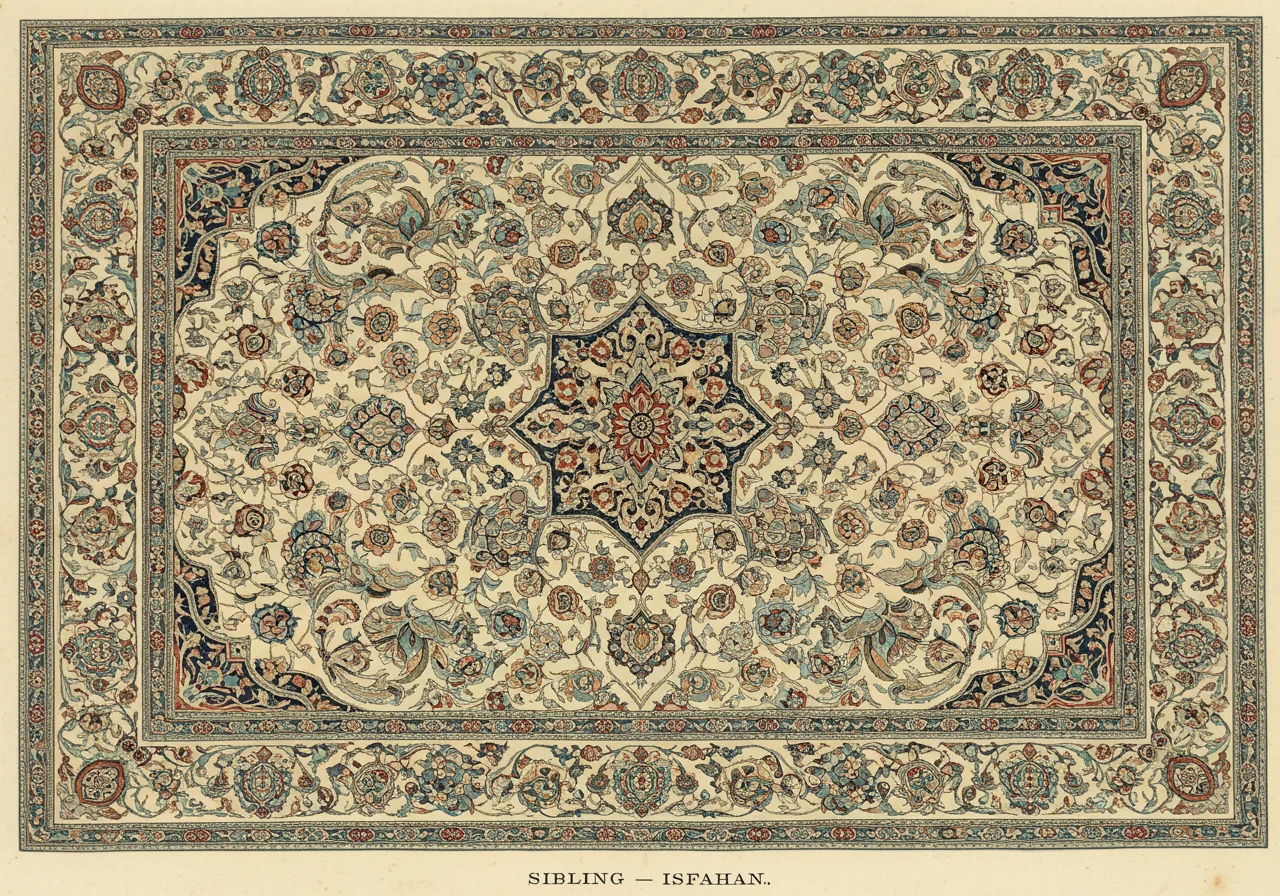
An Isfahan is the carpet of Isfahan, the central Iranian Safavid capital, and is the finest of the Persian urban-workshop traditions. Isfahan uses the asymmetrical (Persian) knot, runs at substantially higher knot counts than Tabriz (often four hundred to eight hundred kpsi), is frequently woven on silk warps, and produces pieces of curvilinear-floral vocabulary at a level of refinement that no other Persian centre regularly matches. An Isfahan beside a Tabriz reads as the same vocabulary translated into a finer register — and at substantially higher prices in the current market. The asymmetrical knot is the immediate separator: a curvilinear medallion rug with the Persian knot is probably Isfahan or central Iranian; a curvilinear medallion rug with the Turkish knot is probably Tabriz or northwestern.
A Mashad is the carpet of the eastern Iranian city of Mashad, and is typically a large room-size piece with a single central medallion in deep wine-red ground, dense allover field of small floral ornaments, and the asymmetrical Persian knot. Mashad shares Tabriz’s medallion format but uses the deeper Persian palette and the central-Iranian-style allover field; the proportions and the saturation of the red are the easiest separators.
A Sarouk — particularly the American Sarouk of the 1920s and 1930s — is the central Iranian rug that was specifically overdyed in deep rose for the American market in the inter-war period. American Sarouk rugs typically carry an allover floral spray on a saturated rose-overdyed ground, with no central medallion, and are now collected as their own category. The two types competed directly in the inter-war American market and the modern dealer often shelves them adjacent.
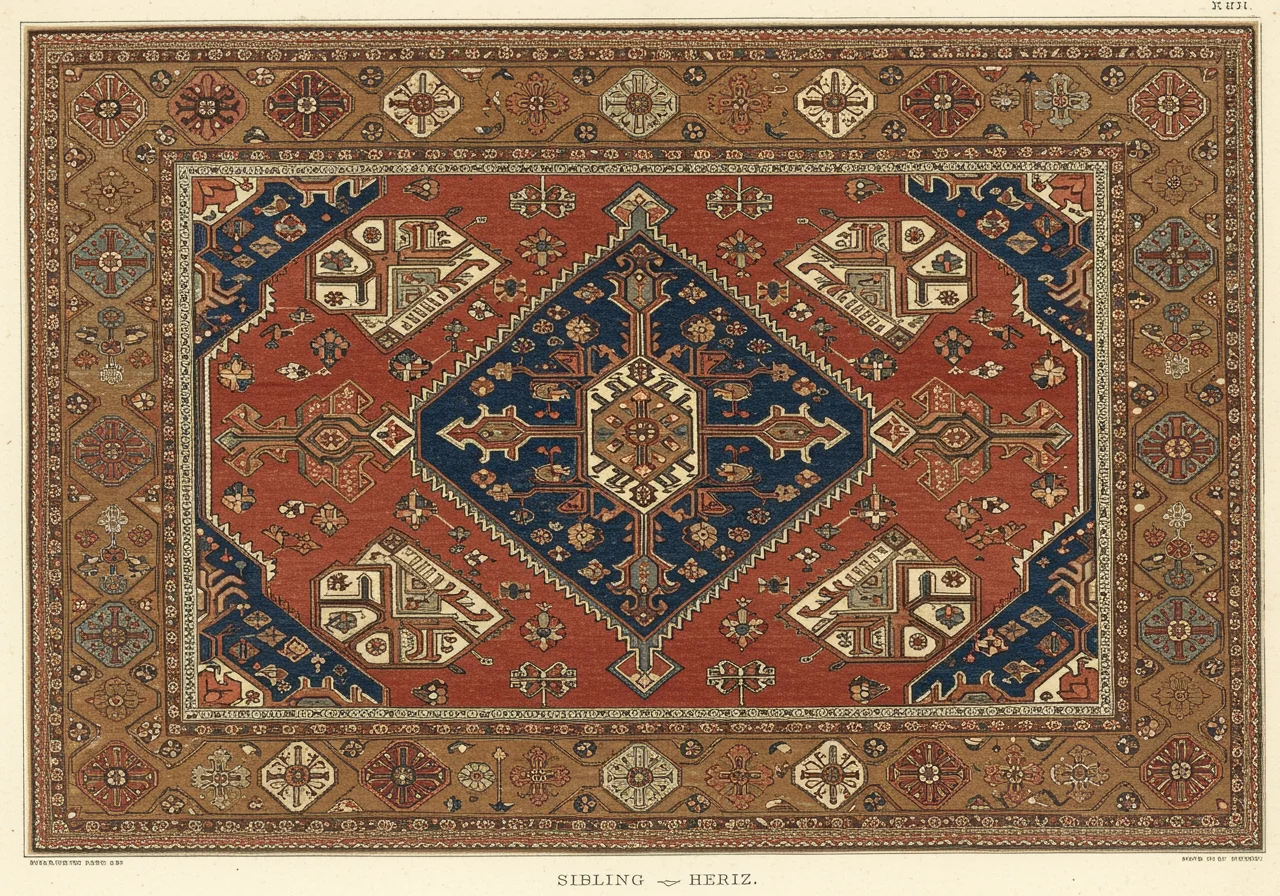
A Heriz — the village-workshop type covered in the previous post — is the Tabriz’s nearest geographic neighbour and its sharpest stylistic contrast. The two types together are the foundational pair for reading northwestern Persian weaving: Tabriz curvilinear and fine, Heriz geometric and moderate; Tabriz urban and named-master, Heriz village and anonymous; Tabriz on a wider and softer palette, Heriz on the brick-red signature; Tabriz at a hundred to two hundred kpsi, Heriz at sixty to a hundred. A reader who has the Tabriz/Heriz contrast clearly in mind has the basic axis along which every other Persian rug can be located.
What One Looks At
The practical discipline of identifying a Tabriz, when one is standing in front of a candidate rug, comes down to a short ordered checklist.
One looks first at the design vocabulary. Curvilinear floral and arabesque ornament throughout, with sweeping vines, curling leaves, palmette pendants, and a curvilinear central medallion — this is the Persian urban-workshop signature, of which Tabriz is the principal northwestern representative. If the design is geometric and angular, it is not a Tabriz; it is a Heriz, a Caucasian Kazak, a Bidjar, or one of the geometric village types.
One looks next at the knot count. A hundred to two hundred kpsi is the Tabriz commercial range; over two hundred suggests a master-grade workshop piece (Hadji Jalili, Petag); over three hundred suggests Isfahan or one of the very fine central Iranian workshops; under sixty suggests Heriz or a coarser village type. The knot count is most easily measured by counting bumps in a one-inch square on the back.
One looks at the knot type. Symmetrical (Turkish) on the back is consistent with Tabriz and with the broader northwestern Persian tradition. Asymmetrical (Persian) suggests Isfahan, Kashan, or central Iranian work — though some modern Tabriz workshops have adopted the Persian knot.
One looks at the foundation. Cotton warp and weft is the Tabriz norm. Silk warp suggests a very fine antique Tabriz (uncommon but documented) or, more frequently, an Isfahan or Hereke. Wool foundation is anomalous and suggests village rather than urban workshop provenance.
One looks at the palette. Soft rose, salmon, apricot, ivory, pale gold, soft greens — this is the Tabriz workshop palette, particularly in late-nineteenth-century antique pieces. Deep saturated wine-red is more characteristic of Kashan, Mashad, or Sarouk; brick-red is Heriz; deep navy or ebony is uncharacteristic of Tabriz and suggests something else.
One looks at the wool quality. Soft, lustrous, finely spun pile is the Tabriz workshop signature. Kork (lambswool) at master-grade Tabriz is unmistakable to a trained hand — the surface has a particular silky character that ordinary wool does not match.
One looks for the signature. A small Persian (Nastaliq) cartouche at one end of the field, typically the bottom border, may name the master weaver, the workshop, or the date. The signature, where present and legible, is the strongest single piece of evidence one can hope for; the signed Hadji Jalili pieces in particular constitute their own collected category at the high end of the market.
And one looks at the proportions and the wear pattern. A great Tabriz has proportions of an immediate rightness — the medallion sized to the field, the spandrels sized to the medallion, the border weighted to balance the field. The wear pattern of an old Tabriz is silvery in the high-traffic centre, more saturated in the protected margins, and softens gradually rather than abruptly. The harder-won judgments — the comparative ones, against many other Tabriz examples seen — are what come only with time at the dealer’s bench.
The next post in the rug arc will be either Bakshaish — the older village tradition out of which Heriz proper grew, the antecedent the Heriz post pointed toward but did not treat in detail — or one of the Caucasian types (most likely Kazak), which would establish the second axis along which the rug arc will need to operate (Persian versus Caucasian, urban-versus-village versus tribal-versus-court). The choice will depend on what photographic material is available at the time of writing.